
By Marc S. Sanders
Lester Burnham declares in less than a year he’ll be dead. When we meet him, he’s masturbating in the shower, sleeping in the back of the family vehicle on the way to work, and declaring that his wife Carolyn used to be lovely. Heck, he’s acting like he’s dead already. His life has nothing new or exciting to pursue. His daughter, Jane, doesn’t give him the time of day. He’s threatened with being laid off from his magazine call center job that he’s held on to for nearly twenty-five years. What’s to live for anymore?
I guess what’s complimentary about poor Lester is that at least he’s honest with himself. All the other neighbors, except for the gay couple known as Jim & Jim, are just as unhappy it seems and might as well be dead too. A common theme running through the suburban landscape of American Beauty centers on a sense of mental awakening. Who revives sad, lost folks like Lester and Carolyn? Perhaps it’s the generation sneaking up behind them, who are on the cusp of taking their place in young adulthood.
Lester is played by Kevin Spacey, in his second Oscar winning performance. Carolyn is portrayed by Annette Bening who is way overdue for a trophy. Jane the daughter is played by Thora Birch. The headliners of this cast are outstanding in how different and disagreeable they portray a broken family that is forced to live in an unstimulating home while trudging through a lifeless marriage. Look at the set designs within this film. There’s an endless amount of blank walls within the interiors of the homes. Almost no artwork or pictures are to be found.
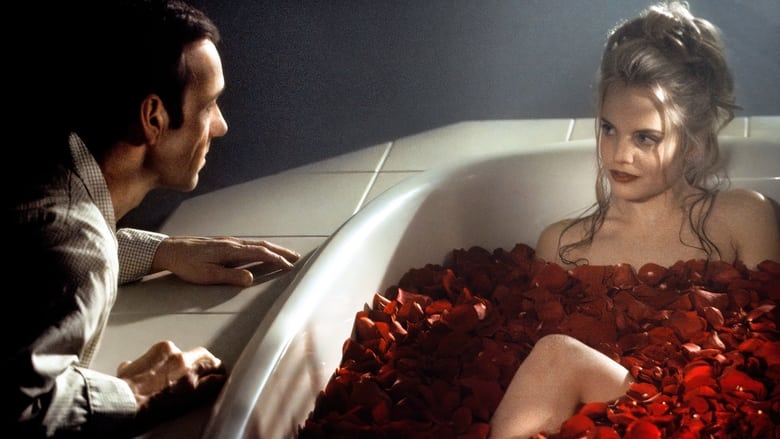
Lester pines and fantasizes about Jane’s best friend Angela (Mena Suvari) getting rained on with red rose petals while she lies naked in a pure white bathtub. Carolyn, the real estate agent who can’t make a sale, sidles up to the dashing Buddy Kane (Peter Gallagher), her competition. Next door is Chris Cooper in a hospital cornered role as retired Marine Colonel Frank Fitts, with his near comatose wife Barbara played by Allison Janey, and their eighteen-year-old resourceful drug dealing son, Ricky (Wes Bentley). He takes advantage of his camcorder at any opportunity to collect the beautiful images found within the world he occupies and observes. That could mean he’s capturing Jane in her bedroom window which faces his own. Later, he’ll show you the freedom of a plastic shopping bag dancing within an autumn breeze. An old shopping bag has more life among a breeze and brown leaves than Lester, Carolyn, Frank or Barbara.
There is a mystery to American Beauty that seems quite odd. We know that Lester will die soon, but how and why? Maybe there’s a twist, because that outcome seems more and more impossible as we see Lester discover a spirited mindset to go after what he wants, when he wants and declare that he’s not going to allow himself to take shit from anyone particularly in his boring dead end job or from his unaffectionate wife. Ricky, the kid with tons of money and electronics equipment, has nothing to lose because he’s not committed to anything at age eighteen and he can just quit an ordinary table-waiting job at any given moment. Why didn’t Lester have the gumption to ever be like Ricky? It seems so simple.
There’s a blink and miss it sign hidden in plain sight. Pinned to the wall of Lester’s work cubicle is the message “Look Closer.” Director Sam Mendes and writer Alan Ball gives the audience a subtle wink to dig within the cracks of suburban life sidewalks. These homes may appear perfect on the outside, with neighborly neighbors, but if you watch with a more critical eye you’ll find an emptiness that has been unfilled for too long. The filmmakers make it easy for you to uncover what eats away at the upper middle-class way of living. Dinner with Lawrence Welk playing in the background is anything but uplifting. It’s imprisoning.
When one member of this community opts to seize his moment, no matter if he’s motivated by a kid’s rebelliousness and the drugs he buys off of him, or the fact that he thinks a beautiful teenage blonde has the hots for him, he sets out to change. He exercises and builds up his body, buys the dream sports car he’s always wanted, quits his job and grows to not caring how this may disturb his unloving wife.
American Beauty seems to remind us how alive we can be when we are younger and not as restrained by the commitments it takes to live like adults with debts and parenthood and jobs and marriage. Look closer though because couldn’t we live as well or more aggressively when middle age arrives?
The irony of Alan Ball’s script is that a boring guy like Lester Burnham discovers exciting things about himself just as the end of his life is approaching. All he needed was stimulation. He never saw his death coming, and you might forget he told you he will soon be dead, but American Beauty works to show how necessary it is to live each day to the fullest.
I sound hokey. I know. Yet, that’s the direction of this film’s trajectory. On the side, you observe those people who do not pursue what will fulfill their own lives and desperately need a modification. Lester was limited to branch out. So is Colonel Fitts and his very sad wife. So is Carolyn, and Jane and Angela, and maybe so is Ricky. All of these people uphold facades about themselves to preserve a happiness on the outside when they really feel worse within.
Sam Mendes is brilliant at drawing upon the subtle messages and insecurities of Alan Ball’s neighborhood characters. About the only people that Sam and Alan do not dig deeper with is the gay couple. I guess since they are happily out of the closet, what is left for them to conceal?
I could not help but compare Mendes’ Oscar winning film to Robert Redford’s. American Beauty is more forthright than Ordinary People. Redford’s film draws out the ugly honesty of the family nucleus when an unexpected tragedy interferes. Then it takes the entire film before the spouses take off their masks and truly declare how they regard each other. It’s crushing to realize a sad truth.
American Beauty rips off the layer right at the beginning, though. A tragedy does not awaken these people to the natures that embarrass them. Simply a hellbent, fed up mindset gets one guy going, and if that one member opens his eyes, then so will others because a simple disruption in ordinary life is next to impossible to live with. Both films are so wise in how they criticize the very people these films were likely catered for.
What do these two Oscar winners say? They tell the middle class, middle age American to simply look closer.
 2 UNPAID MOVIE CRITICS!!!!