
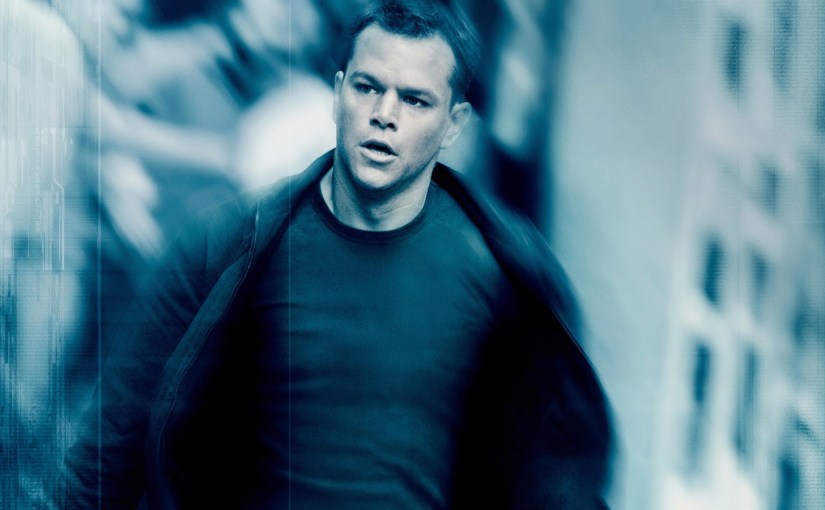
By Marc S. Sanders
Sometimes the same old thing is all we want, right? It’s like comfort food. That’s what the Jason Bourne films offer. The first time (The Bourne Identity) it is original. The second time (The Bourne Supremacy) it is familiar. The third time (The Bourne Ultimatum) it is what we expect. When you get to the fourth and fifth time (The Bourne Legacy and Jason Bourne), well then perhaps you’ve overstayed your welcome.
The second and third films in the Matt Damon action series function as one long four-hour film. They are absolutely gripping in high octane, fast cut editing, pulse pounding music from James Newton Howard, and taut direction from Paul Greengrass. They work because at least two thirds of the material is shown through the eyes of the former assassin Jason Bourne who is trying to learn of his past and who he worked for and why. Plus, though he may hide deep undercover on the other side of the world in places like populated India, he only resurfaces when he discovers someone is trying to kill him.
The other third of these two pictures function on the other side of the coin with clandestine departments within the CIA who only consider Bourne being alive as a threat to the integrity of their black operations. He must be eliminated. There are great acting scenes with Joan Allen first up against an intimidating Brian Cox, and later she’s going toe to toe with David Strathairn. If you are not part of the chase for Bourne, then you are engrossed in the cause these three supporting players offer with government politics and debate. With each passing film, it’s an old, grey haired white gentleman in a suit who is insistent on eliminating Bourne and anyone who he associates with. This started with Chris Cooper in the first film followed by Brian Cox (my favorite) over to David Strathairn. The baton is then passed to Albert Finney. A new film moves over to Edward Norton and then Tommy Lee Jones. Scott Glenn and Stacy Keach are in the recipe too, but they are not as prominent. All these guys start to look alike and when you watch the films in succession, one after the other, like I recently did, you start to question when this actor and this actor entered the fold. Best way to describe it is that it is a ladder climb. There was one guy in charge, then another above him and so on.
The appreciation for the Bourne series comes mostly from its action and the absolute cleverness of its hero. Jason Bourne functions with ease about staying one step ahead of those trying to kill him. They think they have a lead on him, but in reality, he has the lead on them. Do you know how satisfying it is when he calls these people to talk to them and they play dumb? Jason will simply say “If you were in your office right now, then we would be having this conversation face to face.” Moments like this are what gets an audience to clap and cheer. The old white guy has been duped.
The action works because, once again I lay claim to the lack of CGI. So, the overabundance of car chases seems nerve wracking like they are supposed to. That door on that car is actually getting bashed in. That taxi cab is really getting t-boned and turning into a 360 tailspin. Jason can grab a seatbelt, lie down on his side and when the car careens over the barrier onto the landing fifty below, upside down, I’ll believe he gets out with only just a slight limp and a dribble of blood on his brow. Only Jason Bourne can drag a wrecked rear bumper on a stolen police car through a busy Times Square and bash an SUV into a concrete barrier.
Fight scenes are not just fight scenes in the Bourne films. It’s not just fists and punches and karate kicks. Creatively speaking, the films construct their fight scenes to have the hero arm himself with a ball point pen or a magazine that’s wrapped up ready to wallop an opponent in the nose. I’ll never forget when my colleague Miguel and I saw Ultimatum in the theatres and witnessed Jason punching a book into the face of a dangerous bad guy. How many times have you seen a guy get punched in the face? How many times have a seen a guy punch a book into the face of another guy? There’s a difference.
Matt Damon has been quoted as saying he believes the Bourne films carried the least amount of dialogue for him to memorize. Yeah. That’s likely true. These films are visual feasts. They rely on watching Damon move. They are paced by how he walks, drives a car or tinkers with props. Even how he listens and observes move with a kinetic progress.
The locales are spectacular, spanning the globe from India, to Russia, to London, to Morocco, to the Philippines, and on to New York City and Las Vegas. Following the first film, Paul Greengrass directed three of the next four. (Writer Tony Gilroy directed the fourth film, The Bourne Legacy with Jeremy Renner taking the lead while Damon’s character was only talked about.) Each film takes every advantage of the atmosphere, using the overpopulated extras as obstacles and means to hide and weave away from the antogonists while on foot, behind a steering wheel or saddled upon a motorcycle. Greengrass practically invents the concept of putting the viewer so much within the environment, you can almost smell the diesel or the food trucks within the area. Zoom in overhead shots offer quick glances of the playground and traffic we are engrossed in. Approximately twenty-five minutes within the center of The Bourne Ultimatum go by with no dialogue as Jason Bourne pursues a bad guy through a labyrinth of apartment tenements and rooftops, while the bad guy pursues actor Julia Stiles. Finally, when all three catch up to one another, with a leap through a window, do you let out the deep breath you never realized you were holding on to.
The first three films in the series (Identity, Supremacy and Ultimatum) work as a tight trilogy. Each film ends with hanging threads to consider and lend to the next film. By the time Ultimatum concludes, you feel as if all that needed to be told has been covered. The next two (Legacy and Jason Bourne) function as cash grabs for the studio. Legacy is entertaining and it boasts a good cast with Jeremy Renner and Rachel Weisz trying to outrun the government adversaries. It hinges on operating as parallel material that occurs in the prior Damon installment. While Jason Bourne is being pursued, this is happening over here. It’s not unwatchable, but it is also truly unnecessary as it doesn’t advance the universe of the series at all. A thrilling motorcycle chase closes out the film, but it’s a retread of what we’ve seen before. It gets old quickly. The film demonstrates that guys like Jason are trained to become dependent on drug enhancements for their highly trained arts of warfare and instinct. Renner’s character is just another kind of Jason Bourne. I was more impressed when I thought Jason was just a highly skilled fast learner to all that he’s capable of. If you tell me blue and green pills lend to what he’s capable of, well then, he’s not much of a superhero in my eyes anymore.
With the final film, Jason Bourne, Greengrass returned to the director’s chair and Damon agreed to come back (paycheck had to be right, I’m sure), though he was significantly greyer and older than his prior films. It was a weak return. Just when we think Bourne has learned everything he needed to know and he could now live comfortably underground as a street brawler for bucks, he is informed that his deceased father knew and did some things for these secret agencies that put Jason on this path of special operations. It doesn’t hold much weight and the payoff is nothing special. Another car chase occurs in Vegas that appears nearly shot for shot similar to what we already saw in Damon’s prior installments.
I wrote in an earlier review of The Bourne Identity, that Matt Damon works so well in the role because he’s such an unexpected surprise. He’s not the muscle guy like Stallone or Schwarzenegger. He comes off common. In the first three films, he’s simply a kid. When you place him in action or see how he gets the drop on a bad guy who is surveilling him, it is so satisfying. The Bourne films work best with the locales they choose to shoot from. Bourne will spy on his pursuers from a rooftop building across the street from where they are. This is inventive filmmaking not just found in the pages of the script. Paul Greengrass strategically shoots his players. Director Doug Liman planted the seeds for this series’ potential (The Bourne Identity), very loosely based on the Robert Ludlum novels with creative adaptations from Tony Gilroy, primarily. Greengrass enhanced the characters and their motivations by use of scenic locales, skillful shaky cameras to make it look like the audience is running at the same pace of Bourne and his adversaries, and quick cut, real time editing. He applied this approach to his 9/11 film United 93. The last two films are good even if they seemingly peter out the series, but overall, the four sequels hold up very well.
If you’re asking, the best of the series is The Bourne Ultimatum, followed very closely by The Bourne Supremacy. Either way, no matter which film you’re watching, you’re in for a good time when Jason Bourne shows up on the grid.
 2 UNPAID MOVIE CRITICS!!!!