THE MIST

By Marc S. Sanders

I’m tough to satisfy when it comes to monster movies.  Too often they all look the same, or they behave with similar instincts and motives.  There’s a new dinosaur movie coming out this year where they apparently stalk a military unit.  So!  I’ve seen seven Jurassic Parks.  About the only monster that still gets under my skin are the acid pumping, knives for teeth xenomorphs of the Alien franchise.  Everything else is been there, done that, and this includes the insect like pests found within the mist of Steven King’s The Mist, directed by Frank Darabont.  Fortunately, there’s a better and much more engaging attraction to this eat ‘em up blood fest.

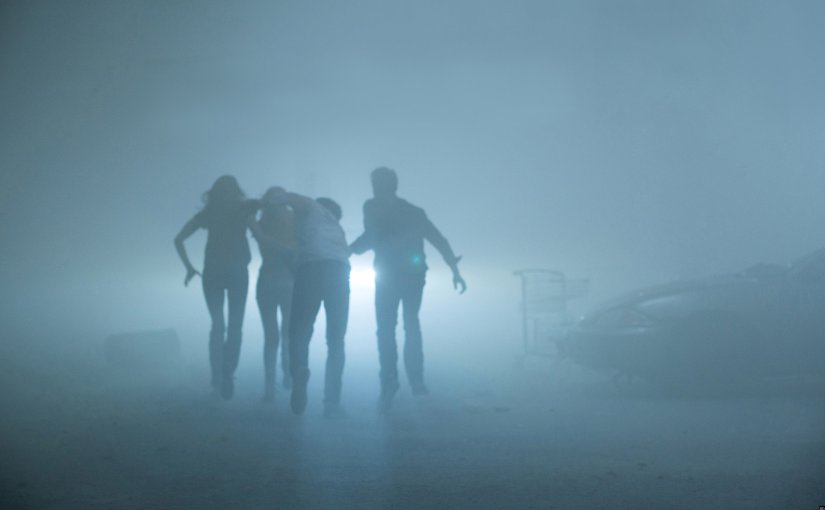
Within another small fictional town in Stephen King’s version of Maine, a dark and stormy night kills the power within the area.  The next morning large fallen trees appear to have damaged the homes of David Drayton and Brent Norton (Thomas Jane, Andre Braugher).  Phones and power remain out, but a curious cloud of mist grows over the lakeside area.  

The gentlemen decide to go into town for supplies with David’s son Billy (Nathan Gamble) in tow.  The checkout line of the supermarket is crowded with tourists and residents when a similar mist envelopes the building and clouds up the expansive front window of the shop.  An elderly man runs through the parking with a bloody nose and urges the shoppers to lock the doors because there are things within this unwelcome mist that are terrifying and bloodthirsty.  I’ll spoil this for you. The old coot is right.  The creepy crawlies are thirsty for blood and hungry for flesh.

You’ve seen much of what Darabont’s screenplay adapts from King’s novella in similar iterations of horror.  The wheel is not reinvented here and though an explanation of this mist and the organisms it conceals is spelled out, nothing is jaw dropping.  Seems similar to how King’s The Stand opened.  The cast of this B movie is what needs to be talked about.

Sure, there are doubters of things terrorizing the community just before the blood is spilled.  Some characters make hard decisions despite the urging of others not to leave the store.  Yet, when these flesh eaters become evident, then the end of days gospel of Mrs. Carmody (Marcia Gay Harden) permeates through the populace of the supermarket.  That’s when The Mist grows a brain to demonstrate the power of fear, threat, and especially influence.  The disturbing Mrs. Carmody exaggerates the purpose of this phenomenon with select biblical scripture both documented and I believe conjured on the fly by her.  Now I am reminiscing back to tenth grade English when I studied Lord Of The Flies.  A tribe forced to live together will ultimately divide.

Darabont so wisely reads a collection of different walks of life forced to either work together or work against each other, both sides with desperate means to survive.  William Sadler is a dimwit mechanic who goes through three different modes of purpose during the film.  He starts with a tough guy mentality, then on to timid fear and regret, and lastly, he’s reawakened to echo the call of Marcia Gay Harden’s religious zealot.   Truly insightful because I often wonder how any person can so easily succumb to the influential beliefs of someone else.  I mean you would have to be dense to allow that to alter your mindset, right? Well Stephen King and Frank Darabont remind me that there’s more dense people on this planet than wise.  A dread of cabin fever only exacerbates to succumb to what someone will tell you. Therefore, let’s observe how the morons respond to the dominant personality.

The action for the sake of jump scares and expected horror does not disappoint too much.  There’s screaming. There’s lots of blood. There’s lots of running too, and monsters and webs and teeth and claws.  A sneak away trip to the pharmacy next door is neat centerpiece, but you’ve seen stuff like this so many times before. Frances Sternhagen gets the opportunity to use a makeshift, bug zapping, flame thrower that made me laugh and cheer.  

The jump scares are not very effective, though.  One bug thuds against the window pane. Otherwise, there’s monster stuff to absorb like tentacles, claws, teeth and webbing. I don’t go for slasher flicks and endless bloodletting gore like most movie makers of this genre attempt to achieve.  Too much blood is boring and a sign of a lack of story.

I was invested in uncovering why this all started.  I was taken with how a small group of people quickly engages in a mob mentality because their individual desperations refuse to satisfy. What instincts will undo people when hope dwindles and your companions turn on you?  Darabont presents some effective moments for these questions. However, once the exposition was out of the way, I didn’t care who lived or died.  My concern was knowing how whoever survives gets out of this dilemma.

The answers come and there is an unexpected ending tacked on by Darabont that is not recounted in King’s work.  Trust me when I say I’ll never forget the conclusion of The Mist.  Same as I’ll never forget the ending to The Sopranos.  That’s not necessarily a compliment though because I think Frank Darabont was only adding unnecessary insult to injury. He resorts to using a terrible psychological epidemic for one last twist of his gleeful, mischievous knife in my back.  I am not spoiling anything for you dear reader, but James Cameron went this route during a sequence in Aliens and it made much more sense, while offering convincing justification.

While you might like the chills and thrills of The Mist, be warned that it’s the ending that’ll leave you angered for days and nights thereafter. I had a furious urge to throw my popcorn at the screen.  

Popcorn can be found on aisle 5 by the way.  Bug spray on aisle 9.
DIE HARD 2: DIE HARDER

By Marc S. Sanders

I think we’ve debated enough about whether Die Hard is considered a Christmas movie. So what about the next installment, Die Hard 2: Die Harder?

Truthfully, who cares?!?!?

Director Renny Harlin (Cliffhanger with Sylvester Stallone) takes over from John McTiernan and he does a capable job of depicting a frenetic Christmas Eve at Dulles Airport in Washington DC, sprinkled with the latest in early 90s technology like fax machines, pagers, tasers and even a reference to Radio Shack. But by golly, the film still remains modern as The Simpsons is shown on local TV.

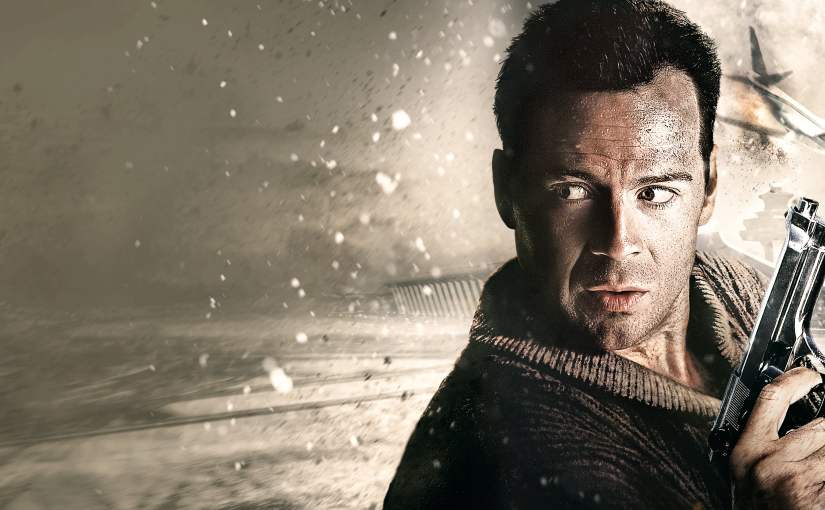
The ingredients are pretty much the same as the first film and while Alan Rickman is sorely missed, William Sadler does alright as a cold hearted Colonel on a mission to aid an escape of a powerful drug overlord. Bruce Willis’ John McClane will not allow that to happen.

Willis is maverick and defiant again though this script doesn’t allow for better one liners that the first film offered. He’s doing his same one man army schtick though with an endless supply of bullets for his service weapon, and it’s nice to return to form.

Harlin is a good action director featuring snow mobiles, shootouts, shootouts on snow mobiles and exploding planes and satellites. Amazingly enough though, a crowded Christmas airport is unaware of all these massive fires and explosions going off all over the nation’s capital and all proceeds as normal until it’s broadcast on TV in the last act of the film. Meh!!! Everyone has Christmas on their mind.

Heck…well then I guess Die Hard 2 (with the inventive subtitle Die Harder) is in fact a Christmas movie. Glad that’s settled.

Happy Holidays. Let it Snow!

THE SHAWSHANK REDEMPTION

By Marc S. Sanders

The purest form of humanity can be found in some of the most unexpected places. Frank Darabont’s first film, The Shawshank Redemption, based upon a novella by Stephen King is a perfect example of that truth. In a federal prison, the true test of a man’s character is established. Will a prisoner be as cold hearted as the crime he’s been punished for, or will he find a deeper meaning to his existence for himself and those around him? What if this particular man is actually innocent, wrongfully convicted? Will his innocence of crime be upheld?

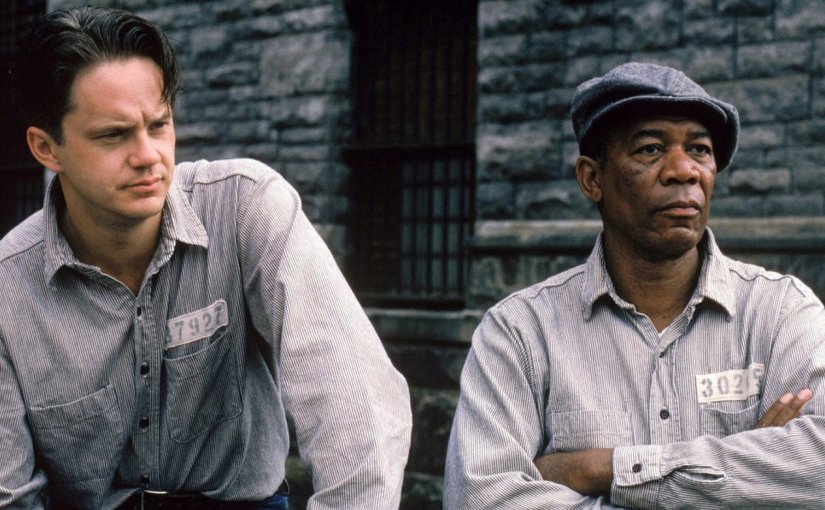
To experience The Shawshank Redemption is to learn about a community that I am completely unfamiliar with, and I’d bargain most of its viewers are as well. Shawshank prison is not a place I would like to check into. Though many of its residents display heart and comradery, nonetheless. These men likely didn’t know they were capable of such merit until Andy Dufresne (Tim Robbins) arrived to serve two concurrent life sentences for murdering his wife and her extramarital lover. Andy says he’s innocent without any desperation or urgency because none of that elevated showmanship would make a difference. The evidence and circumstances at trial unfortunately were coincidental to easily sentence Andy for a crime he didn’t commit. Everyone at Shawshank insist they’re innocent. Likely though, Andy is the only one who can genuinely make that claim.

Andy’s introduction to the prison is hard for the first couple of years. He’s consistently beaten and raped by inmates who need to exhaust their sexual tendencies. Fortunately, he sidles up with Ellis “Red” Redding (Morgan Freeman in maybe my favorite role of his career). Red is the go-to man for contraband resources like whiskey or as Andy requests a small rock hammer and a large poster of Rita Hayworth. Everyone is happy to know a guy like Red. Yet, Andy does not lose sight of his personal value. He was a banker by trade and when an opportunity opens up, he assists the viciously frightening prison guard Byron Hadley (Clancy Brown, who really should have more villainous roles in film beyond his voiceover as Lex Luthor in cartoons) with a legally accepted government tax exemption. More importantly Warden Samuel Norton (Bob Gunton) takes advantage of Andy’s talents to sustain his seemingly innocent money laundering schemes.

There is much education to be had from viewing The Shawshank Redemption. I learned what the term “institutionalized” means from Red’s experience. A man who has served a near half century has become accustomed to prison life. He offers little significance or purpose outside the prison walls. I also learned the value of music and literature and art. It’s needed to survive those lonely nights in a prison cell, or worse in the hole where you can wind up should you step out of line from the Warden’s strict guidelines of adhering to discipline and the Holy Bible. What you hear and what your read stay with you in your heart and mind, offering a most valuable commodity – hope. A life sentence will take away your liberties to walk freely among the masses, but nothing will take away what you’ve absorbed. If you can at least hold on to your memories, then you will never lose hope. Andy reminds Red and his fellow prison inmates of the hope you hold onto no matter how long you are held against your will.

Frank Darabont introduces a spectacular midway scene where Andy finally receives a donation of books and records for a prison library he envisions building for Shawshank. He uncovers a vinyl record of an Italian opera and with complete disregard for rules, he airs the music through the intercom. Darabont gathers gorgeous close ups of the hundreds of prison extras with overhead shots of the yard, woodshop and infirmary. The men freeze for a moment to look up in the sky from where the music is emanating from while mixed in with the soothing voiceover narration from Freeman. It’s a beautifully directed scene. A risky scene for late 20th century audiences who are used to quick cuts of action in their films with powerhouse soundtracks and pop music. Darabont found a way to connect the audience delicately to the film through Andy’s personal values and Red’s learned observations.

The Shawshank Redemption is an exceptional piece of writing. I can’t compare it to King’s source material as I’ve never read the story. Having said that, I’m typically hot and cold on the author’s books and screenplays. Sometimes they go too over the top for me. However, Darabont honed in on a perfect balance of likable characters and honest life within a prison; at least I feel that it’s honest. All men are created with good inside them. What they learn from day one is what can drastically change them and what can come of their sins can revert their instincts. Andy Dufresne is the instrument that redeems the men of Shawshank prison. Tim Robbins is right in this role; maybe his best role for his career as well. He does not underestimate any of the men in Shawshank and keeps to his personal enrichment which he also shares, despite the selfish hypocrisy of those meant to maintain order like the Norton and Hadley.

Morgan Freeman is the man who is becoming more and more institutionalized to prison life, always failing to get paroled for a murder he committed when he was a young and stupid kid. If not for Robbins’ melancholy performance as Andy, Freeman’s performance as Red would not realize a new kind of importance for himself. In fact, many of the inmates wouldn’t be able to acknowledge what they are capable of or what they mean in the world they live in without Red, but more importantly Andy as well. Morgan Freeman and Tim Robbins make for one of the best on screen couples in film history. Their chemistry is magical. Any scene between them can be studied for the weight of emotion or lack there of which the two actors carry. They both went on to win Oscars later in their career, respectively from a pair of Clint Eastwood projects actually, but the argument can be said that the awards should have come their way for Darabont’s film.

The ending to The Shawshank Redemption is an unforgettable and unexpected piece of storytelling that never seems to imply itself before the reveal and yet pleasantly makes so much sense. Maybe the one convenience to build to it’s winning conclusion stems from the location of Andy’s cell within Shawshank prison. Bah!!!! I dismiss that little contrivance to allow me to joyously appreciate this film over and over again.

There are ironies and unfortunate moments to see in The Shawshank Redemption. Still, there are revelations and opportunities to cheer and feel better about yourself when watching the movie. It’s one of the most uplifting films you will ever see. It’s inspiring and imaginative. Most of all it is smart and defiant. The Shawshank Redemption never believes in despair. It only grasps upon the hope of its characters. The Shawshank Redemption is a must see film.