EQUILIBRIUM

By Marc S. Sanders

It’s amazing what drugs can do to you.  Take them on a regular basis and perhaps you can maintain focus and discipline as an enforcer to a dystopian humanity.  Then again, if you stop taking the medication, maybe you’ll open your eyes wider with an ability to nurture, care and appreciate.

This is the set up to writer/director Kurt Wimmer’s futuristic sci fi tale, Equilibrium.  The immense action scenes look like a modified springboard off of what The Matrix provided.  Be that as it may, at least the story stands on its own with an Orwellian inspiration to give it legs. It actually looks like an elder stepbrother to that Apple Super Bowl commercial directed by Ridley Scott.

The best of a specialized police force is the Grammatron Cleric, John Preston (Christian Bale).  Within the bustling city of Libra, large monitors periodically remind commuters to take their routine Prozium.  This allows emotions and feelings to be suppressed.  Thus, order is upheld.  Jealously, for example, is ostracized from this community. The Clerics must heed to this program strictly as a means to live by example.  

Still, even with most of the world population wiped out, there are factions and individuals who do not abide by this governance.  Preston, along with large squads of heavily armed militia seek out these offenders and often discover their fix for stimulation coming from sources of art, literature, and music.  Apprehend the criminal(s), and destroy the contraband they conceal under floor boards and behind plastered walls.  The actual Mona Lisa becomes an early casualty of legal property possession. 

If the culprits take up arms, they’ll be no match for the Clerics, especially the best of this class, John Preston.  

Yet, what happens if John opts not to continue his dosage?

Equilibrium does very well at teaching this unfamiliar science fiction before exploring how it all crumbles.  The expository opening presents an exciting scene of Preston’s methods.  Later, it follows how the system malfunctions.  

Miguel warned me ahead of time because about the only thing I feign at seeing in a movie is any kind of harm to a dog.  A disturbing moment occurs as John experiences his “awakening,” and considering the value I have for a dog’s affection I cannot deny how necessary the moment plays here.  It lends to the change in the protagonist’s character arc.  It is a cruel scene but with anything that feels unjust, within reality or fiction, an event has to occur to pull our heads out of the sand.

The action scenes have a unique flair to them as the Clerics reveal firearms that dispense from under the uniformed sleeves ready to use for firing, but with a martial arts kind of gloss.  While you watch it’s just plain cool, and Christian Bale looks great doing the stoic, less is more exertion to the moments.  He’s such a good actor at performing choreographed dances of shoot ‘em up violence while struggling to maintain an uncompromising mentality this character is expected to be accustomed to.

On the other hand, his new partner, Brandt, is either drafted incorrectly in the script or miscast with Taye Diggs in the role.  He’s a Cleric in training and an admirer of Preston. If the Clerics are supposed to be devoid of emotion, then why is his envy of this man so apparent.  It’s Taye Diggs stepping off his familiar Broadway stage.  However, I do not believe that’s what Equilibrium is expected to offer.  Brandt seems to possess too much pleasure for his calling.  Ultimately, Brandt becomes the antagonist who serves the greater power as his suspicions grow about Preston’s “withdrawal.”  Taye Diggs and Brandt feel like they belong in another film.

Preston had a wife who disappeared mysteriously as well, and he’s left with two children who are being designed to perform like him.  I found the kids to be too much excess for Wimmer’s script though.  Yes, the son turns up at a crucial moment of discovery.  However, after the children appear early in the film, their father does not associate or see them again until close to when the story is wrapping up.  I’m certain the daughter had no more than one line of dialogue. I think it would have been better to excise this storyline altogether.  It has no urgency, nor is it fleshed out enough.  Why must John Preston be a father?  

Equilibrium is an interesting sci fi amalgamation of George Orwell and Phillip K Dick constructs.  There are some disturbingly decent ideas here and if you’re not careful you may find yourself comparing its designs to what some worldwide political climates feel like today.  Don’t overthink it though.  

It has some faults, but the action is entertaining.  Fortunately, Christian Bale occupies the whole of the piece.  The guy is just too dang cool, dressed in black garb with surprise weapons appearing from nowhere at his will while he twirls through the air with his arms outstretched and ready for fast moving combat.

Let’s see John Preston face off against Neo from The Matrix next.  My god, that’ll make the John Wick movies feel like nursery rhyme programs.

Think about all the artillery and jiu jitsu. 

I gotta lie down.  The headrush is making me feel like I overdosed on Prozium. There was a time when I got emotional over things, wasn’t there?

GO

By Marc S. Sanders

Character perspective is so vital to a story.  It becomes even more important when you are telling multiple tales.  When you have a collection of five or six characters in your screenplay and they each have a circumstance that overlaps with one another, a smart way to narrate one reckless evening is by chopping up the time period into multiple plotlines.  Numerous stories offer several perspectives and then you may appreciate what director Doug Liman accomplishes with one of his earliest career films, Go.

Go focuses on an assortment of early twenty-somethings scrounging for money while also taking in the nightlife during an evening close to Christmas.  Two supermarket cashiers, Ronna and Simon (Sarah Polley, Desmond Askew) have different things on their mind.  Ronna, who is exhausted having worked double shifts, is on the verge of getting evicted from her apartment because she has no money to pay the rent.  Simon just wants to go with his buddies for a good time in Las Vegas, but he’s got to work.  So, the two swap shifts. 

The script follows the Ronna avenue first where she meets up with some acquaintances of Simon’s looking to score some ecstasy.  Ronna thinks of a get rich quick scheme to meet with Simon’s drug supplier, Todd (Timothy Olyphant), and then sell to Simon’s buddies directly.  Naturally, it doesn’t work out so neatly.

The second act of the film focuses on Simon with three buddies (Taye Diggs, Breckin Meyer and James Duval).  Because Simon is written as happy go lucky, but also careless, he’ll get into his own kind of adventures and mischief.  It can only happen in Vegas.

The third act turns the viewpoint over to those acquaintances that approached Ronna, two soap opera actors named Zach and Adam (Jay Mohr, Scott Wolf).  These guys weren’t just looking to score some drugs.  They’re up to something else entirely.

I’ve never been one to take to movies where the characters are intoxicated or high through most of the film.  I can only handle so much of Seth Rogen’s drug episode schtick like with Pineapple Express, released years after Go.  What’s most appealing about Liman’s film, however, is that you are moving along one path, and then suddenly you are reversed and driving down the other side of the fork in the road.  This routine occurs again for a third time. 

Much like Quentin Tarantino’s Pulp Fiction, you can argue that the writer/director could simply take the straight route from beginning to end.  Yet is that really interesting?  Would Pulp Fiction have worked as well or better than its final composition?  Don’t we usually see that approach in everything else out there?  As well, these characters are not following a storyline that contains gripping material with symbolism or intense dialogue and circumstances.  So, how exactly do you heighten a kid buying drugs off another kid while keeping the viewers’ attention span?  You stir the pot.  (No pun intended.)

Following a rage dance club effect of opening credits, Liman does a close up of Katie Holmes as Claire, Ronna’s friend.  She’s talking to someone, who we can’t see, about how fun the surprises are with opening Christmas presents.  Go works from beginning to end because it turns in surprise encounters that you would never expect.  Call it a butterfly effect.  A flap of the wings leads to this encounter which leads to that encounter and so on.  If you are taken with the film, you just might smirk with pleasant surprise when you uncover who Claire is actually speaking to.

Early on in the film, we will see a one-sided conversation on the phone.  Later we will see the other side of that same call and I get a kick out seeing a story running parallel to another story I just got done seeing. (Forgive the redundancy of that sentence, but that’s the point!)

Another moment will have a character draw a gun on another character, only a hit and run with a car disrupts the moment.  Thankfully, we’ll meet the personalities behind that car later on.  As the picture becomes more and more clear, you might cheer “Bravo!” at the invention of Go.

As noted before, Doug Liman’s movie has been compared to the drive behind Pulp Fiction.  I understand the temptation to make that association.  However, this movie stands on its own.  Where Tarantino will show perspective of different characters, he will branch off into forward thinking with new events.  Go steers its focus to parallel plot points.  We see what’s occurring in Los Angeles right now with Ronna.  Later, we will see what’s happening in Las Vegas at that very same time with Simon.  Tarantino picks up where we left off.  Liman documents what’s happening elsewhere.  While these two characters are going along their own paths simultaneously in different parts of the universe, what happens to one of them will bear on what happens to the other as the trajectories continue. 

I might be making this out to be fancier than it ever needed to be, but it’s a kick ass good time, nonetheless.  The soundtrack is absolutely fun.  You get absorbed in the settings, almost wanting to be in the Christmas night club party with strobe lights and neon colors, or the Vegas casinos and strip joints.  The personalities and dialogue are super smart and witty with hilarious comebacks.  “If you were any more white, you’d be clear!”

At the time Go was released in 1999, from a marketing perspective, it did not appear all that attractive.  Lots of club music and symphonics surround the picture.  The most marquee name in the film, probably still, is Katie Holmes who is not exactly on the same level as an Angelina Jolie or even a Jennifer Lawrence of today.  Yes.  Nearly twenty-five years later many of these young actors are more recognizable.  I dare you to come up with their names though as soon as you see them in the picture.  However, because I’m not watching Tom Cruise or Brad Pitt, I have no expectations of how any of these various storylines are going to turn out.  When the film leaves the Ronna storyline, are we going to get to see what happens to her next?  Will Simon get back from Vegas?  Lots of questions abound as the film moves on.

While Go is reveling in its debauchery, it’s performing as a smart machine that hits all the right notes where it will lay the groundwork for comedy, but then segue into serious material where the protagonists find themselves in a situation they might not be able to escape.  Go is a movie that keeps you alert, even if you’re high, during one sleepless and irresponsible night. 

HEAT (1995)

By Marc S. Sanders

My all time favorite crime drama, as well another one of my most favorite films, is Michael Mann’s Heat which is widely recognized for the much-anticipated moment where Al Pacino and Robert DeNiro finally share the screen together for the first time. The Godfather Part II never counted as their characters performed in different time periods. Still, Heat has so much more going for it, beyond just its headliners.

Michael Mann wrote the screenplay he directed. It deeply involves both the thief, Neil McCauly (DeNiro), and the homicide detective who pursues him, Vincent Hanna (Pacino), with inspiration from two real life characters. Therefore, this film drives with more authenticity than a standard Lethal Weapon picture. Much more is at stake than a standard kill shot, arrest or the score to take down. The women and children and partners these guys become associated with carry a weight and sense of value. Even the hoods who betray them hold significance. How they matter and are part of the story is just as pertinent.

The story focuses on DeNiro, with Val Kilmer and Tom Sizemore taking down high stakes scores, not petty liquor store hold ups. An early armored truck hold up goes well until a new partner executes the three security guards in broad daylight on the street, at point blank range. Pacino takes the case along with his brilliant squad of detectives that includes great supporting performances from Mykelti Williamson, Ted Levine and Wes Studi. Then it becomes a cat and mouse tale where two equals match one another in wits, skill, and experience. To believe the equal match up though required casting Pacino and DeNiro. The film would not work with any other pair. Through their respective careers, their various performances came off different than one another. Yet, it has been often easy to imagine either one of them playing their classic roles instead. I could envision DeNiro as Michael Corleone or Serpico. I can also envision Pacino as Rupert Pupkin or Travis Bickle. The range of these actors is unlimited.

Diane Venora and Ashley Judd are two actresses not used enough in films. As the wife to Pacino’s round the clock detective, Mann provides time for Venora to show the pain of a woman in love with a man who can hardly ever be home because he’s always on the prowl of DeNiro’s professional thief and his crew. Venora is a likable woman in the role, only the circumstances of her marriage and the difficulties of dealing with a troubled pre teen (a fantastic Natalie Portman who will break your heart with just three scenes) are gradually making her cold. She has a great monologue midway through the film that is terribly dark, as she surmises Pacino’s cunning detective.

Ashley Judd is a different kind of cold as the wife of Val Kilmer’s gambling addicted sharpshooter. She’s a beautiful housewife and mother to a toddler that is trying to maintain a happy home. However, the balance of living with a career criminal is near impossible to maintain.

Michael Mann put so much thought into characters like this. Other directors and writers would keep the story on the streets and in the hideouts and city precincts. Mann goes not just for the low level criminal hoods who provide information in a night club at 2 AM. Mann allows his crime drama to spill over into the home.

He even allows a side story to occur with an ex con (Dennis Haysbert) out on parole trying to get his life back in order. What does this guy with his loving girlfriend have to do with anything else? Eventually, the bridge is connected, and it comes down to an emotional and heartbreaking conclusion.

Heat deliberately takes its time to flesh out a lot of great characters. The large cast are all given moments to stand apart from the rest. It is primarily a quiet, talking picture of careful planning and investigation. However, when the legwork is complete, Mann arrives at two scenes right in the middle of the film. The first is the now famous coffee shop sit down confrontation between Neil and Vincent. Mann did a masterful job of capturing the two actors doing some of their finest work with nothing tangible to aid them; no props or grand music or effects. Just a table in the middle of a crowded coffee shop. The professionals allow their history to show only so much but the cop and thief know this is not going to be easy from here on out. Mann did numerous takes, but with at least two cameras showing at each go round. So, if Pacino is talking, we see DeNiro’s facial reactions and vice versa. Pacino’s take #11 is also DeNiro’s take #11. It is one of the all-time great scenes in film history. Beautifully written. Beautifully constructed. Beautifully performed.

The next centerpiece is the bank robbery that occurs at midday in downtown Los Angeles. Neil and crew are almost scott free when Vincent and squad intercept them in the middle of the street. What sets this massive shootout (based on a real incident) above all others is that I actually get choked up and emotional over the moment. Characters that I have become acquainted with for the last 90 minutes are swept up in huge risks and danger of massive gunfire and ambushes. I even become terrified for the extras that Mann includes in this scene. I’ve watched this scene a hundred times and I can’t help but actually get tearful over it. Mann has the power to make me have an affection for these characters. As well, how will the spouses, who become aware of this matter, be going forward? That accounts for much of the latter half of the film.

Neil holds true to a philosophy he learned while doing time. If you spot the heat around the corner, allow nothing to interfere that you cannot walk away from immediately to avoid getting apprehended. He is put to the test of that motto when he falls in love with an introverted graphic designer played with quiet reserve by Amy Brenneman. This storyline will sum up the ending. Again, Mann shows the characters on the outside of these guys with their guns, working in an underworld environment. How do the risks of these guys play out on others?

Technically, Heat succeeds as well with brilliant blues, blacks and whites in cinematography. Major accolades for Dante Spinotti. Everything from the well-lit coffee shop to Neil’s unfurnished, ocean view apartment and even a blue Camaro that Neil drives away in through an underground tunnel are brilliant. Spinotti paid careful attention to the evolution of the characters. As Neil drives into that tunnel, the car turns white hot. He is on his way to escape with an unsure Brenneman by his side. Often in moments like this, the film tells more than any piece of dialogue could ever sum up.

Heat is a must watch film for genuine portraits of characters few of us will ever cross paths with. We should understand, though, they have more than just a drive to steal or to get an arrest. These guys exist for more than just the score. Few crime dramas ever approach that angle, and that is why Heat is such a special film.

CRASH (2005)

By Marc S. Sanders

Paul Haggis’ vignette themed script for Crash should not have won Best Screenplay. The film he directed should not have won Best Picture. Could it be that because this picture is masked as that special movie with that especially poignant message that it got the recognition I don’t think it ever deserved? I can appreciate the attempt at bringing hot button social issues like racism and injustice to light, but it does not need to be as immaturely contrived as this picture.

Crash occurs over two days within the city of modern day Los Angeles. A select group of characters of different social classes and ethnicities are covered, and the film circumvents back and forth among their perspectives. For the most part, all of these people have major social hang-ups with people outside their race. The first example shows us that if a white woman who is simply cold on a winter night hugs her husband tightly for some warmth, apparently a couple of black men will automatically believe this woman is fearful of their approach.

Especially today, I know that prejudice exists, but to this extreme and this contrived…I’m not sure. I guess I’m not sure because I have not experienced it enough to be convinced yet. When I read a friend’s testimony of falling victim to racial prejudice I lean towards believing everything they tell me. I guess it’s this movie, Crash, that left me feeling dubious and maybe that’s because the circumstances seem way too forced.

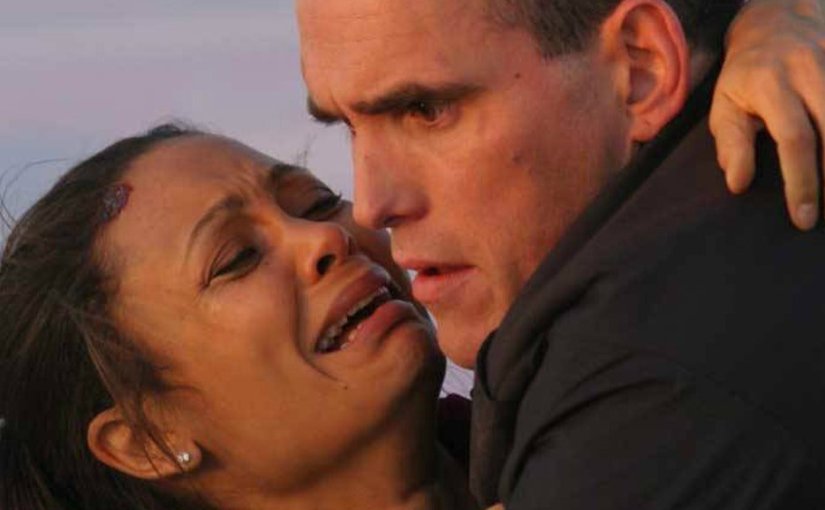
A racist cop (Matt Dillon) will pull over a well to do Muslim man (Terrence Howard) driving a high priced SUV and perform a sobriety test for no reason. Then the cop will deliberately frisk the man’s wife (Thandie Newton) with digital penetration. The next day, it’ll just happen to be that this woman will have no choice but to be rescued from a burning car by this same racist cop. Now I’m supposed to believe that the racist cop is not so bad, and the woman learns to become more tolerant. Well gee, thank heavens for coincidences!

The Muslim man (a television show director) gets car jacked the following day, and in a tense pull over moment he’s mistaken as the criminal. Fortunately, the partner of the racist cop (Ryan Phillipe) is there to subdue the situation. I’m sorry, but life doesn’t work out to be this tidy. Call me cynical, but more often than not we are not given a second chance at first impressions.

One of the real car jackers (Chris “Ludacris” Bridges) gets a moment of clarity and suddenly he’s generously giving out his last forty dollars to a group of Asian people being held in a van for human trafficking. Forgive me. If I want to begin respecting this car jacker who has held multiple people at gun point and even runs over a man, only to toss him out on the drive up to the Emergency Room, I’ll be more apt to do so if the criminal turns himself in.

I dunno. Maybe I’ve got a personal issue with Crash. It could not be more apparently preachy in how it patronizes me to simply understand the seething hate and criminal violations of its characters. I’m supposed to empathize with the racist cop because his ill father can’t get the health care he’s entitled to? I’m supposed to understand the prejudicial anger that the WASP wife (Sandra Bullock) of a District Attorney (Brendan Frasier) expresses because she no longer trusts her dedicated Hispanic housekeeper or the locksmith (Michael Pena) changing the locks on their house following a car jacking?

No. Paul Haggis didn’t earn that response from me in almost all of the short story scenarios his film offers. Maybe it’s because I tend to compartmentalize my episodes. I like to think that I don’t allow one experience with one kind of person cloud my judgement on the next person I encounter. A waiter can totally screw up my order and can even mouth off to me in a heated moment. Yet, I’ll return to the restaurant on another occasion because it’s likely I’ll run into a different waiter.

Haggis depicts people who appear to have a blanket opinion of other people with different backgrounds. These are all extremely prejudiced people with next to no understanding of where each of them stem from. An angry Persian man (Shaun Toub) puts blame on the locksmith after his convenience store is ransacked. The locksmith was only trying to explain that the back door needed to be replaced. The Persian refused to listen because his English is limited. So he just gets angry and curses the locksmith out. Haggis opts to insert a language barrier between the two men to serve up an eventual tense and dramatic moment in a neighborhood driveway with a loaded gun and a little girl. A loaded gun and a little girl! Yup, I think they teach these are the true ingredients for effective drama on the first day of screenwriting class. Again, it all comes about a little too forced.

The conveniences and ironies that bubble up at times are surprising. “Oh that guy is that guy’s brother! I see.” Things like that. However, I don’t think that is necessarily the strength of the picture.

In a film like Magnolia, we are treated to the vignettes of a handful of people too. However, not every single one of those people are sketched by means of their prejudiced natures. They are drawn by a variety of different elements whether it be a traumatic past or an inclination to do good. Then it’s kind of fun to uncover how each player is connected to one another.

In Crash, the players are only connected by the hate they carry within themselves, and Paul Haggis forces a redemption upon most of them with small gestures or a line of dialogue or the purity of a welcome snowfall to close out the film. Sorry, life is lot more messy and complicated than that. I guess I’m saying I may have learned a lot more about human nature from a downpour of frogs than a downpour of snow.