
TRAIN DREAMS

By Marc S. Sanders

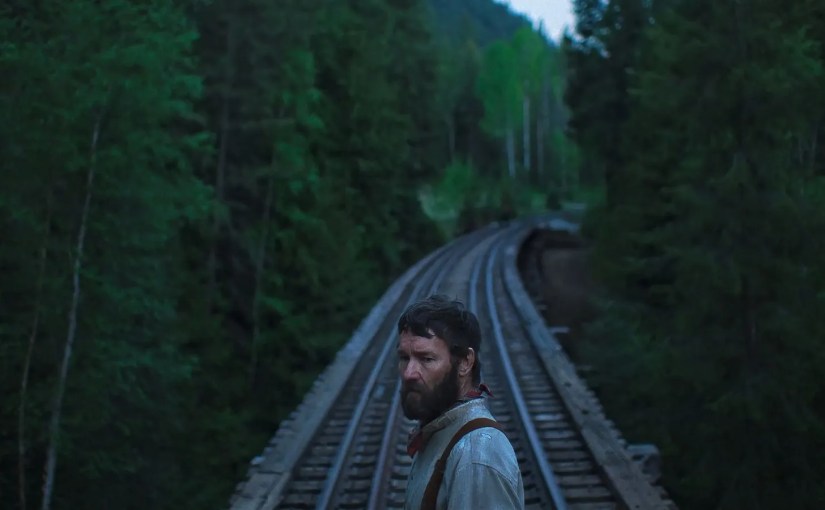
Clint Bentley directs a script he co-wrote with Greg Kwedar, based on Denis Johnson’s novella, Train Dreams.  It’s a gorgeous looking picture that covers an early 20th century logger and railroad worker within the dense woods of Washington state.

Joel Edgerton is Robert Grenier, a bearded logger with an unknown background. The soothing voiceover narration from Will Patton tells us that Robert never knew his parents and is unsure of his exact age.  

Unexpectedly, he quickly falls in love with Gladys (Felicity Jones).  They envision an idyllic life together in a log cabin next to a peaceful lakeside.  They have a daughter and could not be happier.  Yet, during logging season, Robert must leave his family behind to cut down trees for industry supply of a quickly evolving western civilization.  He takes other jobs laying down railroad tracks that lend to the conveniences of transportation and shipping (before the reliance of air travel), including the logs he cuts down. His purpose is circular to a thriving country.

His committed work is not always pleasant.  As a means of revenge, a friend is gunned down right in front of him.  The casualness of the act is the most shocking element of this moment.  Still, there is no time to grieve.  

When he’s working on the railroad, he bears witness to the cruel treatment that others deliver to a Chinese immigrant.  He can not stand up to these behaviors.  He has money that needs to be earned.  So the work takes precedence.

A mentor and demolition expert (William H Macy) meets an unfortunate fate, as well.

Tragedy personally befalls Robert upon his return home following a job. Now, the man is left to resort to isolation where little human interaction exists among the wooded areas.

It’s hard to take your eyes off Train Dreams, now playing on Netflix, and one of ten films Oscar nominated for Best Picture.  The screenplay speaks like a Robert Frost poem.  That’s a compliment and a shortcoming for me.  Will Patton says so much when there’s not much to be said.  Rather, Bentley’s film works visually as you watch a concentrated Edgerton focus on his character’s hallucinations and especially the loneliness he endures in the second part of the film.  

Regrettably, this movie is also a little boring.  Sometimes it feels like I’m watching one of those short nature films you look at while in a museum that a documentarian provided.  When I’m a tourist, a ten minute film like this can show the trees getting chopped as they make their slow tumble to ground.  Frankly, when it’s too hot outside is when I go into these theaters to get some air conditioning and a quick snooze.  Train Dreams teeters on that experience.  

There’s no denying how solid the film is considering the subject matter.  Technically it’s very impressive with expansive forest fires and artificial trees masked as tall pines to demonstrate the sawing of hundreds year old barks.  When the camera is pointing up through the green leafed branches into the wide blue expanse of sky, you want to freeze frame and perhaps paint a scenic skyline.  Adolpho Voleso’s cinematography is rich in color.  Definitely worthy of recognition.

I found it interesting how much I took Robert’s perspective for granted.  He uses a floppy aluminum saw that is pulled and pushed to cut through the wood.  As he gets older, a fellow woodsman relies on an battery powered chainsaw, thus making Robert’s skills more obsolete.  

Later, he meets a woman (Kerry Condon) who has been recruited to oversee the treatment of the forests from a high-rise lookout post; she just might the coming of the forest rangers.  Robert only knew of trees from what was way over his head.  Now he can look down upon them.  The ending goes even further and demonstrates how Robert’s self-absorbed isolation held him back from keeping up with a developing age of technology like automobiles and airplanes, far beyond the trains that had been the faster way to travel along the tracks that he built.

Train Dreams is an interesting issue of a National Geographic that I’d never have picked up had the Oscars not given it some recognition.  Now that I’ve seen it, it’ll go back on top of the tall stacks of magazines in my grandmother’s basement.

SILKWOOD

By Marc S. Sanders

As the 1980s were setting its stride, Silkwood might have been one of the earliest in a line of films to focus on the union worker who fights back at the billion-dollar corporation.  Some might unfairly regard the movie as The China Syndrome, Part II. Other well-known pictures of this mold are even more familiar to me like Michael Mann’s The Insider.  However, director Mike Nichols, working with a first screenwriting effort from Nora Ephron who partnered with Alice Arlen, showcases the aggravation on not just Karen Silkwood, the real life potential whistleblower, but also her friends and co-workers in a one factory town just outside of Oklahoma City.

Karen (Meryl Streep) lives with her boyfriend Drew (Kurt Russell) and her best friend Dolly (Cher) in a run-down house in the middle of nowhere.  They ride to work together at the local plutonium manufacturing plant where they dress in scrubs and gloves. Punch in, punch out kind of days, and often they are expected to work double shifts and weekends.  Karen works an assembly line where she places her hands in rubber gloves and assembles dangerous combinations of chemicals in an enclosed box.  It’s also routine that before you leave your station you wave your hands over a sensor to ensure you have not been exposed to radiation.  There’s even sensors you walk through as you enter and leave the plant.  When those sensors go off, a calm kind of film seemingly turns into a horror movie.  The last thing anyone could ever want is to get “cooked.”

Karen does not live a perfect life.  Her three kids reside with their uncompromising father in Texas.  Money is not ideal.  Dolly is a slob and has also invited her girlfriend to live with them.  Karen can manage with all of this, but when she observes some unconventional activities around the factory she gets up the nerve to head the union for better protection and working conditions.  However, the further she goes looking at files and photos, jotting down notes of what people say and do, plus taking trips to Washington DC, and getting phone calls from attorneys at night, she becomes more and more isolated from Dolly and Drew, along with the rest of her close-knit workers.  Karen is not just risking her job, but everyone else’s jobs and worse her own life.

The attorneys lay it out to the townsfolk and the union of the horrifying statistics that go along with radiation exposure.  The tiniest fraction of a miniscule of exposure to the smallest crumb of chemicals could increase a human’s bearable limit towards radiation and cancer.  The sad irony is that the more that is learned, the more the people of this area smoke and smoke some more.  Granted, this story takes place in the early 1970s, though.    

The company is primarily represented by an intimidating Bruce McGill.  He’s great in everything he does and is worthy of an Oscar nomination somewhere.  M Emmet Walsh has no lines but his presence is enough to shake you; the slimy guy you easily recognize from every other movie you have seen.  While the company’s overbearing intrusion is shown plenty, the script for Silkwood focuses more on how these working people get by.  They are treated unfairly and in dangerous working conditions, but they also know this is the only place that offers steady income in the area.  Without this factory, the whole town would be left in dire straits.  Karen is repeatedly told or implied to leave well enough alone.

Meryl Streep notches another harrowing performance on her resume and bears such a departure from more sophisticated characters found in Sophie’s Choice and Kramer Vs Kramer.  Karen Silkwood is not educated and she bears an unmistakable white trash dialect but she’s also not stupid and the more progress she makes at exposing the plant’s shortcomings the more unfairly she is treated with department transfers and workplace shake ups that she is indirectly blamed for.  Potential threats on her life begin to build, but she only upholds a bravery.  You really observe the strength of Meryl Streep.  She’s at the top of an elite class of actresses at this time that also included Sally Field, Jessica Lange and Glenn Close.

Cher plays Dolly in her first on screen role.  The variety act performer probably subjected herself to a bigger departure than Streep.  She was not a professionally trained actress at the time.  Mike Nichols insisted on no makeup along with her hair unkept and flat, while dressed in green chino pants and baggy sweatshirts.  The new actress carries herself so well without the usual glitz that accompanies her.  Her scenes with Streep are workshops in acting technique. 

Kurt Russell delivers another understated performance.  One of the best actors out there who has never been enough of a critical darling.  Drew is likable and Kurt Russell plays him as a settled in match for Streep’s portrayal of Karen.  Watch how they tangle up in each other’s arms in bed or when he snaps at her as she carries on her crusade while he’d rather things be left alone.  His timing is perfect for the script.

Mike Nichols keeps his film calm, except when the go by the numbers narrative must be disturbed.  A radiation cleanse with high pressure hoses will make you wince.  The factory alarms will terrify you.  Meryl Streep accepts the physical taxations necessary for this setting.  Nichols gets in close with his camera to show how cleansers dressed in scrubs and masks rub Streep down until her skin is a burning red.  I distinctly remember how her right ear appears in this scene, getting flushed by something just short of a fire hose, and the aftermath of her sitting in a chair is so discomforting while a company doctor assures her that there’s not much to worry about as long she brings in her urine samples daily.  In fact, soon all of the employees are tasked with delivering their urine samples.  What kind of place is this?

While Silkwood is based on a true story with a burning question left behind, I do not want to reveal too much.  Many have seen Silkwood since it was released over forty years ago, but as the third act begins, the fallout only becomes more disturbing and Mike Nichols directs a horrifying sequence built primarily on the pealing of old wallpaper.  That’s all I want to suggest. 

Karen Silkwood was a very unlikely crusader.  She probably never envisioned what she would become and what she would fight for.  Yet, she uncovered horrible truths that should not have been occurring under the eye of billion-dollar corporate America.  After watching Silkwood, I can only imagine what else was there to turn over.

NOTE: Another good reason to watch Silkwood is to discover early performances from some amazing character actors who were either just starting their careers or continuing to hide in the crowd. 

Scavenger hunt for Anthony Heald, James Rebhorn, David Strathairn, Ron Silver, Fred Ward, Diana Scarwid, Bill Cobbs, M Emmet Walsh, Craig T Nelson, Tess Harper, Will Patton, Richard Hamilton and Josef Sommer.