JFK – DIRECTOR’S CUT

By Marc S. Sanders

Oliver Stone’s JFK is told through perspective, not necessarily history.  It’s not a biography and I do not believe Stone would ever claim it to be so.  It’s a thinking person’s picture that gives viewers entitlement to question what occurred, how it occurred and why it occurred.  It might guide you not to trust what anyone says, sees or hears, but let’s face it.  Probably the day Kennedy was shot, November 22, 1963, could we ever completely trust anyone ever again? 

(Forgive my cynicism.  I must backtrack a little.  I still trust my wife and daughter.)

Oliver Stone works through the eyes of New Orleans Prosecutor Jim Garrison (Kevin Costner, in what may have been his most challenging role to date at the time).  Garrison sees a little too easily that there are circumstances out of place, or maybe too neatly in place to satisfy the ultimate resolution that a known American defector to the Soviet Union, like Lee Harvey Oswald (Gary Oldman), acted alone in the assassination of the President.  Stone wrote the script for JFK with Jim Marrs and used Garrison’s input from his own novel. Nearly every scene builds into another possibility of how that fateful day came to be.  Stone even questions if a famous photo of Oswald on the cover of Life Magazine is real.   Too many cover ups with a building list of body count witnesses and too many coincidences keep Garrison up at night.  So, he assembles a crack team of investigators and fellow attorneys to reopen the case and question the official Earl Warren Commission.

Firstly, JFK is magnificent entertainment with a hair raising and unusual original score from famed film composer John Williams.  His notes on percussion with dings and harpsichord strings cue in at just the right moments when Stone introduces another one of many scenes that point out what seems cagy and suspect. The music of JFK works as a narrator.  This narrative keeps you alert.  Maybe you should look in each corner of the screen at times for some subtle clues.

It was also wise of Stone to go with a well-known cast of actors.  The Oscar winning editing from Joe Hutshing and Pietro Scalia moves at a breakneck pace.  Yet, because I recognize fine performers like Ed Asner, Jack Lemmon, Kevin Bacon, Tommy Lee Jones, Brian Doyle-Murray (Bill’s brother), John Candy and Joe Pesci it is easy to piece together who is playing who and what significance they lend to the many theories Garrison and Stone question next.  

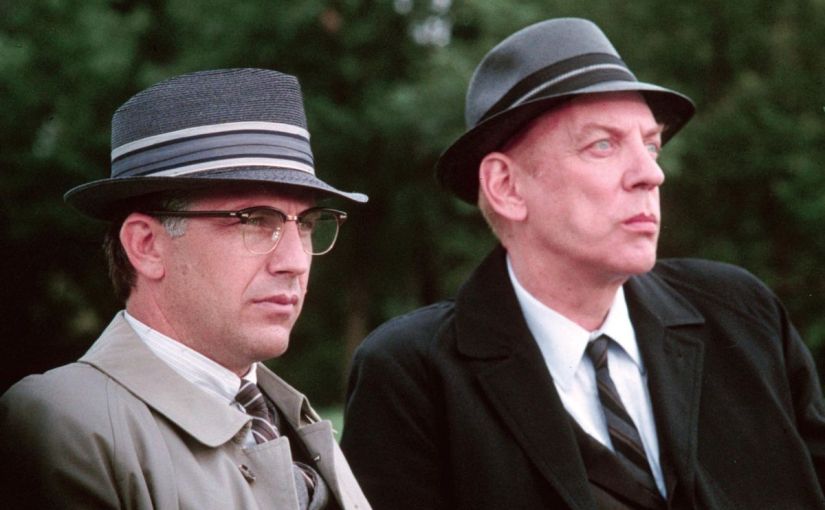
My admiration for the casting continues with the Garrison team that performs with Costner – Michael Rooker, Laurie Metcalf (especially impressive), Wayne Knight, and Jay O. Sanders.  There’s also a clandestine trench coat guy named X portrayed by Donald Sutherland.  Who even knows if this guy ever existed?  He’s more secretive than Deep Throat, but Mr. X has a hell of a lot of information to justify Jim Garrison’s suspicions.  That is an especially marvelous sequence between two men strolling through Washington D.C., eventually concluding a disturbing realization on a park bench.

Sissy Spacek brings out another dimension to the Jim Garrison character.  She’s his wife and the mother of five who suffers the loss of her husband’s attention which is entirely focused on this compounding investigation.  I like Costner’s take on the Garrison character.  Early on he politely asks one of his associates to stop cursing.  He does not like that kind of talk.  Later, it is Garrison who is dropping a number of eff bombs in front of his wife and young children.  This conundrum of a case, a very puzzling detective story, is unraveling the investigator. 

JFK was instrumental for further Congressional consideration following its release.  Files were reopened.  Additional research was executed, and soon many of those secret documents pertaining to the assassination will be revealed in 2029.  Back in 1991, of course that appeared to be a lifetime away.  It’s time we know everything, though.  Arguably, most of who were involved in this incident are dead by now.  Let us know our history.  Still, Garrison was bold enough to point skepticism at not just the adversarial relationship Kennedy may have had with Castro, the Cubans and their Communist allies, but also the people within the CIA and the FBI.  Lyndon Johnson is not even free from scrutiny after he’s sworn in.  Some on Garrison’s team went so far as to factor in culpability from the mafia.  Garrison was not so keen on that theory, actually. 

The construction of Oliver Stone’s film is unparalleled.  I think it’s his best film to date and I can find few others that even compare to how he assembled the picture.  It begins with the voiceover of Martin Sheen laying out many news cycles that were occurring ahead of Kennedy’s murder such as the Bay Of Pigs and the President’s supposed efforts to withdraw from Vietnam.  Sheen’s narrative comes at you very fast with Stone incorporating real life home movies of Kennedy along with his brother Bobby, as well as Castro, and television news footage from Vietnam and anywhere else events were happening.  By the end of the roughly five-minute opening, your head might be spinning. 

Thereafter, though, Stone goes through Garrison’s day on November 22, 1963, watching the outcome following the momentous event and the writer/director works his way into the drama beginning with Asner and Lemmon as two drunk old guys walking through the rain and getting into an argument. 

Three years pass by and so begins Jim Garrison’s motivations to follow multiple trails of breadcrumbs that lead to a lot of different places, all unlike what Earl Warren surmised. 

The scenes work quickly from that point on, and cuts of theoretical reenactments occur.  Who knows if any of these scenes are factual?  Stone and Garrison want you to at least consider their reasonable likelihood.  Moments happen where Joe Pesci and Tommy Lee Jones’ characters appear to be lying about even knowing one another while Stone will depict a sexual role play encounter between them which also includes Kevin Bacon as someone with no more reason to lie. 

Episodes are deeply focused on Lee Harvey Oswald depicted as an infamous and suspected patsy in association with others who may have a reason to want Kennedy dead.  Gary Oldman hides so well in the role.  Oliver Stone even lends focus to how different witnesses describe Oswald.  In some scenes it is Oldman, but then there are other times where a shorter, more overweight man may have been the real Oswald. Later, there’s an Oswald who is taller and more slender. 

A few years ago, I was visiting Dallas, and I was able to spend a some time walking around the crossroads where Kennedy was shot in the convertible while seated next to his wife Jackie.  Watching JFK again lent more clarity to all of the locales such as where Oswald was supposedly shooting from the top floor of the corner book depository.  Kevin Costner and Jay O. Sanders go through the motions of Oswald firing the three shots from his rifle in the short amount of time span.  The script also questions why Kennedy was taken out by Oswald after the turn off the corner of Elm and Houston. There appears to be a better wide-open clear shot long before the turn with the car only going ten miles per hour.  The men question if it was Oswald, then why didn’t he take advantage of the clearer shot.

I know.  I could go on and on.  I have to stop myself.  There’s a ton – A TON – of information in JFK.  It becomes addicting to watch.  You don’t even want to pause the long film for a bathroom break.  I watched the extended Director’s Cut by the way. 

Many common critiques of JFK lean towards how many of these scenes did not even happen.  People are happy to point out there’s no evidence to truly say any of Oliver Stone’s enactments occurred.  I agree, but that’s not the point of this director’s piece.  This is primarily told through the eyes of Jim Garrison.  Kevin Costner is great as the listener, the observer and especially at the conclusion, the describer.  Watch him physically respond to anyone he shares a scene with.  There’s a memorable twitch he offers while at the scene of the assassination that works perfectly with a jarring echo of a gunshot edited into the film.  He’s also great at turning his head down as the thinker while Mr. X lays out an enormous amount of information that comes from several different directions.  Because the film comes from Garrison’s perspective, it does not have to be true.  It only has to be what the investigating prosecutor reasonably believes, and what he absorbs from suspects, witnesses, and his devoted team. 

A final speech of Garrison’s is told at the trial of suspect Clay Bertram, aka Clay Shaw (Tommy Lee Jones), who was the only man tried by Garrison for Kennedy’s murder.  First, it’s important to note that during this fifteen-minute sequence, when Stone cuts back to Garrison in the courtroom, Costner is wearing different suits.  So, while it is assembled as an ongoing rundown, it is not meant to all be in one instance.  Garrison lays claim to an endless amount of possibilities and circumstances that at times have no correlation with each other but could possibly all merge together towards November 22, 1963.  Critics argued this speech of Garrison’s never took place.  That’s correct.  However, this is a movie and for the efficiency of information to come out, a funnel must be opened up to learn what is being pursued and what has been uncovered.  This is the strategy that the script for JFK adopts and it works, leaving you thinking and rightfully doubting what our governing bodies and history books have told us.  Most famous of all of these nonsensical happenings delivered by Garrison is the “Magic Bullet Theory” made extra famous by Jerry Seinfeld with Wayne Knight on the comedian’s sitcom.  It’s silly but it is also a response to the impact that came from JFK.

JFK has a very glossy appearance from the Oscar winning cinematography.  Reflections and natural glares come off of Jim Garrison’s glasses.  The exasperation, along with the shiny persperation of John Candy’s sleazy lawyer character is undeniably noticed as his integrity is being questioned.  Staged reenactments are shown in black and white, clear color or grainy distressed output (such as recreations of the known Zapruder Film).  Nothing is clear about what led to Kennedy’s murder.  So, Oliver Stone’s filmmaking team will ensure that nothing should look consistent.  There are no straight answers; only endless amounts of reasons to ask another question after another.

Oliver Stone does not make JFK as complex as some will have you believe.  It’s quite easy to piece together who represents what in this story.  Many theories are offered at lightning speed, but they hardly ever intersect with each other until a probability is completely laid out on the table and then the film moves on to the next one.

JFK may have a long running time and a large cast with a lot to say and ask, but it’s an exhilarating thrill to behold.  Who knows what is true?  The importance of Oliver Stone’s masterpiece demonstrates that much of what we were told as truth may not consist of the entirety of facts. 

Again, question your governing bodies and ask the hows and whys and whos.  Oliver Stone reminds us that we have that right as the citizens of America. 

What really happened to our President, and who was really responsible?
DEAD AGAIN

By Marc S. Sanders

Kenneth Branagh is inventive director.  Arguably, his most uncelebrated film is the noir inspired mystery, Dead Again, which features himself and his wife at the time, Emma Thompson, in the leading roles. 

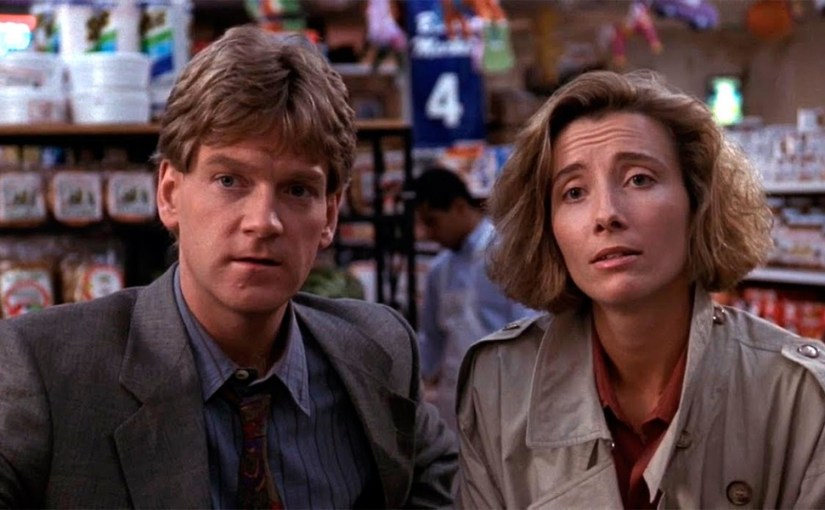
Branagh and Thompson do double duty, playing multiple parts in two different time periods.  In a 1940s post war Los Angeles, they are Roman and Margaret Strauss.  Roman is a composer.  Margaret is a musician in his company.  They quickly fall in love and live in the limelight of glitz and glamour amid the gossip magazines of the time.  Their life together only becomes juicier when Roman is sentenced to death for the murder of Margaret.  The weapon of choice, a pair of scissors.

In present day 1991, Branagh portrays a private detective named Mike Church who ends up being responsible for an amnesiac, Thompson, who can’t even speak when she’s found.  The woman has unexplainable dreams that recall moments of Roman and Margaret’s life together only to end up as terrible nightmares.  A curious hypnotist (Derek Jacobi) enters the story to lend aid to Mr. Church and the woman.  He serves as a guide, bringing her back to the times of the celebrity couple, helping her to find clues that perhaps could lead to her true identity and uncover exactly why she is haunted by these dreams.

Additional characters enter the storyline as well.  There’s Wayne Knight as a humorous sidekick for Church.  In the flashback 1940s, there’s Andy Garcia as a handsome Pulitzer winning journalist who follows the escapades of Roman and Margaret.

Dead Again is not a long movie, and that lends to how good a film it is.  It’s a lean picture that sets up its clues the moment it starts.  Branagh gives you a background tutorial with newspaper headlines that flash up within the opening credits.  The two time periods are separated with the 1940s shown in gorgeous black and white, while the modern scenes are presented in color.  Branagh puts on a German accent for Roman.  Thompson is English for Margaret.  In the present day, they are Americans.  Of course, it is acknowledged that the respective characters look alike and that allows for possibilities of reincarnation, karma and past lives to enter the frame. 

The screenplay from Scott Frank gets you curious.  What connection could these two wildly different couples have with one another?  What don’t we know about the murder of Margaret at the hands of her husband, Roman?  Who really is the woman that Thompson is portraying in modern times?  How is it possible that a private dick like Mike would coincidentally end up with this “Margaret lookalike” amnesiac?

The cast is having a lot of fun with the puzzle, particularly Derek Jacobi.  His old English mannerisms offer a relaxing storyteller’s narrative to the film.  It feels as if his hypnotist carried over from an Alfred Hitchcock film.  I also appreciate how far apart the respective characters that Branagh and Thompson play.  Not only am I watching a thrilling mystery, but I’m looking at skilled, well-trained actors demonstrating a wide range of performance work.  At times, it’s as if I’m watching two different movies.  How exactly are they going to intersect, though?

I originally saw Dead Again in theatres and was taken with it immediately.  I did not see the end coming and when the veil was lifted, my eyes went wide open.  It has a terrific plot twist.  Branagh, known at the time as a celebrated Shakespearean actor/director, introduced a sweeping, mystery yarn that relishes in fun escapism like Hitchcock or Orson Wells would apply to film noir.  It only makes sense, looking back over thirty years later, why the director opted to turn his craft towards rejuvenating the classic Agatha Christie stories (Murder On The Orient Express, Death On The Nile) for film.  We are better for his contributions.

Now, Dead Again is a film that deserves the attention from a new generation of movie lovers.

JURASSIC PARK

By Marc S. Sanders

Michael Crichton’s best-selling novel, Jurassic Park, is my favorite book of all time.  I recall reading it in one Friday night a week before the Steven Spielberg adaptation was released in theaters.  It was the easiest book to breeze through and I never stopped thinking about Crichton’s approach to a what if scenario where dinosaurs are resurrected in the name of scientific discovery and profitability.  Ideas related to chaos theory and DNA experimentation were considered against the mayhem of people running for their lives in an amusement park attraction.  Amid the action, there was opportunity to think and consider.  Spielberg’s film doesn’t offer enough time for ponderance.  It starts out that way, but it doesn’t finish its thought.  That’s always been a hinderance for me.

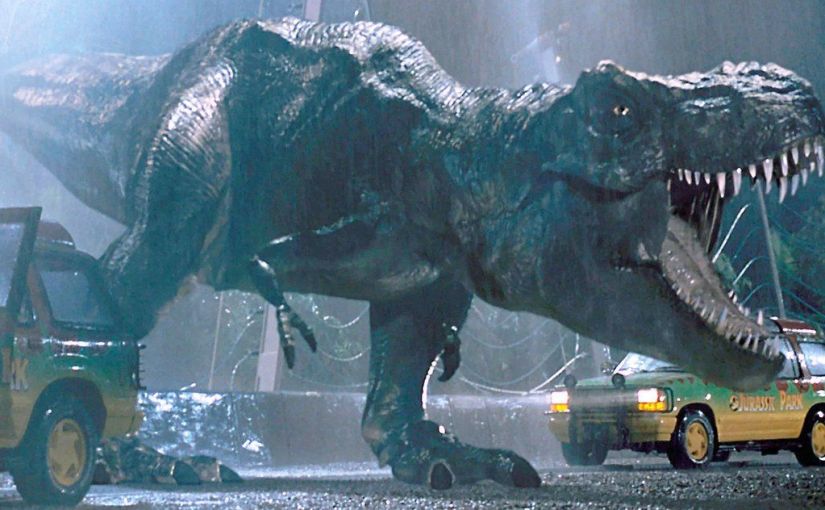
There’s no question regarding the immense thrills the film brings, even thirty years later.  Effects and puppeteer wiz Stan Winston (how I wish he hadn’t passed away so soon) outdid himself following memorable recreations from films like Aliens and Predator.  The centerpiece of the blockbuster is of course the T-Rex.  Spielberg follows his age-old approach of not showing the monster right away, though high publicity and massive merchandising of the early 1990s never kept this cat in the bag anyway.  Oh well!  Yet, when the humungous, twenty-ton dinosaur puppet makes its grand entrance midway through the film, it still holds as a spectacular scene, especially because two fine child actors (Ariana Richards, Joseph Mazzello) with high pitched screams heighten the terror.  Look, you should know by now.  If Steven Spielberg is aiming for the rafters of box office thrills, he’s gonna put the kids in danger first and foremost.

Velociraptors are the other big stars of this creature feature and the behavior of these CGI animals is magnificent as we observe them communicate with one another.  Like the T-Rex, we don’t get an immediate first glance of them either, but their squeals and screeches as they leap in for a monster mash smorgasbord get us to jump in our seats.  When the veil is lifted on these guys, Spielberg and his effects crew go further by granting them with quick agility.  Before all this, we are told by the science experts of how they are strategic pack hunters with cheetah like speed and how they tear away at flesh as they pounce on live prey.  You wince as you imagine.  They are also smart too.  These dogs can open doors! 

Again, all good stuff here.

The best character is the sarcastic mathematician, Ian Malcolm (Jeff Goldblum), who insists resurrecting dinosaurs is a terrible idea for the modern age.  Goldblum is so good with the script written by David Koepp that my favorite scene in the picture is when the main characters sit around the dinner table to discuss what has surprisingly been thrust upon them.  I yearned for more scenes like this.  Ian Malcolm offers up a new iteration of “Matt Hooper” (Richard Dreyfuss in Jaws) that I just didn’t get enough of.  Only the surface is scratched on the argument of intelligence versus stupidity.  In Jaws, we got nearly a full hour of this welcome back and forth.

What lacks is what Jaws provided over a decade earlier.  The debates of how to live (or die) with dangerous animals begins, but doesn’t finish in Jurassic Park.  It merely gets started, and then the argument gets abandoned to allow for unending carnage.  Don’t get me wrong.  I love carnage in my movies.  However, Crichton illustrated an even amount of attention to chaos blended with intelligence (or ignorant lack thereof) when he wrote his book.  I got a textbook education from Michael Crichton.  From Steven Spielberg and David Koepp, I just got a thin dog eared comic book.

Goldblum is third in line in the cast credits behind Sam Neill and Laura Dern as Alan Grant, a paleontologist, and Ellie Satler, a paleobotanist.  They, along with Malcolm, are cordially invited by billionaire entrepreneur John Hammond (Richard Attenborough) to visit his private island that is soon to be converted into Jurassic Park, a zoo/amusement park consisting of live dinosaur attractions.  The dinner sets up the debate of Hammond versus the three scientists.  Is anyone being responsible with the potential to act upon breakthrough discoveries?

Granted, if Hollywood was going to make a dinosaur movie, then it was going to be catered to children age 10 and up.  Kids and families of four or more sell tickets.  The novel doesn’t aim towards that demographic, however.  It is darker and the Hammond character is more sinister and greedier.  He’s not a fleshed-out villain in the film.  He’s lovable.  The film simplifies itself too much as it devolves into a run and chase and chew and chomp adventure of screams and outstanding John Williams music.

I watch the film over and over again because visually it remains magnificent, but I still remind myself that it is not enough.  Steven Spielberg’s film is admired and so well regarded and perhaps it is deserving of its legacy, thirty years, five sequel films and a couple of Universal Studios attractions later.  On the other hand, I wish it allowed its brain to develop a little bit more. 

Steven Spielberg’s interpretation of Jurassic Park could’ve been as smart as a velociraptor.

DIRTY DANCING

By Marc S. Sanders

Dirty Dancing was a major surprise at the box office. For me, it is such an eye opener because of how good it actually is, and how well it still holds up. It’s energetic and fun and a different kind of escape from the endless supply of action films and gross out comedies.

Here’s a film with a no name director, Emile Ardolino (I’m sorry, who????) and produced by…excuse me…Vestron Video???? It did not carry a cast with box office clout either, the tallest guy from The Outsiders and the older, bratty sister from Ferris Bueller’s Day Off. Yet, the film wins out in the end.

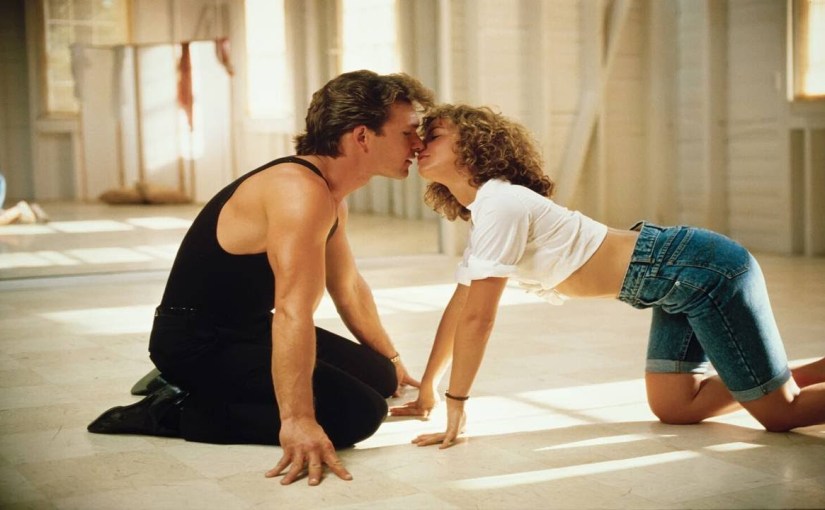
“Baby” Houseman (Jennifer Grey) arrives with her family to a Catskills like vacation resort during the summer of 1963. Usually costumed in whites, Baby is as virginal as her moniker suggests. Eventually, she gets taken with the entertainment staff who spend their off hours dancing in, shall we say, a non-conservative manner. Particularly, she falls for the gorgeous head dance instructor, Johnny Castle (macho name, dressed in macho cool blacks with macho cool shades) played by Patrick Swayze.

Every development of their relationship is telescopic. Yes! We know they’re gonna fall in love despite coming from two different worlds. They’re gonna sleep with each other. Then they’re gonna argue. Then they’re gonna make up and then they’re gonna have the big dance to close out the film with one huge extravaganza. However, it’s the material within that grabs me, and much of that is thanks to the chemistry of Swayze and Grey.

The leads dance beautifully together, and when a music montage comes up, it is adoring to see the frustration of the dance instructor with his giggling student. It’s also charming to see them work it out as well. Reader, I’ve seen this stereotypical “chick flick” many times and I still get caught up in it. The movie comes alive in their puppy love with music and dance. Hey, I got a sensitive side to me. What can I say?

The subplots of the film are lacking though. An abortion storyline really is not necessary to assemble all these characters together. Jewish high income guests meet rebellious, but mostly kind hearted, staff members. There are a couple of distracting jerks too. Something more substantial could have been here. Perhaps, a more meaningful acknowledgment where the two parties favor or do not favor each other, and why. Abortion is a heavy subject matter that does not blend well with the rest of this film, though. The fact that the script never even utters the word “abortion” tells me that the film isn’t even sure of itself with this side story.

As well, when one dancer friend (Cynthia Rhodes) needs emergency medical help, couldn’t Baby’s doctor father (Jerry Orbach) just stop to listen for the explanation? Guess not. He just chooses to stop speaking to his daughter. Thus, making it hard for Baby to hang with Johnny. This could all be resolved with a quick sentence of dialogue. As my colleague Miguel suggests however, then there’d be no movie!!! It’s called the idiot plot, I guess.

A third sub plot involves a pick pocket thief and the reveal comes ridiculously out of nowhere. It’s here to give reason for Johnny’s reputation to be threatened one more time, while Baby defends him. Now this storyline has next to no purpose of existing. Johnny’s reputation in the boss’ eyes was tarnished enough already. This is cutting room floor material.

Dirty Dancing is a film that is merited in its special talents, but not necessarily its whole story. The consistently good soundtrack of oldies mixed with some anachronistic 80s tunes work so well. The setting is completely absorbing with its mountainous camp getaway cabins and intermittent calls for entertainment activities like with its social director (played deliberately corny by comedian Wayne Knight). It feels authentic and escapist. Therefore, I look past those silly plot developments that scotch tape one enthralling moment of dance, sex appeal and music for another.

This most recent time of watching the film was especially fun as I got to witness my twelve-year-old daughter seeing it for the first time. Nothing shows how special a movie, any movie, can be than to see your daughter slap her face when Baby chickens out from doing “the lift” with Johnny during a dance performance. Later, when she finally accomplishes that feat, my daughter sat up with a huge smile on her face. If you ever ask me why movies are so special, I might just have to reiterate this experience when I watched Dirty Dancing with my Julia.