THE TAKING OF PELHAM ONE TWO THREE (1974)

By Marc S. Sanders

I’m a big fan of gritty, urban crime thrillers.  A wealth of them came out in the 1970s.  There was a rawness to their material.  They were equal opportunity offenders, picking on every race and demographic out there. It only lent an honesty to the characters that occupied these spaces.  The two guys that easily come to mind are Dirty Harry and Popeye Doyle from The French Connection.  Still, there were others that wedged their way through the cracks.  The Taking Of Pelham One Two Three from 1974 belongs in this fraternity of films as well. 

Walter Matthau is Lt. Zachary Garber, who has a ho hum job working the law enforcement area of the New York City subway system.  Beyond muggings and vagrants lying around you wouldn’t expect any major crimes to happen underground and thus Zach moves with a slow pace that never gets him upended or panicked.  Yet, on the day that he is giving a tour to some visiting Japanese subway architects, a hijacking of the train to Pelham Bay, number one two three, occurs.  Four armed men, only designated by Mr. Blue, Mr. Green, Mr. Grey and Mr. Brown don fake mustaches, hats and overcoats.  They are demanding a cash ransom from the city in the amount of one million dollars.  Zach and his crew have less than an hour to respond with the money, or Mr. Blue (Robert Shaw) will order the killing of one hostage for every sixty second delay.

Joseph Sargent’s film then steers its way into several conundrums.  Even if the ransom is paid according to the criminals’ exact instructions, how are these guys going to make an escape from underground?  What’s the nebbishy mayor supposed to do?  He’s in bed with the flu and he doesn’t know how to respond to this kind of craziness.  What’s the point of him making a public appearance near the scene of the crime? 

Long before everyone’s favorite hostage flick, Die Hard, came about Sargent’s movie was poking fun at the humorous and inconvenient cracks that leak out of a serious captive crisis.  First you gotta get the mayor to agree to the demands and as his wife (Doris Roberts) sensibly points out, there are seventeen potential voters on that train.  Then, you gotta count the money and drive it from uptown to midtown before the clock runs out.  That’s not so easy.  You think New Yorkers get out of the way when a speeding patrol car is barreling through the city? 

Zach doesn’t have it so easy as well.  Schluby Walter Matthau is great at trying to contain a situation but his co-workers are not so understanding.  Rush hour is less than two hours away and this stand still train is holding up the subway traffic.  Dick O’Neil and Jerry Stiller are genuine hilarity born directly out of the concrete jungle for roles like this. O’Neil has to keep all tracks open and the trains moving.  Initially, Stiller doesn’t take this seriously – a precursor to his Frank Costanza role on Seinfeld.

Robert Shaw was always one of the best villains and antagonists with films like From Russia With Love, The Sting, and Jaws.  He’s just as good here, but like those other characters, Mr. Blue is unique.  He carries a uniform, hospital cornered method, and he keeps it to the letter so well, that he’s relaxed enough to play his crossword puzzle as he waits for the money to arrive.  Martin Balsam is Mr. Green, a nervous underling recruited for operating the train.  Hector Elizondo is a crazed kamikaze kind of guy who might just knock the criminals plan out of whack because he’s a little too trigger happy.

The Taking Of Pelham One Two Three carries a simple plot.  What makes it complicated though are the characters surrounding the story.  There are a few levelheaded guys on both sides, but it’s the others around them and even the daily happenings of New York City that tilts any progress to be made off kilter. 

The city and many of these characters are unpredictable and therefore surprises will trip everything up just when it all seems to fall into place.  This even happens in the very, very, very last scene and caption of the film.  I’d love to share what a simple involuntary action that can break any of our concentrations does for a couple of these guys, but then I’d spoil the fun.  Trust me though, you get the last laugh before the end credits roll.

THE TAKING OF PELHAM ONE TWO THREE (1974)

by Miguel E. Rodriguez

DIRECTOR: Joseph Sargent
CAST: Walter Matthau, Robert Shaw, Martin Balsam, Hector Elizondo
MY RATING: 9/10
ROTTEN TOMATOMETER: 98% Certified Fresh

PLOT: An NYC transit chief must outmaneuver a gang of armed professionals who have hijacked a New York subway train and threatened to kill one hostage per minute unless their demands are met.


How?  How is it possible that it’s taken me this long, until fifty years after its release, to finally watch the original The Taking of Pelham One Two Three?  Until now, my knowledge of the film included only its title, its basic plot, and the fact it was remade with John Travolta and Denzel Washington.  Now that I’ve seen the original, my desire to watch the remake has dwindled from microscopic to zilch.  This is one of the most thrilling heist films I’ve ever seen, and its influences are clearly felt in the best thrillers in the decades since its release, from Die Hard to Speed to Reservoir Dogs.

In the first half of the 1970s, widely regarded as one of New York City’s worst decades (at least by me, anyway), four armed men methodically hijack a subway train, decouple the engine from the rest of the train, and bring it to a stop between stations.  Their leader, known only as Mister Blue (Robert Shaw), radios the transit system authorities with his ultimatum: deliver one million dollars to the train in one hour and leave quietly or he and his companions will kill one hostage for every minute the money is late.

The chaos that ensues is sprinkled with the kind of humor I did not expect from any cop thriller made before Die Hard.  The transit chief, Lt. Garber (Walter Matthau as an unlikely but strangely convincing action hero), must interrupt a tour he is giving to a visiting cadre of Japanese subway officials.  Colorful dialogue is provided to the transit system engineers and administrators as their carefully maintained schedule is destroyed by the hijackers.  One of Garber’s associates shows where his priorities lie when, in the middle of a hostage crisis, he complains, “Jesus…you realize the goddamn rush hour starts in an hour?!”  This and many other moments provide welcome comic relief, but they are also firmly grounded in the reality of career officials under a great deal of stress.  There is never a moment that doesn’t feel exactly right.

When it becomes clear the hijackers mean business and will have no compunction about following through on their threats, important logistical questions arise.  Where will they get the million dollars from?  The bedridden city mayor (who bears an uncanny resemblance to Ed Koch, four years before the real Koch was elected) doesn’t know.  The hijackers want it in specific numbers of bundles of fifties and hundreds.  How long will it take to assemble the money correctly, assuming they even GET the money?  Lt. Garber raises an interesting question: where will the hijackers go once they get their money?  They can’t simply get off at the next station, and they can’t leave the controls of the train while it’s in motion, thanks to the “dead man’s switch” that prevents such a thing.  What’s their end game?  Another transit official, played by Jerry Stiller, has the answer: “They’re gonna fly the train to Cuba.”

These and many other questions (including why the train is called Pelham One Two Three) are answered during the film’s running time, although one of them is answered without getting too specific because either it really is impossible to do so, or the filmmakers had no desire to lay out a step-by-step procedural for budding criminals.

One of the most important factors in the film’s success is its slam-bang pacing.  I’m not saying it’s cut together like Run Lola Run or an MTV video, not at all.  But the flow of the film is meticulously managed to keep the suspense going even when not much is happening on the train for their one-hour waiting period.  This is accomplished by having a local beat cop happen upon the train and provide close-cover reconnaissance to the transit authorities.  There’s also suspense among the passengers, obviously, as they plead with their captors.  (They provide more comic relief when one of them asks how much their captors are asking for their release.  “One million dollars,” one of them answers.  The hostage takes a perfectly timed beat, then says, “That’s not so terrific.”  Welcome to New York, ladies and gentlemen.)

Everything comes together so efficiently, so elegantly, that it’s a bit depressing that the film’s director, Joseph Sargent, would return to his roots and make a string of TV movies with only one other high-profile film to his name 1987’s Jaws: The Revenge.  That these two movies were made by the same director is mind-boggling.

I do have one quibble, though, and I will do my best to spoil as little as possible.  It involves a showdown where one man has a gun and the other doesn’t, and the infamous “third rail” in New York’s subway system.  If someone can successfully explain to me why one of those two men makes the choice he does, I will be happy to mail them a shiny new penny.  As it stands, that man’s decision made zero sense to me.  It almost felt like the screenwriter had written himself into a corner.  It was the one questionable moment in the entire film for me, but it did not ruin the movie, for what it’s worth.  It’s still an amazing ride.

The Taking of Pelham One Two Three deserves to be mentioned on any list of great ‘70s thrillers like The French Connection and Dog Day Afternoon, especially the latter with its tricky mix of humor and suspense.  It grips you with its realism and credibility right from the opening scenes and barrels along with barely a minute to breath right up to the literal final image.  This is superior filmmaking, and any fan of film, at any level, needs to add this to their must-watch list.

JFK – DIRECTOR’S CUT

By Marc S. Sanders

Oliver Stone’s JFK is told through perspective, not necessarily history.  It’s not a biography and I do not believe Stone would ever claim it to be so.  It’s a thinking person’s picture that gives viewers entitlement to question what occurred, how it occurred and why it occurred.  It might guide you not to trust what anyone says, sees or hears, but let’s face it.  Probably the day Kennedy was shot, November 22, 1963, could we ever completely trust anyone ever again? 

(Forgive my cynicism.  I must backtrack a little.  I still trust my wife and daughter.)

Oliver Stone works through the eyes of New Orleans Prosecutor Jim Garrison (Kevin Costner, in what may have been his most challenging role to date at the time).  Garrison sees a little too easily that there are circumstances out of place, or maybe too neatly in place to satisfy the ultimate resolution that a known American defector to the Soviet Union, like Lee Harvey Oswald (Gary Oldman), acted alone in the assassination of the President.  Stone wrote the script for JFK with Jim Marrs and used Garrison’s input from his own novel. Nearly every scene builds into another possibility of how that fateful day came to be.  Stone even questions if a famous photo of Oswald on the cover of Life Magazine is real.   Too many cover ups with a building list of body count witnesses and too many coincidences keep Garrison up at night.  So, he assembles a crack team of investigators and fellow attorneys to reopen the case and question the official Earl Warren Commission.

Firstly, JFK is magnificent entertainment with a hair raising and unusual original score from famed film composer John Williams.  His notes on percussion with dings and harpsichord strings cue in at just the right moments when Stone introduces another one of many scenes that point out what seems cagy and suspect. The music of JFK works as a narrator.  This narrative keeps you alert.  Maybe you should look in each corner of the screen at times for some subtle clues.

It was also wise of Stone to go with a well-known cast of actors.  The Oscar winning editing from Joe Hutshing and Pietro Scalia moves at a breakneck pace.  Yet, because I recognize fine performers like Ed Asner, Jack Lemmon, Kevin Bacon, Tommy Lee Jones, Brian Doyle-Murray (Bill’s brother), John Candy and Joe Pesci it is easy to piece together who is playing who and what significance they lend to the many theories Garrison and Stone question next.  

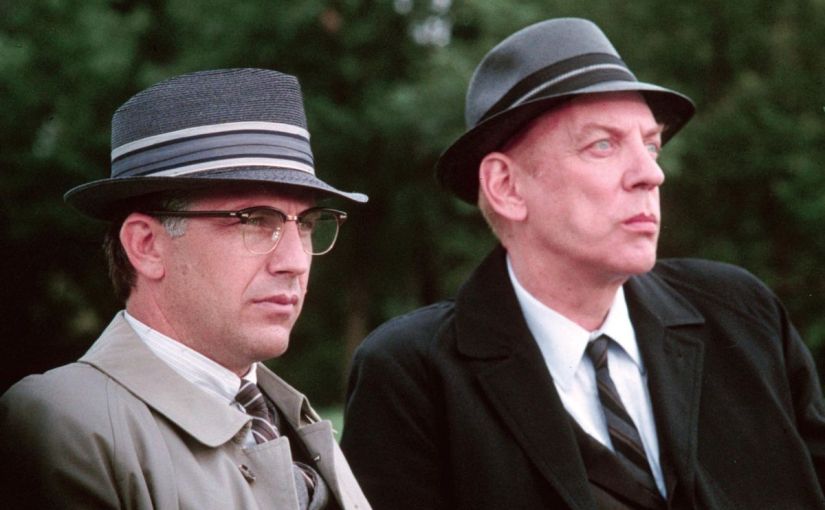
My admiration for the casting continues with the Garrison team that performs with Costner – Michael Rooker, Laurie Metcalf (especially impressive), Wayne Knight, and Jay O. Sanders.  There’s also a clandestine trench coat guy named X portrayed by Donald Sutherland.  Who even knows if this guy ever existed?  He’s more secretive than Deep Throat, but Mr. X has a hell of a lot of information to justify Jim Garrison’s suspicions.  That is an especially marvelous sequence between two men strolling through Washington D.C., eventually concluding a disturbing realization on a park bench.

Sissy Spacek brings out another dimension to the Jim Garrison character.  She’s his wife and the mother of five who suffers the loss of her husband’s attention which is entirely focused on this compounding investigation.  I like Costner’s take on the Garrison character.  Early on he politely asks one of his associates to stop cursing.  He does not like that kind of talk.  Later, it is Garrison who is dropping a number of eff bombs in front of his wife and young children.  This conundrum of a case, a very puzzling detective story, is unraveling the investigator. 

JFK was instrumental for further Congressional consideration following its release.  Files were reopened.  Additional research was executed, and soon many of those secret documents pertaining to the assassination will be revealed in 2029.  Back in 1991, of course that appeared to be a lifetime away.  It’s time we know everything, though.  Arguably, most of who were involved in this incident are dead by now.  Let us know our history.  Still, Garrison was bold enough to point skepticism at not just the adversarial relationship Kennedy may have had with Castro, the Cubans and their Communist allies, but also the people within the CIA and the FBI.  Lyndon Johnson is not even free from scrutiny after he’s sworn in.  Some on Garrison’s team went so far as to factor in culpability from the mafia.  Garrison was not so keen on that theory, actually. 

The construction of Oliver Stone’s film is unparalleled.  I think it’s his best film to date and I can find few others that even compare to how he assembled the picture.  It begins with the voiceover of Martin Sheen laying out many news cycles that were occurring ahead of Kennedy’s murder such as the Bay Of Pigs and the President’s supposed efforts to withdraw from Vietnam.  Sheen’s narrative comes at you very fast with Stone incorporating real life home movies of Kennedy along with his brother Bobby, as well as Castro, and television news footage from Vietnam and anywhere else events were happening.  By the end of the roughly five-minute opening, your head might be spinning. 

Thereafter, though, Stone goes through Garrison’s day on November 22, 1963, watching the outcome following the momentous event and the writer/director works his way into the drama beginning with Asner and Lemmon as two drunk old guys walking through the rain and getting into an argument. 

Three years pass by and so begins Jim Garrison’s motivations to follow multiple trails of breadcrumbs that lead to a lot of different places, all unlike what Earl Warren surmised. 

The scenes work quickly from that point on, and cuts of theoretical reenactments occur.  Who knows if any of these scenes are factual?  Stone and Garrison want you to at least consider their reasonable likelihood.  Moments happen where Joe Pesci and Tommy Lee Jones’ characters appear to be lying about even knowing one another while Stone will depict a sexual role play encounter between them which also includes Kevin Bacon as someone with no more reason to lie. 

Episodes are deeply focused on Lee Harvey Oswald depicted as an infamous and suspected patsy in association with others who may have a reason to want Kennedy dead.  Gary Oldman hides so well in the role.  Oliver Stone even lends focus to how different witnesses describe Oswald.  In some scenes it is Oldman, but then there are other times where a shorter, more overweight man may have been the real Oswald. Later, there’s an Oswald who is taller and more slender. 

A few years ago, I was visiting Dallas, and I was able to spend a some time walking around the crossroads where Kennedy was shot in the convertible while seated next to his wife Jackie.  Watching JFK again lent more clarity to all of the locales such as where Oswald was supposedly shooting from the top floor of the corner book depository.  Kevin Costner and Jay O. Sanders go through the motions of Oswald firing the three shots from his rifle in the short amount of time span.  The script also questions why Kennedy was taken out by Oswald after the turn off the corner of Elm and Houston. There appears to be a better wide-open clear shot long before the turn with the car only going ten miles per hour.  The men question if it was Oswald, then why didn’t he take advantage of the clearer shot.

I know.  I could go on and on.  I have to stop myself.  There’s a ton – A TON – of information in JFK.  It becomes addicting to watch.  You don’t even want to pause the long film for a bathroom break.  I watched the extended Director’s Cut by the way. 

Many common critiques of JFK lean towards how many of these scenes did not even happen.  People are happy to point out there’s no evidence to truly say any of Oliver Stone’s enactments occurred.  I agree, but that’s not the point of this director’s piece.  This is primarily told through the eyes of Jim Garrison.  Kevin Costner is great as the listener, the observer and especially at the conclusion, the describer.  Watch him physically respond to anyone he shares a scene with.  There’s a memorable twitch he offers while at the scene of the assassination that works perfectly with a jarring echo of a gunshot edited into the film.  He’s also great at turning his head down as the thinker while Mr. X lays out an enormous amount of information that comes from several different directions.  Because the film comes from Garrison’s perspective, it does not have to be true.  It only has to be what the investigating prosecutor reasonably believes, and what he absorbs from suspects, witnesses, and his devoted team. 

A final speech of Garrison’s is told at the trial of suspect Clay Bertram, aka Clay Shaw (Tommy Lee Jones), who was the only man tried by Garrison for Kennedy’s murder.  First, it’s important to note that during this fifteen-minute sequence, when Stone cuts back to Garrison in the courtroom, Costner is wearing different suits.  So, while it is assembled as an ongoing rundown, it is not meant to all be in one instance.  Garrison lays claim to an endless amount of possibilities and circumstances that at times have no correlation with each other but could possibly all merge together towards November 22, 1963.  Critics argued this speech of Garrison’s never took place.  That’s correct.  However, this is a movie and for the efficiency of information to come out, a funnel must be opened up to learn what is being pursued and what has been uncovered.  This is the strategy that the script for JFK adopts and it works, leaving you thinking and rightfully doubting what our governing bodies and history books have told us.  Most famous of all of these nonsensical happenings delivered by Garrison is the “Magic Bullet Theory” made extra famous by Jerry Seinfeld with Wayne Knight on the comedian’s sitcom.  It’s silly but it is also a response to the impact that came from JFK.

JFK has a very glossy appearance from the Oscar winning cinematography.  Reflections and natural glares come off of Jim Garrison’s glasses.  The exasperation, along with the shiny persperation of John Candy’s sleazy lawyer character is undeniably noticed as his integrity is being questioned.  Staged reenactments are shown in black and white, clear color or grainy distressed output (such as recreations of the known Zapruder Film).  Nothing is clear about what led to Kennedy’s murder.  So, Oliver Stone’s filmmaking team will ensure that nothing should look consistent.  There are no straight answers; only endless amounts of reasons to ask another question after another.

Oliver Stone does not make JFK as complex as some will have you believe.  It’s quite easy to piece together who represents what in this story.  Many theories are offered at lightning speed, but they hardly ever intersect with each other until a probability is completely laid out on the table and then the film moves on to the next one.

JFK may have a long running time and a large cast with a lot to say and ask, but it’s an exhilarating thrill to behold.  Who knows what is true?  The importance of Oliver Stone’s masterpiece demonstrates that much of what we were told as truth may not consist of the entirety of facts. 

Again, question your governing bodies and ask the hows and whys and whos.  Oliver Stone reminds us that we have that right as the citizens of America. 

What really happened to our President, and who was really responsible?

THE FORTUNE COOKIE (1966)

by Miguel E. Rodriguez

Director: Billy Wilder
Cast: Jack Lemmon, Walter Matthau, Ron Rich, Judi West
My Rating: 5/10
Rotten Tomatometer: 96%

PLOT: A crooked lawyer persuades his brother-in-law to feign a serious injury.


Billy Wilder’s The Fortune Cookie reminds me of what it might be like to watch Jerry Lee Lewis play “Chopsticks.”  You sense it’s being done as well as it possibly can be done, but you wonder why it’s being done at all.  C’mon, man, let’s hear “Great Balls of Fire!”

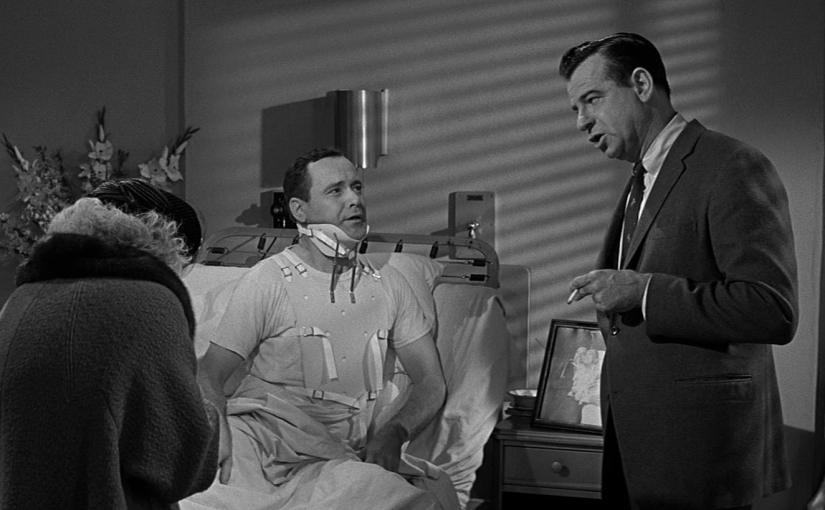
Notable for being the first of twelve films Jack Lemmon and Walter Matthau starred in together, The Fortune Cookie tells the story of a hapless TV cameraman, Harry Hinkle (Lemmon), who is covering a Cleveland Browns football game from the sidelines.  A burly punt returner accidentally runs him over during a play and knocks Harry out cold.  While he recuperates in a hospital bed, his thoroughly unscrupulous brother-in-lawyer, Willie (Matthau), concocts a very modern-sounding plan: Harry will fake serious injuries in the hospital so Willie can work his magic with the insurance company and get a big payout.  Harry demurs at first but is enticed to go along when he finds out his ex-wife, for whom he still carries a torch, is very interested in assisting with his recuperation from his “serious” injuries.

Meanwhile, the poor football player who knocked him down, Luther (Ron Rich), is wracked with guilt over the damage he thinks he’s caused.  He pitches in to buy Harry a motorized wheelchair and offers to assist with his rehab back at home.  This gnaws at Harry’s conscience.  Things don’t get any better when he’s brought a lunch of Chinese food at the hospital, and the fortune inside his fortune cookie bears a grim warning…

There’s nothing wrong with The Fortune Cookie that a rewrite or some editing couldn’t have fixed.  That might be considered sacrilege, considering the script was penned by Wilder himself and his legendary writing partner, I.A.L. Diamond, but in watching the film, I was struck by how many scenes involved a semi-static camera just watching people talk, and talk, and talk.  I don’t mind a lot of dialogue in a scene when the characters have something to say, or when the story is being driven forward.  But here, we usually get a five-minute scene when a two-minute scene could have done the job just fine.

Take one scene in particular that almost had me literally nodding off, when Harry’s ex-wife, Sandy (Judi West), has returned home to help with Harry’s rehab.  Harry is still feeling guilty about the sham he’s perpetrating, but he’s so besotted with Sandy that he’s willing to keep up the pretense just to keep her around.  They catch up a little, blah blah blah, he says he never threw away his ring, blah blah blah, she dumps out her purse looking for her ring, blah blah blah, he puts on a little music, he’s happy, she’s happy, and <snoorrrrrrre.>

I could list any number of films, including some of Wilder’s other films, where other characters talked for even longer than Harry and Sandy, but they were so much more interesting!  What happened here?  What went wrong?  Even in the scenes where Willie, the huckster, is rattling off his grand plans and needling the insurance company attorneys, Matthau just comes off as a two-bit hack that no sane person would pay any attention to.

I’m not saying he must be likable, that dreaded word.  There are movies that are very, very good and that contain nothing BUT unlikable characters. (Anyone wanna watch The Godfather?) But here, something is off with the tone.  When I wasn’t bored, I was inflamed with distaste for what Harry was being forced to do, both by Willie and by his own hormones.

The movie does have one saving grace.  The comeuppance, when it, er, comes up, is brought about with the kind of shock comedy scene that Mel Brooks might have loved.  I don’t want to spoil it, but it features the kind of language that would have been right at home in Blazing Saddles.  When I got over the shock of what I had just heard, I sat back in admiration and smiled, and thought to myself, a little ruefully, “Now what would this movie have been like if it had been this nervy all the way through, instead of just here at the end?”

But The Fortune Cookie even mucks up the ending with an “epilogue” scene that’s so gratuitously manipulative, I wouldn’t be surprised if it had been tacked on by the studio who demanded a happy ending, or at least a happier ending.  If the movie had earned it, I’d have been on board, but everything that came before was so humdrum that it felt super-cheesy.

Billy Wilder’s résumé reads like the Pixar catalog: one hit after the other with only a couple of rare misses.  Double Indemnity.  The Lost Weekend.  Sunset Boulevard.  Ace in the Hole.  Stalag 17.  Sabrina.  Witness for the Prosecution.  Some Like It Hot.  The Apartment.  Even One, Two, Three, which may not exactly be his finest moment, but at least it had James Cagney to liven things up.  I ask again: what happened here?  Where is the dynamite chemistry between Lemmon and Matthau that would become legendary in later films?  Where is the zaniness of Some Like It Hot or the earned pathos of The Apartment or the edginess of Ace in the Hole and Stalag 17?

According to the trivia section on IMDb, the opening football game sequences were filmed during an actual Vikings-Browns football game, which the Browns lost, at home, 27-17.  After watching this movie, I felt like those Cleveland fans must have felt: always glad to see my boys play, but man, it would have been WAY cooler if they had won.