
THE SECRET AGENT (PORTUGUESE, 2025)

By Marc S. Sanders

I’m not going to pretend I understand all of the dynamics of the Portuguese film The Secret Agent.  Most of the events occur in Brazil, dating back to 1977 – apparently a time of “mischief,” as the opening text describes.  Mischief is not the term I would use, but perhaps it is how a totalitarian regime dismisses their fearful and harsh dominance over its people.  Writer/director Kleber Mendonça Filho drives home the message that it is unwise to rebel against the government.  Still, it may be a necessary evil to welcome an independent future, unchained from a fascist government.

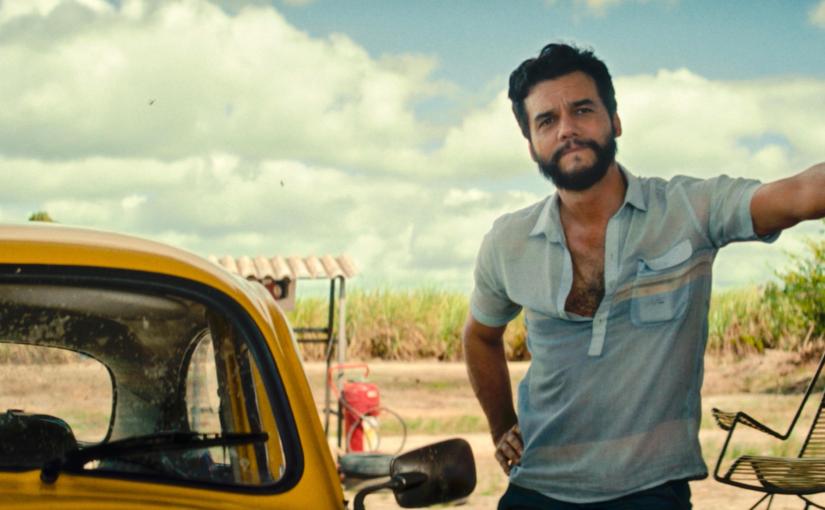
Celebrated Brazilian star and Oscar nominee Wagner Moura is Armando Alves.  The story begins as he pulls into a gas station only to see a corpse covered by cardboard lying a few yards away in the dirt.  Rabid dogs are wanting to sniff and feed off the remains.  Seeing a dead body may alarm any of one of us, but Armando seems personally concerned at that random sight.  Filho’s story will eventually make us understand why his protagonist returns to his hometown of Recife with an enormous amount of dread.

Elsewhere, back where he worked as a technology expert, there’s a gruesome and unforgettable discovery.  A severed human leg is wedged within the maw of a dead shark resting upon an operating table.  The local constable, Euclides (Robério Diógenes) and his sons have been summoned to investigate.  It’s gruesome but the Sheriff and his cohorts find amusement in this gore.

The Secret Agent is hardly anything of what its title implies, but it’s biting with suspense.  Kleber Mendonça Filho constructs scenes that honor American classics like Goodfellas, The Bourne Ultimatum, another actual film called Secret Agent, and especially The Godfather and Jaws.  The latter operating as a driving element that bonds Armando to his young son Fernando (Enzo Nunes).  The story operates like a chase film, though there’s not much running to be had.  It’s all about how this man can remain hidden with only his deceased wife’s parents knowing specifically why he’s in town.  

By the way, rhetorically speaking, why is his wife deceased?  

Armando is hiding along with others considered to be rebellious against the government.  Go against the doctrine and risk being apprehended or executed.  The best that this man can do is hide in plain sight as someone else under a different identity.  He’s now known as Marcelo.

As I noted earlier, I have no knowledge of Brazilian history.  So initially it was challenging to understand the circumstances of the time and setting.  Portraits of Brazil’s President are hung everywhere.  Kleber Mendonça Filho makes sure to get push in shots repeatedly of this imposing, uniformed figurehead.  So, wherever you go, you will be found.  It’s interesting to see the big bad of this piece limited to a photograph that repeatedly appears.  Otherwise, the antagonists consist of a pair of smart and ruthless father/son assassins, the wealthy industrialist with a personal vendetta who hires these men to hunt down Armando, and a local corrupt police captain, Euclides. 

The Secret Agent requires an aggressive exercise in reading the English subtitles of this fast-talking Portuguese film.  There are also moments that weigh down the pace of the film.  For example, when Armando arrives at his hideaway, the seventy-seven year old woman who keeps the domicile has to introduce the other refugees he will be living with, while walking us through the vast labyrinth of this apartment building.  It’s a drawn out scene that mostly feels pointless as many of these characters have no major significance to the story.  

Kleber Mendonça Filho’s technique often reminded me of Quentin Tarantino.  It’s clear he is a lover of movies by drawing inspiration from favorite sequences in other celebrated films.  There’s even an incredibly odd sort of nightmare involving a terrorizing—well…I’m not going to spoil that.  See for yourself what comes out of nowhere.  

Still, many scenes occur in the back room of a local cinema adjacent to the projection booth where Armando’s father-in-law works.  What’s playing? The Omen.  A resistance leader, named Elza (Maria Fernanda Cândido) archives recordings of Armando’s testimonies but admits she and her partner nearly shit themselves watching the horror piece.  Imagine the power of film.  Amid all of this real life, bloody turmoil, and still The Omen and Jaws can scare the living crap out of you.

The Secret Agent surprised me with its tension.  I believe I am typically challenged to connect with films and characters that speak a language that I’m unfamiliar with while occupying a locale I have little knowledge of.  It’s often frustrating.  Yet, I feel wiser for having watched Kleber Mendonça Filho’s film.  An interesting dimension presents itself midway through as suddenly we see laptops and cell phones enter the piece.  Like the film taught me, archived recordings of Armando and other refugees are played on cassette to lend a first person point of view to what was happening fifty years earlier.  The need to know more and uncover what ultimately happened to Armando is absorbed by a young student named Flavia (Laura Lufési) who is motivated to explore beyond the recordings and go out into the modern world of Recife.

This story recollects a frightening time in Brazil’s late twentieth century history with dangerous threats coming from all sides.  It’s fascinating to see this man, Armando, try to uphold a sense of normalcy for the sake of his young son.  From Fernando’s perspective, his father and grandparents try to shelter him from seeing the scary movie phenomenon, Jaws.  At his age, it’s better he only knows how terrifying Jaws is compared to what’s occurring on the streets of his hometown and within his country.  

The Secret Agent is an excellent film.  One of the best of 2025’s Oscar nominated pictures.
CIVIL WAR

By Marc S. Sanders

On the drive home, my wife and I left saying that we could not recall this country existing on a such a divisive plane within our lifetimes as it is currently.  Maybe we were not paying enough attention as we were growing up.  With that in mind however, it’s not unreasonable to see a possible future coming to life from Alex Garland’s Civil War.  What’s clear is the vitriol displayed in Garland’s film is not surprising.

Civil War is an observational piece as it is told through eyes of photojournalists who function with no stake in the conflict.  Lee (Kirsten Dunst) has become a legendary war photographer.  Along with Joel (Wagner Moura), who’s a reporter, they intend to journey through the Northeastern battlegrounds from New York City to Washington D.C.  As they believe, the seceded states of California and Texas are close to overthrowing the government, they are determined to interview and photograph the President (Nick Offerman) before he’s taken prisoner or more likely, assassinated.  An old-time New York Times journalist named Sammy (Stephen McKinley Henderson) and Jessie (Cailee Spaney), a young photographer who idolizes Lee, tag along.  To do this trip is a crazy undertaking, but Lee and Joel know what importance their purpose serves and the fact that they have press passes should uphold their survival amidst violence and chaos. 

My wife asked which side does writer/director Alex Garland lean towards politically and I said I do not know as he’s primarily known for science fiction movies (Ex Machina, Annihilation).  Garland likely wants his political leanings to remain unknown as it upholds what Civil War deliberately steers its focus away from.  We never learn what policies each side of this war stands for or what instigated it.  In fact, it is quite intentional of Garland to make what are arguably the bluest and reddest states in the United States the united seceders who lead one side of this bloody chess board. 

This fictionalized war is well established when the picture opens.  The President attempts to deliver a speech that is clearly uncertain despite the staple resilient vocabulary he includes.  Nevertheless, buildings on fire randomly appear, looters are bloodied pulps who are strung up by random factions, downed helicopters are the carnage occupying a parking lot in front of a JC Penney.  Nothing that anyone says, much less the President of the United States are going to sway this country into a state of comfort.  That time has passed.

The production value of Civil War is astonishing.  Sometimes it looks just like photographic accounts of what we see on the evening news coverage from the Middle East.  Garland also never forgets that his main characters are photographers as he captures in freeze frame people being randomly shot or beaten or simply screaming at one another.  The film abruptly turns off the sound and a black and white photograph interrupts the chaos for you to catch a freeze frame glimpse.  The editing lends to the character designs of the story’s four main players.  I did question, however, why video footage was not also taken beyond just photographs.  Cell phones are not used or mentioned in this picture.  The inconvenience of Wi Fi on a laptop is however. 

The sound design of the film is spectacular and reminiscent of how powerful it served in the Oscar winning film The Zone Of Interest.  As the characters set up camp for the night, rapid pop pop pops are heard in the distance.  On multiple occasions, Garland gets you right in the middle of the various firefights that occur in and around office buildings or what were once shopping districts.  The machine gun fire and rubble blasts are all around you.  The cinematography is also quite eye opening.  I like to think of areas like Virginia and the Carolinas as beautiful American spots during the summertime, and that is when these events unfold. Yet, to see how ugly it is amidst endless debris and bloodshed is an awful, still convincing effect.

My Cinemaniac pal Thomas made a good point about Garland’s approach.  Out of nowhere a needle drop of songs will intrude on the picture and often I found them to be overly distracting and definitely unnecessary.  One such number is a hip hop tune with samples from an 80s tune (I can’t remember which one now) that plays over a gunfire scene.  Regrettably, it takes me a little out of the picture.  Thomas is entirely correct in this area. This technique is not effective as when Oliver Stone or Francis Ford Coppola included The Doors in their set pieces. 

Kirsten Dunst is quite good in her role.  Lee knows where to point her camera, and Dunst lives up to the legendary status that her character is supposed to have.  You can feel the exhaustion that teeters on her mental stability, especially as the story reaches its third act.  Lee has been doing this for far too long and the horrors are a part of her now.  Her trauma can never be erased or covered.  Cailey Spaeny is the standout performer though as Jessie, the young girl who is eager to reach the levels of her idol.  Lee wishes Jessie would just not tag along.  Alex Garland writes good characters, but they are not what stayed with me following the conclusion of the film.  What upholds Civil War is the depiction of this all too convincing reality. 

I write this article the morning after Iran delivered missiles and drones in the direction of Israel and with every article I’ve read, I ask myself again and again what is the purpose.  These efforts are not done for strategic overthrow.  Rather, actions are executed with hate and revenge and the only ones who are paying for it are those that are not arguing; those that are just trying to raise families and live in peace.  Alex Garland might know what finally began his fictionalized American civil war, but none of that matters any longer.  It’s what the pawns do to one another in place to place to place.

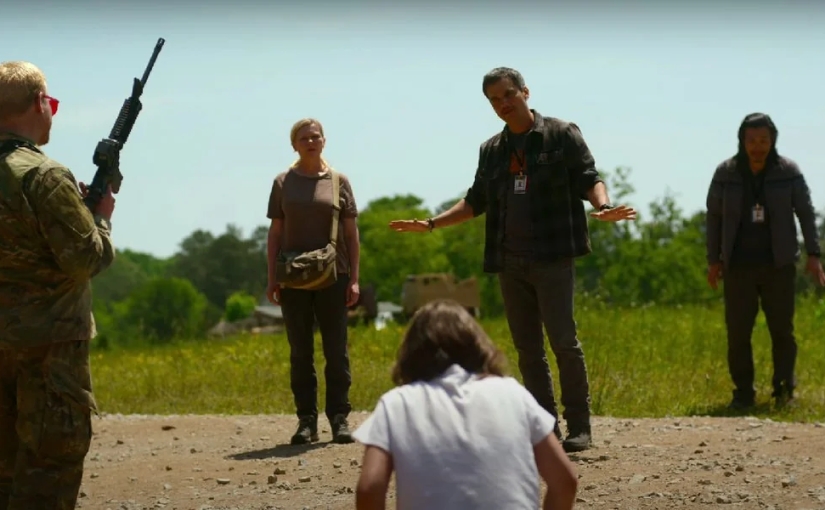
The fighters and individuals you meet in his film all move with their own ulterior motive.  A chilling scene includes Jesse Plemons (Dunst’s real-life husband) dressed in camouflage fatigues who does not even have a statement or a cause to deliver.  His minimal dialogue is nowhere near as expressive as the vast graveyard of Americans he’s sprinkling with lye and burying. When the press team comes upon him, nothing they say matters or motivates him to lower his machine gun.

Fighting, fighting, fighting.  That’s all you see in Civil War.  You don’t even know the position that the President holds, or even what his name is.  You never learn what party he represents either.  I salute Alex Garland for not leaning one way or another.  It is the divide that is tearing our country, our world, apart and not what we stand for. 

Sadly, some commentators on social media have already devised in their own minds that Civil War is a “woke film” (whatever the fuck that means) simply because of the pink (HOT PINK!!!!!) sunglasses that Plemons’ sadistic character wears.  Reader do not listen to the voices in your head.  There is no political agenda to this film.  Rather, Civil War shows us what occurs when political agendas have been entirely deafened by gunfire.