GHOST

By Marc S. Sanders

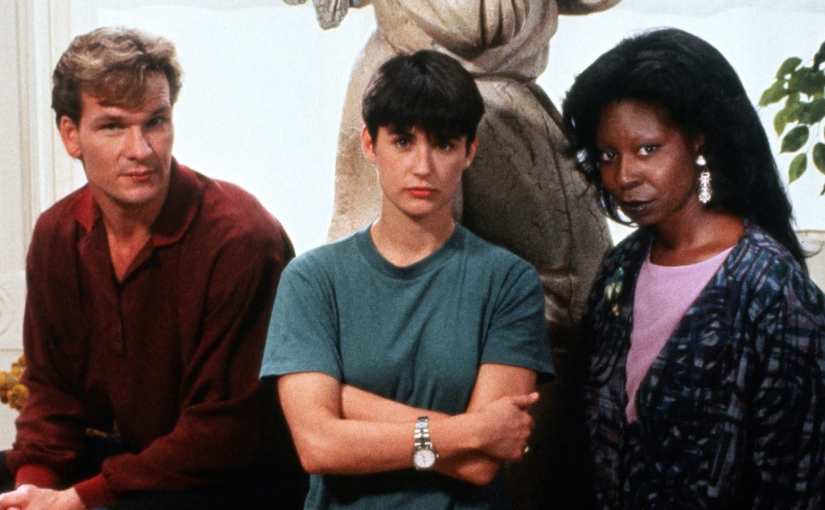
For a perfect blend of the supernatural, suspense, mystery, drama, romance and comedy, the first film that will always come to mind is the surprise hit film Ghost from 1990.  One of the zany Zucker brothers, Jerry to be more precise, who introduced the world to slapstick spoof (Airplane!, The Naked Gun) directed this film turning Demi Moore into a ten-million-dollar actress, placing Patrick Swayze ahead of his Dirty Dancing looks and earning Whoopi Goldberg a very well-deserved Academy Award.  Ghost was a film for all kinds of movie goers.

Sam Wheat (Swayze) is an up-and-coming New York City business executive who loves his new live-in girlfriend, Molly (Moore) even if he can only say “Ditto!” when she tells him she loves him.  Shortly after the picture begins Sam is gunned down following an evening at the theatre.  Unbeknownst to Molly and anyone else living on earth, Sam’s spirit lives on though, and he realizes that he was not the victim of some random mugging/murder.  Now, Sam must find out who arranged to have him killed and why, while also protecting Molly from becoming a victim.

Along the way, Sam crosses paths with a phony con artist, working as a medium, named Oda Mae Brown (Goldberg) who turns out to be the real thing when she can actually hear Sam’s voice and communicate with him.  Sam must recruit Oda Mae to be a go between for him with Molly and everyone else necessary to follow up on in order to resolve the mystery of his sudden death.

Ghost succeeded in every category of filmmaking.  Rewatching the film decades later, I believe Demi Moore should have gotten an Oscar nomination.  Her close ups on camera with beautiful, muted colors from Adam Greenberg’s cinematography are masterful.  Greenberg should have been nominated too.  He’s got perfect tints of pearl whites both on the cobble stone streets of New York with the outer architecture of the apartment buildings, as well as within the studio apartment where the couple lives.  He strives for an ethereal look with his lens. Gold often occupies Molly’s close ups with dim lighting.  Blues and blacks and steel glinting shines follow Sam’s trajectory. 

Look at the lonely scenes that Moore occupies in the couple’s apartment.  There’s a haunting image of isolation with no dialogue capturing the young actress at the top of a staircase when she eventually rolls a glass jar off the top and it shatters below.  It’s one of the moments that defines a sorrowful character, and not many cry on screen better than Demi Moore.  Later, Sam is engaging in a pursuit through the subway system and races down a steep blue escalator in the dead of night.  Zucker places Greenberg’s camera at the bottom of the escalator to show the depth of hell that Sam may be risking continuing his chase.  The images and transitions of this whole movie from scene to scene are stunning.

I mistakenly recall Whoopi Goldberg as just a comedienne doing her stand up schtick in this film.  Not so.  Goldberg looks radiant on film and while she starts out comically as the script calls for, she eventually resorts to sensitive fear of what her paranormal partner demonstrates as real within this fantasy.  There are so many dimensions to this character.  She’s silly.  She’s exact in her nature for what’s at stake and the dialogue handed to her from Bruce Joel Rubin’s Oscar winning script compliments the actress so well. Goldberg never looks like she’s working for the awards accolades. Yet, she earned every bit of recognition that followed her.

Patrick Swayze makes more out of the straight man role than what could have been left as simple vanilla.  His spirit character uncovers more and more about his afterlife and what happened to him as the film moves along. With each discovery, you’re convinced of Sam’s surprises and what he becomes capable of as a ghost.  Long before superhero films became the novelty, Sam Wheat operates like one who has to learn of his origin and then acquire his new talents and powers to fend off the bad guys.

Jerry Zucker, working with Rubin’s script, Greenberg’s photography and Oscar nominated editing from Walter Murch, along with haunting yet sweet scoring from Maurice Jarre, builds a near perfect film.  The narrative of Ghost shifts so often from comedy to crime to drama to romance and the various natures of the piece hinge so well off each other.  That’s due to storytelling and the editing necessary to smooth out any wrinkles.  You become absorbed in Jerry Zucker’s direction, especially with the movie’s most famous scene where Demi Moore and Patrick Swayze are sensually doing pottery together accompanied by Bill Medley’s rendition of “Unchained Melody.”  Watch that scene with someone you love or take it in on a late Saturday night by yourself with no one to distract you with cackles and eye rolls.  You’ll see how effective Zucker’s work is along with Swayze and Moore upholding the scene in a dark, empty apartment.  Take it as seriously as the scene was originally constructed.  (Then go watch Zucker’s Naked Gun 2 ½ for a chuckle.)

The mystery of Ghost works well with surprises if you are watching it for the first time.  You build trust with a character only to realize it is a ruse for something else.  I do not want to give too much away.  For viewers who have never seen the film, maybe you’ll see an early twist as soon as the film begins.  Maybe not.  Either way, Ghost performs very naturally, unlike a forced kind of twist that M Night Shyamalan too often relies upon.  I do advise that you not watch the trailer that was used for Ghost as I believe it deals out too many of the film’s secrets.

There are movies that I watch over and over again because I love to relive the special moments they offer.  Ghost has those kinds of gifts and yet I have not seen it in ages.  I’m glad.  To experience the picture again was such a treat.  While I recalled all of its secrets, this time I was able to take in the various technical achievements and the assembly of the piece, along with outstanding performances. 

I have no problem saying that Ghost possesses the best performances within the vast careers of Demi Moore, Patrick Swayze and Whoopi Goldberg.  Ghost still holds up. It deserves a rewatch and an introduction to new generations.

BATMAN RETURNS

By Marc S. Sanders

I’ve always been a little hot and cold with Tim Burton’s films.  They are beautifully constructed in set and costume design, always well cast with exceptional talent and composer Danny Elfman’s music accompanies perfectly with Burton’s wide collection of social misfits and altogether celebrated weird material.  Still, more often than not, I leave Burton’s movies feeling less fulfilled than I want. Tim Burton’s one sequel film to date, Batman Returns, is one such example. 

To commemorate the annual Batman Day, I opted to watch Burton’s return to the murkiest of comic book locales, Gotham City, where Michael Keaton reprised the role of billionaire Bruce Wayne who dons the costume of The Dark Knight.  This time the villains of the week are the grotesque Penguin (Danny DeVito) and the sexy, dominatrix like Catwoman (Michelle Pfeiffer). 

Penguin resurfaces from the sewers of Gotham 33 years after his parents abandoned him as an infant, depositing him into the city reservoir in a bassinet to be raised by…you guessed it…penguins.  (Schools of penguins reside in the city sewers???? I guess it’s better than rats.)  Nerdy and mousy Selina Kyle is raised from the dead by the gnawing and licking of random alley cats to take on a warrior persona for Catwoman.  How exactly a feline resurrection works in either myth or science is never explored.  I guess I just have to go with it.  The manipulator behind these villains’ actions is a wealthy industrialist named Max Shreck, portrayed by Christopher Walken.  I was never sure of his stake here.  I’m only supposed to understand that he’s unlikable on the surface and he is not good for Gotham. 

I love all these actors.  I love them in these roles.  I do not love the script doled out for them though, which serves none of them well.

Batman Returns is best when the Batmobile or the Bat Glider is on screen.  They are awesome pieces of hardware to see in action as much as any tripped-up James Bond vehicle.  However, these are props.  They don’t speak, or laugh, or cry, or get angry.  Therefore, they don’t drive or develop a story.  When Luke Skywalker pilots an X-Wing Fighter, I care about the pilot.  The pilot speaks for the vehicle.  Batman doesn’t speak for the Batmobile. 

It’s ironic that the title character has only one sentence of dialogue in the first 30 minutes of this two-hour film.  There’s no dynamic to Batman or Bruce Wayne.  Keaton looks great sitting by his fireplace in deep thought or watching his television as the bat signal beams upon him.  He stands, and then when we see him next, he’s sitting in his bat car in full horned head regalia.  Otherwise, the Batman character is a prop to be used for scapegoat tactics by Penguin, Schreck and Catwoman, or he’s present to hurl a bat gadget, or throw a stiff-arm punch.  He doesn’t even do much of that stuff, anyway.  In Batman Returns, I learn nothing new about Batman or Bruce Wayne or his crusade to protect Gotham City.

Keaton shares one good scene in the film with Michelle Pfeiffer. It may be the one scene with a story to it as the two are dressed down from their comic book evening wear to dance slowly at a masquerade Christmas ball where they gradually realize who they are when they are not with one another.  Of course, we know this should be so obvious, yet a rule of thumb for comic book literature is not to realize what’s right under your nose.  A nice touch to this scene is having Keaton and Pfeiffer be the only guests not wearing a mask while everyone else is.  Batman and Catwoman have in fact dressed up as someone else for the costume party.  Very ironic and almost clever.

Too much material is given to Walken as the conniving Max Shreck.  Walken performs well, but just like his Bond bad guy in A View To A Kill, he belongs in a different movie.  The Schreck character lends nothing to this Batman adventure.  Who’s interested in this guy?  McDonalds and the other merchandising companies could even see how unattractive this character is.  So, why couldn’t Tim Burton or his writers and producers?  I’ll pay you a gazillion dollars for your rare, never manufactured Max Schreck action figure.  Yet, the bland script from Daniel Waters and Sam Hamm arguably provides the most dialogue to this guy.  You’ve got Batman, Penguin, Catwoman, even Alfred the butler and Commissioner Gordon, and yet this grey-haired guy with a wolf like pompadour in a bland, black business suit is hijacking a Batman movie.  Makes no sense.  Much of Batman Returns is made with cutting room floor material taped together featuring an unwanted Christopher Walken.

Who else is better to play The Penguin than Danny DeVito?  No one!  So, it is disappointing when the squat actor has nothing to do.  A seemingly inspired storyline from the campy Adam West TV series, and maybe a handful of comics, have him running for Mayor of Gotham.  A good start, but then the script does nothing remotely interesting with it, even though this stuff sells itself.  Where’s the political jokes to parallel the campaign? Where’s the ridiculous podium debates?  Imagine Penguin kissing little old ladies and holding babies while on a campaign trail.  None of that happens here.  You have outstanding talent from DeVito and yet all he’s left to do is ride around in a duck boat, spit out black and green sludge goo, and scream frustrations in a groggy, ear-piercing bellow on more than a couple of occasions. Unlike Jack Nicholson before him, DeVito is abandoned to play scenes with no dialogue while he chomps on raw fish or screams for the sake of screaming. 

An error in judgement was layering the actor in ugly makeup and unattractive costume wear.  Usually, DeVito is seen wearing a stained and damp white footy pajama suit with black dental pieces and very black eyeshadow on a whited out facial texture with a giant hook nose.  This is Danny DeVito.  He already looks like The Penguin.  If it ain’t broke, don’t fix it!  The only charming accessories are his top hat and his collection of umbrellas (shooting fire or bullets or flicking out knives) that serve as exclamation points on dialogue when a jokey punchline could not be considered with even just a smidgen of effort from the writers.  The umbrellas were more expressive than the guy operating them, and yet even they were hardly used in any action scenes.

Batman Returns has some sloppy scene cuts as well.  A scene will appear with Catwoman skipping through a store, then it’ll jump to Batman punching out a few circus clowns, then the two meeting up on a rooftop somehow.  Why, where and how did this all happen?  The math doesn’t add up.  Penguin will somehow appear within this stitchery too.  For what reason?  Three movies are happening here and none of them are communicating with one another.

Films like the original Batman, or Edward Scissorhands or even Pee Wee’s Big Adventure carry the weirdo trademark of Tim Burton.  I know what I’m getting when I turn on almost any one of his films.  (Ed Wood being the surprising, and pleasing biographical exception.)  These are gorgeous, macabre films to look at, whether they are dimly lit or staged in deliberately bright and gaudy rainbow colors.  Yet, there are often scenes or moments that lack that hook that carries you from the exposition to the acclimation I normally get from the universe on screen before my eyes.  Batman Returns especially lacks that transition. 

Because the film looks so good, it is not the worst of the Dark Knight’s many films.  Yet, it is an uninspired and disappointing piece.  Any film with such storied and legendary characters as these is going to be a big letdown if they are given nothing to do.  Why, oh why, did they give almost all of the lines to the boring guy in the business suit?  If I wanted to entertain myself with an accountant, all I needed to do was sit in the lobby of an H & R Block.

ONE FLEW OVER THE CUCKOO’S NEST

By Marc S. Sanders

After watching One Flew Over The Cuckoo’s Nest for the first time in many years, I recognized a political dual taking place on the battleground of an insane asylum. Director Milos Foreman sets the stage for one patient to win over the community from the Head Nurse in charge.

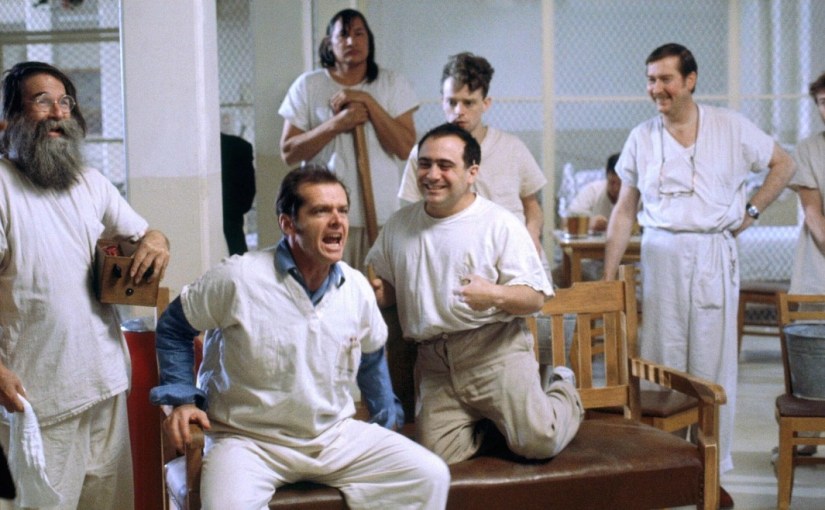
Jack Nicholson is Randall P McMurphy, a criminal who is transferred to the asylum for examination even though there are likely suspicions he’s faking his current condition as a means to escape prison life work detail. Louise Fletcher is his opponent as Nurse Ratched who has maintained an organized control over the floor of 19 men with an assortment of mentally unwell behavior.

McMurphy is a cut up as soon as he joins the gang. At first he appears observant during Ratched’s daily sessions where she asks the men to contribute to the discussion but at the same time she couldn’t be less encouraging. She’s happy to welcome ideas with open arms but don’t disrupt the process. There will also be “Medication Times” and there will be samples of classical and childlike music to subdue the patients as well. McMurphy may request the volume be lowered, but that’s not a simple request that Nurse Ratched will honor.

McMurphy’s experience outside the realm of insanity works as a wake up call for some of the men which consist of introductory performances from great character actors like Christopher Lloyd, Danny DeVito and Vincent Schiavelli. The stand out is Brad Dourif as Billy Bibbit, the stuttering suicidal young man with the baby face who fears his mother’s judgment as Nurse Ratched methodically continues to imply.

McMurphy wins over the crowd eventually. A fascinating scene is when Ratched challenges McMurphy to obtain enough votes among the men in order to watch the World Series. The count of raised hands appears to tie, but then Ratched reminds him that he needs one more vote to win. Before he can get to that point, the session is ended by Ratched. The call for election is lost due to a technicality by the governing control. An election won’t silence the voice of the people as McMurphy quickly encourages the masses to watch a blank television screen imagining his own interpretation of the game. Ratched can only domineer to a certain degree. Here’s the flaw in the Ratched character. At last a breakthrough among these ill men is established as they’ve learned to vote for themselves. They want to watch a baseball game. Ratched won’t stand for progress though.

Questions arise in One Flew Over The Cuckoo’s Nest. Is McMurphy truly faking his mental condition? Is Ratched so drunk on control to disregard doctors’ opinions for his release and keep him institutionalized? If he’s not insane, then why would she want him there? Is it all about Ratched’s obsession with winning?

Ken Kesey wrote the original novel the film is based on. He hated Foreman’s approach particularly with disregarding telling his story from the perspective of the deaf/mute six foot five Native American that McMurphy regards as “Chief” (Will Sampson). Chief seems to be the quiet one who does not take sides until McMurphy demonstrates the ease of obtaining freedom such as when the Chief helps him escape over a barb wire fence and then takes the men on a boating joy ride. I can’t side with Kesey’s insistence that the film be done from the perspective of the silent, yet memorable Chief. Film is a different medium than what’s read on a page. You can’t watch people’s thoughts. What I do find interesting is that Kesey opted for a Native American as McMurphy’s best sidekick. This is a man whose ancestors historically lost their land. McMurphy attempts to rob the rule of the asylum from Nurse Ratched. The political undertones just seem so apparent. The government control, however, is hard pressed to surrender even after McMurphy arranges for his own party of celebration complete with booze and alcohol. Ultimately, and sadly, the fate of McMurphy shows that he eventually becomes a product of his own environment. The Chief however, acknowledges his independence though.

One Flew Over The Cuckoo’s Nest is the second of three films to win the five main Academy Awards (Best Picture, Director, Actor, Actress, and Screenplay). It deserved it, and because of the film’s unsettling and messy nature it’s almost surprising that it was so well received. It’s not a glamorous film. It can show the ugliness of men drowning in their own consciousness.

At the same time, the film shows the subtle yet brutal control of those living fulfilling lives at the expense of the constituents they oversee. Sure, let’s have an open minded community of provoking thoughts, but only if it’s confined to the restrictions that remain in place. Step outside those lines and a more permanent technique will be applied so you adapt to what’s mandated…unless you can bodily lift a concrete water fountain and smash it through a cage bar enclosed window to freedom.