
WISH

By Marc S. Sanders

Disney’s Wish seems to stand out from many other films within the studio’s vault because the lack of filmmaking confidence appears so obvious.  What does it tell you when a newly original story is continuously guided by winks and nods from past successes?  We see this thing can’t stand on its own two feet.  So, let’s dress a character up like Peter Pan and literally name a random deer Bambi.

A sorcerer trained in the arts of magic oversees his newfound Mediterranean island kingdom known as Rosas.  He is King Magnifico (Chris Pine) and he has attracted people from all over the world to reside under his rule on the condition that he collects their wishes to be held by him in glittering, floating blue bubbles.  The people of Rosas lose all memory of their respective wishes and now live month to month with anticipation that Magnifico will award them the wishes he holds as a kind of equity or collateral.   

Asha (Ariana DeBose) is a seventeen-year-old who is eager to finally witness her grandfather Sabino’s (Victor Garber) wish come true as his 100th birthday finally approaches.  She also aspires to meet the great sorcerer and hopefully become his apprentice.  As soon as she meets the King though, Asha realizes Magnifico is a greedy, selfish individual who thrives off the admiration of the people of Rosas while savoring the wealth of everyone’s longings.  In other words, Magnifico is a cult leader.

Chris Pine does good voice work here.  He’s gleeful and manipulative and uncaring and evil all at the same time.  Disney’s colorful animation lends to his vocal performance of course with Maleficent inspired glows of green spells which the character conducts.  Yet, my adult mindset could not get past the fact that I’m looking at an animated inspiration of David Miscavage, long time head of the Church Of Scientology.  Magnifico’s wife Amaya (Angelique Cabral) is the quietly naïve representation of David’s wife, Shelly (who has not been accounted for in years).  The poor people of Rosas are the brainwashed disciples believing in this false prophet.  I guess it’s not a terrible concept to apply to a fantasy, but once I see the allegorical connection, Wish makes me feel uneasy.  My fault I guess for watching too many HBO documentaries and listening to former Scientologist Leah Remini too much.

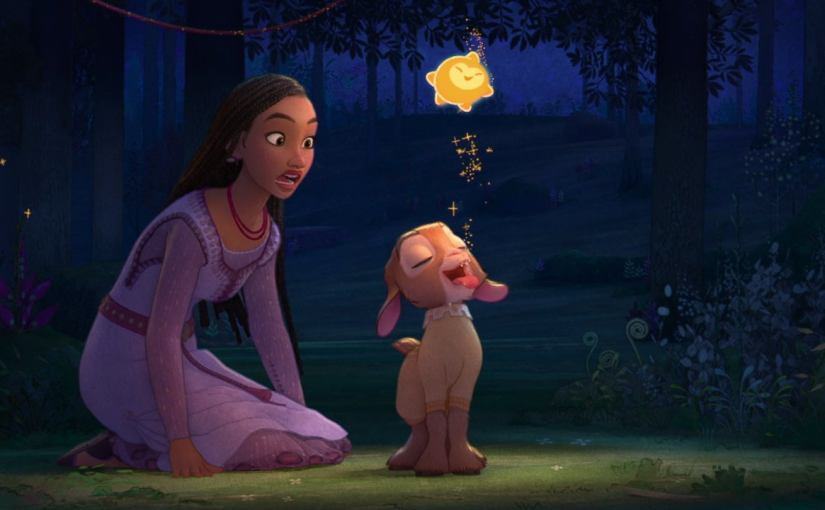
Asha is the hero of this story who makes a wish upon a star.  Actually, a literal character named Star enters the picture.  Star squeaks like a precious darling, ready to be your children’s next plush toy acquisition.  He shoots sparkling trails of gold out of his pointed appendages.  With Star’s help, Asha will reach the standard showdown with the villain by the film’s end and the awakening of the people below.  It’s all trite material that’s been done before.

Wish relies on the vast history of fantastical stories, believing you can fly and be heroic or simply a sidekick tagging along with the protagonist.  Asha has seven friends.  One is referred to as grumpy.  Huh!  How do you like that? Must it be so apparent so often though?  Thanks to Star, forest animals talk and one even makes an inside gag to Zootopia.  You’re practically asked “Get it?  See what I did there?” Magnifico bears a striking resemblance to Jafar and even resides in a similar castle to the Aladdin villain with stone spiral staircases to explore.

The colors and animation are just as engaging as nearly any other Disney film.  A few songs work, but there’s nothing on the level on what was accomplished during the days of Rice and Menken, or even more updated fare like Frozen.  I can’t recall the title of a single number from Wish.  Magnifico sings.  Asha sings multiple times.  The two duet together and it’s not terrible. Ariana DeBose could sing the phone book and I’ll feel swooned.  The supporting people of Rosa sing in choral support as well.

Still, what tainted my experience was turning a very real epidemic of cultish culture into a fantasy catered for all ages to enjoy.  The wishes the people offer up are the endless “donations” that a cult mentality always requests.  While I appreciate being accepted into a fraternity of Disney loving storytelling, I did not need to be banged over the head with so much saluting either.  The end credits contain one classic Disney character after another appearing next to the ongoing scroll.  Hi Dumbo.  Hi Genie.  Hi Peter.  Hi Belle. 

Disney always reminds us to believe our wishes will come true and yet with Wish the studio chose to go with what is blatantly familiar.  It’s time for some fresh ideas again that especially do not source themselves from the reality of harmful sects spreading false doctrines. 

NOTE: I still have a fresh idea from a very popular legendary story that Disney, nor Universal or Warner Bros has yet to touch.  Maybe it’s time I get it down on paper.  Hmm.
TITANIC (1997)

By Marc S. Sanders

James Cameron’s Titanic will always remain a timeless piece.  Audiences adore the relationship between the two lovers from different worlds, Jack and Rose, who meet aboard the maiden, and final, voyage of the doomed cruise liner.  Maybe more importantly, the craftsmanship of this film is still beyond compare.  Many know that when this picture was in the making, its budget ran way over and endless rumors of waterlogged technical challenges were rampant through media reports.  Titanic was predicted to sink James Cameron’s career.  Instead, it was the grand Hollywood underdog that no one expected.

I recall seeing the film twice in theaters during the Christmas season of 1997.  I was not so enamored with the script or the fictional love story that Cameron conjured as the central narrative for the real-life tragedy that took approximately fifteen hundred lives on April 15, 1912.  The visual effects were the marvel to watch, and what I patiently waited for, during the second half of the picture.  I had to tread water through the first half though.

A hardly known, but already Oscar nominated (What’s Eating Gilbert Grape?),  Leonardo DiCaprio portrays Jack Dawson, the poor member of the ship’s steerage company who falls in love with an aristocratic young woman named Rose Dewitt Bukater.  Rose is played by Kate Winslet, who’s uncomfortable with the snobbishly wealthy first class section of people she’s forced to associate with by mandate of her possessively cruel, and supercilious fiancée named Cal (Billy Zane) and her mother, Ruth (Frances Fisher).  Call it a Romeo & Juliet love story.  Two lovers are forbidden to be with one another.  Yet, they are going to do it anyway.  It’s simple and nothing dimensional.  It seems to have parallels to Disney’s rated G interpretation of Beauty & The Beast.  Fortunately, what saves the storyline are the performances and chemistry of DiCaprio and Winslet.  These are not even the best roles of either actor’s storied careers.  Yet, they are anything but unlikable. 

The relationship they share aboard Titanic, as it makes its way from Europe to the United States, is told in flashback by a 101 year old woman (Gloria Stuart) to a marine exploration crew who have been meticulously searching through submerged remains of the ship on the ocean floor of the Atlantic.  The most important element to come from this section is a wise choice by Cameron to include an informatively brief analysis of how exactly the ship took on an overabundance of ocean water following a collision with an iceberg, and how it gradually began to sink, weigh down, and split apart before finally concluding with a straight dive down into the murky, cold depths.  I must note that film critic Gene Siskel acknowledged this storytelling device upon the film’s initial release. He hailed this sequence because it offered an early “blueprint” of what audiences could expect to happen and witness during the film’s second half.  We all know the ending to the film, but how exactly did it happen?  The quick breakdown helps.

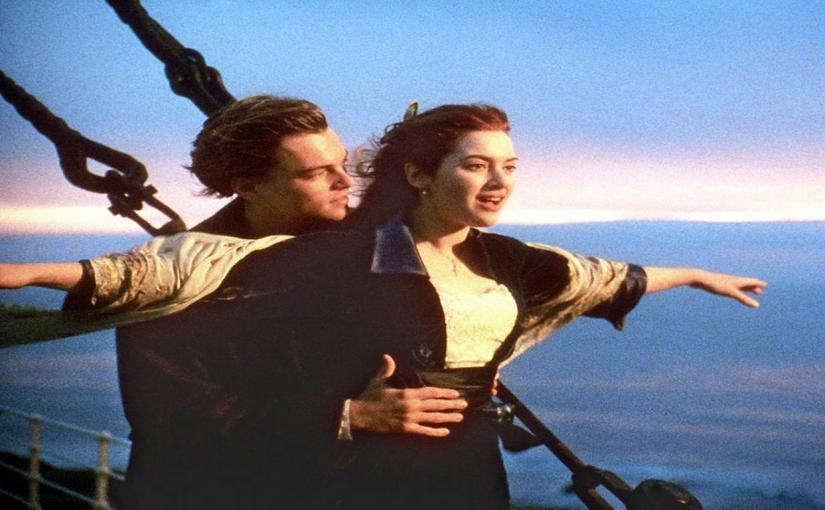
Ahead of the tragedy, Cameron and his set designers offer a grand, functioning piece of machinery that is absolutely impressive to modern audiences, even over a century later.  The decks and hallways are wonderous.  The forward and aft locations seem familiar and solid.  The CGI on this reinterpretation of Titanic is undetectable.  If this film was going to live up to its name, it most certainly has done so.  This ship looks tremendous and strong and indestructible just as the architect and engineer (Victor Garber, Jonathan Hyde) written into the script proudly lay claim to.  The famous moment of the film where Jack supports Rose on the forward bow of the ship with a sunset sky in the background is positively gorgeous.

I do have reservations with the film though.  I think both stories, the forbidden romance and the demise of the ship, in Titanic work.  However, when spliced together, the picture leaves me feeling uneasy.  James Cameron has weaved his fictional romance, appropriate for used, yellow stained paperback books, with a horrifying tragedy.  It’s what you would find in those cheesy Irwin Allen disaster epics from the 1970s.  When Cal’s anger over Jack’s intrusion comes to a boil, he pursues the couple, firing a pistol at them while the ship is continuing to sink.  Jack is apprehended and handcuffed in the lower deck and his doom seems imminent as the water level grows higher.  A priceless blue diamond serves as a MacGuffin that goes back and forth to deliver the operatic divide of these characters.  These are all cinematic inventions painted upon a well-known historical tragedy simply for the sake of adventure and suspense. 

I also found it unconvincing that the only person aboard the ship to question the contingency planning and safety measures ahead of any potential disaster is young Rose, who has no insight into mariner regulation or procedure.  Of all people, it only occurs to Rose that Titanic is not equipped with sufficient lifeboats for all twenty-two hundred people on board.  For storyline options, these avenues written by James Cameron sometimes take me out of the film. 

What I hold fascinating though is where the film depicts the eventual panicked response of the passengers and crew.  We see the captain appear helpless in his defeat against the nature of the ocean running its course over the ship he commands.  A string orchestra chooses to simply perform amid the ongoing disaster, which I have read actually happened.  Most breathtaking is how all the extras in the film react to the growing shift of the ship.  Their slant becomes steeper.  The people do their best to shuffle through the flooding, eventually having to keep their heads above water.  Helpless children are abandoned.  For an emotional punch, the steerage in the below decks is gated off from reaching the top of the ship, and giving themselves a chance at survival on a life boat.  James Cameron accounts for every response and detail that likely occurred during the sinking of the ship.  It’s captivating to witness, despite how tragic the outcome.

Though I do not care for the mix of the love story and the real-life submergence of the ship, Titanic has many strengths beyond what James Cameron achieved with the most up to date technology in visual effects, at the time.  Billy Zane is a villain that you love to hate.  Truly an underrated antagonist in the history of film.  David Warner is an intimidating henchman.  Kathy Bates is a welcome Unsinkable Molly Brown, the crass wealthy woman who sets herself apart from the pretentiousness of her lady peers.   

The exceedingly three-hour running time allows you to become completely familiar with the ship from stem to stern and again the set pieces are magnificent, whether you are hobnobbing with the wealthy up top or the steerage down below.  Every pipe or rope or stairway or hallway or chandelier serves a purpose.  The costumes and makeup designs are appropriate, including the frozen complexions on the bodies that float on the ocean surface following the tragedy.  Cameron’s use of the camera is amazing as he offers wide, expansive shots of nothing but dark ocean with hundreds of people suffering towards their demise. Thus driving home the point that there’s nowhere to find salvation and relief from the bitter cold air and sea water.  These poor people faced unimaginable challenges while competing with panicked crowds, and lack of foresight from those in charge of this newly designed technological wonder.  The movie covers everything that worked against these passengers.

Titanic is an incredible accomplishment. There’s much to see and absorb.  The last time I saw the film was nearly twenty five years ago and much of the footage never escaped my memory.  James Cameron left an indelible impression on moviegoers.  Regardless of the misgivings the film holds, Titanic has held its rightful place as an all-time landmark in cinematic achievement.

NOTE: I took advantage of seeing a newly restored 4K version in 3D at my local movie theater.  I have never been a huge fan of 3D as I often find it murky and distracting from the story.  Had Titanic been offered in standard 2D, that is what I would have gone to see.  Fortunately, this re-release is an exception to my impression with 3D presentations.  The picture is glorious, and I highly recommend the film be seen while it remains in limited release.  Titanic in 3D should not be missed.