
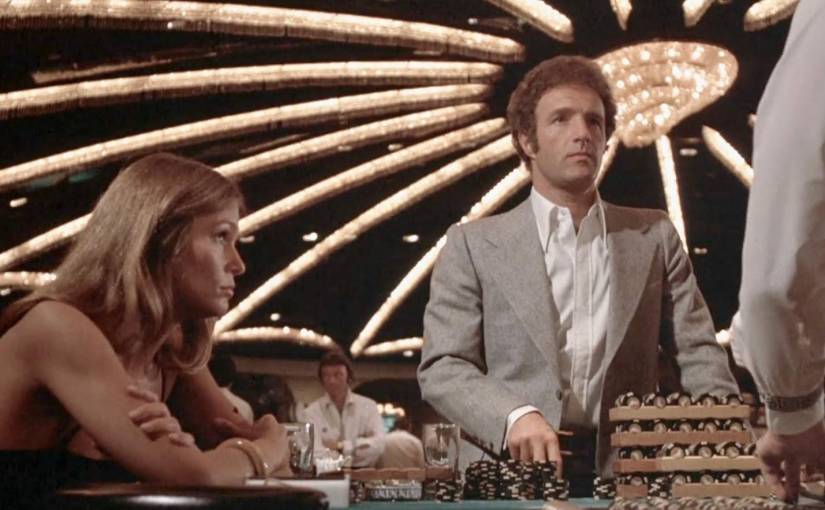
THE GAMBLER (1974)

By Marc S. Sanders

James Caan is Axel Freed, The Gambler, and when the film starts it shows the main character figuratively at the bottom of a very deep hole.  From this point on, he’s always looking at its great endless height above; a depth so low or a height so high, that there’s no crawling out of this trap.  No matter the opportunities that rescue Axel from a $44,000 debt to some bookies, he’ll never allow himself to be saved.

The autobiographical inspiration of James Toback’s first screenplay is hardly entertaining, but it held my attention all the way through.  Axel is a well-educated literature professor and an expert on Dostoyevsky but he’s entirely foolhardy.  A parallel inspiration comes from the author’s novella The Gambler.

I dunno.  Whether it’s 1974 or 2024, if I’m told I owe forty-four grand to someone who will otherwise break my legs and then who knows what else, I’d be terrified with fear.  Axel Freed seems to brush off his dilemma as he cruises through the city in his Mustang convertible.  To him, this is just the current setback of the week.  Nothing big.  He’s been in worse situations.  At least that’s what he tells himself. Axel swallows some pride and asks his mother (Jacqueline Brooks) for a loan, and she has to go through her own hoops to scrounge up the funds.  Look for an early appearance from James Woods as an unsympathetic banker.  Once mother’s monies are in hand though, Axel opts for a different route than to wipe his debt clean. Therein lies the anchoring burden of gambling addiction.

Toback’s script, directed by Karel Reisz, is not so much about a story as it is about living with overwhelming compulsion.  He writes good dialogue performed with apathy by Caan.  It’s not about winning.  It’s about the thrill of possibly losing the money he’s got in hand. 

Once Axel obtains money, he ventures off to Vegas feeling sure that he will double what he’s got and still manage to pay off this huge debt.  The brilliance of the film is that it had me tricked as Axel marathons through victory at every table while also feeling confident on three college basketball games that seem to be moving in his favor.  I was not sure if I was looking at a hero or a despairing loser during this sequence.  Reisz convinces me that it can go either way for Axel with his girlfriend, Billie (Lauren Hutton) in tow.

As many films, books, and programs that I’ve encountered focusing on gambling and the addiction it musters, I feel confident I know the outcome of the piece.  What sets The Gambler apart though is the realistic nature of what this kind of craving does to a person.  It depicts the victim as in denial, rejoicing when he dodges bullets, thinking he’s invincible.  The film demonstrates how those close to Axel Freed respond to his mounting dilemmas, but also how they are affected.  It’s inclusive not only of his Billie, his mother, his self-made millionaire grandfather, or even his main bookie (Paul Sorvino), but an admiring student of his as well. 

There are scenes that I could see how they are going to play out as soon as they begin.  I’m sorry but when I see tough guy character actors like Burt Young and Vic Tayback enter a story like this, I know something, or someone, is about to endure some damage and walk away feeling terribly threatened.  Still, I’d be complaining if Toback excised moments like this from his screenplay.

The ending left me feeling a little perplexed as to if it really belongs here.  It’s not a happy ending but seemed to come out of nowhere and I questioned its relevance against everything else that was seen before. 

The strength of The Gambler lies in the honesty of James Toback’s script and the performance of James Caan.  The film belongs exclusively to Caan and his character, with the others entering the frame when they are called upon for a cause and effect of Axel’s actions and decisions.  There’s nothing to celebrate in a hard drama like this, but I applaud the film’s will to uphold a genuine truth of how gambling addiction leaves behind a crippling life for those caught in continuing temptation.

BULLITT (1968)

By Marc S. Sanders

The car chase with the movie attached to it is Bullitt from 1968, directed by Peter Yates, featuring Steve McQueen in the title role.  Why do I phrase it that way?  Well, as far as I can tell in the three or four times that I’ve seen the movie, the main attraction is the well-known, and pioneering, car chase at the crux of the film.  Otherwise, the plot is very thin, with characters that have next to no complexity or dimension.

Frank Bullitt has been summoned on a Friday afternoon to the home of a prosecutor/politician named Chalmers (Robert Vaughn).  He’s been requested to guard a key witness over the weekend ahead of giving a deposition on Monday morning that will expose “The Organization.”  Frank lays out the shift schedule with his precinct partners, and soon after the witness is gunned down and sent to the hospital with life threatening injuries.  Now it’s up to Frank to find out how the organization located the witness and who is behind the conspiracy. 

Bullitt moves at a slow pace.  There are some foot chases through the hospital.  Chalmers gives the standard frustration with how the protection assignment has fouled up, and plenty of close ups are given to the marquee actor, McQueen.  For some sex appeal, Jacqueline Bisset appears as Bullitt’s girlfriend offering up a speech that shows resentment for his occupation amid a world of death and violence.  A better monologue of this sort would come later in Michael Mann’s Heat with Diane Vinora expressing her disdain for Al Pacino’s determination as an obsessed detective.

Nevertheless, Bullitt is an important film to watch, if for nothing else then to see what it has inspired since its time.  The legendary car chase between Bullitt’s dark green Ford Mustang and the silent villains’ black Dodge Charger is nearly ten minutes long, and still holds as one of the greatest ever filmed.  The fact that the film takes place in San Francisco only lends to the scene.  The best car chases take place among the sloping streets of San Francisco.  Fortunately, the chase is not accompanied by music, but rather by well timed sound editing of burning rubber and screeching tires, revved up engines, side swipe banging and chassis slams on the hilly pavements. Yates also includes good close ups of McQueen and the villains in the Charger.  They were not always driving the cars.  There were stunt doubles, but I’m not seeing the difference while I’m watching.  I might see the cars pass by the same green VW Beetle three times, but the editing is so perfectly assembled here that it is fair to argue this is one of the greatest scenes in film history. 

In later years, directors would pull moments from Bullitt to use in their own films like the Dirty Harry pictures, The Seven-Ups, and Heat.  One moment during a foot chase in an airport seemingly inspired moments for later films like The Fugitive and Skyfall.  The hero is looking amidst a sea of crowds for the antagonist.  Peter Yates films bystanders in this moment going from one walking face to another.  He cuts back to McQueen moving his eyes from left to right and back again, looking and looking.  The bad guy that Bullitt is trying to find is just an ordinary white guy with brown hair; no discernable features like you might notice in an Alfred Hitchcock movie or a James Bond entry.  So how do you find the guy who just looks like everyone else?

Bullitt sets up a twist or two.  Honestly though, I can’t recall where those moments are resolved.  The witness being protected undoes the chain lock on the door just before he’s gunned down.  Why?  What was the exact purpose to do that?  As well, who exactly gave away the secret location of the witness, and again, why?  These questions weigh on my mind after watching the film.  Bullitt is not a confusing or multi-layered movie.  It’s pretty simple with very minimal dialogue and works like a showpiece for scenes.  So, I have yet to uncover where I got lost or what I missed that could answer those questions.

Best I can say is that if you’re a film buff seeking out where certain standards started, it’s best to watch Bullitt.  After you watch Nicholas Cage supposedly drive a yellow Ferrari through the streets of San Francisco in The Rock, you’ll at least say, “Uh uh.  Bullitt did it better the first time.”

ALICE DOESN’T LIVE HERE ANYMORE

By Marc S. Sanders

Martin Scorsese was destined to be a great director. No doubt about it. Look at 1974’s Alice Doesn’t Live Here Anymore. Not only does it offer an Oscar winning performance from Ellen Burstyn as Alice, but this early career film contains skilled tracking shots.

Scorsese uses his camera like a musical instrument. He times it to move on a certain cue. Near the end when Alice needs to pick up her 12 year old son Tommy (Alfred Lutter, well played here) from a police station, Scorsese is clearly on foot positioned behind the police counter. When the time is right, he walks it behind the cop and extras in a crescent step by step over to behind Alice. We are in the scene. It didn’t take much imagination, but Scorsese is economical for an engaging payoff. The camera continues to follow a young Jodie Foster as Tommy’s rebellious pal, Audrey and then after she’s quickly escorted out by her mother, it peers into the room where Tommy is waiting. It’s an unbroken steady cam moment that predates his classic tracking shot of the Copacabana in Goodfellas, or the bloody overhead outcome from Taxi Driver.

The story is decent, though nothing big. Alice is forced to flee following one set back after another with the men she encounters in her life. First she’s unexpectedly widowed from her unappreciative and cruel husband, next she encounters a charmingly young Harvey Keitel who sheds his first impression quickly. Then she comes across Kris Kristofferson but is he right for her?

The second half of the film inspired the basis for the classic TV show Alice, featuring Linda Lavin and Vic Tayback who plays Mel the cook in the film as well. Scorsese uses the diner sequences for some good laughs of confusion and slapstick with side characters Flo (scene stealer Diane Ladd) and Vera (Valerie Curtain, another scene stealer).

These are good characters here. You want Burstyn’s Alice to be happy and succeed as a mother to Tommy and become the singer she dreams about. She’s adoring. She tries, and she always works hard. Burstyn has some great moments of various range whether she’s feeling like a pestered mom driving the long highways, having anguish and fear with the men who cross her path, or when she’s singing Gershwin’s “I’ve Got A Crush On You” at the piano of a seedy bar. I loved her in the role.

This is not really a special movie. Yet, it’s an important one in cinematic history. See this film to see the master director when he was merely a pupil, exceeding what was likely minimally ever expected of him to accomplish.

Martin Scorsese is just a great director.