BATMAN FOREVER

By Marc S. Sanders

Last month, upon hearing the news of Val Kilmer’s unfortunate passing, Joel Schumacher’s Batman Forever actively swept the social media rounds.  Fans of Kilmer praised his one and done occupation with the costumed role.  Some declared the film their favorite of all the superhero’s cinematic adventures and expressed their immense appreciation of the Juilliard graduate as Bruce Wayne and his vigilante persona.  He’s good.  Yeah.  I’m not going to say he’s great though because the film doesn’t offer much meat for Kilmer to chew off the bone.  As for the film, well, it’s a Joel Schumacher movie.  Should it be good?

The director took over the reigns from Tim Burton.  Michael Keaton opted not to return following two films and thus Kilmer was contracted.  The villains of the week are a very miscast Tommy Lee Jones as Two Face and Jim Carry doing a misbehaved class clown interpretation of The Riddler.  Unlike Burton’s noir approach, Batman Forever is gleefully campy and colorful with overly apparent winks and nods to Batman’s butt, codpiece and notorious chest nipples.  None of it necessary because it’s all wrapped in vinyl and plastic.  Buy the action figures if you want to cop a feel.

Akiva Goldsman was the head screenwriter.  His script carries no reluctance in delivering cliche dialogue.  “It’s the car right? Chicks dig the car!”  or “I’ll get drive thru.” (McDonalds was a proud sponsor.) Worse though are the two halves of the picture.  Kilmer’s Batman endures his ongoing traumatic psychosis of losing his parents, while Jones and Carrey go for a reiteration of the beloved Adam West slapstick TV series.  These two languages never speak to one another.  The hero and the villains hardly confront or challenge each other and never hold a substantial conversation during the course of the film.

Jim Carrey and Tommy Lee Jones try way too hard to duplicate what Jack Nicholson’s Joker portrayal memorably did the first time.  There is no backstory to Jones’ character except a brief news clip.  Otherwise, the middle-aged actor looks like he’s exhausting himself out of breath while trying to match Nicholson and Carrey.  As a Batman fan, he’s entirely wrong for this role.  The Two Face alter ego is the handsomely vain district attorney Harvey Dent.  According to comics lore, when Dent gets half his face grotesquely disfigured, he develops a deep-seeded anger to losing his looks and it leads to his ongoing villainy.  Tommy Lee Jones is a fantastic actor, but he is not the Adonis that Billy Dee Williams (Burton’s Harvey Dent) carried his charming career on.  The makeup job with Estee Lauder pink and purple is awful craftsmanship.

Jim Carrey is doing his usual schtick that skyrocketed his career with Ace Ventura and Dumb & Dumber, but it’s overly abundant here.  Goldsman, Schumacher and Carrey take equal blame.  This Riddler only offers three or four puzzles.  Otherwise, we get Carrey doing the Nicholson gags that should never have made the final print; a baseball pitcher tossing a curveball bomb in the Batcave and a mad scientist routine that drives the bad guy’s stupid plot line of using television waves to absorb the collective intelligence of the people of Gotham City.  The more this side story carries on the more mind numbingly stupid it becomes.  The Riddler’s device is nothing more than a kitchen blender that glows neon green while it hardly maintains balance on anyone’s head.  Junky production value.

Nicole Kidman is radiant as the next romantic Bat gal in line.  She’s so much better than this insubstantial material, though. She consists of zero significance.  Nothing else I can say.

Chris O’Donnell makes his first of two appearances as Dick Grayson, Batman’s sidekick known as Robin.  O’Donell actually has the most interesting storyline as a daredevil kid who tragically loses his family but can’t sit still when adventure awaits.  He gets into all kinds of mischief on his motorcycle and within the confines of Wayne Manor before he finally dons the famous costume. Yet, even when he’s standing in the same frame as Kilmer, both actors look like they are performing in different films.  One guy is hyperactive.  The other is morose and neither seems to be reading from the same script. Their chemistry is begging. Did these guys ever stop and develop an appreciation for one another?

Joel Schumacher applies a candy-colored polish to his Gotham City with black light graffiti, bright lights and more glow, glow, glow!!! Even the street gangs use neon glowing fighting sticks and Two Face’s henchmen work with neon red machine guns.  Oy!!! Enough.  Willy Wonka’s factory was not this sugary sweet.  Batman Forever is one film that can give you diabetes just by looking at it.

Other than an impressive opening scene with a helicopter and a cylindrical bank vault, none of the action sequences are worthy of postponing your bathroom break.  Batman’s fighting prowess and his ugly car and jet look like they are being run by an eight-year-old with his action figures.

So, as I noted before, I took another look at Batman Forever to explore what Val Kilmer did with the role.  He would have been a good Batman if he was given some things to do.  Ultimately, his dashing good looks complement Bruce Wayne’s suits and ties quite well and his square jaw fits perfectly in the mask.

What else can I say except I can’t imagine any chicks loving the car because this Batmobile has a pointless fin sticking out of the chassis and the wheels glow white, plus there’s an odd rib cage of lights on the sides of the vehicle.  Oh, and it drives up the wall of a building.  Is this where people are supposed to be impressed with Val Kilmer?
TOP GUN: MAVERICK

By Marc S. Sanders

Top Gun: Maverick is why we should never, ever give up on movie theaters and only settle for the flat screen TV.  This is a film, a sequel to a very hokey, cheesy 1980s blockbuster, that will top my list of most unexpected surprises.  This picture seemed inconceivable to accept, and yet, barring an unnecessary love story subplot, I relished every second of it.  Finally, a movie delivers more, a lot more, than its trailers ever promised.

One of Tom Cruise’s best films has him return to preppy boy Navy Aviator pilot Pete “Maverick” Mitchell.  He’s a captain now, declining opportunities for promotion over the last near 35 years since we first saw him on screen in 1986.  Like Cruise, Maverick looks like he’s barely aged.  So, with that in mind, I guess we can accept that he can jack up his Kawasaki Ninja motorcycle to unbelievable speeds with no helmet, and can take a super powered jet to Mach 10 speed, crash it and survive with everything on his person still intact.

Maverick is called upon by his old Top Gun classmate and former competitor Iceman (Val Kilmer) to teach a class of the current one percent of elite fighter pilots.  They are about to embark on a mission to take out an enemy weapons depot hidden behind treacherous low altitude mountain terrain with sharp curves and narrow pathways.  The area is also highly secured with machine guns, rockets, advanced radar, and enemy fighter jets.  This film truly convinced me that this mission is actually impossible.  Even Ethan Hunt of the Impossible Mission Force couldn’t survive this. 

The highlight of Top Gun: Maverick is of course the aerial training and combat maneuvers done with actual F-18 jets that Cruise has gone on record insisting that the cast fly in.  The barest minimum of CGI and manufactured effects were used.  As a producer powerhouse in Hollywood, if Tom Cruise demands his action to be as convincing as possible, you are going to get your finished product.  Much of the second act of the film focuses on Maverick outsmarting his students in the skies.  These are the best the country has to offer but they haven’t encountered Maverick yet.  The planes fly at one another and over each other and spiral together like a well synchronized ballet.  I believe the footage that Tony Scott provided in the first Top Gun film still holds up very well.  In this new film, it’s a tremendous enhancement. I know nothing about the laws of physics or computing the trajectories a jet can make at a particular speed, but what this film demonstrates is that what seems inconceivable is downright actual.  You can not help but be impressed.

Still, to satisfy my particular movie requirements cannot hinge on action alone.  I have to care about the characters.  The characters are the stakes at play in dangerous action films like Die Hard or Indiana Jones.  It’s what heightens the suspense.  Fortunately, the script from Peter Craig takes time to invest in an older, more mature Maverick who remains haunted, but wiser following the loss of his best friend and co-pilot Goose.  Now, Goose’s son, code name Rooster (Miles Teller) is one of the stand out students who holds a grudge against Maverick.  It’s not as simple as the guy losing his father at a young age.  There’s more to it to be revealed. 

Teller plays well off of Cruise, as do the other hot shot students made up of Monica Barbaro, Lewis Pullman, Jay Ellis, and Glen Powell.  They’re all daredevil pilots like the first film offered, but they are written with more believability this time.  These are not the frat house beach bum guys that were so often shown in 1980s pictures.  Powell, known as Hangman, and Teller’s Rooster fill the Iceman/Maverick opposition here.  Only this time, it gets more personal as the characters go after their back stories and history.  Maverick is caught in the middle.  So, the drama is well played here. 

Director Joseph Kosinski makes the mission easy to comprehend.  Graphic maps show the impossible trajectory these pilots are expected to face.  The audience easily understands the challenges of going at impossibly low altitudes followed by fast upward careens into near atmospheric space while still trying to maintain consciousness and not get shot down. 

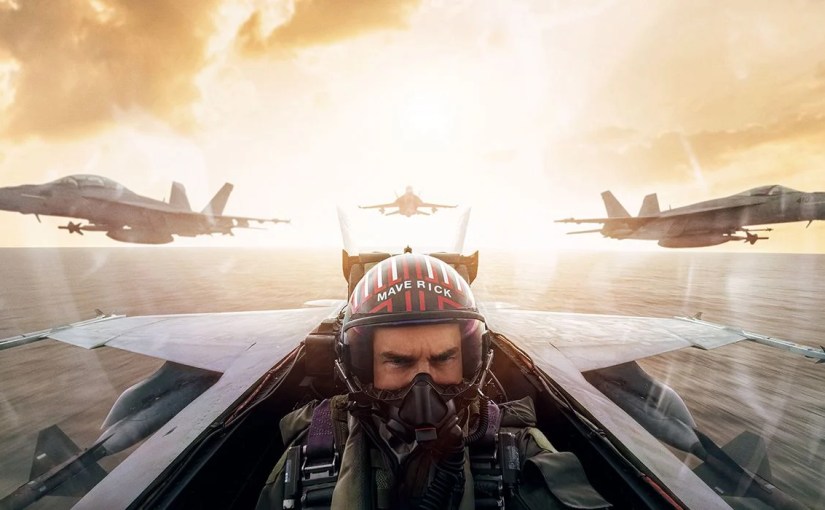
At the very least, to enjoy this picture, I think I’m thankful that I’m not a Navy pilot.  If I was, perhaps I’d be apt to dismiss the daring stunts that are committed over the course of the film.  I don’t want to know what can and can’t be done.  Let me have my illusion.  What’s especially appreciated is the perspective you’re given from the cockpit of these jets whether they are flying in a straight line, or alongside another plane or when Cruise himself is there in his trademark Maverick helmet taking his aircraft into an inverted and upside-down position with the top of the snowcapped mountains beneath him.  It’s positively mind-blowing. 

Maybe you have an idea of how the film will end up.  I won’t spoil it, but I certainly stopped thinking about it as the movie played along.  This movie had my undivided attention for just over two hours.  Moments occur where characters are in such convincing peril that any outcome would have worked and kept the integrity of the film.

Naturally, there’s a love story.  Most people didn’t care for the romance of the first film.  Not me.  I really liked how Kelly McGillis and Cruise performed together.  It was sweet and sensitive.  It took its time.  (See my review.)  For this picture, McGillis wasn’t welcomed back.  Google her quite frank and very honest response as to why she’s not here.  Instead, Jennifer Connelly romances Cruise as a bartender named Penny Benjamin (yes, the Admiral’s daughter).  Opposite Cruise, they look like a good couple.  However, when their shared scenes come up, honestly if you need a pee break this is when to rush out of the theatre.  The two characters don’t challenge one another like the first time around.  Penny has to just hide Maverick from her teen daughter.  Meh.  That’s sitcom fare.  This is nothing terrible here.  It’s just not overly necessary.  Does Maverick need to have a love interest?  Is it the end all be all?  This movie would have held up just fine without the love story.  Just be glad there’s another shirtless beach scene for the guys to frolic around this time with a couple of footballs. 

Without question, to date as of this writing, Top Gun: Maverick is the best picture I’ve seen this year.  I already declared the inventiveness of Everything, Everywhere, All At Once as one of the reasons why that film is one of the best of the year.  Cruise’s film tops it though.  The craftsmanship on display is like nothing you’ve seen before.  It challenges the technical marvels of James Cameron’s auspicious achievements and raises the bar for anything to come out after it.

If people like Tom Cruise and other daring producers in Hollywood can manufacture films on this level of story, adventure and suspense, then please, please, please do not close up the Cinematic Multiplexes.  Top Gun: Maverick is meant for the big screen; the biggest screen you can find with the best sound system available.  I’ll be sure to see again it while it remains in theatres.  In fact, release this film every summer until something else tops it.  It is a that good a film. 

TOP GUN

By Marc S. Sanders

For a movie that focuses a lot on showers, men’s locker rooms and bare chested sweaty and chiseled volleyball players, it’s a wonder that it is called Top Gun.  Maybe the title has another indirect meaning to it, other than a moniker for a Navy fighter pilot school of the elite.  Maybe these guys are elite for a different reason.

The Tony Scott film that is supposedly about the top one percent, the best of the best, American fighter pilots in the Navy is arguably the most important film in Tom Cruise’s career.  It launched the actor into a superstar sensation that has hardly faltered since the movie’s release all the way back in 1986.  But is it a good movie?  Well, yes and no.

I’ve always loved Tony Scott’s filmmaking technique.  Sure, his sun-soaked film shots are constantly repeated.  He always relishes in enhancing the beaded glow of sweat drenching his actor’s faces, arms and chests.  It’s seen in nearly every moment of Top Gun, as well as other celebrated pictures like Crimson Tide, Beverly Hills Cop II and True Romance.  Orange sunlight blankets palm trees and beach lined streets.  Bar saloons and military headquarters are lit in sexy blues and greens.  It may lack originality after seeing a few of his films, but it just makes the movie all the more sexy. 

Tony Scott is also a well-versed director in action sequences.  He’ll get your pulse racing and Top Gun is the best example.  The fighter jet sequences in this film are masterful in editing, sound and speed.  It’s fantastic to see how the planes will twirl around and then shoot themselves straight up into a vertical trajectory in the sky and finally cut in on actors Tom Cruise, Anthony Edwards and Val Kilmer for a “WOO!” moment in the cockpit.  This stuff still holds up.

Yet, unlike other modern-day films that focus on cadets or students in our armed forces, Top Gun doesn’t concern itself with the discipline of what it takes to serve in the Navy.  This is the informal, class clown version of An Officer And A Gentleman.  You only need look as far as Tom Cruise’s character’s pilot call name, Maverick.  The name itself is a one-word thematic description of what you are watching.  So, the kid who learned to say “what the fuck” in Risky Business, went on to do daredevil flybys while disobeying orders.

Maverick’s real name is Pete Mitchell.  He has no family except that of his co-pilot, Goose (Anthony Edwards).  The disappearance of his Navy pilot father remains a mystery…because it is sexy and cool to have a mystery for your handsome hero in a film like this.  Call it DRAMATIC HEFT!!!! 

When Maverick and Goose get the opportunity to attend “Top Gun” – a fighter school specializing in training the best pilots in the world in aerial dog fighting – they are intent on getting their names on the plaque for the best of the best of THE BEST.  Competition comes in the other prettiest of the pretty boys with Iceman (Val Kilmer).  These are all great likable characters.  Yet, even when I saw this film at sleepaway camp at age 13, I couldn’t help but notice how distracted it gets with the abundance of erotic machoism on display here.  What would serve as dramatic dialogue in another film is presented in a steam room area allowing opportunity to see the male cast wrapped in towels around their waists with wet spiky blond and black hair.  It truly doesn’t matter what they are talking about in this scene.  When you are watching it, all that you are hearing is the sound of Charlie Brown’s unseen and indecipherable school teacher.  “Waa waa.  Waa waa waa waa!”

That’s not enough though.  The infamous volleyball scene keeps you awake.  I don’t care if you are hetero or homo or bi or pan or plus, the beach volleyball scene keeps you alert as one of Kenny Loggins’ many movie songs plays in accordance.  Tony Scott doesn’t just go for tossing the ball around.  Slow mo captions are offered of each guy just posing with their chiseled arms and chests.  You may not take your eyes off of it, but oh my…what does this have to do with the discipline of attending Navy fighter pilot school training?????

The romance is second to none.  Truly!  These days, people talk about Jack and Rose in Titanic or Ross and Rachel on Friends.  For me, it’s Maverick and Charlie (Kelly McGillis).  Cruise and McGillis really light up their scenes together.  It’s an absolute perfect pairing of sex appeal and it is really when Top Gun performs at its smartest level.  The dialogue is strongest during their scenes.  The romance isn’t rushed but nicely flirted with, and when tragedy strikes within the thin storyline of the overall film, the relationship goes in another supportive and appreciated direction.  When I was a kid, with hormones being discovered for the first time, my buddies and I would elbow each other during the midnight blue sex scene between McGillis and Cruise with the Oscar winning song “Take My Breath Away” from Berlin playing.  I look at this scene now and it is modern romance at a beautiful best.  A fantastic scene from Tony Scott. 

Charlie is the unexpected, well-versed contractor for the Navy giving counsel to the pilot students on how best to operate the jets.  In the 1980s, action blockbusters normally held the women as the barely dressed damsels to be rescued, and nothing more.  The female characters didn’t have brains and the only brawn to go around was saved for Princess Leia or Marion Ravenwood (Raiders).  Charlie is an exception though.  McGillis plays the character as someone who is aware that these testosterone-filled guys will regard her as a piece of meat, until they realize otherwise.  The irony of Top Gun is that the nearly all male cast, Cruise included, are the pieces of meat.  The one main female role is actually the brains of the whole operation.  McGillis was a marvelous actress back in the day.  Go look at Witness and The Accused to see what I mean.  With her help, Cruise elevates above the hokey dialogue of the Top Gun script. Kelly McGillis really could act well in almost anything.  I wish her career went further, honestly. 

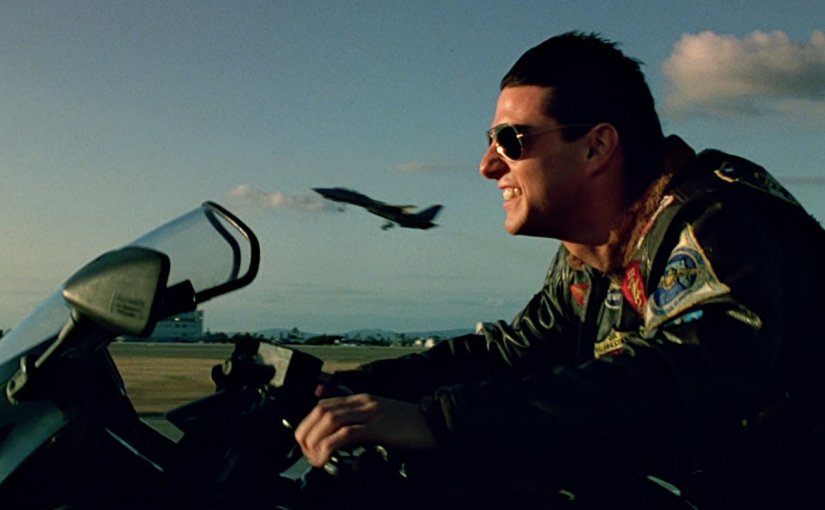
Top Gun remains a mainstay in 1980s pop culture.  If the VH1 channel is doing a documentary on the decade of Madonna, Michael Jackson, parachute pants and neon pastels, Top Gun is also brought up in the mix with a close up of Tom Cruise’s toothy grin and his aviator sunglasses.  We were never watching Oscar winning material here, but somehow the film that introduced all of us to Tom Cruise still feels like a day at the beach with the twenty something boy toy in his tight jeans and leather bomber jacket riding his Kawasaki Ninja motorcycle at top speed or breaking the sound barrier in his fighter jet with his shiny navy-blue helmet on his head.  Top Gun and Tom Cruise demonstrated that it’s a party to serve in the Navy.  Why not?  Vietnam was behind us and the decade was not embroiled in war.  Join the Navy!!!!  It’s fun and you get to shower with the best-looking guys in the world.  You’ll even get to play volleyball with them and date your sexy flight instructor.

A lot of the dialogue and the storyline may sound like an adult, military interpretation of Saved By The Bell, but you can’t break away from the sexy allure of what Tony Scott with Cruise, Kilmer, McGillis and Edwards put on the screen.  It’s always been there and somehow a sequel was never made. 

Wait a second!  WHAT??????

TRUE ROMANCE

By Marc S. Sanders

The structure built into the script for True Romance by Quentin Tarantino, directed by Tony Scott, is like the trunk of a solid oak tree with strong, sturdy branches representing its collection of seedy characters in off color scenes. Tarantino sets it up – an Elvis infatuated boy meets a rookie call girl (Christian Slater, Patricia Arquette). Boy marries girl, and then boy & girl find a suitcase filled with a fortune in uncut cocaine. A simple storyline that now allows a bunch of fun, short vignettes to be played out, all leading to one moment after the other within this universe of outlandish, lurid debauchery.

What works so well in True Romance is that literally from beginning to end, you are always meeting a new and incredibly interesting character. Each scene welcomes someone else into the fold. For that, you need an all-star cast. Gary Oldman, Samuel L. Jackson, Christopher Walken, Val Kilmer, Conchata Farrell, Dennis Hopper, James Gandolfini, Brad Pitt, Bronson Pinchot, Saul Rubinek, Michael Rapaport, Tom Sizemore, Chris Penn, Ed Lauter, Elvis & martial arts master Sonny Chiba. The list goes on and on. It should be noted that some of this cast were hardly bankable stars before this film, which flopped at the box office in 1993. Before the movie became a cult B movie obsession on home video and cable, it was blazing the trail of well-established careers for much of its talent.

Nearly every character can have a story of their own written about them. Take Gary Oldman in one of his best roles as the vicious looking pimp named Drexel, a white guy adopting a Jamaican gangsta accent with dreadlocks, gold caps on his teeth, a blind eye and wickedly curved scar down the side of his face. His appearance alone makes me beg to know this guy’s background in a whole other movie. Drexel’s introduction comes early when he pumps a shotgun into two hoods. Shortly thereafter he’s conversing with Clarence Worley (Slater), and we know who’s in charge of this scene. Oldman is only given about 10 minutes of screen time, but it’s hardly forgettable.

The same goes for Walken, as a well-dressed mafia don interrogating Clarence’s father (Hopper). This scene has become legendary for film lovers, and it carries into a stratosphere of intelligence and timing in performance duality. It remains one of the best scenes Tarantino ever wrote as we learn a probable origin of Sicilians from a doomed Dennis Hopper. This is an acting class at its finest.

Jeffrey L Kimball filmed the piece showing contrasts of a wintery cold and dirty Detroit versus a sun-soaked Los Angeles. It’s sharp photography of gorgeous colors schemes.

Hans Zimmer scored the soundtrack, deliberately saluting Terrance Malick’s Badlands where we followed a similarly young criminal couple played by Martin Sheen and Sissy Spacek. Zimmer’s fun, melodic tones to celebrate Arquette and Slater’s adventures is perfectly in tune with the two-dimensional charm of their new and happy relationship. Most of Tarantino’s script is not taken seriously. Zimmer was the right device for that.

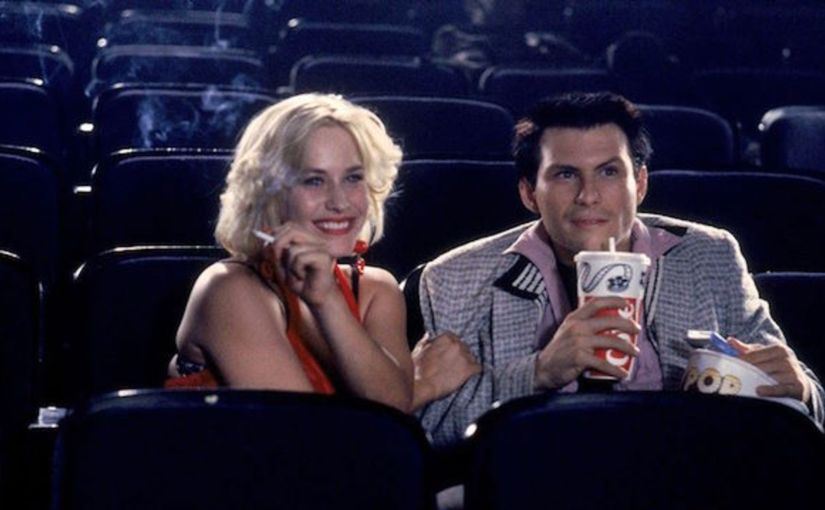
A few spare moments are played with dread, though. Slater and Arquette are truly in love. So, Tarantino & Scott threaten what the film treasures. Arquette as a call girl named Alabama Worley is incredible throughout the film. She’s a silly, adorably cute Southern belle dressed in secondhand store accessories, such as a cow spotted patterned skirt with neon blue sunglasses, and red cowgirl boots. This is not someone you’d hire to manage your accounting firm or run a library. However, Arquette’s emotional range really comes through during a brutal beating scene with Gandolfini. It pains a viewer to watch the moment, but it comes long after we’ve grown to love her.

Later, towards the end, our favorite couple is again endangered during a three way Mexican standoff. It’s hilarious, and way off kilter, but then it also gets downright scary.

That’s the beauty of True Romance. It’s a well-organized mess of emotions from comedy to drama to violence and silliness. Tarantino has great set pieces put together in a connect the dots rhythm.

It’s an endlessly quotable film. It’s a visual film. It’s a literal roller coaster of dangerously amusing storytelling told with affection and gratuity. It’s also quite sweet.

True Romance remains one of my favorite films of all time.

THE PRINCE OF EGYPT (1998)

by Miguel E. Rodriguez

Directors: Brenda Chapman, Steve Hickner, Simon Wells
Cast: Val Kilmer, Ralph Fiennes, Michelle Pfeiffer, Sandra Bullock, Jeff Goldblum, Danny Glover, Patrick Stewart, Helen Mirren, Steve Martin, Martin Short (whew!)
My Rating: 10/10
Rotten Tomatometer: 80% Certified Fresh

PLOT: Egyptian Prince Moses learns of his identity as a Hebrew and, somewhat reluctantly, realizes his destiny to become the chosen deliverer of his people.


I sat down to watch The Prince of Egypt for the umpteenth time today, ostensibly in honor of Passover, but really it’s just an excuse to watch it again.  In the 24 years since its release, it’s become one of my favorite animated films.  I started out thinking it was a gimmicky cash grab.  Then I realized how majestic the score and songs were (by Hans Zimmer and Stephen Schwartz, respectively).  Then I came to appreciate how effectively it humanizes the Exodus story, so it becomes something more than just an excuse for some crazy visual effects.  Then I looked more closely at those visual effects and realized how magnificent they are, too.

So now it’s a treat when I watch it.  But something rare and unexpected happened to me when I watched it today.  Before I get into that, though, for anyone who may still be unfamiliar with this marvelous film…

Moses (Val Kilmer), a prince of Egypt, younger brother to Rameses (Ralph Fiennes) and son to the great Seti (Patrick Stewart), is comfortable with his place in the world.  One day, he comes across Miriam (Sandra Bullock), a Hebrew slave who boldly informs him he is not Egyptian.  He is, in fact, the son of a Hebrew slave woman who set him adrift on the Nile River to spare him from the bloody purges ordered by Seti, the man he calls father.  Disturbed and conflicted, Moses unthinkingly kills an Egyptian slave driver in a heated moment and leaves behind the only family he’s ever known to face his fate in the desert.

There he meets Tzipporah (Michelle Pfeiffer), a Midianite girl on whom he showed mercy earlier, and her family.  Embracing his new Hebrew identity, he marries Tzipporah and becomes a shepherd.  Time passes.  One day, Moses is searching for a lost sheep when he is confronted with a strange sight: a bush that appears to be, not burning, but covered in cold white flames, nevertheless.  To his shock, a voice speaks from the bush.  It is the God of his ancestors, and He is displeased with how His people are being treated in Egypt.  He commands Moses to go to Egypt and tell the pharaoh to let His people go…

Need I go on?  The staff, the plagues, the blood, the angel of death, the pillar of fire…it’s all presented here in spectacular fashion.

When DreamWorks first announced plans to make what basically amounts to a musical version of The Ten Commandments, I was skeptical to say the least.  I even remember what theatre I saw it in: the Ybor Centro movie theater in 1998.  I sat through the movie, and I allowed my skepticism to color my entire viewing experience, right up until the sensational Red Sea parting, which even now is one of the great animated sequences of all time.  But aside from that, I felt The Prince of Egypt was all flash and no substance, a way for an upstart movie studio to get people into theaters with an overabundance of star power and little else going for it.  But after watching it on home video repeatedly…I mean, REPEATEDLY…I started to analyze it a little more.

The first thing that really renewed my interest and appreciation for the film was the humanization of the main characters, particularly the relationship between Moses and Rameses.  Moses is no movie idol in this film.  He’s just a man.  Kind of a scrawny man, too, not classically handsome like his brother, Rameses.  Where Moses looks a little spindly and frail, Rameses looks like he lifts weights, or whatever folks did back then on “arm day.”  I also like how the movie allows these two men to behave and relate to each other like real brothers might.  They race chariots down city streets, needle each other, call each other names, play pranks on the high priests, the whole nine yards.  It’s a dynamic the two men surely must have shared as brothers growing up, but it never gets addressed in other interpretations of the story.  Because we get to see how much they love each other, the scene where Moses reluctantly turns his back on Rameses carries so much more weight than we might be accustomed to seeing.

This dynamic comes full circle when Moses returns to demand freedom for the Hebrew slaves.  Rameses is now pharaoh, and laughs at Moses’ demands, wondering what his “angle” is.  And then, when the plagues are visited upon Egypt and the city has nearly crumbled, the two men share a scene of astonishing power.  Rameses sees his city in ruins, but ruefully remembers how Moses used to get him out of trouble when they were younger.  It’s a wonderfully human moment.

The second element of the film that sparked my renewed interest was the music.  At the end of the opening number, which is itself emotionally powerful on several levels, a solo female voice sings out, “Deliver us!” right at the end of the song.  I can no longer remember a time when that moment didn’t give me goosebumps.  The score by Hans Zimmer is magnificent.  There is one particular motif of a choir of voices that we hear whenever we are in the presence of something holy or mystical, and even that gives me goosebumps.  Another moment that deservers recognition is during the big number, “When You Believe,” as the Hebrews are flowing out of Egypt.  At one point, the song is replaced by a Hebrew folk song, “Ashira L’Adonai,” sung by a little girl.  Her voice is joined by several others, and then a few more, and then a whole choir, and then the whole orchestra comes in for a reprise of the chorus, and if you don’t get goosebumps at that moment, you need a vacation.

The third element that keeps me coming back to this movie is the visuals.  True, the CGI visuals are relatively primitive compared to what was going on at Pixar around the same time.  The chariot race between Moses and Rameses features CG chariots which you may notice have wheels that don’t always turn while the chariot is moving.  This was an aspect of the film that led to my early dismissal of it.  But then came the Angel of Death scene, with a hole literally torn in the sky and sinister tendrils pouring out of it and into the village streets.  And then came the eye-popping Red Sea sequence.  More so than any other version I’ve seen, The Prince of Egypt made me feel in my bones that, yes, THIS is what it would have looked like if uncountable tons of water were parted down the middle, clearing a path large enough for the entire Hebrew nation to walk across.  (Depending on who you ask, that number could have been up to two million people, so we’re talking about a WIDE path.)  As they walk between the two massive walls of water on either side, lightning flashes illuminate sea life swimming alongside them, including some really large fish.  Now THERE’S something you don’t see every day.

So, yeah, the movie is amazing.  People may quibble about its historical inaccuracy, or the liberties it may take with certain religious beliefs.  But that does not diminish its power in the slightest bit.

Which brings me back to what I mentioned in the opening paragraph:

I sat down to watch the movie today, and for reasons I can’t explain, the opening scenes were bringing a lump to my throat.  That solo female voice singing “Deliver us!” nearly brought a tear to my eye.  And it nearly happened again after a wedding song.  And again, when Moses is leading the Hebrews out of Egypt to the strains of “When You Believe.”  And when Moses slams his staff into the shallow waters on the banks of the Red Sea, and those waters shot up into the air and kept going and going…my God, man, I nearly lost it.  I was one thread of self-control away from going full-on blubber-fest.  I mean, I grabbed my chest like a Victorian lady reading a Jane Austen novel.  In the middle of my emotional experience, I kept asking myself, “What is WRONG with me?!”

The answer is, of course, nothing is wrong with me.  I was just in exactly the right frame of mind to have a borderline religious experience while watching a movie.  It’s the same when I watch the finale of Fantasia 2000, when the sprite erupts from the ground in a gesture of pure joy.  Or when Riley learns the importance of experiencing sadness at the end of Inside Out.  Or any number of other transcendent films that can put me right in the middle of the story emotionally.  The Prince of Egypt does exactly that through a well-managed mixture of story, visuals, and music.  It may not be perfect from a technical standpoint, but it gets me where it counts, and that’s all that matters.

HEAT (1995)

By Marc S. Sanders

My all time favorite crime drama, as well another one of my most favorite films, is Michael Mann’s Heat which is widely recognized for the much-anticipated moment where Al Pacino and Robert DeNiro finally share the screen together for the first time. The Godfather Part II never counted as their characters performed in different time periods. Still, Heat has so much more going for it, beyond just its headliners.

Michael Mann wrote the screenplay he directed. It deeply involves both the thief, Neil McCauly (DeNiro), and the homicide detective who pursues him, Vincent Hanna (Pacino), with inspiration from two real life characters. Therefore, this film drives with more authenticity than a standard Lethal Weapon picture. Much more is at stake than a standard kill shot, arrest or the score to take down. The women and children and partners these guys become associated with carry a weight and sense of value. Even the hoods who betray them hold significance. How they matter and are part of the story is just as pertinent.

The story focuses on DeNiro, with Val Kilmer and Tom Sizemore taking down high stakes scores, not petty liquor store hold ups. An early armored truck hold up goes well until a new partner executes the three security guards in broad daylight on the street, at point blank range. Pacino takes the case along with his brilliant squad of detectives that includes great supporting performances from Mykelti Williamson, Ted Levine and Wes Studi. Then it becomes a cat and mouse tale where two equals match one another in wits, skill, and experience. To believe the equal match up though required casting Pacino and DeNiro. The film would not work with any other pair. Through their respective careers, their various performances came off different than one another. Yet, it has been often easy to imagine either one of them playing their classic roles instead. I could envision DeNiro as Michael Corleone or Serpico. I can also envision Pacino as Rupert Pupkin or Travis Bickle. The range of these actors is unlimited.

Diane Venora and Ashley Judd are two actresses not used enough in films. As the wife to Pacino’s round the clock detective, Mann provides time for Venora to show the pain of a woman in love with a man who can hardly ever be home because he’s always on the prowl of DeNiro’s professional thief and his crew. Venora is a likable woman in the role, only the circumstances of her marriage and the difficulties of dealing with a troubled pre teen (a fantastic Natalie Portman who will break your heart with just three scenes) are gradually making her cold. She has a great monologue midway through the film that is terribly dark, as she surmises Pacino’s cunning detective.

Ashley Judd is a different kind of cold as the wife of Val Kilmer’s gambling addicted sharpshooter. She’s a beautiful housewife and mother to a toddler that is trying to maintain a happy home. However, the balance of living with a career criminal is near impossible to maintain.

Michael Mann put so much thought into characters like this. Other directors and writers would keep the story on the streets and in the hideouts and city precincts. Mann goes not just for the low level criminal hoods who provide information in a night club at 2 AM. Mann allows his crime drama to spill over into the home.

He even allows a side story to occur with an ex con (Dennis Haysbert) out on parole trying to get his life back in order. What does this guy with his loving girlfriend have to do with anything else? Eventually, the bridge is connected, and it comes down to an emotional and heartbreaking conclusion.

Heat deliberately takes its time to flesh out a lot of great characters. The large cast are all given moments to stand apart from the rest. It is primarily a quiet, talking picture of careful planning and investigation. However, when the legwork is complete, Mann arrives at two scenes right in the middle of the film. The first is the now famous coffee shop sit down confrontation between Neil and Vincent. Mann did a masterful job of capturing the two actors doing some of their finest work with nothing tangible to aid them; no props or grand music or effects. Just a table in the middle of a crowded coffee shop. The professionals allow their history to show only so much but the cop and thief know this is not going to be easy from here on out. Mann did numerous takes, but with at least two cameras showing at each go round. So, if Pacino is talking, we see DeNiro’s facial reactions and vice versa. Pacino’s take #11 is also DeNiro’s take #11. It is one of the all-time great scenes in film history. Beautifully written. Beautifully constructed. Beautifully performed.

The next centerpiece is the bank robbery that occurs at midday in downtown Los Angeles. Neil and crew are almost scott free when Vincent and squad intercept them in the middle of the street. What sets this massive shootout (based on a real incident) above all others is that I actually get choked up and emotional over the moment. Characters that I have become acquainted with for the last 90 minutes are swept up in huge risks and danger of massive gunfire and ambushes. I even become terrified for the extras that Mann includes in this scene. I’ve watched this scene a hundred times and I can’t help but actually get tearful over it. Mann has the power to make me have an affection for these characters. As well, how will the spouses, who become aware of this matter, be going forward? That accounts for much of the latter half of the film.

Neil holds true to a philosophy he learned while doing time. If you spot the heat around the corner, allow nothing to interfere that you cannot walk away from immediately to avoid getting apprehended. He is put to the test of that motto when he falls in love with an introverted graphic designer played with quiet reserve by Amy Brenneman. This storyline will sum up the ending. Again, Mann shows the characters on the outside of these guys with their guns, working in an underworld environment. How do the risks of these guys play out on others?

Technically, Heat succeeds as well with brilliant blues, blacks and whites in cinematography. Major accolades for Dante Spinotti. Everything from the well-lit coffee shop to Neil’s unfurnished, ocean view apartment and even a blue Camaro that Neil drives away in through an underground tunnel are brilliant. Spinotti paid careful attention to the evolution of the characters. As Neil drives into that tunnel, the car turns white hot. He is on his way to escape with an unsure Brenneman by his side. Often in moments like this, the film tells more than any piece of dialogue could ever sum up.

Heat is a must watch film for genuine portraits of characters few of us will ever cross paths with. We should understand, though, they have more than just a drive to steal or to get an arrest. These guys exist for more than just the score. Few crime dramas ever approach that angle, and that is why Heat is such a special film.

KISS KISS BANG BANG (2005)

By Miguel E. Rodriguez

Director: Shane Black
Cast: Robert Downey Jr., Val Kilmer, Michelle Monaghan
My Rating: 9/10
Rotten Tomatometer: 85% Certified Fresh

PLOT: A murder mystery brings together a private eye (Kilmer), a struggling actress (Monaghan), and a thief masquerading as an actor (Downey Jr.).


Kiss Kiss Bang Bang is so good, it’s a total freaking mystery how this same director, Shane Black, wrote and directed one of the worst movies I’ve seen in the past 20 years: 2018’s The Predator.  Just had to get that out of the way.

I envy you if you haven’t seen this movie yet, because one day it’ll be on Netflix or something, and your curiosity will get the better of you, and you’ll experience for the first time one of the great comedy mysteries ever written.  The dialogue flies faster than an episode of Gilmore Girls, so prick up your ears and stay on your toes, cause this train waits for no one.  The laughs are big and genuine.  The surprises are legion.  The mystery itself is a bit of a head-scratcher the first time around, so maybe watch it again, and you’ll get it.  Trust me…you’ll want to watch it again.

Downey Jr. and Kilmer exhibit the kind of unforced chemistry that deserves comparison to Newman and Redford.  If they decided to stage a two-person show consisting of nothing but the two of them interrupting each other, I’d pay to see it.  The actor in me gets a rush watching them play off each other, with Kilmer tossing off some of the great movie insults of all time.  Example:

Harry (Downey Jr.): “Do you think I’m stupid?”
Gay Perry (Kilmer): “I don’t think you’d know where to put food at, if you didn’t flap your mouth so much. Yes, I think you’re stupid.”

The screenplay is just one of the many delights of this movie.  It’s full of “meta” scenes and dialogue.  A scene occurs, and the movie pauses while the narration tells us, “That is a terrible scene.  Why was it in the movie?”  Or the movie is clicking along and suddenly it pauses again and the narrator tells us, “Oh, s**t, I skipped something!  That’s bad narrating.”  Brilliance.  To paraphrase Bugs Bunny, they do that kind of thing all through the picture.

Kiss Kiss Bang Bang utterly flopped in 2005, grossing a paltry $4.2 million domestically, against a $15 million budget.  What the heck happened?  You’ve got charismatic leads (especially Downey Jr., who was, even then, starting to resemble the Tony Stark we know and love), a beautiful femme fatale (Michelle Monaghan, hubba HUBBA), an intriguing mystery, lots of laughs, surprises galore, a snarky screenplay…this should have been a hit.  Did Warner Bros. refuse to advertise it?  Or did they advertise it incorrectly?  (20th Century Fox did that with Fight Club.)  Was it – gasp! – too smart for the general public?

Who can say?  Regardless of box office performance or name recognition, Kiss Kiss Bang Bang will always stand, for me, as one of the greatest comedy mystery meta-noirs of all time.  (Of course, with that many genre tags, it may BE the only one of its kind…)