
By Marc S. Sanders
The companion piece to Clint Eastwood’s World War II film, Flags Of Our Fathers, and shot back-to-back, is Letters From Iwo Jima. It’s not so much a war film as it’s a perspective of a losing battle during the height of the war, shown through the eyes of Japanese soldiers bearing little ammunition, food, and supplies while being plagued with dysentery and starvation.
Right from the start, what I found interesting is how similar the Japanese mentality is to that of American soldier characters I’m all too familiar within other cinematic retellings. Paul Haggis recruited Iris Yamashita to write the screenplay, entirely in English, and then translated into Japanese. The subtitles seem to read with a familiar English vernacular that my limited knowledge of Japanese culture would never expect. I also find it interesting that rankings are the same from General to Lieutenant for example, and the salute to officers is precisely identical. All of these similarities, and still the world powers find reason to fight one another.
The running theme of the picture reminded me of the television show M*A*S*H. An assortment of characters take the time to write home about their experiences and fears along with the hardships they are enduring with unpure water, sweltering heat, infectious bugs and exhaustion. One soldier’s letters are told will get censored if they ever reach the mother land. These men are bakers and scholars, forced to serve a power that controls them. They are not spies or regular army men. They had no choice but to be here digging and preparing to kill.
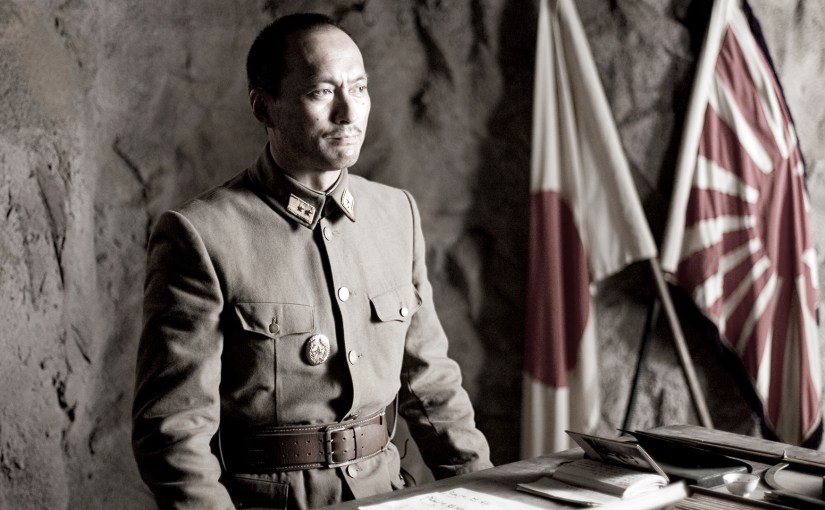
Ken Watanabe portrays General Kuribayashi. In the beginning of the film, he is writing a letter to his wife as he is landing on the island days ahead of the battle to come. One of his biggest concerns is that he did not finish installing the kitchen floor in his home before leaving. Kuribayashi is a celebrated strategist and hero, who actually studied and worked abroad in the United States. He even broke bread with famed American military leaders and carries a valuable gift from them in his holster. Yet, he is committed to his country’s Imperial Army and he knows he will not return home from this island. He also knows that he will have to kill the very same men that he shared a meal with just a few years earlier. That kitchen floor is what is on his mind.
A young infantryman named Saigô (Kazunari Ninomiya) was forced to enlist while his loving wife is carrying their child. I’ve seen character situations like these before. It’s much more revealing to see what cinematic history has described as the enemy to my John Wayne and Clint Eastwood heroes, though. Recently, I listened to The Cine-Philes podcast recap of the film Crimson Tide, and they focus heavily on the midway dinner scene among the officers. Denzel Washington’s character concludes that “…the true enemy of war is…war itself.” Letters From Iwo Jima delivers on that argument.
Ahead of the well-known battle, there’s a quiet tranquility among the Japanese troops. They debate about digging trenches and even fighting on the island which is devoid of any stronghold or power. It’s also an unwinnable battle as the Japanese have realized that they are getting no air or naval support because much of their military cavalries have already been decimated. The ultimate purpose for these men is to hold off the Americans, who are ten times more powerful, for as long as possible. No man serving the Imperials is to surrender. They will fight until they are as good as dead. General Kuribayashi’s best idea to hold out is to dig caves within the mountainsides, thus making it challenging for the American soldiers to locate Japanese within the darkness of the caverns. It worked longer than it should have as the engagement that was expected to only last five days went as long as thirty-six days instead.
Disturbing moments within the film do not compromise. A small unit’s unified shout of “BANZAI!” will live with you forever when you see what they jointly commit within the cave they occupy. Eastwood convincingly shows you the carnage. Another character recollects how he was enlisted for five days in the military before he was forced to serve at this miserable place for disobeying a direct order. His humanity undid him. Letters From Iwo Jima tells the stories before the occurrences that left gravesites (estimated to be ten thousand Japanese men lost) on its black sand beaches.
In a way it makes me proud that Clint Eastwood chose to direct Letters From Iwo Jima. While his war pictures (Where Eagles Dare, Kelly’s Heroes), and even his Dirty Harry films which lean on prejudice for the truth found in humor, are endlessly memorable, he opts to take a sensitive position to the other side of the coin. Eastwood does not lose sight of the fact that his heroes celebrated during the first half of his career were heroically killing and taking out fellow humans. Letters From Iwo Jima recognizes the loss of humanity amidst the rocket fires and artillery of violence. Six Japanese men will take to killing a captured American by beating and stabbing him into lifelessness. Later, faceless Americans concealed by the director’s familiar shadows of photography will point blank kill a pair of unarmed Japanese men.
Flags Of Our Fathers points a critical eye at the celebrations of victory. Letters From Iwo Jima acknowledges victory is beyond reach but the enemy of all of us, war, is never done with any of us.
 2 UNPAID MOVIE CRITICS!!!!