
By Marc S. Sanders
Heretic operates like you’re playing Dungeons & Dragons but adapted into an Escape Room experience. The stakes at play are bigger than just your life. You have no choice but to truly test your faith. Can you adhere to the religious beliefs you always vowed to uphold when a lunatic is holding you captive?
Sister Barnes and Sister Paxton (Sophie Thatcher, Chloe East) are two impressionable young ladies who are proud to spread the gospel of The Church of Jesus Christ of Latter Day Saints from door to door. With bicycles and pamphlets in hand, proudly wearing their name tags, they visit the homes of those who have recently expressed interest in the church.
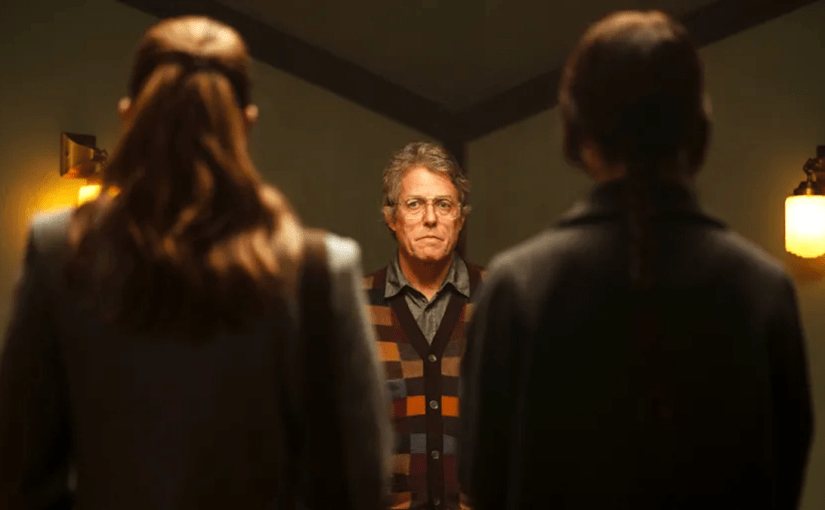
As a dark and stormy night approaches, they knock on the door of an eerie house that belongs to the charming Mr. Reed (Hugh Grant in an utterly surprising role). Once the ladies are assured that the gentleman’s wife is at home, ready to offer some blueberry pie, they happily enter and are quickly engaged in an unsettling test that will carry on through the evening.
I went into Heretic not knowing a single thing about the film and that made my encounter with the piece that much more interesting. It’s a disturbing thriller that always kept me curious. Mr. Reed seems to go on tangents that eventually get to a point where the Sisters are confused, but eventually coherent of the strange man’s demonstrations. The film is not shy about challenging practically every religious denomination known to man from Christianity to Judaism to Islam and Mormonism. According to Mr. Reed the ten thousand other doctrines spread across the planet need also be questioned.
Higher powers and miracles – do they really exist?
There’s no doubt that Heretic is a suspenseful thriller teetering on horror but unlike most effective efforts in this genre I was never uneasy with the picture. It doesn’t rely on jump scares and only gore introduces itself when it must serve the storytelling. However, it’s an intelligent character study where the heroines are challenged over and over again while remaining in captivity. So, I was always enthralled with how Sister Barnes and Sister Paxton will entertain their destiny from one step to another. Stay for pie or don’t. Lie or tell the truth. Choose the purple door or the green door. Belief or Disbelief.
As someone who is primarily educated in Judaism only, it was still not hard to follow the wordy, rambling dissertations of Mr. Reed. He easily compares his own take on religion to the different interpretations found in music from bands like The Hollies and Radiohead, as well as the various editions of the board game Monopoly which suddenly take on new meanings. He even brings up Jar Jar Binks to deliver a point. It’s odd.
Hugh Grant is an unlikely selection for a role like the charming, yet sinister Mr. Reed. As weird as he is in this darkened house with endless hallways, I wanted to trust him through most of the first half of the picture. I didn’t care if there was a haunting corridor or staircase to walk down. This is Hugh Grant of Notting Hill fame. Grant’s resume of roles lends to the surprising effectiveness of his part here. He’s always been that adoring charmer on screen. Ian McKellan or Anthony Hopkins? I’d never trust them. Hugh Grant? Well, why wouldn’t I?
I was hoping-praying actually-that Heretic would not dissolve into a sick rape and slasher movie typical of when young girls are welcomed into a creepy, inescapable house. That’s cheap, exploitative thrills. Fortunately, this movie never goes that route.
The roles of the two Sisters are brilliantly written. To open the piece, before you know anything about Sister Barnes and Sister Paxton the two women are sitting on a park bench that bears a seedy condom advertisement while staring into a heavenly Utah sky. The topic of their conversation is of a pornographic nature. Sinful and mischievous, despite the value they hold in their religion and the proud purpose they serve with the church. These are complex characters that are compelled by their antagonist to make some fair hypotheses about if they genuinely embrace what they claim to value and share with a community.
Heretic is most definitely a psychological thriller with some grotesque imagery. It gets its audience caught in a trapped claustrophobia thanks to a lot of spooky atmospheric labyrinths. Furthermore, its strengths lie in the writing, directing and most importantly three of the best performances to come out this year from Hugh Grant, Sophie Thatcher and Chloe East.
This is a thinking thriller for anyone who has ever uttered a single prayer at least once in their lifetime. If that’s you, then Mr. Reed may have some questions for you. Get out of the rain and step inside.

 2 UNPAID MOVIE CRITICS!!!!