M*A*S*H

By Marc S. Sanders

Forgive me.  I’m not sure my position on Robert Altman’s film will be fair.  All my life, I think I deliberately eluded seeing the motion picture of M*A*S*H as I have been so accustomed to the classic television show that ran for eleven seasons on CBS.  As I expected the two properties couldn’t be further apart from one another.

Altman’s movie still carries a zippy kind of perspective to the horrors of war.  With their hands and surgical scrubs in the thick of gory, blood red surgery, the characters are so much more apathetic to the turnaround of wounded that arrive at the 4077th American mobile army hospital, located three miles from the explosive front lines of the bloody Korean War.  The well-known characters were first given live action roles here following the published novel by Richard Hooker.  

Most surprising is near the end of the film when two doctors realize they are being sent home. One surgeon who is in the midst of operating on a head injury actually instructs a colleague to take over.  This guy has his hands covered in brains and blood and chooses not to finish saving his patient’s life.  Alan Alda of the television show, as a writer, director or while portraying Hawkeye Pierce, would never respond in such a manner. Yet, this is the approach that Robert Altman chose to follow, having infamously always despised the TV series that eclipsed his film in popularity.

Altman’s movie is a slap in the face to the famed oxymoron called “military intelligence.” In 1970, we say bravo for finally saying something frank and honest while a Vietnam War has carried on far too long for not necessarily any of the right reasons.  It’s not so simple to declare war is hell.  It’s much more complicated and horrifying than that.

The film’s opening bylines are quotes by celebrated military leaders of the time, like MacArthur and Eisenhower.  However, these championed commanders are lampooned as we watch shlubby Hawkeye Pierce (Donald Sutherland) arriving in Korea.  He heads directly towards a General’s jeep and steals it, plain as day.  From there on, M*A*S*H operates like a precursor to Animal House with a series of hijinks and a lack of care for military leadership or the U.S.’s purpose in this conflict.  

About the only time, there is any care or forthright anger from anyone is when the jerky Major Frank Burns (Robert Duvall) chastises an underling.  Trapper (Elliot Gould) and Hawkeye punch his lights out and the schmuck ends up in a straightjacket.  Nonetheless, these guys could care less about criticizing and exposing the truth about the institution they have been drafted to serve.  Their purpose is not to make an ironic statement like a Doonesbury comic strip.  They just punch the commanding officer in the face and drink.  The TV show was at its strongest when it relied on the wit and delivery.  Trapper and Hawkeye never use irony or intelligence to belittle a buffoon.  They punch, or they embarrass an authority who’s taking a shower. Regretfully, it’s the dialogue that’s lacking. Robert Altman encouraged much improv on the set and overlayered conversations within his scenes. He found nothing organized or neat and pretty about war, including daily functioning. Chaos did not only reign on a battlefield.

The pace of M*A*S*H moves episodically, and it is likely what led to the idea of a half hour TV show that dominated the airwaves for the better part of eleven years.  A character called Painless contemplates suicide and so a Last Supper reenactment before he sends himself off is inserted. It’s a funny caption from these halfwits, but a storyline focused on deliberately ending a life does not connect with me in a humorous way here. Burt Reynolds, the dark comedy Heathers, and even more recently Tom Hanks toed the line of humor to be found in death by suicide. I think it worked better in those examples. With the somber, well known theme song of “Suicide Is Painless” that is forever linked with M*A*S*H, I just could not muster the laughs for this bit.

There’s also time to build comedy against another regular army brat like Major “Hot Lips” Houlihan (Sally Kellerman, also the best and most memorable of the cast).  The iterations of shower hijinks has been duplicated so often since the release of this picture. Therefore, this gag is dried up. It does not hold its impact fifty years later after dozens Porky’s movies. As well, there’s golfing off the helicopter pad, heavy drinking and a long, drawn-out final act of an overstayed football competition which leads to one of the first times the F-word was used in a mainstream American film.  

In 1970, Robert Altman delivered a bold, risky and daring film to counteract against a losing Vietnam War and the heroism of John Wayne’s bravado in war pictures.  The chutzpah to lash out against American politics likely felt relatable to many who saw different and more realistic images when they understood their young sons and daughters were not coming home and were thus forever changed.  Richard Hooker’s properties and stories lent an understanding to the animosity of those who forced the war on America’s children and loved ones.  War has never been consistent with the short film propaganda asking you to buy war bonds. M*A*S*H negated the heroism of Hollywood sensationalism found in machine gun fare and overtaking a hill while draped in green fatigues with shiny bronze ammunition hanging off their shoulders. These soldiers of war deserve our country’s utmost respect, but they did so much more than what John Wayne demonstrated. They offered up parts of themselves they would never get back.

M*A*S*H deliberately left out the heroes.  However, seeing the film for the first time, over fifty years later, I wish that at least we could follow the escapades of doctors who also directed a bed side manner to the pawns who were dying while upholding their leaders’ cause.  The doctors of Robert Altman’s interpretation hardly emulate a reason to care. 

The film interpretation of M*A*S*H is outdated of its time of release and the period in which it takes place.  I like to think we live more humanely than not just how our military leaders functioned.  I wished these physicians used their scalpels with a much less obtuse absence of empathy.  Hate the puppet masters, yes. Yet would it kill these guys to still care about the puppets? 

ALIEN

By Marc S. Sanders

To be lost and alone is my absolute greatest fear.  I don’t know what to do when I find myself in situations like that.  I feel palpitations and terrible anxiety.  The only argument my wife and I had on our honeymoon was when we got lost in the Louvre in Paris.  She was relaxed.  I definitely was not.  I didn’t know in which direction to walk through the massive museum, located in a country that I’m not at all familiar with, inhabited by a majority of people who speak a language that I’m terribly limited at using for conversation.

When a person is completely, physically isolated, the only thing to depend on is his/her own wits and sensibilities.  That’s step one in constructing a scene of terror.  Step two is to lock that person away with an entity that is unpredictable, unrecognizable, smart and grotesquely frightening.  In a film, each time that entity comes into the play, the scene should not look like the last time the protagonist or the audience encountered this creature.  Whatever I learned a few minutes ago is not going to offer much help the next time around. 

I’ve just described the spine of the story that makes a horror film like Ridley Scott’s Alien so successful.

Science Fiction always works best when it can be convincing enough to lend authenticity to the fiction of its, well, science.  With Alien, a variation of biology and evolution lends to the terror of the picture and you don’t even realize it until the movie is half over. The title character is introduced in different characterizations with every scene it is called for.  First, it’s an egg, then a tentacled creature wrapped around the face of an unfortunate victim.  Later, at dinner time, it reveals itself in an unforgiving and memorable scene as a phallic shaped organism with a snake like tail and steel teeth.  Lastly, you just can’t even describe what it is except to say it is huge and its even worse than the monsters you imagined as a kid hiding in your closet or under your bed.  Credit has to go to the creature designs from H.R. Giger.  Every limb or shape of the monster seems to serve a purpose.  If that’s not enough, the animal bleeds acid that’ll burn through the hull of an enormous spaceship.  The alien in this 1979 film, later deemed a “xenomorph,” is one of the scariest and most unforgettable monsters in movie history.

A crew of seven are piloting a large ship back to the planet Earth.  Their cargo is carrying mineral ore (whatever that is).  This crew is not military of any kind.  There’s a science officer, but by and large, I’d characterize these people as truckers in outer space working on behalf of a company, by hauling a load across the galaxy.  During the long journey, they rest in a cryo-like sleep.  As the film opens, they are awakened by their transmission computer, known as “Mother,” to respond to a distress call.  Their ship has been diverted from Earth to investigate an unexplored planet.  As the piece continues, the crew brings back a plus one. They have no idea what to expect or how to handle its presence, and then they are hunted across the maze of the large ship, dispatched one by one.

The byline for Alien is marketing brilliance.  In Space, No One Can Hear You Scream.  It only scratches the surface of the terror you encounter when watching this terrifying film.  Ridley Scott uses art direction set up with long, dark hallways and warehouse size rooms that make the cast appear infantile.  His labyrinth of a spaceship offers up practically any place for a killer creature to hide and strike at an opportune time. 

It’s important to point out that Alien lends to the argument for the value of 4K resolution.  This latest print to honor the film’s 40th anniversary offers much clarity within the dark settings of the picture.  Having seen Alien countless times, I still examine each frame carefully because Giger’s designs allow the monster to blend in properly with engineering architecture of long and large pipes and cables, and immense darkness.  Chains hang from the ceilings and water drips down for no reason to be explained.  It’s just how the spaceship lives, apparently.  The atmosphere rattles you, however, when you realize there’s a dangerous bug crawling around somewhere.  Did I just catch a glimpse of the alien’s head there????  Was that his tail????  Is that a limb, like an arm or a hand????  I know all of the highlights of the picture by now, but to this day I still look for when and where the silent terror is looming, thinking I missed it from the last time I watched.  Would you believe on this last viewing, I found a caption of the alien I don’t recall ever seeing before?

Once the monster is established and we see our heroes within inescapable danger, then paranoia and mistrust can lend to their erratic nature.  The screenplay from Alien co-creator Dan O’Bannon establishes how the “grunts” of the seven (Yaphet Kotto, Harry Dean Stanton) debate what is and isn’t their responsibility and what monies they truly are entitled to on this mission.  Early on, before the threat is even considered, a divide exists within the band.  They are not always going to get along.  Later, the debate on whether to quarantine the crew members who investigated the distress signal on the strange, unknown planet comes into play.  It would be easy to simply make Alien all about blood, guts and sci fi laser pistols in a post Star Wars/Star Trek era, but it is even more effective to create disagreements and seeds of unreliability among the group.  One or two of them could end up operating in a different and unexpected direction that won’t help their cause.  Maybe it’s not just the alien we should be afraid of.

The seven members (5 men, 2 women) all have different personalities.  They like one another well enough, but they all have uncommon values and motives.  Sigourney Weaver portrays Ripley, the third in command, behind two men.  However, in outer space, does it really matter where she falls in the line?  The science officer, Ash (Ian Holm), seems to drift into his own way of thinking, separate from the rest.  Captain Dallas (Tom Skerritt) moves along the straight and narrow, only doing what’s assigned simply to move on and get things over with.  The other woman Lambert (Veronica Cartwright) does not have much dialogue to work with, but her expressions seem to be questioning why she even took this job.  Was this woman desperate for work and this is the best she could find?  She’s definitely the most unrelaxed and fearful of the crew.

Like Steven Spielberg’s Jaws, Alien does not operate on the movie monster alone.  There are other factors at play.  A popular Hollywood story is that Spielberg didn’t show the shark for a long period of time simply because the thing would not work, mechanically speaking.  Ridley Scott, however, demonstrates that he can present the animal one way and then show it in a completely different form later.  When it has reached what we can only believe is full evolution, we still don’t get a clear physical picture of the creature’s design from head to toe.  Scott will show us teeth, or maybe a shoulder blade or a tail that whips or moves at a slow and cautious pace.  The alien functions with a combination of real-life predators’ behaviors.  It hatches.  It sheds its skin.  It bites.  It runs.  It hunts a prey.  It grows and evolves…and seemingly very quickly.

Alien has been duplicated many times following its release, including a few shameless sequels.  Mind you, some of the franchise follow ups remain exceptional in their own right.  What misgivings Ridley Scott’s movie have later inspired cannot be helped.  Mr. Scott should consider it an honor, at best, that various craftspeople have attempted to top what he accomplished, I guess.  Those copycats don’t follow the recipe of Alien though.  There’s either too much of an ingredient included like blood and guts or there’s a lacking in its script, such as the eerie haunts of a dangerous setting or the overeager intelligence of its characters.  Whatever the case may be, the achievements in horror work so well in Alien, because it moves with dread, uncertainty, helplessness, a lack of knowledge, and then with only a few touches of gore and violence that are mostly left to our worst imaginations. 

Alien is not only one of the best science fiction films ever made.  It is also one of the best horror films ever made.

TOP GUN

By Marc S. Sanders

For a movie that focuses a lot on showers, men’s locker rooms and bare chested sweaty and chiseled volleyball players, it’s a wonder that it is called Top Gun.  Maybe the title has another indirect meaning to it, other than a moniker for a Navy fighter pilot school of the elite.  Maybe these guys are elite for a different reason.

The Tony Scott film that is supposedly about the top one percent, the best of the best, American fighter pilots in the Navy is arguably the most important film in Tom Cruise’s career.  It launched the actor into a superstar sensation that has hardly faltered since the movie’s release all the way back in 1986.  But is it a good movie?  Well, yes and no.

I’ve always loved Tony Scott’s filmmaking technique.  Sure, his sun-soaked film shots are constantly repeated.  He always relishes in enhancing the beaded glow of sweat drenching his actor’s faces, arms and chests.  It’s seen in nearly every moment of Top Gun, as well as other celebrated pictures like Crimson Tide, Beverly Hills Cop II and True Romance.  Orange sunlight blankets palm trees and beach lined streets.  Bar saloons and military headquarters are lit in sexy blues and greens.  It may lack originality after seeing a few of his films, but it just makes the movie all the more sexy. 

Tony Scott is also a well-versed director in action sequences.  He’ll get your pulse racing and Top Gun is the best example.  The fighter jet sequences in this film are masterful in editing, sound and speed.  It’s fantastic to see how the planes will twirl around and then shoot themselves straight up into a vertical trajectory in the sky and finally cut in on actors Tom Cruise, Anthony Edwards and Val Kilmer for a “WOO!” moment in the cockpit.  This stuff still holds up.

Yet, unlike other modern-day films that focus on cadets or students in our armed forces, Top Gun doesn’t concern itself with the discipline of what it takes to serve in the Navy.  This is the informal, class clown version of An Officer And A Gentleman.  You only need look as far as Tom Cruise’s character’s pilot call name, Maverick.  The name itself is a one-word thematic description of what you are watching.  So, the kid who learned to say “what the fuck” in Risky Business, went on to do daredevil flybys while disobeying orders.

Maverick’s real name is Pete Mitchell.  He has no family except that of his co-pilot, Goose (Anthony Edwards).  The disappearance of his Navy pilot father remains a mystery…because it is sexy and cool to have a mystery for your handsome hero in a film like this.  Call it DRAMATIC HEFT!!!! 

When Maverick and Goose get the opportunity to attend “Top Gun” – a fighter school specializing in training the best pilots in the world in aerial dog fighting – they are intent on getting their names on the plaque for the best of the best of THE BEST.  Competition comes in the other prettiest of the pretty boys with Iceman (Val Kilmer).  These are all great likable characters.  Yet, even when I saw this film at sleepaway camp at age 13, I couldn’t help but notice how distracted it gets with the abundance of erotic machoism on display here.  What would serve as dramatic dialogue in another film is presented in a steam room area allowing opportunity to see the male cast wrapped in towels around their waists with wet spiky blond and black hair.  It truly doesn’t matter what they are talking about in this scene.  When you are watching it, all that you are hearing is the sound of Charlie Brown’s unseen and indecipherable school teacher.  “Waa waa.  Waa waa waa waa!”

That’s not enough though.  The infamous volleyball scene keeps you awake.  I don’t care if you are hetero or homo or bi or pan or plus, the beach volleyball scene keeps you alert as one of Kenny Loggins’ many movie songs plays in accordance.  Tony Scott doesn’t just go for tossing the ball around.  Slow mo captions are offered of each guy just posing with their chiseled arms and chests.  You may not take your eyes off of it, but oh my…what does this have to do with the discipline of attending Navy fighter pilot school training?????

The romance is second to none.  Truly!  These days, people talk about Jack and Rose in Titanic or Ross and Rachel on Friends.  For me, it’s Maverick and Charlie (Kelly McGillis).  Cruise and McGillis really light up their scenes together.  It’s an absolute perfect pairing of sex appeal and it is really when Top Gun performs at its smartest level.  The dialogue is strongest during their scenes.  The romance isn’t rushed but nicely flirted with, and when tragedy strikes within the thin storyline of the overall film, the relationship goes in another supportive and appreciated direction.  When I was a kid, with hormones being discovered for the first time, my buddies and I would elbow each other during the midnight blue sex scene between McGillis and Cruise with the Oscar winning song “Take My Breath Away” from Berlin playing.  I look at this scene now and it is modern romance at a beautiful best.  A fantastic scene from Tony Scott. 

Charlie is the unexpected, well-versed contractor for the Navy giving counsel to the pilot students on how best to operate the jets.  In the 1980s, action blockbusters normally held the women as the barely dressed damsels to be rescued, and nothing more.  The female characters didn’t have brains and the only brawn to go around was saved for Princess Leia or Marion Ravenwood (Raiders).  Charlie is an exception though.  McGillis plays the character as someone who is aware that these testosterone-filled guys will regard her as a piece of meat, until they realize otherwise.  The irony of Top Gun is that the nearly all male cast, Cruise included, are the pieces of meat.  The one main female role is actually the brains of the whole operation.  McGillis was a marvelous actress back in the day.  Go look at Witness and The Accused to see what I mean.  With her help, Cruise elevates above the hokey dialogue of the Top Gun script. Kelly McGillis really could act well in almost anything.  I wish her career went further, honestly. 

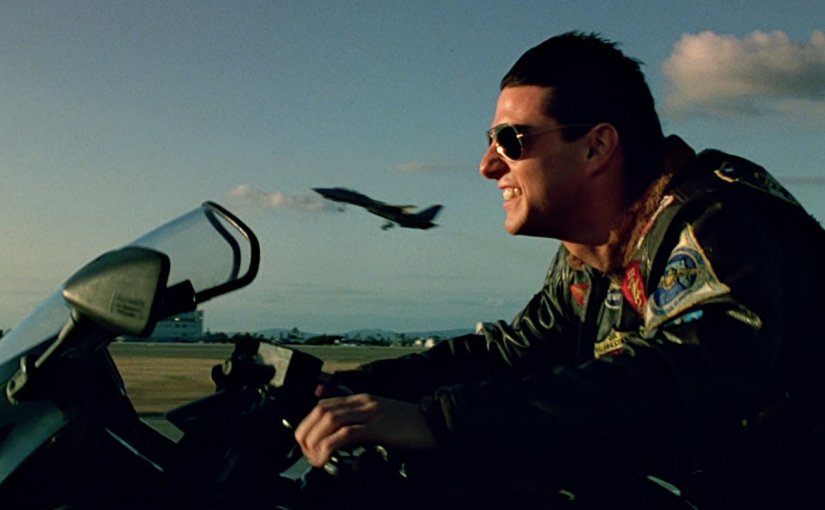
Top Gun remains a mainstay in 1980s pop culture.  If the VH1 channel is doing a documentary on the decade of Madonna, Michael Jackson, parachute pants and neon pastels, Top Gun is also brought up in the mix with a close up of Tom Cruise’s toothy grin and his aviator sunglasses.  We were never watching Oscar winning material here, but somehow the film that introduced all of us to Tom Cruise still feels like a day at the beach with the twenty something boy toy in his tight jeans and leather bomber jacket riding his Kawasaki Ninja motorcycle at top speed or breaking the sound barrier in his fighter jet with his shiny navy-blue helmet on his head.  Top Gun and Tom Cruise demonstrated that it’s a party to serve in the Navy.  Why not?  Vietnam was behind us and the decade was not embroiled in war.  Join the Navy!!!!  It’s fun and you get to shower with the best-looking guys in the world.  You’ll even get to play volleyball with them and date your sexy flight instructor.

A lot of the dialogue and the storyline may sound like an adult, military interpretation of Saved By The Bell, but you can’t break away from the sexy allure of what Tony Scott with Cruise, Kilmer, McGillis and Edwards put on the screen.  It’s always been there and somehow a sequel was never made. 

Wait a second!  WHAT??????