POINT BREAK (1991)

By Marc S. Sanders

Stop me if you heard this one before.  Richard Nixon, Gerald Ford, Jimmy Carter and Ronald Reagan walk into a bank…

Yeah.  That’s right.  I’m talking about Kathryn Bigelow’s Point Break.  There’s a line in the movie where the rookie FBI hero, Johnny Utah (Keanu Reeves), is described by his new supervisor as being young, dumb and full of cumb.  Pretty fair assessment.

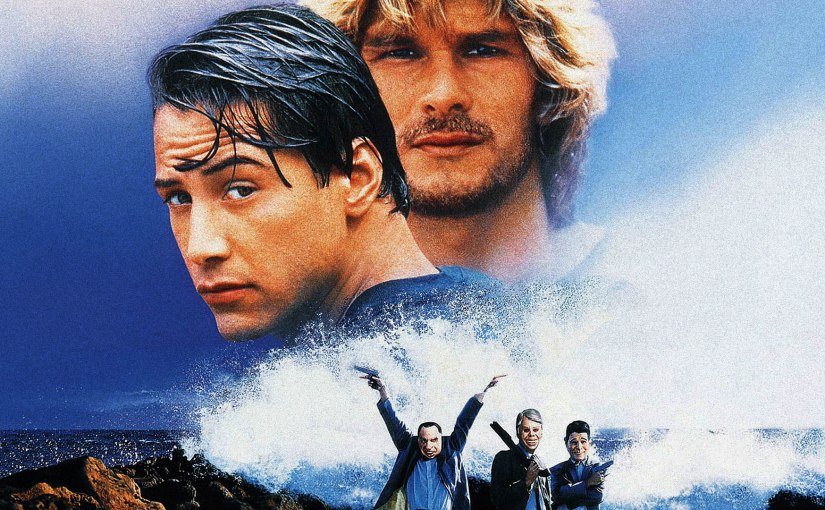
Much of this crime caper works despite the silly summary.  Agent Utah’s seasoned partner Pappas, played by Gary Busey, believes that a series of coastal California bank robberies are being committed by surfers who roll into town each year when the waves are at their most tubular.  They don silly looking rubber masks in the appearance of the Ex-Presidents of the United States to commit their ninety second smash and grab.  Fortunately, Johnny Utah looks and talks like Keanu Reeves who was raised in Hawaii and has experience playing a gomer like this in two other movies that were headlined by some dudes named Bill & Ted.  As well, don’t forget what he hilariously did in Ron Howard’s Parenthood.  Yes, Johnny Utah should fit right in with the California surf.

Point Break does not take itself seriously in its first half.  Johnny has to learn how to look the part of a surfer with a neon pink board amid the colony of saltwater dwellers.  Standard stuff pops up like the angry supervisor (John C McGinley) who screams about no progress being made.  Unfortunately, a romantic love interest named Tyler has to enter the fold played by an actor I’ve never been fond of, Lori Petty.  I’m supposed to believe that she is going to teach Johnny how to ride the waves and chastise him when he’s doing it wrong, and then he’s going to fall hard for her when she delivers one arbitrary piece of dialogue after another.  “What’s this pig board piece of shit?”  “Too much testosterone around here. Later!” Also, for those intimate scenes in the dark calm waters with the moon and stars gleaming in her eyes, Tyler has to ask Johnny something along the lines of “What’s that strange look you got?”  and “There it is again.”  Maybe it’s not all Petty’s fault.  The script doesn’t give her much to work with honestly.  Nothing Tyler says is relevant.  How it is delivered by Petty is not the least bit intriguing and honestly with only few nip/tucks, this character storyline could have been saved for special edition DVD featured deleted scenes that you’ll only watch once and never share on You Tube. 

On to the good stuff. 

You can see how amazingly talented a director like Kathryn Bigelow really is and it is no surprise that a couple of decades of experience led her to a well-deserved Oscar for directing The Hurt Locker.  Going all the way back to films like Blue Steel and Point Break demonstrated that Kathryn Bigelow made a name for herself based on stellar filmmaking skills.  Just look at the sky diving footage alone.  You see all the tricks as the camera follows the daredevils out of the plane and into the sunny blue sky with genuine close ups and acrobatic flips to relish in.  Sensational work.  Gorgeous photography and smooth, unshaking camera operations. Nothing artificial in these sequences.

Moreover, there is the surfing of course.  The checkered bag guy of this action picture is another variation of a dashingly handsome Patrick Swayze with shaggy dirty blond hair, dirty blond facial whiskers and his distinctive voice that if it could be described as dirty blond it would be dirty blond. Plus, a chiseled chest to show off during a karate fight scene.  He plays a guy named Bodhi.  I guess Walter, Melvin, Murray and Jack would not be cool enough.  (My dad, uncle, and grandfathers by the way.)  While Johnny maintains his undercover investigation with Pappas watching from the outside, he becomes enamored with Bodhi and his crew.  They like him in return.  Yet are these those Ex-Presidents who are robbing the banks?

Point Break is a smarter thriller than I think the filmmakers even realized because other than Lori Petty it is cast very well with Reeves and Swayze in the lead roles and a fun cooky Gary Busey on the side.  These actors are game for the quick moving adventures that Bigelow strives for.  There’s a fantastic foot chase through the back streets of Santa Monica following one such bank robbery.  This scene alone is eligible for a Best Editing Oscar with handheld Steadicams following the running players in and out of houses, around flaming gas stations and backyards with barking dogs and dense red light running traffic getting in the way.  Amazing film work.

The surfing would have to be stellar if the antagonists are in fact surfers. The photography is magnificent with narrow waves curving over the cameras directly pointing at Swayze, Reeves and cast coming right towards the screen while balanced on their boards with golden suns hovering overhead.

While Point Break does not seem to know when to end because the credits could have rolled up on three or four different occasions, at least the film insists on having fun with itself. 

I recall in The Predator Olivia Munn’s character went to MIT with a science major that somehow also included military trained special ops in its elite curriculum. I’m expected to believe that nonsense.  On the other hand, when I see Bill’s friend Ted has graduated in the top two percent of his FBI class at Quantico, Viginia, I can buy it.  I don’t have to dwell on it. Now I can enjoy the ride from a sky diving standpoint or a choppy mariner’s perspective.  My suspension of disbelief is bought, sold and paid for. 

Point Break is a smart thriller with a dangerously fun, zippy edge to it.
SAVING PRIVATE RYAN

By Marc S. Sanders

How much blood needs to be spilled to change the color of an ocean red?  The battle of Normandy during World War II showed quite a bit, and Steven Spielberg more than convincingly duplicates that terrible episode in world history with his war picture Saving Private Ryan

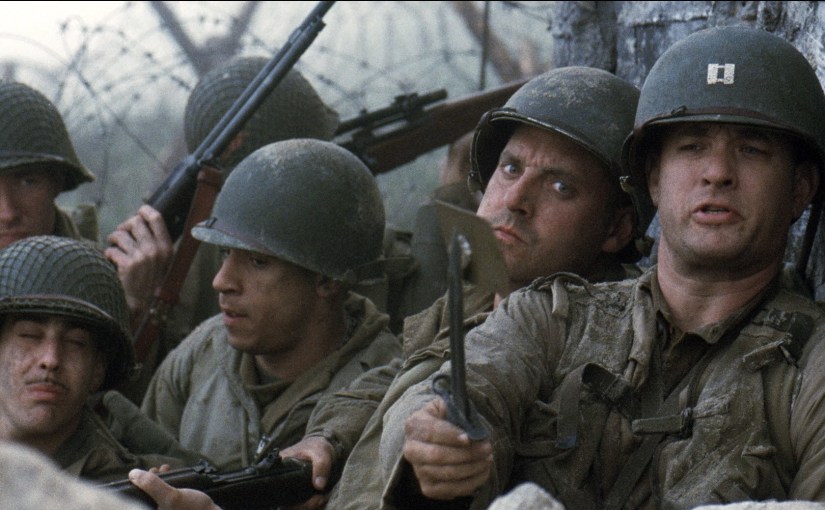
Spielberg earned his second Oscar for direction with this film from 1998.  It’s not only a technical marvel, but it’s a story that tests the nature of humanity when a squad of American soldiers ask themselves if saving the life of one man is worth sacrificing themselves.  Tom Hanks leads the team of recruits.

Saving Private Ryan begins on June 6, 1944 when thousands of American soldiers were inevitable sitting ducks as they washed ashore on Normandy Beach to engage in battle with German forces.  Spielberg’s footage is astonishing.  First of note is the cinematography is wisely washed out of color.  The sky is grey.  The ocean water and sand feel frigidly cold.  The most dominant color is blood red.  The fear displayed on the thousands of extras portraying soldiers, who never look mentally ready for battle, is palpable. 

The shots in this roughly thirty-minute opening do not compromise.  A soldier is seen walking around looking for his arm that has been shredded from below his elbow.  Other soldiers will turn over one way out of camera, but when they roll back into frame there’s a smoking hole where their face used to be.  Deadly head shots come out of nowhere.  Army medics have their hands soaked in bright red blood while trying to use scissors and thread to sew up wounds caked in wet sand. 

The action slows down at one point to focus on Hanks.  We haven’t even gotten to know his character yet, but we realize he is exhausted of this violence.  His hearing seems to deafen for a moment while he watches the horror quickly unfold as he puts his helmet back on only to have blood-stained water shower down over his head.  War is not meant for heroics and glamorization.  War only serves chaos and brutal death. 

Following this incredible opening sequence, one of the most impressive ever to start a film, Captain John Miller (Hanks) receives orders to locate the titled character, a paratrooper named Private James Francis Ryan (Matt Damon).  The army insists on sending the young private home to his grief-stricken mother, who has recently lost her other three sons in the conflict.  So, Miller recruits a handful of men consisting of fantastic actors like Tom Sizemore, Edward Burns, Vin Diesel, Adam Goldberg, Barry Pepper, Giovanni Ribisi and Jeremy Davies to make the trek across war torn Europe and rescue Private Ryan before he perishes as well.  How is that really fair though?

Any one of these men are sons to a worried mother back home.  The script for Saving Private Ryan by Robert Rodat has the men question why should they risk their own lives to find this one kid?  What makes him more special than any one of them?  Is the United States Army being fair?  Are they using this special mission as a means of propaganda?  Questions like this are irrelevant to the war department.  Just get him the hell out of there.

The journey of Miller’s squad is not just a simple hike.  At any given moment, they will come across a bombed-out town or another regimen who has just experienced their own kind of hell.  Further questions are asked when Miller recognizes an opportunity to take out an enemy battalion.  His own men suggest circumventing around this potential battle.  Miller won’t hear of it.  He’s a soldier.  Yet, after it is done, there is loss of life.  Should he have listened to their warnings or was he right to engage the enemy to avoid another team of allies suffering a terrible fate? 

Other dilemmas also come into play.  Should they escort a family and their young children who have lost their home?  The brutal dialogue of the script says that’s not their job.  Their goal is to take out the enemy and eventually rescue this one man.  Should an unarmed German prisoner be forced to dig his own grave and later be executed for the atrocities he’s committed?

War tests the ultimate limits of man.  What has to be done to allow us to finally, ultimately and justifiably shed ourselves of our humanity?  A correct answer is never provided in Saving Private Ryan.

Amid a series of astonishing battle scenes and images, two parts of the film stand out for me.  Following the loss of one of their comrades, there is disorder within the ranks.  This is where Tom Hanks takes control of a chaotic scene.  John Miller knows his soldiers have placed bets on what he does for a living back home.  Considering the strategist that Miller shows himself to be, its quite startling to find out what his occupation is.  It’s so surprising that Hanks as Miller uses it to temper his men which segues nicely into why Miller honors the mission assigned to him, even if it means risking his own life.  It’s not the best answer to why one man is more valuable than any other, but it’s the only one we are going to get. 

An even more powerful image comes to mind in the third act.  Jeremy Davies plays a Corporal assigned to the team to be a German and French interpreter.  He’s a soldier in this war, but he’s the last one you would want in combat.  As the American forces await the inevitable arrival of a German tank and a large number of troops to arrive, the men assign Davies to hold on to the long chains of ammunition and artillery.  He is draped in bullets around his neck and shoulders.  As the battle engages, shots are fired in all directions, men are quickly dispatched and Spielberg wisely has his cameras follow a helpless, weeping Davies do nothing but run from one end of the street to the other and up the stairs of a blown-out building.  He has all of the power in the world but he lacks the muster to kill and destroy which is what the nature of war demands.  He can even hear a man slowly die by stabbing in the floor above him. Yet, the Corporal can’t even rush to rescue his friend, and slaughter the enemy.  War destroys, but it also paralyzes man to act beyond an intrinsic nature of peace.  Each time I watch this scene, I can’t get past what this poor young man is truly capable of while being utterly helpless at the same time. 

I found Spielbergian techniques in Saving Private Ryan that hearken back to other celebrated moments in his film repertoire.  Tom Sizemore engages an enemy, only for both of them to run out of ammunition.  So, they wind up clumsily throwing their helmets at each other.  Indiana Jones might have done something like this for the sake of some form of slapstick.  Spielberg applies desperation to this scenario however.

The German tank at the center of the third act is somewhat reminiscent of the shark from Jaws.  Before we get an opportunity to see it, a focused Barry Pepper in a sniper’s bird’s nest gives a visual description of how big it really is and what accompanies it.  Later, Miller and Ryan have taken cover in a trench of rubble only to be overtaken by this beast as it careens over them.  The mouth of its cannon seems to come alive just before it blasts out a tower.  It’s just as scary and shocking as even Spielberg’s pictures of fantasy and adventure came before the release of this picture.  Every shot Steven Spielberg provides in any one of his films build towards an intrinsic and organic response from his viewers.  He always works with that goal in mind.  The tank is the tool used here.

The art direction is fascinating in this film as well.  A knocked over chair is picked up before a soldier stands it up as sturdy as he can on top of splintered wood and crumbled stone.  Sand on the beach is blasted up and out, sometimes splattering the lens of the camera.  Ocean water too.  Pockets of afterburn flames will be seen in the distance of a war-torn area.  The tangibility of these set pieces works cohesively with the distressed colors of a weathered and battle-stricken Europe. 

As chaotic as Spielberg demonstrates war to be, the editing is also commendable.  A war movie like this is not an action picture for the sake of escapism.  We don’t need to see the gun that fired the bullet that pierces the skull of a person.  We just need to see the person get a bullet that penetrates his helmet only to blow his head off to understand the unforgiving nature of war.  A man might be dialing up headquarters requesting air support, but he suddenly will not finish the conversation.  Editing allows the unexpected to become all too common in the midst of battle.

Saving Private Ryan is one of the best films ever directed by Steven Spielberg.  He had already shown real brutality not embedded in fantasy with films like The Color Purple, Empire Of The Sun and especially Schindler’s List.  Yet, with this picture, small factions of men, seeking world conquest, might have started this terrible conflict, but the movie does not concern itself with those instigators.  Instead, we witness the pawns at the disposal of war.  We see the collateral damage that suffer and die at the hands of unseen powers that be.  With Robert Rodat’s script, Steven Spielberg questions the value of one man versus a collection of men, and how any man, who may physically endure this terrible period in time, can also mentally survive long after it is all over. 

TRUE ROMANCE

By Marc S. Sanders

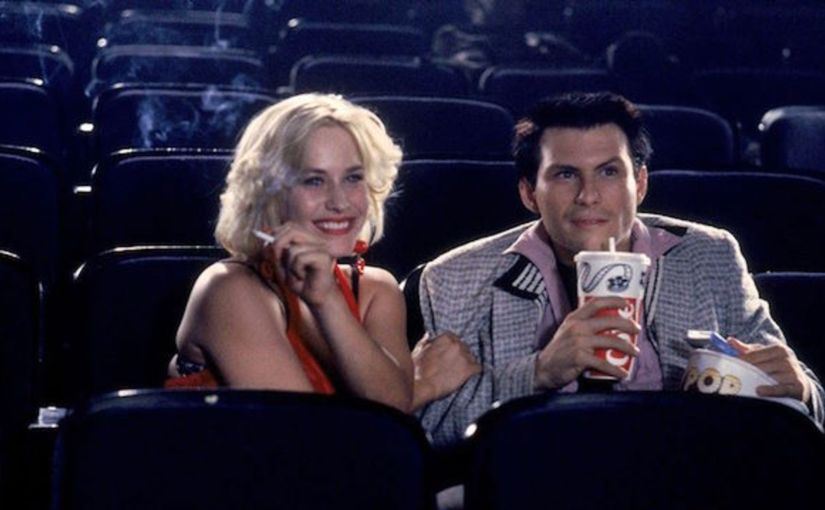
The structure built into the script for True Romance by Quentin Tarantino, directed by Tony Scott, is like the trunk of a solid oak tree with strong, sturdy branches representing its collection of seedy characters in off color scenes. Tarantino sets it up – an Elvis infatuated boy meets a rookie call girl (Christian Slater, Patricia Arquette). Boy marries girl, and then boy & girl find a suitcase filled with a fortune in uncut cocaine. A simple storyline that now allows a bunch of fun, short vignettes to be played out, all leading to one moment after the other within this universe of outlandish, lurid debauchery.

What works so well in True Romance is that literally from beginning to end, you are always meeting a new and incredibly interesting character. Each scene welcomes someone else into the fold. For that, you need an all-star cast. Gary Oldman, Samuel L. Jackson, Christopher Walken, Val Kilmer, Conchata Farrell, Dennis Hopper, James Gandolfini, Brad Pitt, Bronson Pinchot, Saul Rubinek, Michael Rapaport, Tom Sizemore, Chris Penn, Ed Lauter, Elvis & martial arts master Sonny Chiba. The list goes on and on. It should be noted that some of this cast were hardly bankable stars before this film, which flopped at the box office in 1993. Before the movie became a cult B movie obsession on home video and cable, it was blazing the trail of well-established careers for much of its talent.

Nearly every character can have a story of their own written about them. Take Gary Oldman in one of his best roles as the vicious looking pimp named Drexel, a white guy adopting a Jamaican gangsta accent with dreadlocks, gold caps on his teeth, a blind eye and wickedly curved scar down the side of his face. His appearance alone makes me beg to know this guy’s background in a whole other movie. Drexel’s introduction comes early when he pumps a shotgun into two hoods. Shortly thereafter he’s conversing with Clarence Worley (Slater), and we know who’s in charge of this scene. Oldman is only given about 10 minutes of screen time, but it’s hardly forgettable.

The same goes for Walken, as a well-dressed mafia don interrogating Clarence’s father (Hopper). This scene has become legendary for film lovers, and it carries into a stratosphere of intelligence and timing in performance duality. It remains one of the best scenes Tarantino ever wrote as we learn a probable origin of Sicilians from a doomed Dennis Hopper. This is an acting class at its finest.

Jeffrey L Kimball filmed the piece showing contrasts of a wintery cold and dirty Detroit versus a sun-soaked Los Angeles. It’s sharp photography of gorgeous colors schemes.

Hans Zimmer scored the soundtrack, deliberately saluting Terrance Malick’s Badlands where we followed a similarly young criminal couple played by Martin Sheen and Sissy Spacek. Zimmer’s fun, melodic tones to celebrate Arquette and Slater’s adventures is perfectly in tune with the two-dimensional charm of their new and happy relationship. Most of Tarantino’s script is not taken seriously. Zimmer was the right device for that.

A few spare moments are played with dread, though. Slater and Arquette are truly in love. So, Tarantino & Scott threaten what the film treasures. Arquette as a call girl named Alabama Worley is incredible throughout the film. She’s a silly, adorably cute Southern belle dressed in secondhand store accessories, such as a cow spotted patterned skirt with neon blue sunglasses, and red cowgirl boots. This is not someone you’d hire to manage your accounting firm or run a library. However, Arquette’s emotional range really comes through during a brutal beating scene with Gandolfini. It pains a viewer to watch the moment, but it comes long after we’ve grown to love her.

Later, towards the end, our favorite couple is again endangered during a three way Mexican standoff. It’s hilarious, and way off kilter, but then it also gets downright scary.

That’s the beauty of True Romance. It’s a well-organized mess of emotions from comedy to drama to violence and silliness. Tarantino has great set pieces put together in a connect the dots rhythm.

It’s an endlessly quotable film. It’s a visual film. It’s a literal roller coaster of dangerously amusing storytelling told with affection and gratuity. It’s also quite sweet.

True Romance remains one of my favorite films of all time.

HEAT (1995)

By Marc S. Sanders

My all time favorite crime drama, as well another one of my most favorite films, is Michael Mann’s Heat which is widely recognized for the much-anticipated moment where Al Pacino and Robert DeNiro finally share the screen together for the first time. The Godfather Part II never counted as their characters performed in different time periods. Still, Heat has so much more going for it, beyond just its headliners.

Michael Mann wrote the screenplay he directed. It deeply involves both the thief, Neil McCauly (DeNiro), and the homicide detective who pursues him, Vincent Hanna (Pacino), with inspiration from two real life characters. Therefore, this film drives with more authenticity than a standard Lethal Weapon picture. Much more is at stake than a standard kill shot, arrest or the score to take down. The women and children and partners these guys become associated with carry a weight and sense of value. Even the hoods who betray them hold significance. How they matter and are part of the story is just as pertinent.

The story focuses on DeNiro, with Val Kilmer and Tom Sizemore taking down high stakes scores, not petty liquor store hold ups. An early armored truck hold up goes well until a new partner executes the three security guards in broad daylight on the street, at point blank range. Pacino takes the case along with his brilliant squad of detectives that includes great supporting performances from Mykelti Williamson, Ted Levine and Wes Studi. Then it becomes a cat and mouse tale where two equals match one another in wits, skill, and experience. To believe the equal match up though required casting Pacino and DeNiro. The film would not work with any other pair. Through their respective careers, their various performances came off different than one another. Yet, it has been often easy to imagine either one of them playing their classic roles instead. I could envision DeNiro as Michael Corleone or Serpico. I can also envision Pacino as Rupert Pupkin or Travis Bickle. The range of these actors is unlimited.

Diane Venora and Ashley Judd are two actresses not used enough in films. As the wife to Pacino’s round the clock detective, Mann provides time for Venora to show the pain of a woman in love with a man who can hardly ever be home because he’s always on the prowl of DeNiro’s professional thief and his crew. Venora is a likable woman in the role, only the circumstances of her marriage and the difficulties of dealing with a troubled pre teen (a fantastic Natalie Portman who will break your heart with just three scenes) are gradually making her cold. She has a great monologue midway through the film that is terribly dark, as she surmises Pacino’s cunning detective.

Ashley Judd is a different kind of cold as the wife of Val Kilmer’s gambling addicted sharpshooter. She’s a beautiful housewife and mother to a toddler that is trying to maintain a happy home. However, the balance of living with a career criminal is near impossible to maintain.

Michael Mann put so much thought into characters like this. Other directors and writers would keep the story on the streets and in the hideouts and city precincts. Mann goes not just for the low level criminal hoods who provide information in a night club at 2 AM. Mann allows his crime drama to spill over into the home.

He even allows a side story to occur with an ex con (Dennis Haysbert) out on parole trying to get his life back in order. What does this guy with his loving girlfriend have to do with anything else? Eventually, the bridge is connected, and it comes down to an emotional and heartbreaking conclusion.

Heat deliberately takes its time to flesh out a lot of great characters. The large cast are all given moments to stand apart from the rest. It is primarily a quiet, talking picture of careful planning and investigation. However, when the legwork is complete, Mann arrives at two scenes right in the middle of the film. The first is the now famous coffee shop sit down confrontation between Neil and Vincent. Mann did a masterful job of capturing the two actors doing some of their finest work with nothing tangible to aid them; no props or grand music or effects. Just a table in the middle of a crowded coffee shop. The professionals allow their history to show only so much but the cop and thief know this is not going to be easy from here on out. Mann did numerous takes, but with at least two cameras showing at each go round. So, if Pacino is talking, we see DeNiro’s facial reactions and vice versa. Pacino’s take #11 is also DeNiro’s take #11. It is one of the all-time great scenes in film history. Beautifully written. Beautifully constructed. Beautifully performed.

The next centerpiece is the bank robbery that occurs at midday in downtown Los Angeles. Neil and crew are almost scott free when Vincent and squad intercept them in the middle of the street. What sets this massive shootout (based on a real incident) above all others is that I actually get choked up and emotional over the moment. Characters that I have become acquainted with for the last 90 minutes are swept up in huge risks and danger of massive gunfire and ambushes. I even become terrified for the extras that Mann includes in this scene. I’ve watched this scene a hundred times and I can’t help but actually get tearful over it. Mann has the power to make me have an affection for these characters. As well, how will the spouses, who become aware of this matter, be going forward? That accounts for much of the latter half of the film.

Neil holds true to a philosophy he learned while doing time. If you spot the heat around the corner, allow nothing to interfere that you cannot walk away from immediately to avoid getting apprehended. He is put to the test of that motto when he falls in love with an introverted graphic designer played with quiet reserve by Amy Brenneman. This storyline will sum up the ending. Again, Mann shows the characters on the outside of these guys with their guns, working in an underworld environment. How do the risks of these guys play out on others?

Technically, Heat succeeds as well with brilliant blues, blacks and whites in cinematography. Major accolades for Dante Spinotti. Everything from the well-lit coffee shop to Neil’s unfurnished, ocean view apartment and even a blue Camaro that Neil drives away in through an underground tunnel are brilliant. Spinotti paid careful attention to the evolution of the characters. As Neil drives into that tunnel, the car turns white hot. He is on his way to escape with an unsure Brenneman by his side. Often in moments like this, the film tells more than any piece of dialogue could ever sum up.

Heat is a must watch film for genuine portraits of characters few of us will ever cross paths with. We should understand, though, they have more than just a drive to steal or to get an arrest. These guys exist for more than just the score. Few crime dramas ever approach that angle, and that is why Heat is such a special film.