CAPTAIN PHILLIPS

By Marc S. Sanders

“You had thirty thousand dollars, and a way to Somalia. It wasn’t enough?”

– Captain Richard Phillips

Paul Greengrass is a director with a documentary style technique.  Look no further than his salute to the hero hostages of United flight 93 on 9/11.  United 93 depicted an ordinary Tuesday of people going about their business on commercial airlines and in working in radio towers. Eventually, it was nothing but ordinary.  Greengrass reminded us of the day the world permanently changed.  He applied the same technique to his film Captain Phillips when a commercial cargo ship was hijacked by Somali pirates looking for a large amount of American dollars to bring back to their tribes. 

Tom Hanks is Captain Rich Phillips, an Irish American Naval captain residing in Vermont.  When the film starts, the captain is packing up one last bag and signing off his computer.  The screen shows a trajectory course that he will command the American cargo ship Maersk Alabama around the horn of Africa and make do on his delivery of hundreds of corporate cargo containers.  Though he’s well aware, he is given official warnings to be mindful of Somali pirates in the area.  When he rides with his wife (Catherine Keener) to the airport though, it is not international threats that concern him.  Rather it is whether their son is going to start taking his life seriously with grades and aspirations.  Whatever Captain Phillips does faces professionally is simply routine.  No matter how dangerous, it’s his family back home that concerns him most.

Even in this opening throw away scene, Greengrass looks like he’s shooting reality TV with a cameraman placed in the back seat of the characters’ SUV, getting shaky side shots of the husband and wife taking a drive to the airport.  The handheld technique will carry over the course of the film and sometimes it will relax itself when caution is of utmost importance.  Other times, it will emote frenzied chaos when desperation and time have overloaded the senses.

The film allows time for the Somali pirates led by an unknown, but eventual Oscar nominated actor named Barkhad Abdi to assemble a group of four to lead a charge into the deep waters seeking out a target to hijack and pillage.  They are armed with machine guns and foolish gusto, which will be hard to negotiate.  After one day’s failure, the pirates manage to overtake the ship and then Captain Phillips must subvert the pirates away from the majority of his crew hidden within the confines of the large engine room of the ship. 

As the second half of the film takes over, it becomes a claustrophobic encounter aboard a small lifeboat.  The pirates have taken Phillips as their hostage along with thirty thousand dollars in cash and their plan is to return to the shores of their country and negotiate with the United States for the Captain’s release.

With no navigation for the pirates to follow, the Navy intercepts the lifeboat with a battleship and an aircraft carrier in nearby waters. Now it becomes a strategic plan for Phillips to stay alive while the armed services try to peacefully end this conflict with no harm to the hostage.

The length of Captain Phillips is close to two and a half hours and you realize it because that is the point.  The main subject at the heart of this true story was held in this tiny boat with limited vision of what was occurring outside, fighting rough seas while constantly being berated in a foreign language by his captors.   It’s also never easy for any authority to negotiate with powers that are operating with dizzying confusion and helplessness.  The only advantage these pirates have is to hold on to their prized captive.  There is nowhere to run, or swim, or much less spread out in this tiny ocean vehicle that lacks any kind maritime direction or security.  Paul Greengrass makes sure you know this as he often points his camera upwards from tiny crevices on the floor, lining up at the pirate players along with Barkhad Abdi and Tom Hanks.  Sometimes a cameraman must have been standing and pointing a handheld down at Hanks watching his captors while he tries compute his next move.  Within these cramped quarters, you can smell the body odor and feel the desperate need for a shower, a drink of water or a morsel of food as these people remain contained within this floating box.

Elsewhere, I’m especially impressed with how Paul Greengrass observes the routines of the Navy and US Seals who are doing their best to end this situation.  The Seals, who are also sharpshooters, covertly parachute on to the nearby aircraft carrier, gear up and position themselves.  It’s so routine even though I know they are being especially careful.  Some tactics for easy movie narration are likely adopted here.  The commander makes clear that they need green targets, not red.  I’m sure it is more complex than that. How these military men speak and carry stoic expressions like it is another day at the office works in converse to the chaos occurring in the tiny boat that everyone has their eyes set upon.  Yet, Greengrass’ documentarian strategy remains consistent in both environments.  You are getting a “You Are There” experience to uphold the film’s authenticity.

Tom Hanks is great and easy to rely on as usual.  However, his performance does not seem so impressive until you finally witness his sensible and alert demeanor deteriorate and crumble to pieces.  You might know the ending to this heart pounding story, but I won’t spoil it here. A final scene bears the right side of an equal sign to all the hysteria you watched add up before. Tom Hanks’ penchant for improvisation is what strengthens the epilogue of the film, following a harrowing climax.  It might just be his best scene ever on film.  Knowing his celebrated career, I gave that declaration quite a bit of thought.

Captain Phillips is a taut, sensational thriller where common sense cannot easily win against irrational thinking. Still, that is exactly what took place. You involuntarily hold your breath until the film suddenly goes quiet, the director’s camera stops in place, and a sharp order is given.  Only then do you finally exhale and slowly sit back in your seat.  Paul Greengrass is a master at timing out the tension.
HERE

By Marc S. Sanders

I get a thrill out of being in a location occupied by someone from the past.  Last week, I toured Paramount Studios and sat on the bench that Tom Hanks did when he shot Forrest Gump.  There’s something exciting about it.  Time capsules or a recovery of an ancient burial are fascinating to me.  Just once I’d love to hold in my possession Action Comics #1, Superman’s very first appearance.  Often, items like this are preserved behind glass in museums to witness and study.

Robert Zemekis is a “What if?” director.  What if a man was marooned on a deserted island or what if you could communicate with extra-terrestrials from another galaxy?  What if live humans could interact with cartoon characters? He reunites with Hanks as well as Robin Wright for his newest film called Here.  The picture attempts to answer what precisely happened in one specific, exact location since the dawn of Earth.  

The film opens with the violent creation of the planet, complete with molten rock and falling meteors stirring about, along with an ice age, and a prehistoric period.  Then it is on to further points in history that the script from Eric Roth will occasionally return to, such as the plight of a Native American tribe and then later close to a post-Revolutionary War era where a house with a large bay window in the living room is erected and a famed historical figurehead is referred to.  We witness the activities on both sides of this living room’s bay window, and what was there before it.

There are brief views of folks living in the early twentieth century when new technology like airplanes are fresh, and eventually a Lazy Boy becomes essential to any home.  

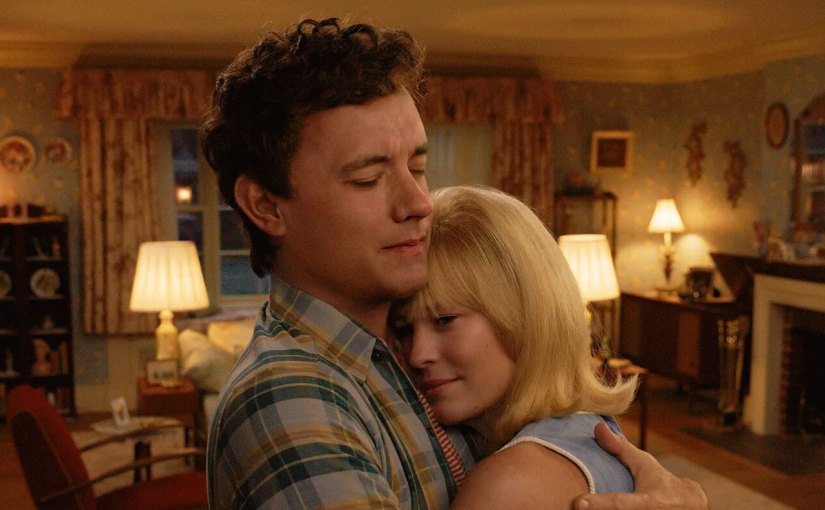
Primarily though, there are three generations of a twentieth century family lineage that starts with Paul Bettany as a PTSD alcoholic World War II veteran, and his housewife Rose (Kelly Reilly).  Tom Hanks portrays Richard, their eldest child who aspires to become a career painter before his plans are interrupted by marrying his pregnant girlfriend, Margaret (Robin Wright).  Life, however, gets in the way of his dreams.

Finally, we are brought to a more current point with an African American family living through challenging times of police brutality and Covid.

Over the course of the whole movie, Zemeckis has you believe that his camera never moves once from this specific place.  He narrates the activities that occur in this broad scope of time with pictures within pictures.  Rectangles or squares will appear to show what happened later in life or back in the past on this specific spot and then transition the scene to that new period episode he wants us to witness.  Where the fireplace is located, a squirrel climbed the bark of a tree that was once there.  Where the sofa is now, there worked a slave laborer from the 1700s, or its where a Native American smoked a pipe before then.

If Here was any longer the novelty might have worn off.  Fortunately, the characters with the most interesting storylines are given to Bettany, Reilly, Hanks and Wright.  The challenges of living long lives raising children, dealing with job security, health, love, loss and stress are carried by them.  We grow accustomed to how the family lineage evolves, particularly with Thanksgiving dinners, Christmas photos, marriage, graduations, and children growing up.  

It helps that the latest trend of visual effects, de-aging and aging the players, works convincingly in this picture.  I attended a live conversation at the 2024 AFI Film Festival between Tom Hanks and Robert Zemeckis, and the actor revealed that to get himself back to the age of seventeen and then a thirtysomething all the way to a man in his eighties required Zemeckis’ team to collect thousands of images and footage from the actors’ extensive careers.  Everything was then seamlessly assembled for effective performances.  I think the trickery works.  If it didn’t, then it’s likely Here would not succeed.

My one issue with the film is the glaring omission of substantial storytelling for the African American family compared to the amount of time devoted to the family who lived in this home before them.  The African American characters do not appear fleshed out enough.  They only serve to remind us of current, complicated times that we recently endured or are still living through.  Roth and Zemeckis did not go deep enough with this group, only to bookend it with an unimpactful death.

Here works like a warm blanket to snuggle up with.  I believe it is worth a second and maybe a third watch in order to catch all the little changes in details that vary as time travels through this piece of land that eventually became a living room.  The TVs and what’s on changes from the Beatles first appearance on The Ed Sullivan Show to The Three Stooges to CHiPs (neat wink and nod moment here; tell me if you know what I am thinking of) and Katie Couric and so on.  The furniture gets updated.  So do the phones. What occurs across the street in front of the two-story colonial house changes.  Though we are only seeing one room during the entire running time, it’s near impossible to pinpoint what was there before from left to right and top to bottom. What’s there now and what will be there later is part of embracing the experience of Here.  However, what kept my attention is how Eric Roth and Robert Zemeckis invent ways to keep different time periods connected.  It’s relative to how Zemeckis did numerous minute and detailed face lifts to Hill Valley in his Back To The Future trilogy.

By the end of Here, there’s opportunities to relate to how many of these people end up with their long lives.  They experience all the ingredients of life through love, frustration, happiness, illness, loss, anger, sadness and eventually death.

Here is a deliberate experimental film, and for most of the picture, its attempts at modifying the stage of performance truly work.  Where it falls short is not allowing equal attention to all of the stories that enter this locale.  Then again, if the movie were to go any longer, time might have come to a mundane standstill.  It’s simply a blessing that I had just enough time being Here.

ASTEROID CITY (2023)

by Miguel E. Rodriguez

DIRECTOR: Wes Anderson
CAST: More Actors Than You Can Shake a Stick At
MY RATING: 5/10
ROTTEN TOMATOMETER: 76% Certified Fresh

PLOT: In the mid-1950s, a roadside motel in a fictional mid-Western flyspeck plays host to a junior stargazing event that unexpectedly escalates, changing everyone’s world view forever.  …sort of.


Asteroid City, Wes Anderson’s latest film, feels like a collector’s edition box of Cracker Jack with no prize inside.  Or a cake that has prize-winning decorations, but it’s hollow inside.  It looks phenomenal; one of my fellow cinephiles, Anthony, predicts it will be nominated for cinematography and production design, and I agree with him.  But where the heart of the film should be is simply a crater like the one around which the fictional town of Asteroid City was built.  This is yet another star-studded cast for Wes Anderson, but Anderson has given them very little to do other than wear colorful costumes, look solemnly into the camera, and speak in very precise phrases.

This strategy has served him very well…no…EXTREMELY well in the past.  Moonrise Kingdom (2012) and Grand Budapest Hotel (2014) spring immediately to mind.  But some crucial piece of machinery is missing from Asteroid City.  The characters are colorful and quirky, but at the end of the day, I simply didn’t care about what they did or said.  (Well…except when actress Midge Campbell [Scarlett Johansson] decides to rehearse her nude scene for her next-door neighbor…I did care about that.)

The film opens with a pillarboxed segment in black-and-white.  Our host (Bryan Cranston) explains that we’re about to watch a staged presentation of the newest play from author Conrad Earp (Edward Norton), who proceeds to lay out the “set” for us.  “Upstage right is the crater…upstage left are the motel cabins”, etc.  Then the screen expands to full letterbox and we are treated to eye-popping Kodachrome desert landscapes as we follow a 165-car freight train as it passes by Asteroid City.  Well, “City” should be in quotes…the population is officially listed at eighty-seven.

This is some wacky city.  It’s as if Wes Anderson watched every Coen Brothers film set in the Midwest, from Raising Arizona to No Country for Old Men, and filtered them through a Looney Tunes cartoon written by Charlie Kaufman.  Vending machines on the porch of the rental office sell everything from snacks and drinks to martinis and parcels of local real estate.  (Cost for the real estate parcels: forty quarters…they’re not big parcels.)  An abandoned highway overpass lurks on the outskirts.  Periodically, a police chase roars down the otherwise empty highway, guns firing and sirens blaring.  The residents say nothing about this phenomenon.  And every now and then, the town shakes from nuclear testing being done hundreds of miles away, but close enough that the mushroom clouds are visible.

Man, I love this kind of thing.  The stage is set for one of the all-time great satires, or maybe just a flat-out fairy tale.  We meet the cast of characters who have congregated here to honor young geniuses who have invented everything from rocket packs to particle guns to a projector strong enough to project an image on the moon.  A full rundown of all these characters would wind up being a novella, but if you’re acquainted with Anderson’s work, they will all be familiar to you in one way or another.  (Not least because many of them have worked on Anderson’s other films.)  They have also gathered to witness a rare astronomical event: a solar ellipse.  Not an eclipse.  An ellipse.  The mechanism required to view an ellipse without damaging your retinas looks like something out of Brazil.

Again, I normally love this kind of stuff, really, I do.  But…okay, look, first of all, the film intermittently takes a break from the movie itself to yank us out of the story and show us an event in the playwright’s life that led to the casting of Augie Steenbeck.  Or to show us a rehearsal where an acting coach (Willem Dafoe) encourages the actors – that we’ve already been watching perform in the movie/play – to improvise what it’s like to wake up by first falling asleep.  There’s even a moment where the host shows up where he really shouldn’t be.  And when one of the actors has a moment of existential crisis concerning the character he’s playing, he simply walks off the set, goes backstage and asks the director (Adrien Brody) why he’s doing what he’s doing.

…I mean…what IS this?  Conceptually, I get it, even if it’s a little heavy-handed.  (“What’s my motivation?”  “You’ll have to figure it out as you go along.”  “That’s too hard!”  “Well, that’s life.”)  But…why is it here?  Anderson worked with non-linear structure before in Grand Budapest Hotel, and it worked marvelously.  Here, it feels indulgent.  In fact, many of the scenes in the movie feel that way.  There’s a moment where an army general (Jeffrey Wright) announces he’s going to deliver a speech he’s prepared for the occasion of the “ellipse.”  But this is no ordinary speech.  It’s practically beat poetry, delivered with the kind of conviction that only Jeffrey Wright’s magnificent voice can provide, but…but…why is it here?  Even in this weird, cotton-candy, retro-fever-dream of a movie, this “speech” felt out of place and just plain goofy.  In fact, quite a lot of the scenes between characters felt less like story and more like the kind of dialogues you find in source books for actors.  (101 Scenes for Two and Three Actors…that kind of thing.)

I will provide full disclosure and say the movie did deliver some decent laughs and chuckles.  There is an event that occurs during the ellipse (I’ll have to tread carefully here) that may not be entirely unexpected, but it’s executed and timed so well that I laughed pretty much through the whole scene.  It’s the kind of thing I imagine Buster Keaton and Charlie Chaplin would have thoroughly enjoyed, if I may be so bold.  There is also the problem of the disposition of a Tupperware container holding a valuable, ah, keepsake.  Oh, and that roadrunner was awesome.

But by the time Asteroid City rolled credits, I didn’t feel like I had seen one of Wes Anderson’s best films.  (The Royal Tenenbaums remains his best film, in my opinion.)  This almost felt like a movie made on a whim, kinda like, “Hell, I don’t know if this’ll work, but if I get enough star power behind it, this may turn out to be something.”  Alas, it did not.

A MAN CALLED OTTO

By Marc S. Sanders

There’s A Man Called Otto who seems to be liked by everyone except himself. People in his neighborhood happily say hello to him every morning as he shovels the snow off his walkway.  They will try to chat with him on their morning jog.  He won’t even allow his work, where he was forced to retire, to send him on his way with a celebratory going away party. 

On the other hand, Otto prefers to occupy himself with insisting that the UPS truck driver not drive down their block, sniffing out whose dog left behind a present on his yard and scaring off the real estate agent in the fancy BMW who attempts to convince elderly residents to sell their townhomes and move into assisted living.  A new family moves in across the street and they appreciate Otto’s grumpy insistence of properly parking their car with a U-Haul trailer attached.  What Otto doesn’t appreciate is how one more attempt at a planned-out suicide is foiled by their disruption.

I’m told this late 2022 release is an adaptation of book called A Man Called Ove, which was also turned into a European film that is supposedly better than this picture.  I can’t offer an opinionated comparison as I have neither seen that other film nor read the book.

Tom Hanks is the title character in this film from Marc Forster.  He’s very good and right for the role.  I’m one of the few who find Hanks to be miscast on occasion.  Not here though.  His performance had me thinking back on a more subdued Jack Nicholson in About Schmidt.  Hanks has transitioned finally to the older generation of characters that are not as wide eyed with discovery, innocence and gusto that were depicted in films like Philadelphia, Big or Forrest Gump.

Marc Forster is striving to tug at the heartstrings.  Flashbacks of Otto when he meets his eventual wife, Sonya (Rachel Keller) hint at what led to his current state of nonstop crankiness.  Otto’s a widower but why is he so bitter with himself or any kind person who comes his way?  The younger Otto is portrayed by Truman Hanks, one of Tom’s sons in real life.  It’s inspired casting, because there is a consistency towards the mannerisms and personality within the two separate performances.  Truman Hanks and Rachel Keller pair up nicely as young adults from different backgrounds who convincingly fall in love.

The standout though is the pregnant wife/mother of the new family who’s moved in. Mariana Treviño is Marisol, and she is superb in her comedy as the Hispanic neighbor who is always getting in Otto’s way with prepared home made food to bring over while she relies on the grouch to babysit her children or give her a ride because she doesn’t have a license.  Eventually, a terrific scene arrives where Otto is teaching her to drive, and the two characters open up to one another despite their different backgrounds.  Treviño carries so much range with her part.  She’s ditzy but intelligent, sensitive, and very warm, lovable, and funny.  Every time she appears on Otto’s doorstep, Marisol is a new surprise.  You might think at first that she’s scatterbrained.  When you see her next, she’s intuitive.  Otto may think she knows this person from just one or two encounters, but Mariana Treviño’s performance is so well done and beautifully written that even the viewer really doesn’t know her until the climax of the film.  If A Man Called Otto had gotten a little more publicity traction upon its release, she could have been an Oscar nominated contender.  I think she was definitely worthy of more praise than I could uncover.

The script sets up a lot of questions that carry the film and keep it interesting.  Otto’s internal crisis is one thing, but there’s also a neighbor’s mute husband who apparently shares history with the title character.  There is also a scheme being plotted out behind this pesky real estate agent who blasts his hip hop music from his luxury car. (TRIVIA: Another son of Tom Hanks, Chet, is the rapper heard on the radio.)

I was never really convinced that A Man Called Otto could be a real-life story, however.  Call me a cynic, but the number of sweet natured people all living in one small space seems far-fetched.  These happy go lucky folks, including a transgender teen (Mack Bayda, wonderfully likable in his first film role) who was kicked out of his father’s house, find so much positivity out of life.  I’m not sure real life lays it on this thick!  Sometimes, the side characters appear like walking Hallmark cards.

I also felt uneasy about the suicide theme that is most prevalent throughout the picture.  I think I counted four different ways that Otto attempts to end his life (hanging, shotgun to the mouth, jumping in front of a train, carbon monoxide poisoning).  Each attempt is interrupted somehow and how it’s done is nothing so inappropriate or spoofed, but it is done with an intent of irony and humor. It started to feel comparable to another foiled attempt by the Coyote trying to capture the Road Runner.  Looney Tunes serve a purpose escapist slapstick.  Suicide, even when cheerfully disrupted, often doesn’t put a smile on my face. 

Otto does go through a character arc that I appreciate though where demonstrations of heroism and soul saving are captured.  The ending, while sad, is also quite rewarding.  With Marc Forster’s film, I’ve gotten to know a beautiful collection of well-intentioned and thoughtful people who do not give up on trying to rescue one of their own from a life currently mired in misery. 

A Man Called Otto is a good film worth watching.  The cast is absolutely wonderful and through the performances, everyone seems positively proud of what they accomplished with the final product.  I’d be up for seeing this exact same cast perform this script live on stage.  Still, I offer a warning of caution.  While it is trying to deliver sugary optimism at every turn, it is also coming off a little bit like artificial sweetener. 

ELVIS (2022)

By Marc S. Sanders

Baz Luhrmann’s take on the legacy of Elvis Presley will certainly grab your attention, even if the director refuses to carry an attention span of his own lasting longer seven seconds.  Having watched the celebrated film from 2022 for a second time, eight months after my first viewing, I see more faults with the picture than achievements.  Elvis is strongest when the carnival ride stops moving, allowing its cast of colorful characters to have conversations with one another. 

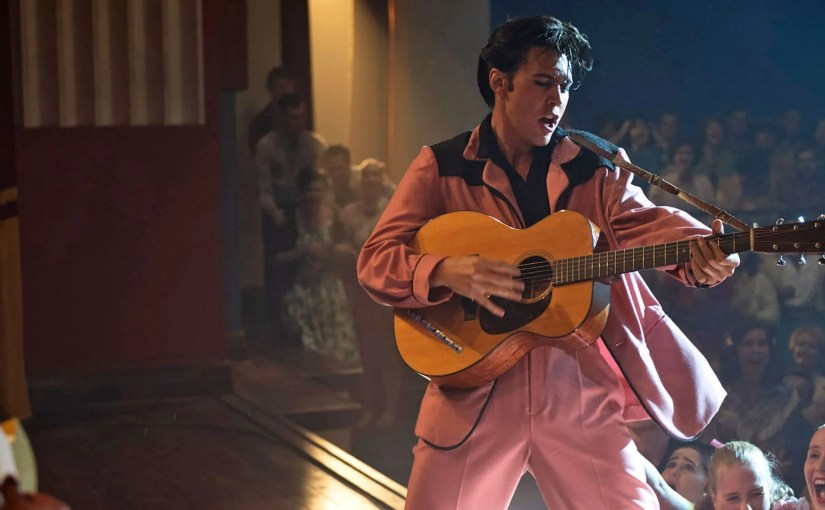
Austin Butler is now a known name for his portrayal of the King Of Rock N Roll, whose career was squandered by a slimy business manager known as Colonel Tom Parker (Tom Hanks).  Butler personifies what pop culture has recognized first and foremost about Elvis Presley, everything from the wild stage presence of dancing to the deep rockabilly singing or speaking (you decide) vocals.  He really bears an uncanny resemblance to The King as well.  Butler could have been better though had he been graced with a more economical and thoughtful script.  I don’t think Austin Butler was given enough to do.

The Elvis character hardly shares any conversations with any of the supporting characters.  That’s the film’s major shortcoming.  There are a scant few scenes of dialogue exchanged between Elvis and his mother and father, between Elvis and the Colonel, and between Elvis and his wife Priscilla Presley.  Baz Lurhmann wrote the script with Sam Bromell and Craig Pearce, and I guess it incorporates some major moments within the singer’s illustrious career but nothing seems to hold much weight.  Elvis gets threatened with being arrested for his pelvis swiveling gyrations while he performs.  We get a close up of the state Governor who leads this censoring campaign, but we don’t get an idea of his warped logic.  Elvis gets drafted into the army and the Colonel thinks to sell it as a comeback when his tour of duty will finish in two years.  Two years go by in a matter of sixty seconds however and the King is back to touring and donning the outrageous costumes, but we don’t see the marketing machinations led by the Colonel.  Where’s the deviousness and conniving?  Where’s the brainwashing of the public and our hero?  Elvis is also bedhopping from one woman to another and popping pills, but these incidents which arguably led to his life being cut short are glossed over with a sway of Luhrmann’s camera work.  When the third act of the film arrived, I didn’t even know Elvis was sleeping around until Priscilla (Olivia DeJonge) announces she is leaving him.  On her way out the door, the two characters share about five or six lines of dialogue before the film races to another transition or scenario.  In this film, the love of Elvis’ life, Priscilla, holds about as much presence as an extra in the film.  Their relationship isn’t explored like Johnny and June Carter Cash in Walk The Line, for example.

Lurhmann edits his scenes with title cards of what year it is or what place it is as Elvis tours the country.  Yet, I never got the feeling that I was inside these time periods.  A minute to a minute and a half go by and suddenly it is “One Year Later.”  What difference does that make?  Where’s the transition in Elvis’ character?  When exactly did he become a sensation?  Suddenly I see that Elvis is moving into a mansion (I think is what will eventually be Graceland) with his parents and I presume he’s…well…he’s a success?!?!?!

An opportunity presents itself for Elvis to have a mentor into the world of celebrity stardom by means of B.B. King (Kelvin Harrison Jr.), but as soon as he introduces himself, the man disappears and is not heard from again.  Elvis only offers a piece of dialogue later suggesting that “B.B. King once said…”  There’s no significance to the influences or naysayers who enter Elvis’ life.  The same goes for Elvis’ mother, Gladys (Helen Thomson).  The Colonel will assure Elvis’ parents that he has their son’s best interests in mind as he blossoms his career, but we don’t get enough of a solid foundation for his mother’s apprehension or her religious doctrine or the alcohol addiction that kills her.  

I know, reader.  You can argue that I’m offering descriptive text for these people.  However, the text that I give in this column is all that you see.  Baz Lurhmann is a flashy director.  I don’t doubt his skill for color with sparkles and glamour. No subject is glitzier than Elvis Presley.  Yet, if a biography is going to be recounted on film, it needs to be more than just a near three-hour music video.  Luhrmann seems prouder of the letter fonts and graphics that introduce another year like 1956 or another state like Tennessee as it zooms towards you from the depths of the screen.  The gloss of the photography in the movie is overly animated, lacking feeling or character arcs.

The script for Elvis seems to also adopt the approach that Milos Forman’s Amadeus took, where the puppet master/antagonist recalls the celebrity’s story.  Colonel Parker provides voiceover with a thick, German/Austrian (maybe ???), dialect for Tom Hanks to deliver.  Unlike popular opinion, I was surprisingly taken with Hanks’ portrayal.  He’s quite the villain in a disproportioned fat suit and bulbous sweat-soaked head.  The relationship between Elvis and the Colonel is nothing surprising.  We’ve seen plenty of bios where the manager swindles the fortunes of the outstanding talent.  Considering that is how it happened, I don’t mind seeing it again in Elvis.  However, much like everything else in the film, it is glossed over.  Only very late in the film do we learn that Colonel Parker is deeply indebted to the Las Vegas casinos, and he signs away a long-term Elvis obligation in lieu of repayment.  Before all of that comes into play however, while we know we can’t trust the Colonel, we also don’t know what his endgame is.  Only near the end, Luhrmann and his script writers throw in a last-minute Hail Mary to shock the viewers and uncover how the Colonel destroyed Elvis’ financial assets and betrayed his trust.  Unfortunately, we haven’t seen much of a relationship between the two rivals after over two hours of film.  A build up is missing.  The best way for a villain to attack a hero is to whet his appetite with trust and then use that reliability as a control device.  The script for Elvis never sets up those early moments of exposition that get the viewer, and more importantly Elvis, to trust the Colonel. 

Michelle Williams once played Marilyn Monroe in a film called My Week With Marilyn.  It’s an astonishing performance in a very shallow film.  In my review of that picture, I wrote that I wish I could see Williams play the role again in a story more worthy of what she puts on screen.  She was above that movie.  I feel the same way for Austin Butler and Tom Hanks here.  These are great actors who were not given adequate material to shine.  If only another Elvis picture could be made with them in the principal roles.

What I find ironic about Elvis is that when I first saw the film upon initial release in theatres, I felt thoroughly impressed.  While I am always more cold than hot on Baz Luhrmann’s movies, I thought maybe this was the exception.  Watching it a second time however, eight months later, I realize that much of the film I could not remember and that is because that movie doesn’t invest in memorable scenes.  It focuses much too much on flashy edit, cut aways.  What I lost from that narrative is an intimate connection to Elvis or any of the other characters. 

Even the music is not as electrifying as it is known for.  There is not enough time devoted to individual set pieces of Elvis performing numbers like Heartbreak Hotel or Jailhouse Rock, and because of the quick cuts, I’m not convinced that Austin Butler is truly crooning away in an Elvis impersonation like Jamie Foxx as Ray Charles or Joaquin Phoenix as Johnny Cash or Val Kilmer as Jim Morrison.  Austin Butler is just not offered ample opportunity to do his best Elvis performing.

As colorful as Elvis’ life was and his legacy continues to be, Baz Lurhmann is certainly a viable candidate to direct this biography.  The problem is maybe that Lurhmann needed an editor and producer who would put their foot down and tell him to try again.  Lurhmann was more concerned with showing his own kind of magic in filmmaking and reserving the story and plot devices for the closing act.  Exposition within the last thirty minutes of a movie usually never works.

APOLLO 13

By Marc S. Sanders

What’s fascinating about Ron Howard’s film Apollo 13 is that I can hardly understand what anyone is talking about.  I don’t know how they identify the problems of the doomed spacecraft.  I don’t know how any of the folks at NASA resolved the issue to get the three astronauts, Jim Lovell, Fred Haise or Jack Swigert (Tom Hanks, Bill Paxton, and Kevin Bacon), back to Earth.  What I do know is that William Broyles’ script, based upon the novel from Lovell with Jeffrey Kluger, allows for an ease of comprehension to know where one thing has started, where it leaves off and where it needs to go with each passing scene.

Forgive me, but when I watch NASA documentaries, I honestly get bored.  It’s amazing what has been accomplished during the history of our space program.  So much has been discovered but it’s only a fraction of what’s still left to be uncovered beyond our planet.  The films and literature that account for the engineering of space craft and what is required to travel in space lose me though.  Ron Howard puts everything in place with Apollo 13, however.  It’s the emotions that stem from the actors.  All I need to understand are the efforts each character serves to the ending that we all know.  It’s not about telling us what these guys are educated with or what science mandates.  Rather, it is about how these people respond to an unexpected and unfamiliar crisis.

On the ground in Houston, Texas Ed Harris portrays Gene Krantz.  He’s a pretty quiet kind of character, but upon his entry into the film, just ahead of the anticipated launch of Apollo 13, he is gifted a pure white vest.  Krantz wears this as his armor, prepared to take on any challenge including navigating a crew of three astronauts towards the moon.  He is surrounded by a school of nerdy looking engineers and scientists, in their short sleeve shirts, skinny ties and black rimmed eyeglasses.  They are all disbursed among an assortment of different departments.  I think one specified simply in human waste disposal aboard the ship.  Yeah, there’s a guy there making sure the urine is dispensed properly.  Again, I couldn’t tell what specialty each man is designed for, but they’re the experts.  Harris simply tells his men what needs to be done by drawing two circles on a chalkboard; one is the moon, the other is Earth.  When a frightening malfunction occurs aboard the rocket, Harris explains that his men now need to get the ship back to Earth by drawing a line between the solar locales.  He doesn’t know how it can be done, but like a football coach he demands his team find a way.

On board Apollo 13, the three astronauts are crammed in what is left of their ship, marooned to float through space. The interior gets extremely cold, exhaustion gradually overtakes them, and they are left with no choice but to power down whatever sources they have left as a means of preservation. 

A third angle comes from the wives and families of the three men.  More precisely, focus is drawn towards Marilyn Lovell (Kathleen Quinlan) with her family, including the children and Jim’s elderly mother watching the television with anticipation for ongoing developments while the media waits outside their doorstep.  The first act of the picture offers the anxiety that Jim’s wife has with this upcoming mission.  There is the standard nightmare scene.  Acknowledgement of the unlucky number thirteen.  Marilyn loses her wedding ring down the shower drain (something that actually happened). Ironically, the Lovells’ eldest daughter seems to carry the same kind of apathy for her dad’s upcoming trip like the rest of the country.  Jim may finally be having his dreams come true, to walk on the moon.  However, the rest of the world is more concerned with the possibility of the Beatles breaking up or what else is on TV.

A side story is delivered by Ken Mattingly (Gary Sinise).  The poor guy was originally a part of Lovell’s three man crew, only to be sidelined at the last minute because of a suspected case of measles.  When things go wrong for Apollo 13, he enters the flight simulator to diagnose the issue and find a resolution.  He’s offered a flashlight but rejects it because the guys in space don’t have that tool.  He specifically tells his men not to give him anything that they don’t have up there, and he refuses to take a break either.  If they don’t get a chance to rest, then neither does he.  This mantra carries over to the other guys working diligently to keep the astronauts alive and get them home. 

Apollo 13 is not a how to picture.  Rather, it is a film that focuses on response. 

Ron Howard offers amazing shots of the rocket and footage in space.  The launch is extremely exciting as shrapnel sheds off the craft during its fiery liftoff. Then other parts disengage after it leaves the Earth’s atmosphere.  The interior looks extremely claustrophobic, but the actors look comfortable within the floating zero gravity confines. Hanks, Paxton and Bacon have great chemistry together whether they are kidding one another about vomiting in space or bickering with each other while caught up in the problem at hand. 

The base of NASA is alive with hustle and bustle.  Not one extra looks like they are sitting around.  They all know what monitor to look at or which teammate to lean over as they desperately discuss what needs to be accounted for.  There’s a great moment that is explained to the audience as if they are a four year old.  A man in charge throws a pile of junk onto a boardroom table and says they need to build something with nothing but what’s on this table to absolve the problem the astronauts are having with carbon dioxide poisoning.  A few scenes later, we see the junky device that’s been rudimentarily assembled.  Who knows what it does?  All I need to know is that it works. 

I did take one issue with Apollo 13.  To heighten the dramatics, sound is provided as the ship comes apart. Even I know that sound does not travel through space.  I forgive it when I’m watching fantasies like Star Wars or Superman.  However, this film recaps a real-life event and during those moments, as startling as they may be, I could not help but think about the dramatic clanging and crashing penetrating my sound system.  Apollo 13 draws from a well-known case, but it still resorts to cinematic tropes to hold my attention.  I wonder if the picture would have worked had it remained faithful to basic scientific fact through and through.  It’s not a terrible offense.  It’s forgivable.  Though it got me thinking. Heck, it obviously never bothered the masses because the film was awarded the Oscar for Best Sound Design.

Ron Howard’s film is a magnificent experience, full of outstanding footage.  It relies on actors who depend on the emotions of the scenario to narrate the story.  Recently, I watched the film Tár with Cate Blanchett.  In that film, the mechanics of orchestral music and conducting are endlessly discussed.  It’s like listening to a foreign language at times while trying to keep up.  Howard’s film could have taken that approach and bored me to tears with a lot of technical jargon from engineers and scientists.  Instead, Apollo 13 succeeds by only presenting the basics of the issues at hand.  I couldn’t name one specific part on the engine of my car, but I know it powers the vehicle, allowing it to go from point A to point B.  The army of NASA folks declare this thing has never done that before or it must be crazy to consider because that has never been attempted.  I can count on the players of Apollo 13 to know what they’re doing.  They are aware of the risks that need to be taken and know what’s at stake.  I don’t need to see their diplomas to trust their concern or computations.

Like other films where known historical events are depicted, Apollo 13 maintains its suspense even if you already know the ending.  The aborted mission to the moon became known as “The Successful Failure.”  It’s refreshing to see how this proud moment all played out. For fleeting window in time America, actually most of the world, seemed to hold a unified care for three men trying to outlast a doomed, desperate and impossible situation. 

Apollo 13 is a triumph.

SAVING PRIVATE RYAN

By Marc S. Sanders

How much blood needs to be spilled to change the color of an ocean red?  The battle of Normandy during World War II showed quite a bit, and Steven Spielberg more than convincingly duplicates that terrible episode in world history with his war picture Saving Private Ryan

Spielberg earned his second Oscar for direction with this film from 1998.  It’s not only a technical marvel, but it’s a story that tests the nature of humanity when a squad of American soldiers ask themselves if saving the life of one man is worth sacrificing themselves.  Tom Hanks leads the team of recruits.

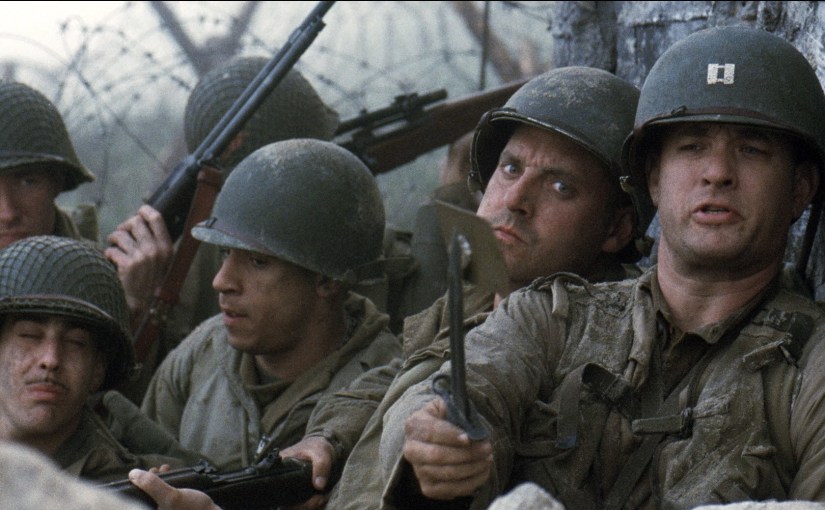
Saving Private Ryan begins on June 6, 1944 when thousands of American soldiers were inevitable sitting ducks as they washed ashore on Normandy Beach to engage in battle with German forces.  Spielberg’s footage is astonishing.  First of note is the cinematography is wisely washed out of color.  The sky is grey.  The ocean water and sand feel frigidly cold.  The most dominant color is blood red.  The fear displayed on the thousands of extras portraying soldiers, who never look mentally ready for battle, is palpable. 

The shots in this roughly thirty-minute opening do not compromise.  A soldier is seen walking around looking for his arm that has been shredded from below his elbow.  Other soldiers will turn over one way out of camera, but when they roll back into frame there’s a smoking hole where their face used to be.  Deadly head shots come out of nowhere.  Army medics have their hands soaked in bright red blood while trying to use scissors and thread to sew up wounds caked in wet sand. 

The action slows down at one point to focus on Hanks.  We haven’t even gotten to know his character yet, but we realize he is exhausted of this violence.  His hearing seems to deafen for a moment while he watches the horror quickly unfold as he puts his helmet back on only to have blood-stained water shower down over his head.  War is not meant for heroics and glamorization.  War only serves chaos and brutal death. 

Following this incredible opening sequence, one of the most impressive ever to start a film, Captain John Miller (Hanks) receives orders to locate the titled character, a paratrooper named Private James Francis Ryan (Matt Damon).  The army insists on sending the young private home to his grief-stricken mother, who has recently lost her other three sons in the conflict.  So, Miller recruits a handful of men consisting of fantastic actors like Tom Sizemore, Edward Burns, Vin Diesel, Adam Goldberg, Barry Pepper, Giovanni Ribisi and Jeremy Davies to make the trek across war torn Europe and rescue Private Ryan before he perishes as well.  How is that really fair though?

Any one of these men are sons to a worried mother back home.  The script for Saving Private Ryan by Robert Rodat has the men question why should they risk their own lives to find this one kid?  What makes him more special than any one of them?  Is the United States Army being fair?  Are they using this special mission as a means of propaganda?  Questions like this are irrelevant to the war department.  Just get him the hell out of there.

The journey of Miller’s squad is not just a simple hike.  At any given moment, they will come across a bombed-out town or another regimen who has just experienced their own kind of hell.  Further questions are asked when Miller recognizes an opportunity to take out an enemy battalion.  His own men suggest circumventing around this potential battle.  Miller won’t hear of it.  He’s a soldier.  Yet, after it is done, there is loss of life.  Should he have listened to their warnings or was he right to engage the enemy to avoid another team of allies suffering a terrible fate? 

Other dilemmas also come into play.  Should they escort a family and their young children who have lost their home?  The brutal dialogue of the script says that’s not their job.  Their goal is to take out the enemy and eventually rescue this one man.  Should an unarmed German prisoner be forced to dig his own grave and later be executed for the atrocities he’s committed?

War tests the ultimate limits of man.  What has to be done to allow us to finally, ultimately and justifiably shed ourselves of our humanity?  A correct answer is never provided in Saving Private Ryan.

Amid a series of astonishing battle scenes and images, two parts of the film stand out for me.  Following the loss of one of their comrades, there is disorder within the ranks.  This is where Tom Hanks takes control of a chaotic scene.  John Miller knows his soldiers have placed bets on what he does for a living back home.  Considering the strategist that Miller shows himself to be, its quite startling to find out what his occupation is.  It’s so surprising that Hanks as Miller uses it to temper his men which segues nicely into why Miller honors the mission assigned to him, even if it means risking his own life.  It’s not the best answer to why one man is more valuable than any other, but it’s the only one we are going to get. 

An even more powerful image comes to mind in the third act.  Jeremy Davies plays a Corporal assigned to the team to be a German and French interpreter.  He’s a soldier in this war, but he’s the last one you would want in combat.  As the American forces await the inevitable arrival of a German tank and a large number of troops to arrive, the men assign Davies to hold on to the long chains of ammunition and artillery.  He is draped in bullets around his neck and shoulders.  As the battle engages, shots are fired in all directions, men are quickly dispatched and Spielberg wisely has his cameras follow a helpless, weeping Davies do nothing but run from one end of the street to the other and up the stairs of a blown-out building.  He has all of the power in the world but he lacks the muster to kill and destroy which is what the nature of war demands.  He can even hear a man slowly die by stabbing in the floor above him. Yet, the Corporal can’t even rush to rescue his friend, and slaughter the enemy.  War destroys, but it also paralyzes man to act beyond an intrinsic nature of peace.  Each time I watch this scene, I can’t get past what this poor young man is truly capable of while being utterly helpless at the same time. 

I found Spielbergian techniques in Saving Private Ryan that hearken back to other celebrated moments in his film repertoire.  Tom Sizemore engages an enemy, only for both of them to run out of ammunition.  So, they wind up clumsily throwing their helmets at each other.  Indiana Jones might have done something like this for the sake of some form of slapstick.  Spielberg applies desperation to this scenario however.

The German tank at the center of the third act is somewhat reminiscent of the shark from Jaws.  Before we get an opportunity to see it, a focused Barry Pepper in a sniper’s bird’s nest gives a visual description of how big it really is and what accompanies it.  Later, Miller and Ryan have taken cover in a trench of rubble only to be overtaken by this beast as it careens over them.  The mouth of its cannon seems to come alive just before it blasts out a tower.  It’s just as scary and shocking as even Spielberg’s pictures of fantasy and adventure came before the release of this picture.  Every shot Steven Spielberg provides in any one of his films build towards an intrinsic and organic response from his viewers.  He always works with that goal in mind.  The tank is the tool used here.

The art direction is fascinating in this film as well.  A knocked over chair is picked up before a soldier stands it up as sturdy as he can on top of splintered wood and crumbled stone.  Sand on the beach is blasted up and out, sometimes splattering the lens of the camera.  Ocean water too.  Pockets of afterburn flames will be seen in the distance of a war-torn area.  The tangibility of these set pieces works cohesively with the distressed colors of a weathered and battle-stricken Europe. 

As chaotic as Spielberg demonstrates war to be, the editing is also commendable.  A war movie like this is not an action picture for the sake of escapism.  We don’t need to see the gun that fired the bullet that pierces the skull of a person.  We just need to see the person get a bullet that penetrates his helmet only to blow his head off to understand the unforgiving nature of war.  A man might be dialing up headquarters requesting air support, but he suddenly will not finish the conversation.  Editing allows the unexpected to become all too common in the midst of battle.

Saving Private Ryan is one of the best films ever directed by Steven Spielberg.  He had already shown real brutality not embedded in fantasy with films like The Color Purple, Empire Of The Sun and especially Schindler’s List.  Yet, with this picture, small factions of men, seeking world conquest, might have started this terrible conflict, but the movie does not concern itself with those instigators.  Instead, we witness the pawns at the disposal of war.  We see the collateral damage that suffer and die at the hands of unseen powers that be.  With Robert Rodat’s script, Steven Spielberg questions the value of one man versus a collection of men, and how any man, who may physically endure this terrible period in time, can also mentally survive long after it is all over. 

THE DA VINCI CODE

By Marc S. Sanders

Akiva Goldsman’s screenplay adaptation of the bestselling novel The Da Vinci Code by Dan Brown suffers from an overabundance of information; like A LOT of information, a TON OF INFORMATION actually. The book is an incredibly fast read with brief chapters and plenty of diagrams and images to study. It surprises me, though, how in depth director Ron Howard’s approach is with the film. Howard must have literally shot every page Brown documented including his edits. Amazingly there is a Blu Ray EXTENDED CUT. It seems Goldsman and Howard at one point couldn’t help themselves. Restraint had to step in for the controversial story’s cinematic debut.

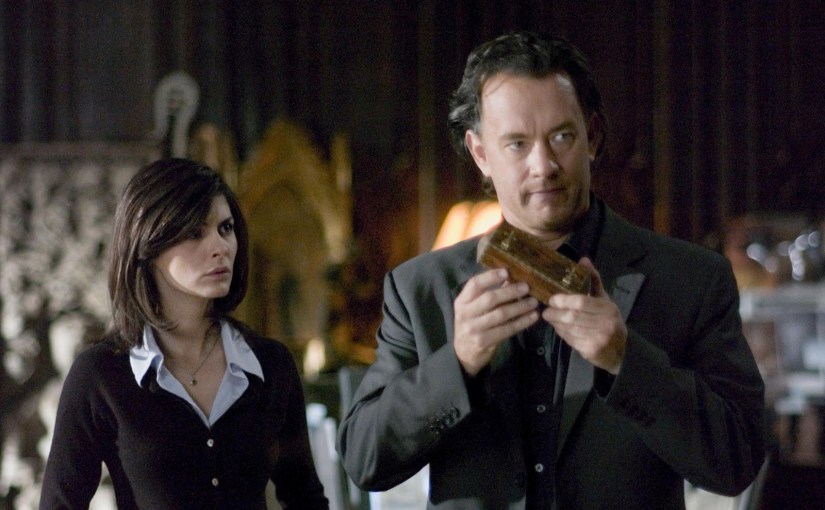
Tom Hanks plays the great modern literary character, Robert Langdon. He is very good in the role of a research expert on historical symbols and cryptology. Hanks even masters Langdon’s self-debilitating weakness of claustrophobia very well, which proves to be a hinderance. It’s maybe an under celebrated part in Hanks’ career because the film is so heavy. Little is talked about this film any longer. (The second sequel, Inferno, flopped at the box office. I’ve yet to see that one.)

Langdon is recruited to go the Louvre in Paris one evening to look over a recently murdered victim left with a pentagram carved in his chest and a gunshot wound in his belly. The victim’s name is Sauniere (Jean-Pierre Marielle). Soon Langdon is teaming up with Sophie (Audrey Tatou), Sauniere’s granddaughter, to uncover one puzzle or clue after another left behind most prominently within the artwork of Leonardo DaVinci, including the “Mona Lisa.” Gradually, a conspiracy is uncovered revealing a strong possibility of how Mary Magdalene and Jesus Christ are actually connected. Amidst all of this, Langdon and Sophie become fugitives under the suspicion of murder. Now the cops (headed by Jean Reno) as well as a secret society within the Catholic Church are hot on their trail to stop them from revealing the truth. A dangerous, self torturing Albino monk (Paul Bettany) also comes into play.

That’s a long ass paragraph I just wrote and it hardly scratches the surface of how in depth The DaVinci Code really is. Because it is so nuanced, I had some major problems with the film. For one thing the cinematography from Salvatore Totino is very dark. I know. Most of the film takes place in the middle of the night within the hallowed halls of the Louvre and the streets of Paris. However, I think certain liberties should have been taken here. The details thrown at the audience never stop. Long summaries of dialogue come into play and at times Totino and Howard will highlight a code or a portion of a piece of art or a passage in a book. Because the story is so deliberately murky, I wish at times what I was looking at could have been presented all the more clearer.

Another issue is with Audrey Tatou who is of French descent and whose character is that way too. Her French accent is too thick to clearly understand every word she is saying. A lot of details become lost because her dialect swallows her words. Natural dialects can be a slippery slope in film. You want the characters to be as genuine as possible but none of that means much if you can’t follow along.

The best surprise of the film reveals itself when Ian McKellen appears, portraying Sir Leigh Teabing, a mentor and friend to Langdon. Yes. He offers up a ton of information too. Too much for any one film really. However, McKellan is so giddy in the role. Leigh relishes the fact that Langdon and Sophie appear at his home. He’s elderly and crippled and excited with glee to come across them so he can share his own theory of Mary, Jesus and what is possibly the real interpretation of the Holy Grail. At ninety minutes into the film, McKellan’s introduction is quite a welcome, relief from the heaviness of everything before.

The DaVinci Code clocks in at over two and a half hours. It feels longer actually. There are multiple endings as surprise traitors need to be revealed, more history and theories need to be uncovered and more European locales need to be visited complete with secret passages and hidden staircases. It took a lot of mental effort to remain patient with the film, and I had already read the book!!!

Ron Howard’s film merits the discussion of whether Brown’s bestseller should have ever been filmed. As good as Hanks and McKellan are, I say no. This is not Indiana Jones with bullwhips and truck chases. This is a treasure hunt that sticks to what is on a page and within an exhibit. To mask what is discovered by dictating endless dialogue from the cast becomes incredibly tedious.

Dan Brown’s story is wildly out there in theory and supposition. It’s what makes it fun, really. So, do I recommend The DaVinci Code? You bet I do. I definitely recommend you read the book.

PHILADELPHIA

By Marc S. Sanders

Tom Hanks most certainly deserved the first of his two Oscars for his portrayal of Andrew Beckett, one of the first protagonists to be an AIDS victim on screen in Jonathan Demme’s 1993 film, Philadelphia. Its a good film but not a great film.

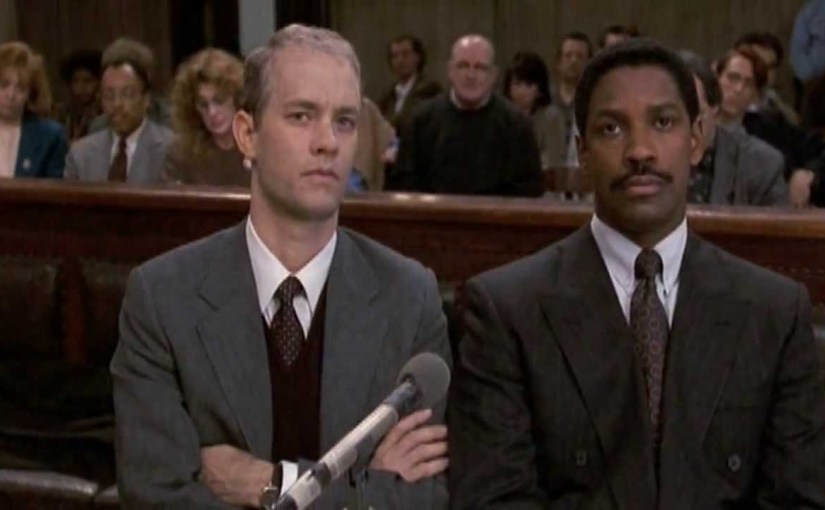
I recall seeing Philadelphia when it was originally released. Seeing it today, my opinion hasn’t changed. I don’t believe the film takes enough risks and the script from Ron Nyswaner is too cookie cutter and simple. Beckett hires Joe Miller (Denzel Washington) to represent him when he proceeds to sue the law firm who wrongfully fired him for having AIDS, and most likely being gay as well. The argument hinges on proving that having AIDS is a handicap that never interfered with Andrew’s work performance. Andrew is clearly made out to be the firm’s best of the young attorneys when he’s assigned their biggest client. Nine days later he’s sabotaged, and soon after he’s fired for an attitude problem and carelessness. Eventually, Andrew and Joe assemble, despite Joe’s prejudices against homosexuals.

The trial, Andrew’s struggle of living with AIDS, and Joe’s own inner debate with associating and defending a homosexual, AIDS victim are the three main storylines.

The first storyline is the best. Demme does a masterful job of showing the evolution of the disease. Andrew could be looking at papers on a desk and when he turns his head, a lesion appears on his neck. Makeup artists Carl Fullerton and Alan D’Angerio deservedly were Oscar nominated as Hanks’ appearance seems to change from one scene to another and another. He’s thinner in one moment with very fine ash gray hair. In another scene, he’s got a full head of hair with an energetic way about him. I cried for Andrew’s deterioration. Hanks and Demme carry that aspect very, very well. The actor does great work of changing his voice when he’s fighting a cold with a terrible cough or evoking massive weakness. As the film progresses and Andrew gets sicker, he’s incredibly pale with a droopy eye. The makeup artists tell the story with Hanks’ performance and Demme’s direction.

The 2nd and 3rd storylines don’t offer much of a challenge. The law firm primarily represented by head partner Jason Robards is too easily “evil.” There’s no subtlety here. Robards gets right in the face of the film – “Andrew brought AIDS into our office.” A better script would wait for the bad guys’ momentous third act Freudian Slip. This case was unchallenging really. It was too easy to win. Especially true considering this great and powerful law firm hires Mary Steenburgen as defense counsel. Steenburgen plays her part very mousy and unaggressive though. This case is too lopsided and uneven and I just couldn’t get past that.

Joe’s own reservations are too apparent as well. He’s meant to represent those that simply never understood the mentality of gay love, nor the scientific evidence of the AIDS virus. He rushes to his doctor following an initial meeting with Andrew. Demme does an extreme close up of this doctor to teach the audience the basics of AIDS. This guy is right in your face with his dialogue. I didn’t care for moments like this. Too patronizing.

A side story attempts to show the intimate relationship of Andrew with his boyfriend Miguel (Antonio Banderas). I still feel the same about this part. The script holds back. Hanks and Banderas give each other “bro hugs” and kisses are done on the bottom cheek. Back in’93, filmmakers were not prepared to go all the way with depicting the true nature of homosexuality. I found it insulting. You finally want to make a film that shows AIDS and homosexuals at the forefront but you stop short at the finish line.

Ironically, Joe has a repetitive line “Explain this to me like I’m a 4 year old…” Demme adopts that method throughout the film with major “in your face” close ups to glaringly make the beliefs of what any character values or has to say as obvious as possible. I felt as an audience member that Demme didn’t have to take it this far. I get it. You don’t have to be THAT FORTHRIGHT.

Washington is a great actor as always. He’s likable even if he’s tripped by the fault of misunderstanding. His “TV GUY” ambulance chasing lawyer is comic relief at times within a film of very heavy subject matter.

Demme’s filmmaking does make some wise choices despite some of my issues. The opening credits offers a lot of footage of the city with people carrying on their daily lives while waving to the camera, selling fish at the market, street dancing, etc, all accompanied by Bruce Springsteen’s sweet, yet haunting theme “Streets Of Philadelphia.” I like this opening as it shows what we see on the surface of the people we live with does not necessarily reveal the struggle any one of us might be enduring. This is a moment where the script is not so easy to grasp. There’s a challenge to accepting Demme’s footage blended with Springsteen’s overture.

Jonathan Demme is a good director, who is sadly no longer with us. I appreciate Philadelphia for showing the illness but not much else. It’s a film that should be seen. I’d argue most would embrace more of the movie than I did. I just felt the envelope could have been, actually should’ve been, pushed further. It was too careful with its subject matter.

A great observation though was recognizing the many faces that appear in the film from Demme’s other film, The Silence Of The Lambs. As well as naming Joe’s baby daughter “Clarice.” I also recognized an identical tracking shot that Demme offers. When Joe goes to visit Andrew in the hospital, it is a shot for shot remake of the tracking movement when Clarice goes to visit Jack Crawford in his office, at the beginning of Lambs. This might not be original, but I had fun recognizing it, nonetheless.

FORREST GUMP

By Marc S. Sanders

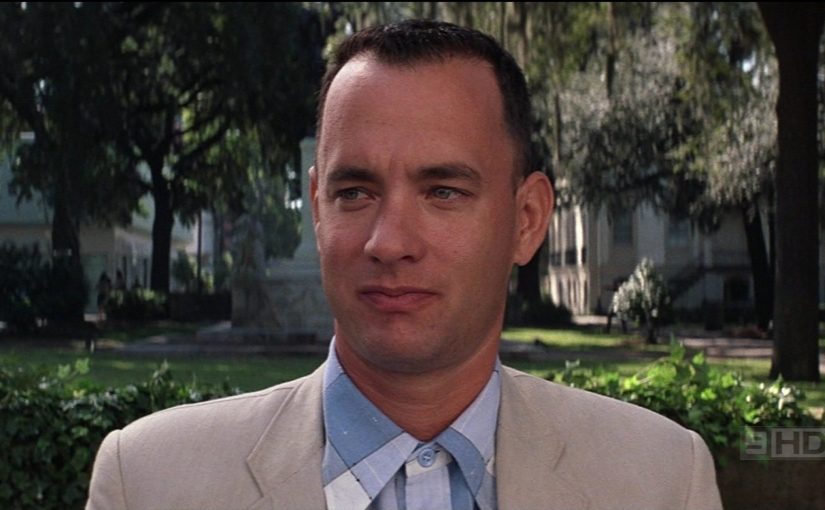
There’s not much that I can say to further praise the merits of Robert Zemekis’ Forrest Gump. It’s a film of legend though it’s a sore spot for die-hard fans of Pulp Fiction, which competed for Best Picture in 1994. Guess which film won. Tom Hanks won the Oscar for the second year in a row, following his outstanding turn in Jonathan Demme’s Philadelphia. Zemekis won Best Director. Eric Roth’s screenplay won as well.

What holds a lasting impression for me about Forrest Gump is the sweeping travel through time of a man with limited intelligence but unlimited willingness to explore and participate, whether it be as a Ping Pong Champion, a Medal of Honor recipient for heroism during the Vietnam War, a millionaire entrepreneur of a shrimping boat business, or a man who just felt like running from one corner to the next of the North American continent. Forrest Gump never knew to compromise a belief he had, probably because he was never aware of the capability to compromise in the first place.

An interesting theme occurs throughout Roth’s screenplay (adapted from the novel by Winston Groom). The people that Forrest encounters are always shouting their ideals and agendas. Yet no one seems to listen. Not just Forrest though. No one at all listens to each other. Lieutenant Dan (Oscar nominee, Gary Sinese) shouts for an immediate evacuation of a hostile territory under attack and no one on the other end of the line, appears to be listening to him. He orders Gump to leave him there, but Forrest does not listen. Forrest only focuses on rescuing his friends, Lt. Dan and Bubba (Mykelti Williamson). What exactly were Americans like the Hippie movements, the War Veterans, the Black Panther party, even the men in the burlesque nightclubs, as well as the various assassinations attempting to accomplish really? Did they accomplish anything? Did any of these parties make an impactful change, or did they just like to hear themselves talk? Did they just want the recognition for only themselves and no one else? When Forrest meets up with his love Jenny (Robin Wright), in a gorgeous caption in front of the Washington Monument (often shown during Oscar film compilations), he has just shared his thoughts over a loudspeaker, unaware that not one of the thousands of war protestors could hear him because the microphone had been unplugged. Later that day, a Black Panther participant only cares to wave his finger and shout his agenda in Forrest’s face. Is Forrest interested? Is he even listening? Is the Jenny, the hippie and her protestor boyfriend listening? Like many Americans, Forrest was only concerned with what was most important to him; Jenny. When Forrest develops a following during his cross country run, everyone is looking for his purpose and his message, and Forrest is unaware that he needed to offer one. Americans are always looking for the next best following. When Forrest passes the Grand Canyon and stops running, the parade of lost souls behind him shouts, “Now what are we supposed to do?” Forrest doesn’t listen. He just walks away and declares he’s tired. America during the mid twentieth century was lost. Forrest was not. Forrest just went in the direction in front of him.

Zemekis pulls an interesting trick of contrasting Forrest against other regulars. The nurse who sits on the bench next to Forrest is more interested in reading a mundane two dimensional issue of “People Magazine.” A man listening to Forrest’s tale of rescue in Vietnam was only concerned with the bullet that struck Forrest in the butt, not the men he saved or the loss of his dear friend Bubba. The old codgers who hang around the local barber shop in Greenbough, Alabama just watch the exploits of Forrest as the years go by. Their hair gets grayer and their skin gets more wrinkled, and life just passes them by while Forrest passes life by. It’s a subtle, yet effective, device that I appreciate on repeat viewings.

Sally Field contributes to the disregard Forrest has for menial issues. If Forrest is going to be denied going to a regular school because his intelligence level falls a few points below average, she will make certain that does not interfere even if it means pleasuring the principal. Mama Gump has the wit and intelligence. Forrest does not. However, their commonality shows in their disregard for what keeps us from living life to the fullest. Without Mama as his influence, Forrest would never have met the President again, and again, and again.

Mama reminds Forrest that “Life is like a box of chocolates…” You know the rest! It doesn’t matter what we get, as long as we get what we pursue.