YOUNG GUNS

By Marc S. Sanders

In the late 1980s a novel idea hit the screens.  An MTV interpretation of the Old West with a rock anthem soundtrack of electric guitars and drums. A far separation from Ennio Morricone’s unbeatable spaghetti western approach.  

The film was Young Guns, featuring handsome stars like Emilio Estevez, Kiefer Sutherland, and Lou Diamond Phillips.  They were each different kind of gunslingers in their own right while delivering stand out personalities.  The film has some problems in editing, and some sequences do not work.  Yet, it remains stylish with impressive set designs, props, costume wear, and an especially appealing array of performances from the whole cast.  

Billy The Kid aka William H Bonney is one of the most notorious outlaws in American history.  Emilio Estevez brilliantly turns the gunslinger into a quick draw joker with an addictive cackle and an adorable smile.  William is taken in by the mentoring John Tunstall (Terence Stamp) who already oversees a collection of orphaned young men.  He’s teaching them to bear responsibility on his farm while they learn proper manners at the dinner table and how to read.

A neighboring industrial enemy, L.G. Murphy (Jack Palance) commissions his men to gun down Tunstall.  Billy and the rest of the gang are then deputized by the local Sheriff to issue warrants for the arrest of the killers.  However, Billy repeatedly exercises his own form of justice by killing one guy after another with his pair of six shooters.  Soon after, the boys are on the run by horseback while creating a whole bunch of mayhem.

I never considered Young Guns to be a perfect film, but I like it a whole heck of a lot.

There are moments that serve no purpose, like when the men get high on peyote, introduced by the Navajo, Chavez Y Chavez (Lou Diamond Phillips).  It’s not amusing.  It’s not quotable and the scene runs too long as we watch the cast walk and talk while in daze.  Frankly, most movie scenes of just watching people get high are boring.  Often, they go nowhere and I’m not sure how to respond. It’s like I’m the designated driver fiddling with my car keys at a drunken binge fest. This is no different.

As well, there seem to be gaps within the body of the story. I know it is inspired by the Lincoln County War, but it’s never entirely clear why Tunstall and Murphy are at odds with each other.  We just have to accept that the two elderly men of equal proportions are against one another.  Still, Palance versus Stamp is a very inviting conflict to look at. (Supposedly, the real John Tunstall was only in his mid-20s.)

Young Guns has a very cool polish.  These cowboys are downright attractive, sexy like Hollywood movies tend to offer, and I love how they handle each other, their horses and their pistols.  Every time a six shooter whips out of a holster and clicks, the movie becomes more alive.  The guys look well-worn within this environment, close to the Mexican border of the 1870s.  The image is just as effective as Clint Eastwood appears in his various assortment of westerns.  

Billy The Kid, over this film and its sequel, is Emilio Estevez’ best role of his career.  The actor has such a cocky, nervy way about him and his over-the-top laugh is impossible to forget.  A favorite scene in all of movies emerges when Billy toys with a bounty hunter in a saloon.  Estevez delivers much fun before gunning the guy down. I never tire of watching that moment.

Kiefer Sutherland is second in line with a graceful sensitivity as the educated and poetically romantic Doc Scurlock.  You worry about him and his courting affair with a young Chinese concubine that is owned by Murphy.  Lou Diamond Phillips specializes in knife throwing as Chavez, the token Navajo.  His presence belongs here as an unpredictable sidekick.  

The best surprise is delivered by Casey Siemaszko as the virginal, boyish illiterate Charlie.  Some gunslingers were afraid to ever become outlaws.  Charlie is ugly and dirty, bumbling and sweet, reminiscent of Fredo in The Godfather films.  Siemaszko never became as established as the others in the cast, but he’s a good performer who delivers panicked fear and brings the glamour of Young Guns down to a semblance of reality.  

Young Guns is a style over substance product.  It has potential for a stronger storyline, but the dialogue works and the cast is stellar, which also includes Dermot Mulroney, Terry O’Quinn and Charlie Sheen.  The sequel is actually better as it commits closer to the intrigue of Billy The Kid.  

Not perfect, but this is a fun escapist western experience.

THE MUMMY (2017)

By Marc S. Sanders

The Universal logo comes up with that familiar music across the blue globe. Then it goes in reverse and turns black and gold to introduce a new franchise known as the Dark Universe.  This is the first installment.  The problem is of all the famed monsters in the studio’s library, they probably shouldn’t have started with The Mummy.  Brendan Fraser’s attachment to this mythical Egyptian horror is still widely accepted, and Tom Cruise is no Brendan Fraser.

This reinvention begins much like the 1999 film by telling of a Pharoh’s daughter who believed she was the sole heir to the kingdom.  Yet, betrayal happens and the beautiful princess is mummified into eternity, buried deep under the desert and laid with vengeance on her mind.  Elsewhere, another tomb is discovered under the streets of London. Could there be a connection? A dagger with a red stone might have the answers.

Jump to present day and Tom Cruise is back with another character who can run very fast.  He is Nick Morton and with his partner he clumsily runs and jumps over rooftops in the Egyptian desert while closely evading military air strikes from above.  Why the military is dropping bombs is apparently irrelevant.  Tom Cruise just needs something to run away from.

A massive crater opens up and the pair along an expert archeologist named Jenny Halsey (Annabelle Wallis) come upon a tomb.   Nick mistakenly frees the Egyptian princess buried within and they transport her, still contained in her coffin, back to London aboard a cargo plane.  Only now Nick is seeing visions of what once was and becoming familiarized with an ancient language with which he had no prior knowledge.  Nick has been chosen.

When you place Tom Cruise on board a military cargo plane, what do you think happens? It doesn’t have to be called Mission: Impossible to be a seemingly impossible mission. The crashing airplane sequence is impressive, not the best, but I’ve seen this stuff already. I’ve seen this stuff already with Tom Cruise. I do not need to see it again. 

The Mummy cannot decide what it wants to be.  It has some good ideas but just when I think I’m watching another Brendan Fraser swashbuckler with a monster, Tom Cruise must pound it over my head that this is a stunt filled trajectory.  

Russell Crowe is a mysterious character offering voiceover narration during a prologue. He later reveals his identity to Nick.  I will not spoil who he turns out to be.  Let’s just say it is likely you heard of this guy.  It’s hard to believe that Nick has not, and Mr. Cruise does not play dumb very well. This man has an interesting laboratory that contains relics and possessions that belonged to other well-known cinematic monsters.  Frankly, this picture should have exclusively belonged to Crowe’s character who comes off very dynamic and fresh while setting up a whole – forgive the pun – universe for a long line of films to come.  

Alas, Tom Cruise sets the stage.  He’s okay in the role, but between his temptation to be Ethan Hunt while adopting a Robert Downey Jr sarcasm and the imperfect Brendan Fraser/Indiana Jones hero, it all gets muddied. I just didn’t like this guy.  Cruise delivers what each chapter of the script demands of him and none of it is consistent. Near the end of the film during the final battle, Cruise offers up a one liner that comes nowhere near as close to what Downey, Fraser or even Arnold Schwarzenegger could have accomplished.

The only clarity I find in the visual effects is that they look rushed for final print towards a summer blockbuster release.  The Mummy Princess (Sofia Boutella) unleashes her monster minions to pursue Nick and Jenny while they are escaping in a clumsy looking ambulance.  As the creatures attack the top and both sides of the vehicle they are shaken off, thrown into trees, or run over.  They all look like monster vomit accompanied by loud hissing to startle your hearing.  

This iteration of The Mummy is partly assembled by the guys who made the Transformers movies where the robots look like metallic throw up mush.  Guys like Robert Orci and Alexander Kurtzman, the director, are poor artisans at the sci-fi/adventure/horror genre.  They know how to helm movies like this about as well as I do.  I don’t know shit, but I do know the visuals here are pure junk while being an enormous step back from the Fraser films of twenty-five years ago.  

The Mummy ends like the Marvel movies with the hanging threads of what we should expect.  I’m game!  Only, don’t do it like this.  Anything but this, please.  

Sadly, as quick as the Dark Universe got started it all got canceled.  This film was poorly received and did not generate the box office bonanza the studio was counting on.  I recall a fascinating publicity photo that assembled Cruise, Crowe, Boutella, along with Javier Bardem, and Johnny Depp. All were publicized to occupy upcoming installments of this new franchise.  The potential was so strong to see the likes of The Mummy, the Invisible Man, the Bride of Frankenstein, the Creature From The Black Lagoon, The Wolfman, Dracula and Jeckyl/Hyde sharing the screen together.  This could have been the antithesis to The Avengers and Justice League with gags of gore to delight audiences.

I swear when I saw that Dark Universe logo at the beginning, I was ready to love this movie.  I really was.  Unfortunately, The Mummy works hard to be a Tom Cruise actioner with his preserved thirty something looks adhered to an assortment of unfinished and indecipherable special effects.  Its script from David Koepp (Jurassic Park) is exhaustingly incoherent.  

The Mummy was a long-term investment by a million-dollar corporation.  It’s too bad the wealth went into junk bonds though. I urge Universal to try again. There is something to be made here, and it cannot get worse than this.

INTERVIEW WITH THE VAMPIRE: THE VAMPIRE CHRONICLES

By Marc S. Sanders

Fantasy of the supernatural or science fiction work best when the writer can teach the reader or the viewer how its foreign worlds work and how the characters who occupy the environments function and live.  Anne Rice had her own interpretation about how creatures of the afterlife live by night.  Her vampires possessed theatricalities.  Some were charming and sophisticated, and relished how they lived immortally while satisfying a hunger for the blood of living humans.  Some struggled with the discomfort that comes from being a remorseful bloodsucker.  The first of Anne Rice’s series of vampire novels, Interview With The Vampire, runs a very wide gamut of perceptions.  By the end of the film adaptation, directed by Neil Jordan, I’ve earned quite an education.  (Frankly, Rice’s novel was tediously slow moving and bored me to tears.)

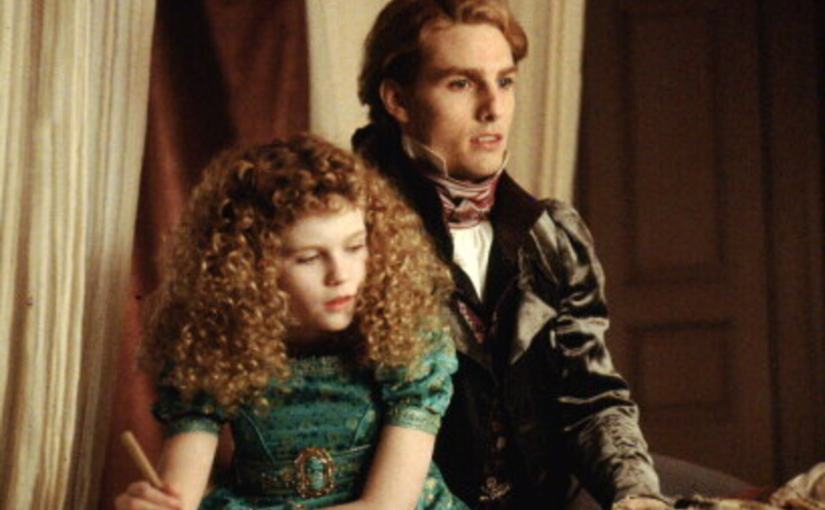
In present day San Francisco, a young man (Christian Slater) sets up his tape deck to record a conversation with a soft spoken pale faced man in a dark suit with a neat ponytail in place.  This mysterious person is Louis, played by Brad Pitt.  His story begins two hundred years earlier, in New Orleans, back to the day when he was incepted into an immortal life as a vampire. His agent of delivery is the devil-may- care and mischievous Lestat, one of Tom Cruise’s most surprising and unusual portrayals.  He gives a brilliant performance that’s as far a cry from his lawyer roles or his Maverick and Ethan Hunt heroes as possible.  

Lestat is eager to guide Louis into the benefits of vampire life.  Louis, having already been depressed following the loss of his wife and daughter during childbirth, cannot grow comfortable with Lestat’s insatiable appetite to feast on aristocratic figures or plantation slave servants.  This is not a match made in heaven and their chemistry as a couple is tested. Louis would rather miserably feast on chickens and rats, while Lestat grows frustrated by unsuccessfully swaying his partner to taste the sweet nectar of blood dripping from the wrist of a lovely young lass.  Lestat turns towards a grander extreme to maintain his embrace of the morose Louis.

Through deception, the men welcome an eleven-year-old “daughter” into their underworld.  Her name is Claudia, played Kirsten Dunst in her introductory role.  I still believe this is her best performance, worthy of an Oscar.  The life of a vampire is delightful to the child, the same as Lestat perceives it.  However, as the decades move on, with changes in fashions and industry quickly developing, so does Claudia’s understanding.  Her body never matures, destined to always remain within the shell of a preteen child, and thus she commiserates with Louis.

It appears like I’ve summarized Anne Rice’s entire story, but I have not even come close.  Interview With The Vampire is to gothic horror the same way The Godfather is to mafia gangster life.  Both communities victimize people of an innocent world, but their members are expected to follow codes of decorum and respect.  The conflict lies in living as a bloodsucking vampire or a criminal gangster.  When a peer interferes or does not cooperate, then the individuals of these respected worlds become violent unto each other.    The viewer/reader observe how their patterns of behavior all play out and how one action or policy generates one response after another.  These films are high ranked authorities on their subject matters.

Louis explains to his interviewer how Bram Stoker’s celebration of vampires is dreamed up escapist fiction, though coffins and the avoidance of sunlight are absolute necessities to carry on.  Just like any person, vampires want to live happily, but life gets in the way and that can be frustrating on any number of different levels.  

Neil Jordan’s film is a marvelous exploration into the mindset of being a vampire.  Tom Cruise perfectly exudes Lestat as a vampire ready to joyously live with sin while he savors and lives a life of eroticism and material wealth.  A child like Claudia sees the attraction of being spoiled and spoiling herself, and she cannot get enough consumption of blood. Eventually though, her mentality outgrows what becomes redundantly mundane.  Louis is relatable like many people.  He is unhappy living the life he was born into.  Lestat grows aggravated with his family’s resistance to partake of what he relishes.  There is an extensive range of emotions on display with Interview With A Vampire. To be a vampire can be a privilege or a curse. It all depends on who you interview.

The look of this film is astonishing.  I know it was shot within New Orleans, Paris and San Francisco locations.  However, I can easily recognize some sound stage locales, and I have no complaints.  The art designs from Dante Ferretti are thoughtfully crafted with lantern lit, rain-soaked cobblestone streets of the seventeenth century to mucky, moonlit swamps.  Horse drawn carriages transporting abundances of coffins serve a purpose of humor and narrative as character misdeeds are routinely committed by Louis, Claudia and especially the trickster Lestat.  The furnishings of the aristocracy are embracing too.  It’s a remarkably convincing step back in time.  

The periodic costume wear by Sandy Powell completes the settings with colorful, silk garments, white ruffled shirt sleeves and buckled shoes for both the men and women as well as for Kirsten Dunst and some cherub cheeked children who come into play.  Everything looks so rich. The whole picture feels like stepping into one of those late-night ghost walking tours I’ve taken in small southern towns like Savannah and St Augustine.  Every scene, even when the film jumps to late twentieth century, is immersive.  

Anne Rice’s screenplay adaptation tells so much within two hours.  She allows time for the characters to sail to Europe seeking out others like them.  The second half of the film teaches us more about what it means to uphold oneself as a vampire.  

Neil Jordan sometimes delivers his film like a how-to documentary because you are consistently learning new details, not so much about plot but about a people you are not as familiar with. Often, the film segues into theatrical play as you might expect from Phantom Of The Opera.  It’s no wonder since eventually Anne Rice puts us in touch with the cabal known as Theatres des Vampires. Stephen Rea and Antonio Banderas get to take center stage within a literal theater where the facade of behaving like a vampire can be executed beyond the suspicions of a – ahem- live audience.  

Rice and Jordan get playful while also performing with horrific familiarity.  The bites on the neck are known to many of us for drinking blood.  Did you also realize that a vampire can drink from a crystal wine glass? There’s an elegance to how the actors’ characters consume the blood of humans.  Cruise and Pitt begin by going in for a passionate kiss, either on the neck or the weightless wrist of a victim.  Lestat is more aggressive. Louis caresses his meals on the rare occasion he dines. Claudia gives a puppy love bite. Cruise especially finds new and titillating ways to dine with each new feast.  Both actors are deliciously homoerotic, but on different parental planes with their child. Their love/hate relationship operates like Shakespearean stage work. That’s why I really take to Neil Jordan and Dante Ferretti’s choice of soundstages.  

I’ve become so bored with zombies and vampires.  How many iterations must be churned out of the same kind of monster.  This year’s horror hit, Sinners, was superb until it stopped being eye opening with surprise.  It eventually became the same old thing and offered nothing new to show me in its final blood-shedding act.  

Interview With The Vampire is one of the best vampire films though.  The film never ceases to speak directly to its audience.  The settings describe how life is lived.  The characters grapple with both internal and external struggles.  

It’s one shortcoming is that Anne Rice, Neil Jordan and cast/crew did not follow up with the author’s subsequent tales.  The subtitle, The Vampire Chronicles, seemed to promise an extension of this universe. I know of other Anne Rice film adaptations that chose not to continue on from what was done here, and the execution was terribly poor and disappointing.  There’s a biographical intelligence to Neil Jordan’s film that many films of all genres lack.

Anne Rice’s first film adaptation set the standard on vampire culture, and I have trouble thinking of anything since its release that closely matches it.  

Interview With The Vampire is the only one with a blood curdling bite.

MISSION: IMPOSSIBLE THE FINAL RECKONING

By Marc S. Sanders

The blessing behind Mission: Impossible The Final Reckoning is that it opts not to follow the uninspired routine that was settled for with the previous entry, Dead Reckoning Part I.  With myself included, that film was poorly received overall (look for my review on this page). It performed way below box office expectations as well.  After its release, writer/director Chrisopher McQuarrie and producer/star Tom Cruise were in a quandary.  The hanging thread of a magical key/MacGuffin and the answer to destroying the omnipotent Entity were left unresolved.  A new film had to be made, despite an empty storyline.  Money had to be spent.  So, the guys needed to invest it wisely.  For the most part, the finances were used quite well as the pair learned what worked. More importantly they steered away from what didn’t.

What this movie improves upon is a hearkening back to some of the favorite elements of almost all of the prior films in the series, now on its eighth chapter.  Naturally, some citations cover what occurred in the last film to drive the continuous thin story of Final Reckoning. There are references made to the mysterious Rabbit’s Foot from the third picture, a favorite of mine.  Most notably, is the return of a long-lost character that no one would ever expect to turn up again. The best thing is that he truly serves the mission.  He’s not just a cameo blink and miss it.  Ghostbusters: Frozen Empire repeated that terrible grievance over and over.  The return of this particular guy actually makes you smile, laugh and cheer.  Yes, believe me when I tell you that marketing for Final Reckoning thankfully do not share every detail.  There’s more here than Tom Cruise running and running some more. 

Miguel and I took advantage of an IMAX presentation, and for two guys who normally favor Dolby, this action/adventure should only be seen on IMAX.  Probably the best film I’ve ever seen in this medium and I saw Dead Reckoning Part I this way, but that did not measure up to what’s offered this time.

Tom Cruise is absolutely nuts.  He’s over sixty and he’s doing some of the most daring stunts he’s ever accomplished.  The insurance bill to cover his safety must be at least half the budget to make the movie.  The famed biplane scenes that you likely caught in trailers, even on the marquee poster, is so much more impressive on IMAX.  You are seeing every limb of the actor’s body stretch to their breaking points to hang on to first a red plane and later a yellow plane.  Cruise’s facial muscles stretch against the G-force that is giving him resistance at ten thousand feet in the air.  McQuarrie makes sure to cover every inch of these flying machines from the cockpit to the wings and the tail rutters and the landing wheels underneath.  Cruise’s superspy, Ethan Hunt, has to climb all over these things as they go up and down and upside down and right side up on top of bursting into flames.  This scene is not even over in ten minutes.  It feels like a good twenty-five minutes and it looks like it’s no easy feat for Mr. Hunt.

Midway through the film finds Ethan Hunt deep sea diving to a shipwrecked submarine.  This sequence might rely more on set design, but I was convinced the entire time that Cruise was actually that deep below the surface of the water.  Memories of James Cameron’s The Abyss come to mind, but McQuarrie’s craft of this middle sequence within his three-hour film is so well edited and designed.  On IMAX you feel yourself submerged with the weight of the ocean above you.  The film will cut to the outside of the sub to show it drifting as Ethan Hunt shifts from one side of the interior to the other.  Whatever action the guy takes, the sub works against him leaving you wondering if the vessel is going to topple over an ocean floor cliff to even greater and unescapable depths. 

I will never like this movie as much as when I saw it in the IMAX screening.  It’s impossible to feel the same way on a large in-home flat screen.  This is a giant movie.

Grand set pieces with the sub or the planes had me thinking that Christopher McQuarrie should get a Best Director nomination.  I know it won’t happen but not everyone can accomplish what’s offered in Final Reckoning.  Could Martin Scorsese or Francis Ford Coppola?  I question that, because this is an altogether different kind of beast.

McQuarrie must have done a polish on the violations he committed with the last film.  The story remains to be nothing but a chase with countdown digital clocks and the urgency for all of these tasks to be accomplished by Ethan and his team at the exact same second (a repeat M:I staple), but the dialogue does not drive in literal circles of similar vocabulary this time.  Terms like “the key” and “the entity” are not so exhaustingly uttered over and over in this film.  Esai Morales, as the conniving Gabriel, is much more interesting.  In the last movie he was terribly boring.  No charm.  No anger.  No brattiness.  Here, he at least gleefully laughs at Ethan’s demise.  He’s still far from a great villain and totally forgettable, but at least he’s given something more to do than just stand menacingly behind Tom Cruise. Morales is not just donning a dark tan and a salt and pepper goatee. 

Most of Ethan Hunt’s team is given something to do, particularly Ving Rhames as Luther and Simon Pegg as Benji, always reliable.  Hayley Atwell was the best feature of the last movie and she’s great here too as the pickpocket, and now supposedly a quick learning kick ass superspy.  Kind of—No-VERY ridiculous but I stopped asking questions.  Atwell deserves a franchise series of her own.  She’s charming and lights up the screen.  Great actor too.

Pom Klementieff as the dangerous assassin Paris is now a good guy and other than speaking eloquent French she’s regrettably become a ho hum element.  There are other unnecessary characters including Kittridge (Henry Czerny) and those two guys who were chasing Ethan in the last movie.  One carries a stupid secret that’s more like an unwelcome surprise.  The other joins Ethan’s team to shoot a gun and look panicked. 

It will only frustrate you to follow when Ethan or Gabriel has the upper hand.  Christopher McQuarrie fleshes out his overly long three-hour picture playing games like that, and I stopped trying to pass his impossible SAT exam.  The attractions are a few of the characters who work with Ethan and the great feats of strength that the hero attempts to overcome. 

It is not the best in the series.  It is a huge improvement over the last picture, though.  What’s most significant is that Mission: Impossible The Final Reckoning is a gorgeous, mind blowing and breathless visual opus.

SEE IT ON THE IMAX before it self-destructs on your flat screen in five seconds.

THE OUTSIDERS

By Marc S. Sanders

As we are about to embark on a trip to New York City to celebrate my wife’s half century milestone (wish her a Happy Birthday, please), we decided to watch the film adaptation of S.E. Hinton’s celebrated novel The Outsiders, read by many high school juniors and seniors, and now a beloved Broadway musical.  The play has to be better than the movie.  It truly would not take much.

Francis Ford Coppola is the director of this very amateur piece that is best known for introducing a who’s who of the brightest actors that would go on to occupy some of the biggest films of the 1980s and 90s.  One of these guys, someone named Tom Cruise, is still a money maker elite. Ironically, he’s got one of the smallest roles in this film.

I can see the potential talent of C Thomas Howell, Ralph Macchio, Patrick Swayze (age 29 here), Emilio Estevez, Rob Lowe and Matt Dillon.  Diane Lane is likely giving the best performance in a next to nothing role as a could’ve been puppy love interest.  However, I said potential.  Had they been directed with just a little bit of passion, it’d be nothing but apparent. Coppola didn’t put enough work into getting this cast into shape.

Hinton’s story focuses on two factions of kids from small town Oklahoma, the greasers dressed in jeans with slicked back hair and tough guy attitudes all portrayed by the gang listed above and the Socs (pronounced Sosh), who are the spoiled rich kids dressed in school letterman jackets and khakis.  Their leader is Leif Garrett, the only known celebrity name at the time of this film’s release.  The antagonism between the groups is as evident as the Jets and Sharks.  The greasers flash their switchblades, curse and strut, particularly Matt Dillon as the fearless tough guy leader Dallas. Yet, within this screenplay, and among the performances by the whole cast, Coppola often relies on hokey, cornball drama that is on par with an after school special.  This is a lousy, rejected Hallmark card come to life. I’ve cried more at “Deep Thoughts With Jack Handy.”

The edits of the picture hide much of the bloodshed until a climactic rumble in the pouring rain presents itself with many endless, overdramatized punches and kicks that clearly don’t make contact.  Yes.  I heard Tom Cruise broke his teeth from a slug to his jaw. Otherwise, the ballet boxing of West Side Story has much more threatening smacks and cracks. 

C Thomas Howell is Pony Boy and Ralph Macchio is Johnny – the sixteen-year-olds who are overtaken by the Socs in the middle of the night. One of the prep kids turns up dead as the two young greasers defend themselves.  They hop a freight train and hide out of town, only to be brought into the spotlight when they rescue a group of little kids from a burning church. Pictures are smack dab on the front page.

The Outsiders is a very brief ninety-minute film that does not do enough to establish relationships among these kids.  Howell has the most fleshed out role.  With his two older brothers (Swayze and Lowe), Pony Boy dresses the part but his appreciation for literature and poetry by Margaret Mitchell and Robert Frost says that his life as a greaser is not for him.  His current situation does not allow for any other opportunities, though. Howell is just mediocre in his performance.  I cannot say I related to his supposed anguish and conflict.  He’s a body saying the lines and standing on his mark for the camera.

Just as in The Karate Kid, Ralph Macchio is an annoying over actor.  His character has an abusive relationship with his parents. However, we never see the parents. Frustratingly speaking, I’d question if this kid Johnny is simply a storyteller looking for attention. Why would Coppola leave out this dimension of one the main character’s home life that is frequently mentioned? Macchio looks more concerned with making sure the collar on his jean jacket is popped up with his bangs hanging down just right for a cover photo on Seventeen Magazine.  The profile that has the cute scar imbedded in his tan complexion is front and center. He always looks like he’s posing for a still shot in front of Coppola’s movie camera.  Macchio delivers the final monologue of the piece, and it’s near impossible to believe the actor truly embraced any of the dialogue of the script.  His performance appears mechanically memorized. 

Matt Dillon looks like he was genuinely trying to turn in a tough guy performance, but his moments on film, especially his final scene, look terribly edited and off kilter.  The cutaways that Coppola uses are awful, like a TV movie that is interrupted by commercials.  Only someone axed the ads from the final print and did not tape the film reel properly together.  

The Outsiders is a coming-of-age story hinged on tragedy and the yearning for a better life, particularly for Pony Boy.  Hinton’s book remains essential reading for young adults needing to relate to characters their own age.  It also serves as an effective homework assignment.  Francis Ford Coppola’s film though offers little focus on what makes any character tick or why there’s a conflict between the rival groups.  Where’s the history and backstory?  Most of the actors, especially Estevez and Cruise, come off as if they are high on sugar with incomplete sentences for lines. What are you guys doing here if not to look anything but hyperactive?

West Side Story and Stand By Me quickly found their footing for adolescent boys with insecurities and uncertain futures.   The respective settings of those films knew these misfit kids, and they in turn interacted within the environments. Coppola went the wrong route because there is hardly any bond between the kids and the other folks who reside in this picture.

From a technical standpoint, The Outsiders is a muddled mess of poorly timed original scores, from Carmine Coppola, wedged into scenes that do not call for anything to enhance the emotional heft.  The director often puts one actor’s close up at a zoom in, while a buddy will be in the foreground. This technique looks like an Olan Mills family photograph you get in the mall.  It’s cringey.  It’s hard to take seriously as well.  

The Outsiders simply does not work to acquire an emotional punch of despair and loss.  These pretty boy tough guys have no effective humor even with Tom Cruise behaving like an ugly, incomprehensible wild man and Emilio Estevez donning a Mickey Mouse t-shirt with his signature cackle.  There’s just too little to relate to anything in this picture that S. E. Hinton magnetically achieved within her pages.  Her book was published when she was age seventeen by the way. What an amazing accomplishment!

Regrettably, the filmmaker who upped the scales of the war picture (Apocalypse Now) with terror and disillusionment, and successfully delivered two of the greatest, most operatic films of all time (The Godfather movies), not to mention his smaller but shocking films like The Conversation offered little attention to what S.E. Hinton captured and impressed upon young readers.  If anything, Coppola was more concerned with shooting picturesque, midwestern sunset landscapes that honestly have an artificial texture to the eye.  Nothing from the music to the photography to the editing to the overt contrivances or the acting seems natural here.

The Outsiders is equally regarded as assembling one of the most impressive groupings of eventual male box office stars, as it is for Francis Ford Coppola’s lazy and uninspired film work.

THE COLOR OF MONEY

By Marc S. Sanders

The Color Of Money is the first and only time that director Martin Scorsese tackled a sequel of sorts.  Paul Newman returned to the screen as Fast Eddie Felson, the hustling pool shark from thirty years prior in The Hustler.  That movie established his career on a bigger scale going forward.

Fast Eddie is older now, and wiser.  He’s much more humbled as a bar owner with a conservative amount of cash on the table to stake younger pool players for small time wagers.  A young John Turturro is who he relies on and quickly loses faith in when a brash, cocky kid named Vincent Lauria (a perfectly cast Tom Cruise) easily undoes his opponent. 

Eddie sees the talent in the kid.  He’s got a helluva break and clears a game of nine ball with as much speed as he has conceit.  What he lacks for in brains and instinct is made up in Vincent’s cool and mature girlfriend Carmen (Mary Elizabeth Mastrantonio in an Oscar nominated role).  It does not take long for Eddie to coach her into realizing that together they can make a lot of money off of what Vincent can do in pool halls across the country.  If only he’d listen to them and do what they tell him to do. Vincent can’t comprehend how sometimes you win a whole lot more, when you lose first.

Scorsese works his camera like a swinging Steadicam.  When he gets close ups of this trio of actors, it’s never just a close up.  He’ll position his lens in a northward direction and then swing around east.  Newman, Cruise and Mastrantonio trust the eye of the camera to follow their performances.  There’s an energy to this kind of shooting.  It makes for a great style.  Scorsese was doing this novel kind of filmmaking, going all the way back to 1971 with Alice Doesn’t Live Here Anymore.  The director is so favored because as typical as a script might seem by its title or its prose, he’s going to find an exhilaration to its narrative.

Along with the director’s resident editor Thelma Schoonmaker, there’s a crackle and quickness to the many variations of pool play – much more playing than I believe was featured in The Hustler.  Schoonmaker makes sure to cut in the cracks of the pool balls as they collide with one another.  The blue cue chalk snows off the tip of the cue sticks.  Reflections of the players appear in the shine of the balls.  Close up profiles of Cruise and Newman lower down into frame just before they take their shots.  Before the kinetic energy found in later films like Goodfellas and The Departed, Scorsese and Schoonmaker were already putting their tag team best at play in The Color Of Money.

Yet, all of this is style with not so much substance.  What kind of story does this next installment in the legacy of Fast Eddie Felson have to say?  Not much really.  While the three actors are doing top notch work, the conversations run very repetitive and do not build toward higher stakes or developments.  Time and again they argue over Vincent’s refusal or naivety to understand the hustling strategies that Eddie has in mind.  Carmen gets it but she goes her own way more often than cooperating with Eddie.  Simply, this is a story of the protégé not grasping what the mentor is trying to teach, and it never evolves from that problem.  It gets stagnant.

What changes within the second half of the film is the introduction of a championship pool tournament in Atlantic City.  Therefore, it’s easy to expect a showdown between Vincent and Eddie.  It happens and there is a twist of a dagger included, but then when the real competition is about to begin, Scorsese concludes his film.  Does it matter who is the better player?  I don’t know, but as the film is wrapping itself up, one character gets short changed.  When that’s discovered, the film opts to also shortchange the audience.  I didn’t think that was very fair.

I think about the notorious ending to the HBO series The Sopranos.  Sure, it’s an ending no one will ever forget but for all the wrong reasons, and I defiantly believe it is because the storyteller ran out of imagination or lost his confidence in upholding an ending that he really wanted.  I feel the same way with The Color Of Money.  The film establishes the skills, intelligence and capabilities of these characters.  Yet, when you take the tool kits away from them, the building never gets completed; only left abandoned.

I’m drawn to watch The Color Of Money.  Michael Ballhaus’ photography is smokey and colorful. I can’t get enough of Paul Newman’s gravelly vocal inflections or even how he unfolds hundred dollar bills from the roll in his pocket.  Tom Cruise humbles himself to look like an idiotic jerk and it works well against the maturity of his scene partners.  Mary Elizabeth Mastrantonio oozes sexual appeal with a lot of brains to uphold the cons.  She has sensational scenes with Paul Newman.  There’s a coolness to the picture because of the cast, the settings, the sounds, the visuals, the editing and the direction. 

This film arrived in 1986 with rock music from the likes of Eric Clapton and Phil Collins.  Beyond Miami Vice and an assortment of John Hughes teen flicks, these artists were making for effective needle drops of atmosphere in films from the 1980s.  Scorsese’s use of the camera keeps me engaged, but when I look at what the characters are anchored to only do, and never rise above, the film does not hold the weight of other character studies that several of Newman’s and Scorsese’s pictures were so astute at achieving.

One scene transcends the arc of Newman’s character and it works beautifully within or out of the context of the picture.  A relatively unknown Forest Whittaker portrays an unlikely kid who goes up against Fast Eddie. As the long scene evolves over their pool competition, the writing hearkens back to the weaknesses and torment that defined Eddie Felson’s character in The Hustler.  If you watch the first film and then jump over to this scene, you recognize a connection for the protagonist of both pictures.  Beyond that The Hustler and The Color Of Money stand a long distance apart from each other.  This scene though is always a favorite of mine for the eventual Oscar winner, Forest Whittaker.  Watch how Whitaker holds his cue stick when he exits the scene.  Think about how he picks the cash up from the table after Newman drops it.  Consider, what his character Amos really means when he asks Eddie: “Do you think I need to lose some weight?”

Had The Color Of Money used more of Whitaker’s character in the film along with the other three, there might have been something more solid to say and introduce within the world of pool hustling with a 1980s barroom vibe.  Same could be said if John Turturro’s character was utilized more.

Paul Newman received the Oscar for this picture.  The actor was nominated seven times before, having never won and the irony is by the time this nomination arrived, Newman opted not to attend the ceremony.  Roles in films like The Verdict (for which he should have won the award) and Cool Hand Luke were much more memorable and fleshed out.  I’d argue Newman likely knew this was not his best performance because it was not the best written of his long-established career, and so he genuinely did not expect to win.  Because he won, it became a celebration of his legendary status as an actor who should have been taken much more seriously, much sooner.   (Two more nominations would follow in Newman’s career.)

BORN ON THE FOURTH OF JULY (1989)

by Miguel E. Rodriguez

DIRECTOR: Oliver Stone
CAST: Tom Cruise, Kyra Sedgwick, Raymond J. Barry, Jerry Levine, Frank Whaley, Caroline Kava, Willem Dafoe
MY RATING: 7/10
ROTTEN TOMATOMETER: 84% Certified Fresh

PLOT: A biography of Ron Kovic, a fiercely patriotic Marine who fights in Vietnam, is paralyzed in battle, and experiences a dramatic turnaround upon his return home.


I can already tell this is going to be a difficult review to write.

There is nothing overtly wrong with Oliver Stone’s Born on the Fourth of July.  It is expertly directed, and the pacing never flags.  Tom Cruise’s Oscar-nominated performance is deservedly legendary; he leaves nothing in the tank, a fierce rebuttal to critics who thought he was nothing but a pretty face.  But even though there is much to admire, when the closing credits rolled, I felt oddly detached.  The movie kept me at arm’s length from really engaging with the lead character.  Or maybe I kept the movie at arm’s length.

Could it be that I simply don’t care for Vietnam films anymore?  Not likely.  One of my absolute favorite films is Michael Cimino’s masterpiece The Deer Hunter.  In fact, the opening scenes of Born on the Fourth of July are reminiscent of that earlier film in that it takes its time establishing the main character, Ron Kovic, as a young man in the early-to-mid 1960s at the dawn of the Vietnam War.  Born and raised in Massapequa, New York, his strict Catholic upbringing and his devotion to high-school wrestling instill a strong sense of right and wrong in the world.  A point is made about how America had never lost a war up to that time.  Kovic’s wrestling coach exhorts him and his teammates as if he were a Marine drill instructor.  “I want you to kill!  You hear me?! …You got to pay the price for victory, and the price is sacrifice!!”  It’s not very subtle, but Stone is making it clear that, in those days leading up to the Vietnam quagmire, the American credo was, “Winning isn’t everything, it’s the ONLY thing.”

Kovic enlists, sees combat, and during two horrific sequences, he experiences: an unintended massacre of Vietnamese civilians, the accidental shooting of a fellow soldier (with Kovic himself behind the trigger), and a fateful gun battle during which a bullet went through his right shoulder, collapsing a lung and severing his spinal cord, paralyzing him from the waist down.  These scenes are appropriately skittish and terrifying, putting us in Kovic’s boots and making us feel the unimaginable stress of fighting a war where half the time you weren’t sure who or what you were shooting at.  Kovic is shipped stateside…and here, as they say, is where his troubles REALLY began.

If the scenes set at the VA Hospital during Ron Kovic’s convalescence weren’t based on his actual experiences, I would denounce them as sensationalistic and manipulative.  Rats roam free among the beds.  (A nurse provides spectacularly unhelpful advice: “You don’t bother them, they ain’t gonna bother you.”)  Orderlies spend their down time getting high on marijuana or worse.  Unchecked catheters get backed up.  When a vital blood pump malfunctions, a doctor has to go to the basement to “rig up a substitute.”  And through it all, Ron Kovic does everything in his power to prove to the (correctly) pessimistic doctors that he will walk again, even re-injuring himself in the process.

(It’s futile, I know, to critique a film for what it’s not instead of what it is, but I can’t help wondering if I might have developed a more emotional reaction or attachment to the film if the entire film had focused on Kovic’s tenure at the VA hospital…although I will admit that would be a thoroughly depressing film.  Also, it might have developed some unintentional similarities to One Flew Over the Cuckoo’s Nest.  Who knows.)

The rest of the film details Kovic’s return home to his family, his emotional swings between the lowest kind of depression (“Who’s going to love me, Dad?  Who’s ever going to love me?”) and angry shouting matches with his parents and occasional bar fights.  Eventually, Kovic has a revelation: he still loves his country, but he can’t stand the government that sent him and his friends halfway around the world for a cause he no longer understands.  After a short hiatus in Mexico (I won’t get into too many details about that plot point because it’s the one section of the film that borders on boring), he returns home and dedicates his life to speaking up for the men and women who returned from Vietnam to a country that, at worst, hated them, and at best, simply didn’t care about them.

Again, the film is a stirring portrait of a man and a life.  However, as much as I want to, I can’t pin down what it is about the movie that failed to reach me at the kind of emotional level that other biographies have done before.  I just recently watched My Left Foot, with Daniel Day-Lewis’s towering performance at its center.  Another film biography, another main character confined to a wheelchair, a character who comes to terms with himself and how the world responds to him and comes up with a way to respond to the world.  But My Left Foot made my heart soar in a way that Born on the Fourth of July never achieved.  I watched the movie intently, focusing on every plot development and every nuance.  But it just didn’t grab me.  I am at a loss to explain why.

Could it be because of the presence of Tom Cruise in the lead role?  He showed these kinds of acting chops again ten years later in Magnolia, giving another Oscar-nominated performance.  In that movie, he completely disappeared into the role, despite having one of the most recognizable faces on the planet.  Perhaps the younger Tom Cruise (only 27 at the time) emits the kind of wattage that overshadows those around him?  So that you’re aware of the face first and the character second?  Maybe.  So why doesn’t the same thing happen in Magnolia or even The Last Samurai?  Perhaps it took him ten years to find a way to modulate or customize his performance so that, when it counts, the character comes first and the Cruise persona second.

I’m speculating.  The bottom line is, Born on the Fourth of July is a worthy addition to the resumes of both Oliver Stone and Tom Cruise.  It knows the story it wants to tell and resolutely sticks with it the whole way.  There are no sidetracks at any time, not even when he becomes an activist.  The focus is always on Ron Kovic, not the cause.  Stone and his screenwriters trusted that the story of Ron Kovic would draw enough attention to the cause on its own.  That approach would work with just about any other film.  This time, it had the effect of diluting the emotional experience while still holding my attention all the way through.  I would still recommend it to anyone who hasn’t seen it, if for nothing else to see Cruise play a role where he gets to sound notes he rarely got to play in his early career.  Would I watch it again?  Maybe.  I think the story is important enough for me to try to see what I might have missed this time around.

JERRY MAGUIRE

By Marc S. Sanders

Writer/Director Cameron Crowe loves all of the characters he creates.  He loves them so much that I bet he’s got volumes of background histories on each one ranging from a nanny – sorry Au Pair – to a cute seven-year-old kid to a brash, hot shot professional sports agent like Jerry Maguire.  Everyone, absolutely EVERYONE, in Crowe’s films has to have a substantial amount of dialogue to bring them attention.  Often it works.  Yet, it’s also his Achille’s heel. 

Roger Ebert called Jerry Maguire a very busy picture and I could not agree more.  Do not mistake me.  I’m quite fond of the film, but yeah, Cameron Crowe unloads a lot in its over two-hour running time.  The title character, played by Tom Cruise in one of his best roles, is the superstar agent who has everything going for him.  He’s engaged to a beautiful talent scout named Avery (Kelly Preston), he has a knack for negotiating the best contracts for the greatest up and coming athletes, and he’s loved – strike that…adored by everyone.  Well…not everyone.  A hockey player’s kid tells him to eff off after his dad suffers his fourth concussion and can barely recognize his family or remember his own name.  It’s only then that he has a revelation in the middle of the night to document a multi-page memo inspiring his colleagues to sidestep the need to make more money. Less clients, and more personal attention to the ones you represent.  Call for everyone in his firm to get behind him in this mentality.  Jerry Maguire will be their martyr.

Well, that gets him fired, and ultimately he’s deemed a loser which is something that poor Jerry cannot learn to live with comfortably.  His one last hope at redemption lies in a promising wide receiver named Rod Tidwell (Cuba Gooding Jr – in a still very memorable role, likely the greatest of his career).  Rod remains committed to sticking with Jerry, but that is not going to make it easy.  He’s often uncooperative.  His pregnant wife, Marcy (Regina King) will not stand for any BS.  Rod is more concerned with obtaining the million-dollar contract, and it takes every last breath of Jerry’s to convince his client that it starts with getting back to just loving the game.

There is also another chance for Jerry to try his hand at love.  Wait, is it love, or is it that Jerry cannot handle being alone?  The test will lie in his relationship with his assistant Dorothy (Renee Zellweger in her breakthrough role), a twenty-six-year-old widow with the cutest kid (Jonathan Lipnicki, impossible not to fall in love with) for a son and a divorced sister named Laurel (Bonnie Hunt) who only has the support of her crying, pessimistic divorced wives support group.

Are you catching on yet to what Roger Ebert was trying to say?  There’s a lot of ingredients to make this stew.  Fortunately, all of it is good material with a great cast, but they are all distractions for one another as well.  At times there seems to be three movies going on at once.  Jerry the agent needs to get back on the horse.  Rod needs to humble himself and listen to his agent.  Dorothy needs to decide if this handsome guy who is the spitting image of Tom Cruise is best for her while she’s trying to be a single mother with a seven-year-old. 

The kid’s Au Pair has ten pages of dialogue.  Marcy has fifteen.  Avery has maybe five, but that’s quite a lot too.  It feels like Laurel and her divorced wives group have fifty pages.  Then there is the jerky antagonist who fired Jerry played Jay Mohr.  There’s just a lot of stuff here.

Jerry Maguire is a well-made film with a natural, feel-good comedic approach.  Cameron Crowe has feelings for all of his characters.  I think he doesn’t even want the Jay Mohr character to get hurt.  Crowe just wants to cradle everyone and kiss them goodnight and give them all a big part in the school play.  It’s a blessing the cast has terrific chemistry.  Anyone sharing a scene with Tom Cruise is doing brilliant work, especially Renee Zellweger and Cuba Gooding Jr.

Crowe’s dialogue might feel schmaltzy during the love story aspect, but it’s captivating.  Cuba Gooding Jr performs like he wrote the character, not Crowe.  He must have invented more to his Oscar winning portrayal of a cocky wanna be football star than the writer could have ever imagined.  “Show me the money!!!!” is still hailed as an all time great scene, chartered by the actor. 

As a director, Cameron Crowe is doing some of his best work.  I recently watched the movie with my Cinemaniac pals and noted to them how much lighting is pointed at the handsome faces of the cast.  It could be Cruise making a negotiation with a promising football star and his no nonsense dad (Jerry O’Connell, Beau Bridges) around a coffee table, or it could be a seductive scene between the romantic leads on a porch.  You never saw so many faces with flawless complexions and the photography of the film looks great from beginning to end.

As overstuffed as Jerry Maguire is, the film ultimately belongs to Tom Cruise, and he delivers Cameron Crowe’s character arc beautifully.  It is such a dynamic portrayal with a lot for Jerry to redeem, learn from and surmise.  The conceit I expect from Cruise is evident.  Sure!  However, it is still a well-constructed portrayal. 

This movie makes me yearn for Tom Cruise to seek out those roles that would come from nowhere and with surprise.  The roles that on the surface never seem like he should be occupying.  Think about this for a second.  This guy has played the seductive Vampire Lestat which was initially poo poo’d by Anne Rice.  He was crippled Vietnam War veteran/protestor Ron Kovic, soon after he played fighter pilot Maverick.  He played the cruelly extreme chauvinistic motivational speaker Frank TJ Mackey amid another crowded cast of exceptional talents and characters. He’s also portrayed Jerry Maguire.  The range of this actor’s talent can only be stretched further and further.  I’d rather know what wonderous role Tom Cruise has in store next, rather than what ridiculous stunt he wants to accomplish for another Mission: Impossible set up. 

Jerry Maguire is a gluttonous picture, but fortunately every entrée is served with heart, genuine emotion, and relatable caricatures.  It’s one of Cameron Crowe’s best films.

COLLATERAL

By Marc S. Sanders

A salt and pepper haired gentleman in a knitted suit with sunglasses arrives at LAX before the sun sets.  He exchanges bags with a man he runs into, played by Jason Statham. Elsewhere, a driver does a polish and check on his taxi cab before beginning his evening shift.  He picks up an attractive, overworked attorney named Annie (Jada Pinkett Smith) and before she hands him her business card, the driver has at least convinced the woman to re-examine her life’s purpose and consider simple ways to escape reality.  The man in the suit is Vincent played by Tom Cruise.  The cab driver is Max played by Jamie Foxx.  They are about to collide with one another on this night and put Michael Mann’s film, Collateral, into play.

Following being a massive fan of the TV show Miami Vice, and the films Thief, Heat and The Insider, I remember my anticipation sky rocketing when I saw the trailers and write ups for Collateral.  Mann, Cruise, Foxx, and crime in a cool looking L.A. with a symphonic soundtrack? I’m there!  It seemed like a perfect formula.  When I finally saw the movie, I think I was let down because it was too formulaic following a step-by-step recipe.  The editing for Collateral is abundantly cookie cutter, never taking any risks with its story.

Vincent chats with Max as soon as he gets in the cab.  He offers eleven hundred dollars to occupy Max’ evening, transporting him from one location to the next. Max has dreams of running his own limo company one day and this easy money is too good to resist.  It’s only when Vincent tosses someone out a fourth-floor window to land on the roof of the cab that Max realizes there’s a hitch to this arrangement.  

Vincent is a hitman out to check off a list of targets before sunrise, and he needs Max as a cab escort.  Threats to Max’ ill mother in the hospital will keep the driver in check, and if inconveniences like a shattered windshield draw the cops’ attention then Max will have to abide by Vincent’s demand for no interference with his plans.  

The two hour running time of Collateral is structured on one stop after another.  Mann abides by side scenes from Stuart Beattie’s script to look at the undercover night detective (Mark Ruffalo) who is one step behind the pair’s frequent stops within the city.   I guess it’s fortunate for this guy that ballistics and coroner’s reports are quickly and readily available within minutes and hours to connect some dots.  

In between the kills, Vincent and Max chat in the cab.  Standard stuff really where Tom Cruise is at one time charming and other times sociopathic.  Jamie Foxx is the bright but frightened guy with dialogue that doesn’t amount to much in convincing this unwanted passenger to either let him go free or to give up on his mission.

Ironically, the many scenes shared between Tom Cruise and Jamie Foxx are the least interesting parts of the film.  When the sound editing isn’t failing by making their dialogue sound like incoherent mumbling, neither guy is ever convincing the other to look in a new direction or consider another idea.  Therefore, the conversations never go anywhere.  Look at films like The Silence Of The Lambs, Cape Fear, Seven, and especially Mann’s best picture to date, Heat by comparison.  Those films work when either the antagonist or protagonist allow themselves to consider the arguments, even if it’s just for a second, against the ones they are debating.

There is action and violence in Collateral, but it’s really a talking piece.  Still, the best exchange of dialogue occurs with Foxx and other cast mates besides Cruise.  A great scene occurs when Vincent insists that Max act under the guise that he is Vincent when he has to report to the drug kingpin employer who originally hired him (a surprise welcome from an at the time unknown Javier Bardem); great acting and writing happening here.  The early scene between Jada Pinkett Smith and Jamie Foxx also works at a thought provoking and interesting level.  These scenes are short one act plays that belong elsewhere.  Jamie Foxx is doing some great work in these moments.

Unfortunately, when Foxx and Pinkett Smith reconnect later in the film, they are not written with the same kind of intelligence during a run and hide third act climax.  The suspense is absent here because the setup is ridiculous.  While standing on the top level of a parking garage, Max can easily see Annie in a fourteenth-floor office window, blocks away across the city, and specifically direct her where to run from the dangerous killer who is a few floors below, all while using a dying cell phone.  

More to the point, why is Annie still wearing a suit and heels, with her hair and makeup done up, at four o’clock in the morning? I know an aggressive lawyer never stops working, but don’t they go home, pour a glass of white wine, get into sweats and pop open the laptop while Miles Davis plays softly on the stereo?  How would these guys even know this is where Annie would be at four in the morning? Reader, you might tell me to dismiss what’s merely circumstantial here, and normally I would.  Yet, if I’m an expert hitman like Vincent is supposed to be, my first instinct is to go to Annie’s home first before the office in the middle of the night.  It’s the circumstances that negate the believability of the main character.  

As expected, Los Angeles looks moody and cool like in any other Michael Mann picture.  He’s got blazing overhead shots that emit a white glow in the thick of night.  The wolf is holding a fang and claw to the neck of the sheep as they careen through this endless city maze.  In that respect, the environment of this film works like a great character game master. What turn or straight avenue or bridge is going to work in either saving Max or getting him killed?

The technique of this filmmaker, who I usually favor, is here.  It’s been seen many times before for the other sharp, well-dressed killers in Michael Mann’s worlds. I welcome it back, but it’s not new or inventive in Collateral.  I guess that’s why the film is ordinary.  It lacks the depth that other productions from Mann rely upon.  The setups are quite amateurish and most of the talking is wholly uninteresting.

In spite of a phenomenal and reputable cast and crew, it’s a shame this Michael Mann installment is only ho hum in its finished product.  Collateral needed another script rewrite, followed by some additional reshoots.  There was a better movie to made here. 

MISSION: IMPOSSIBLE FALLOUT

By Marc S. Sanders

Mission: Impossible Fallout is the best of the so far seven films in the series.  It is carried not only by the stunts that Tom Cruise insists on risking his middle-aged self to perform, for the sake of his fans. As well, the film’s casting and the puzzle twisting script from Christopher McQuarrie, writing with inspiration from his famed Oscar winning screenplay for The Usual Suspects is a treat for the eyes and mind.  If this were a novel, I’d quickly be turning each page to see what comes next.  Like McQuarrie’s well-known invention of Keyser Soze, this movie questions Who is John Lark?  Is Ethan Hunt (Cruise) John Lark? 

Hunt chooses to accept the mission of locating this unidentified Lark who is interested in purchasing enough plutonium to wipe one third of the world population, likely in and around Pakistan and China.  However, the CIA doesn’t trust Hunt’s cavalier instincts and insists he partners up with a hulking Henry Cavill playing an agent named Walker.  Benji and Luther (Simon Pegg, Ving Rhames) are back for hacking, field work and some clever mask trickery.  Ilsa Faust (Rebecca Ferguson), the dubious British MI6 agent from the prior film (Rogue Nation) is a welcome surprise and just as perplexing with her actions.  The big bad, Solomon Lane (a snake like Sean Harris), also returns.

Like all the M:I films, Fallout operates with the same kind of formula.  We have to accept the promise that there’s a world ending MacGuffin.  Ethan and the team are assigned to find who has it and who wants to buy it and can use it.  All of this is written outside of the lines of planning out the action scenes these pictures are recognized for.  It’s as if Cruise, with his producer hat on, sketches stunts with skydives, cars, motorcycles, trucks and helicopters and then assigns his writer/director to apply words for the donut filling within the movie.  Mustn’t forget a reason to include a running sequence for Ethan to perform on rooftops.  Fortunately, all of it works best here, more than in any of the other films.

What sells these pictures, and again Fallout is the best example, is the photography and editing applied to these scenes.  Two sequential car/motorcycle chases occur throughout the streets of Paris.  (Look!  I see our honeymoon hotel, The Hotel Regina located across from the Louvre, as Ethan races by in a BMW!!!!!)  A smashing three-person fist fight in an impeccably white men’s room is a brawl for the ages. 

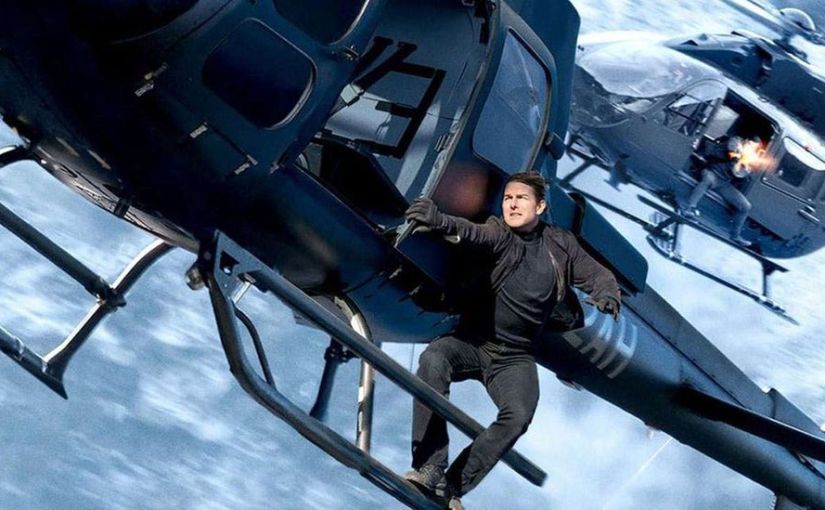
The highlight of this installment is a helicopter chase above and within a mountain valley that first focuses on Tom Cruise himself climbing a rope up, up, up to a chopper and swinging his legs onto the railing to get a foothold.  There’s time dedicated to him falling and inching his way back into the vehicle.  Then it becomes a chopper chase followed by a collision that ends with the remains wedged within a narrow mountain crevice.  What a set piece this is!  Absolutely outstanding camera work.  The wide and close editing, sound and visuals work so perfectly in sync with one another.  I don’t want to watch the making of documentary for this picture.  The trickery of McQuarrie’s camera crew is such a treat.  I’d rather savor the finished product on repeat viewings.

Juxtaposing against this chopper fight are two other scenarios involving Ethan’s teammates.  This is where I’m especially grateful for Christopher McQuarrie’s writing.  Two bombs are rigged in line with each other, and a detonator also must be retrieved by Ethan.  The whole team has to work cohesively, otherwise it is sayonara to much of the Asian continent if both devices explode.  McQuarrie’s “impossible mission” is orchestrated beautifully with suspense cranked way up.  His imagination for adventure allows a magnificently edited third act.  To date, I consider the stakes here to be the highest in the entire series.

The presence of this collection of actors is marvelous with recognition deserving of Henry Cavill donning an untrusting mustache and looking like a brutal, blunt instrument against the superspy Ethan Hunt.  Cavill also plays CIA agent wisely.  He’s got a stoic expression for most of the film but that is because he trusts the audience will assume what a dangerous threat he can be.  Cavill occupies one of the best characters in the seven films.

Mission: Impossible Fallout is truly one of the most thrilling pictures you’ll find.  What’s most important is the action serves the story.  Action just for the sake of action is tiring like in the Fast/Furious films.  There has to be a cost and a tangible feeling to the speed, obstacles and pain that good action scenes serve their characters and the story as a whole.  When Ethan falls from a helicopter or has to jump out a window, I grip both arm rests and let out a collective bellow with the audience.  Films with the grandest of adventure must draw out responses like that.  Otherwise, it’s all just a ho hum journey to the end credits.  Fallout is anything but a stroll.  It’s an absolute balls to the wall, explosive crowd pleaser.