ARLINGTON ROAD

By Marc S. Sanders

Arlington Road is a disturbing and all too real glimpse into how domestic terrorism in the United States operates.  The film from director Mark Pellington becomes more intriguing with repetitive views. Evening news shows and commentators’ programs airing nightly on outlets like FOX, CNN and MSNBC will delve ad nauseam into the hows, whys, and whos of a startling attack upon a populated area within the country.  Theories are pronounced, explored, and fault is found with someone, somewhere.  The protagonist of the film suggests that a name and face must be declared to ensure the country is at peace once again and punishment is rightfully delivered.

What surprises me about Pellington’s film is that it was released in 1999, two years before 9/11.  The worst, modern tragedy at that time was the Oklahoma City bombing.  School shootings were not even as prominent; practically unheard of.  We were only on the brink of Columbine High School’s terrible massacre.  At this precursor moment in time, I have to believe it was especially complex and required meticulous strategizing to bomb a government building.  

When I watched Arlington Road for the first time in theaters, I went with a last resort option for a ritual Sunday movie outing with dad.  We had seen everything else that was playing.  Title is lousy.  (Really lousy – Arlington Road??? That’s the best name they could come up with???) The marquee actors are meh to my twenty-seven-year-old psyche.  (Where’s Harrison Ford or Tom Cruise or Schwarzenegger???). Who’s the director????  Well, for dad and I this film was a huge surprise because of its taut, compelling screenplay and magnificent performances from Jeff Bridges, Tim Robbins and Joan Cusack.  The acting is what stands out the most while you forgive all of the conveniences that intersect to keep the story on its tracks.  

However, when I watch the picture on repeat viewing every couple of years, I realize that other than a random encounter in a parking garage for two characters, everything had been well planned ahead by the villains.  Roger Ebert and even the other unpaid critic, Miguel, took issue with minor happenstances that occur at just the right time.  Well, sorry to disappoint them but Arlington Road has an explanation for nearly every detail that seems contrived when in fact it was all part of a villains’ orchestrated construction.  The bad guys are especially smart in this movie.

Jeff Bridges plays Michael Faraday, a college professor who teaches a history class about domestic terrorism in relation to bombings, shootings, and assassinations.  He lectures his students about the faults and responsibilities of the FBI and other law enforcement departments.  He also provides insight into the people responsible for these heinous acts and often questions if these nefarious figures were lone wolves capable of such madness or were they scapegoats or were there others involved to help carry out these acts.  

Michael is a widower and a father to a ten year old son named Grant (Spencer Treat Clark).  After his FBI wife is killed in the line of duty, Michael has not fully come to grips with the loss.  He is dating Brooke, a former graduate student (Hope Davis), but he is clearly obsessed with what went wrong on that fateful day when his wife perished.

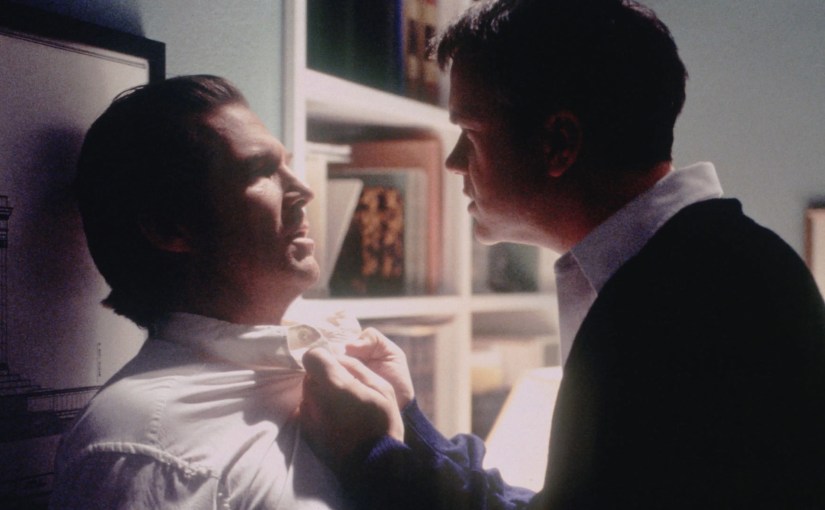
Oliver and Cheryl Lang (Tim Robbins, Joan Cusack) are the happy neighbors who recently moved in across the street.  Michael becomes acquainted with them when he saves their son’s life following a fireworks accident.  The Langs quickly become enmeshed within Michael’s space with child sleepovers, barbecues and evening dinners.  However, the friendlier the Langs seem the more suspicious Michael feels about them.  

Oliver’s backstory seems inconsistent with what Michael observes.  Soon, the professor’s hysteria becomes increasingly amplified.  As wholesome as Oliver and Cheryl are with big, toothy grins and neighborly charm, could they actually be plotting for an act of violence to occur?  As Michael becomes more skeptical around them, Grant, Brooke, plus his wife’s former FBI partner, seem all the more dismissive.  Whatever Michael is beginning to believe is nowhere near as apparent as his own expressive paranoia with big outbursts and unkempt appearances.  Jeff Bridges delivers a manic performance that leaves you breathless and uncomfortable.  He’s so focused on how unhinged this guy is even when he’s just trying to move on with a new normal as a surviving spouse and parent.

One of the many strengths of Arlington Road is reliant upon its ongoing build.  More is learned with each passing scene.  When you feel like you’ve grasped everything, new material presents itself and the actual truths may be more disturbing than what’s already been revealed.  

Joan Cusack is freaky frightening.  She performs to the camera with wool over the viewers’ eyes and she says so much by doing so little.  Before you die, the last thing you want to see is a Joan Cusack with a crooked, unwelcome grin. I salute the simple costuming of Tim Robbins character.  He dresses like Mr. Rogers with a lanky, thin build covered by earth tone sweaters and khakis.  He’s so plain and corny that its terribly awkward. These friendly neighbors hide in plain sight.  

On a first view, Arlington Road may feel like a paint by numbers formula with a few jump scares as the hero sneaks around for clues along with a high stakes chase through Washington DC.  However, I encourage anyone to watch Mark Pellington’s thriller more than once.  The first time you are focused on Bridges, Robbins and Cusack.  The second time you are likely to find what explains the conveniences of the characters and the story.  Then you realize that Pellington and screenwriter Ehren Krueger have done thorough research into what realistically upholds the actions of these characters and situations.

Arlington Road only suffers from a terrible and misleading title.  It’s simply unattractive.  However, the film is compelling and authentically conceived long before a dark trend of American terrorism and mass violence dominated social media and evening newscasts.  It’s a mixed compliment to suggest that the cast and filmmakers got so much right with a topical story that was not yet so commonplace.  

This is an absolutely engaging thriller that I only wish was more fictional and exaggerated than it actually is.
MYSTIC RIVER

By Marc S. Sanders

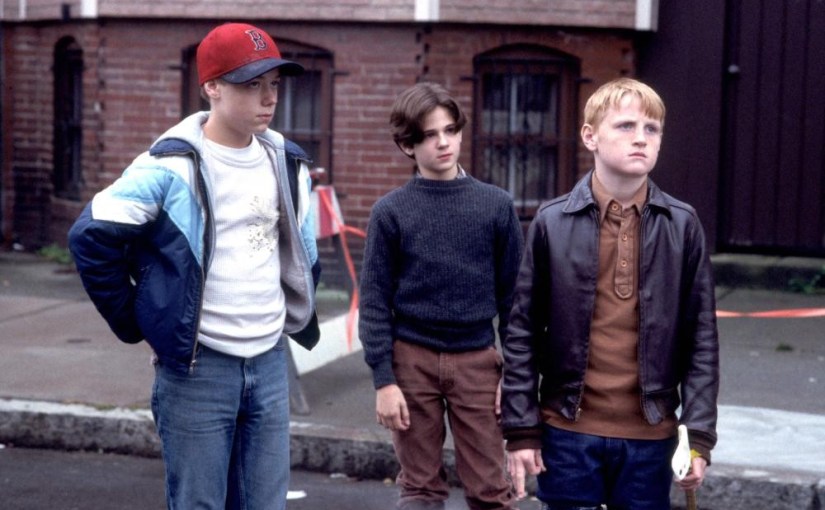
Two crimes, thirty years apart, pave the destiny for three childhood friends during their adulthood, while residing in the same Irish neighborhood of Boston.  Sean Penn is Jimmy, a former criminal.  Kevin Bacon is Sean, a police detective.  Tim Robbins is Davey, who was held captive and molested for four days following an afternoon when the guys were playing street hockey together.  Naturally, Davey was never the same but over the course of events in Clint Eastwood’s psychological crime drama, Mystic River, we learn that Jimmy and Sean likely changed too.

Jimmy’s daughter, Katie (Emmy Rossum), is found brutally murdered following an evening of bar hopping with girlfriends.  Sean and his partner Whitey (Laurence Fishburne) head up the investigation.  While the magnetic screenplay written by Brian Helgeland, based upon the novel by Dennis Lehane, relies on a who done it track, that seems to be less a priority as details unfold for the trio of men.  Jimmy and Davey’s wives (Laura Linney, Marcia Gay Harden) may be hiding some information.  A possible murder weapon invites some curious questions. There’s reason to question Katie’s boyfriend, and Davey’s odd behavior combined with his childhood trauma raises eyebrows as he was one of the last men to see Katie alive.

The less you know about Mystic River the better, but this engrossing cast which earned Oscars for Penn and Robbins, plus a nomination for Harden, is not the only stand out feature.  This film is one of Clint Eastwood’s best directing efforts; definitely one of my favorites.  

First, Eastwood hides many of his characters in dark shadows so the viewer never forgets that all these people have pasts they regret or would rather not resurface.  Sometimes, you hauntingly recognize the silhouettes of Sean Penn and Tim Robbins, each for different and unnerving reasons. Eastwood notably shoots himself this way often when he’s in front of his camera (Unforgiven, Sudden Impact, Million Dollar Baby).  It’s a brilliant photographic strategy that will make you fear or empathize with his flawed protagonists.

Second, Clint Eastwood shoots much of the Boston neighborhood with wide overhead shots in the daytime.  Interiors offer little light no matter the time of day.  Exteriors present the multi floor homes which are easy to see and showcase a labyrinth of crevices, yards and blocks where activity occurs.  

While the title of Lehane’s mystery is hardly spoken until a series of shocking revelations occur at the end, Eastwood ensures the setting of this Boston Irish populace is given much attention.  The more closely located these homes are up against one another, the less apt that any of the residents can truly see what’s going on under their nose.  These people live on top of each other with no room to spread out.  Their nearsightedness is practically blinding.

Furthermore, Eastwood composed the morose soundtrack for this piece. The director seems to speak to the audience because nothing good will likely arrive for any of these folks who grew up together like the generations before them.  Even a colorful Red Sox cap worn by Davey does not offer much cheer or Boston pride.  Eastwood’s musical compositions paint a modern-day setting encased in unimaginable heartache.  

Mystic River is not an easy film to watch.  Yet it’s not gory.  It’s not scary.  It’s the internal struggles of these characters that’s hard to imagine or observe. On the surface Lehane’s story seems reminiscent of most any other crime drama or Law & Order episode of the week.  The challenge is to watch these masterful performances, especially from Sean Penn, Tim Robbins and Marcia Gay Harden.  

We’ve seen moments where the father comes upon the crime scene of a murdered child.  However, Sean Penn delivers this staple with raw, unbearable heartache.  This actor invests his soul into the moment and reminds any one of us, whether we are a parent or child, of how wrenching it is to even imagine losing a loved one to senseless violence.  If I had to ever experience an episode like this, it might just take the entire police force to hold me down too.

Robbins and Harden are husband and wife, who get in over their heads when incidents of surprise occur.  Harden is especially ripped apart with what she knows and what she suspects.  Robbins embraces an inner child who has never outgrown a trauma that stubbornly stays attached to him, even if he’s a loving father.

As difficult as Mystic River is to watch, I’ll return to it on repeat because this cast and crew are at the top of their game.  Dennis Lehane has written other Boston crime stories (Gone Baby Gone with the film adaptation directed by Ben Affleck), particularly involving children, and he recycles his characters for future tales.  To my knowledge, I do not believe he’s ever written a sequel to Mystic River, but I’d love to see what happens to these people after the events of this film unfolded.  

Everything is revealed in Mystic River, except what happens next and I’m dying to know.  

JACOB’S LADDER

By Marc S. Sanders

When a movie works beyond formulaic conventions, it takes risks.  A storyteller will either really impress their audience, or they will leave them feeling shortchanged.  You’ll either get a “Whoa!  Now that’s cool.” (The Usual Suspects, The Sixth Sense, but I did call that ending when I saw it in theatres.  Ask my wife if you don’t believe me.) On the contrary, you’ll arrive at “That’s it?” (The Happening, Signs or any other M Night Shyamalan reach for the rafters but come up foul kind of flick.)

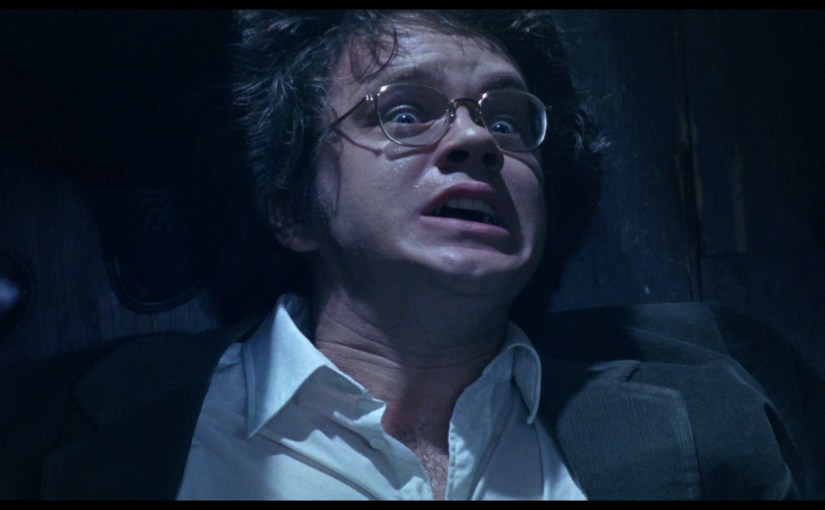
A movie like Adrian Lyne’s Jacob’s Ladder is anything but standard and it asks you to trust in its ambiguity in order to arrive at its big payoff.  For most of the picture it is unclear what you’re watching.  What keeps you engaged is Lyne’s approach to atmospheric indicators, like dark tunnels, dim bulbs, distant echoes and a disturbingly scared and depressed Tim Robbins.  The creepier the film looks and the more ominous it feels, then perhaps it will lead to a conclusion that will leave you satisfied.  Jacob’s Ladder functions like an M Night Shyamalan film where you just want to arrive at the twist.  When it finally reached its destination though, I was ready to turn the car around and go home.

Tim Robbins is Jacob Singer, a Vietnam veteran.  The picture opens up with Jacob returning from the dense jungles to reunite with his squad after what was his like hundredth bowel movement, it seems.  The squad jokes about with men’s locker room talk and then a disturbing occurrence takes place.  The next scene, thereafter, has Jacob dressed in a mailman uniform awakening from a nightmare aboard a New York subway train.  He gets off at his stop, but then he cannot find his way out of the subway station and then he encounters unsettling images like perhaps a demon or two on board a train that just misses running him down.

Much of Adrian Lyne’s film sets up sequences like this where the unexplainable cannot be explained.  Jacob now lives with a girlfriend, Jezzie (Elizabeth Peña), who is growing frustrated with Jacob’s unusual behavior.  It seems he suffers from PTSD following his time in the war, but also he mourns the death of one of his three sons (Macaulay Culkin) from his first marriage.

Robbins is especially good at not going for big moments in his role.  He’s a quiet, cheerless individual working with very little dialogue.  That’s impressive but it’s also a little boring, especially considering that for most of the film it’s near impossible to decipher what is going on, nor what is the exact story to uncover in Jacob’s Ladder.  My patience was trying, up until a stand at attention moment that came from nowhere.  Still, not much arrives thereafter. 

Jacob receives a call out the blue from one of his old army buddies.  When they meet up, it dawns on Jacob that his friend is encountering similar kinds of feelings.  When he reunites with the rest of the squad it occurs to them to sue the United States government for experimental drug treatments that were administered to them while serving in the war.  They turn to an attorney played by Jason Alexander in a role far off from his Seinfeld sitcom days to later come in his career.  This lawsuit may uncover a link for Jacob.  Unfortunately, I think it diverts away from Adrian Lyne’s intended lack of clarity for another kind of movie altogether.  The movie goes in this detour with Alexander’s attorney role and then finds its way back on the main road for the third act.  Hardly any new mileage was to be gained from this rerouting though.

This new development may give a more literal understanding into Jacob’s psyche and condition. However, I think the film fails to pounce on a new opportunity to attack a topical storyline that had become suspect during the actual timeline of the war.  As the film arrives at its conclusion, the script seems to rush to the surprise ending it wanted to garner.

Frankly, an early conversation with a Jacob’s chiropractor (Danny Aiello) easily spelled out the twist for me.  Alas, perhaps that took me out of the film early on. 

There are good ideas and good performances to be had in Jacob’s Ladder.  Yet, I don’t think the film entirely works because of Adrian Lyne’s attempt to push it’s vagueness.  Demons that come out of nowhere during Jacob’s hallucinations should be scary and have a fright shock to them, but instead these moments come off like abstract art that only frustrated me. 

I always thought I knew the ending, and I was right for the most part, but why does a runaway car have to chase Jacob down an alleyway to deliver the point?  Arguably, a boogeyman like Freddy Krueger might have done a better job at disturbing a threat of death than what was ever going on in Jacob’s Ladder.

WAR OF THE WORLDS (2005)

By Marc S. Sanders

There’s a harsh reality to science fiction in the 21st century.  When the aliens arrive on Earth, a little girl will ask her dad “What is it?  Is it terrorists?”  Steven Spielberg’s interpretation of H.G. Wells’ War Of The Worlds covered that territory when it was released four brisk years after 9/11.  All these years later and there’s still some legitimacy to that sadly reasonable question.  I find it interesting that one of the most pioneering novels in sci fi was published just ahead of the twentieth century paving the way for endless approaches to alien arrivals and attacks on Earth.  When Spielberg approaches it on his third try, the trope may have been done to death, but now the reality of the response is updated and all too real, and brutally disturbing.

Tom Cruise is the lead in this adaptation, and he is arguably in the most vulnerable role of his career.  He plays a storage bin dock loader, only regarded as a half caring deadbeat and divorced dad to his teenage son (Justin Chatwin) and 10-year-old daughter (Dakota Fanning). After his ex-wife (Miranda Otto) drops the kids off for the weekend, there’s an uncomfortable game of catch in the backyard followed by the beginning of the mayhem.  What appears like a lightning storm evolves into dead batteries and no electricity along with odd wind currents and hammering echoes.  When the people all around the main characters in their New York neighborhood get vaporized, then naturally their first instinct is to think it’s terrorists.  In today’s science fiction, terrorists are real and aliens are not.

Later, once the extra terrestrials (not the friendly kind who consume Reece’s pieces) have viciously introduced themselves, Spielberg’s film resorts to demonstrating mass exodus of the people of Earth.  Military units advise folks to “keep movin’.”  When the attacks happen, people scatter in different directions.  When a ferry is leaving the mainland, helpless folks rush for the dock, desperately climbing over the gates and leaving loved ones behind.  Spielberg hasn’t forgotten about the unlawful occupations from world history.  He simply applies it to a Tom Cruise action piece.

Tim Robbins shows up as a crazed man hiding in a farmhouse basement with a shotgun ready to begin a one-man revolution.  Cruise tries to contain the hysteria.  A scene like this could have had Nazis or aliens circumventing on the floor above, as the central characters remain as quiet as the Jews used to do in the basement below.  The parallels are eerily the same. 

Still, I respect the reality of the piece.  For one thing, much of the film, scripted by Josh Friedman and David Koepp is pulled right from H.G. Wells’ pages, including the nice and tidy ending that eventually arrives.  Don’t knock it.  That’ how Wells wrote the story to begin with.  Spielberg and crew don’t invent their own new image of the invaders.  They are still the tall three-legged tripods towering over the people of Earth and blasting them with their “heat rays.”  My favorite touch of this film is using Morgan Freeman’s vocals as the bookended narrator reciting Wells’ novel text, nearly word for word.  It’s a welcome salute to the memorable radio show that Orson Welles lent to the story decades before. 

I consider this adaptation of War Of The Worlds to be an observational picture or a reactionary film.  Cruise is not super skilled with fighting techniques and weapons handling.  All he can do is watch and react.  He’s an everyman here, which is actually quite unusual for him when you gloss over his resume.  This is not Maverick or Ethan Hunt: Superspy.  His purpose is to watch and return his kids to their mother in Boston, assuming she is still alive.  The success of the mission here only depends on getting the kids back to mom. 

Dakota Fanning and Justin Chatwin go against the grain of so many other Spielberg kid characters.  They are not intuitive or inventive.  Especially for Fanning’s character, she is just a scared little girl.  Not a Goonie and not like Gertie, who is scared for the sake of humor with precocious one liners.  If aliens were attacking the Earth, this is how my kid would react. 

Once it is established that this movie is a Spielberg running man film, then you may be grateful for the realistic mentality of the story’s community.  You’ll also appreciate the amazing set pieces accompanied by John Williams’ original score that plays like a drive-in monster movie or a Twilight Zone episode.  The aftermath of a plane crash on a Jersey suburban neighborhood is very convincing.  A runaway train set ablaze intrudes upon the cast with great surprise.  A cracked piece of concrete that gets swallowed up below only to immediately vomit a tripod in the air for instant attack is eye popping. 

War Of The Worlds is a well-crafted film, and the thought was definitely invested in its approach ahead of making it.  Yet, I won’t say it’s fun escapism.  It’s a reminder of the unrelenting realities we live in now.  Sadly, it’s not reaching to say that maybe we live in a time where it is in fact every person for themselves.  Even Cruise’s son insists on going off on his own, abandoning both him and his sister with nary a care at all.  Unlike Close Encounters or E.T., there’s not much to laugh or grin at in this Spielberg alien film.

The 2005 adaptation of War Of The Worlds is certainly loyal to H.G. Wells.  It may be realistic in the human nature of its science fiction, but in the end, it is also a very bleak film.  There’s much to marvel at, but once the movie is over, as my colleague Miguel and I often recommend to one another, it’ll likely be best that you get outside and bathe in the warm sun under a blue sky, roll around in the grass with your dog, and taste an apple for the first time all over again.  It’s about all we have left to embrace what little is left of our sanity.

TOP GUN

By Marc S. Sanders

For a movie that focuses a lot on showers, men’s locker rooms and bare chested sweaty and chiseled volleyball players, it’s a wonder that it is called Top Gun.  Maybe the title has another indirect meaning to it, other than a moniker for a Navy fighter pilot school of the elite.  Maybe these guys are elite for a different reason.

The Tony Scott film that is supposedly about the top one percent, the best of the best, American fighter pilots in the Navy is arguably the most important film in Tom Cruise’s career.  It launched the actor into a superstar sensation that has hardly faltered since the movie’s release all the way back in 1986.  But is it a good movie?  Well, yes and no.

I’ve always loved Tony Scott’s filmmaking technique.  Sure, his sun-soaked film shots are constantly repeated.  He always relishes in enhancing the beaded glow of sweat drenching his actor’s faces, arms and chests.  It’s seen in nearly every moment of Top Gun, as well as other celebrated pictures like Crimson Tide, Beverly Hills Cop II and True Romance.  Orange sunlight blankets palm trees and beach lined streets.  Bar saloons and military headquarters are lit in sexy blues and greens.  It may lack originality after seeing a few of his films, but it just makes the movie all the more sexy. 

Tony Scott is also a well-versed director in action sequences.  He’ll get your pulse racing and Top Gun is the best example.  The fighter jet sequences in this film are masterful in editing, sound and speed.  It’s fantastic to see how the planes will twirl around and then shoot themselves straight up into a vertical trajectory in the sky and finally cut in on actors Tom Cruise, Anthony Edwards and Val Kilmer for a “WOO!” moment in the cockpit.  This stuff still holds up.

Yet, unlike other modern-day films that focus on cadets or students in our armed forces, Top Gun doesn’t concern itself with the discipline of what it takes to serve in the Navy.  This is the informal, class clown version of An Officer And A Gentleman.  You only need look as far as Tom Cruise’s character’s pilot call name, Maverick.  The name itself is a one-word thematic description of what you are watching.  So, the kid who learned to say “what the fuck” in Risky Business, went on to do daredevil flybys while disobeying orders.

Maverick’s real name is Pete Mitchell.  He has no family except that of his co-pilot, Goose (Anthony Edwards).  The disappearance of his Navy pilot father remains a mystery…because it is sexy and cool to have a mystery for your handsome hero in a film like this.  Call it DRAMATIC HEFT!!!! 

When Maverick and Goose get the opportunity to attend “Top Gun” – a fighter school specializing in training the best pilots in the world in aerial dog fighting – they are intent on getting their names on the plaque for the best of the best of THE BEST.  Competition comes in the other prettiest of the pretty boys with Iceman (Val Kilmer).  These are all great likable characters.  Yet, even when I saw this film at sleepaway camp at age 13, I couldn’t help but notice how distracted it gets with the abundance of erotic machoism on display here.  What would serve as dramatic dialogue in another film is presented in a steam room area allowing opportunity to see the male cast wrapped in towels around their waists with wet spiky blond and black hair.  It truly doesn’t matter what they are talking about in this scene.  When you are watching it, all that you are hearing is the sound of Charlie Brown’s unseen and indecipherable school teacher.  “Waa waa.  Waa waa waa waa!”

That’s not enough though.  The infamous volleyball scene keeps you awake.  I don’t care if you are hetero or homo or bi or pan or plus, the beach volleyball scene keeps you alert as one of Kenny Loggins’ many movie songs plays in accordance.  Tony Scott doesn’t just go for tossing the ball around.  Slow mo captions are offered of each guy just posing with their chiseled arms and chests.  You may not take your eyes off of it, but oh my…what does this have to do with the discipline of attending Navy fighter pilot school training?????

The romance is second to none.  Truly!  These days, people talk about Jack and Rose in Titanic or Ross and Rachel on Friends.  For me, it’s Maverick and Charlie (Kelly McGillis).  Cruise and McGillis really light up their scenes together.  It’s an absolute perfect pairing of sex appeal and it is really when Top Gun performs at its smartest level.  The dialogue is strongest during their scenes.  The romance isn’t rushed but nicely flirted with, and when tragedy strikes within the thin storyline of the overall film, the relationship goes in another supportive and appreciated direction.  When I was a kid, with hormones being discovered for the first time, my buddies and I would elbow each other during the midnight blue sex scene between McGillis and Cruise with the Oscar winning song “Take My Breath Away” from Berlin playing.  I look at this scene now and it is modern romance at a beautiful best.  A fantastic scene from Tony Scott. 

Charlie is the unexpected, well-versed contractor for the Navy giving counsel to the pilot students on how best to operate the jets.  In the 1980s, action blockbusters normally held the women as the barely dressed damsels to be rescued, and nothing more.  The female characters didn’t have brains and the only brawn to go around was saved for Princess Leia or Marion Ravenwood (Raiders).  Charlie is an exception though.  McGillis plays the character as someone who is aware that these testosterone-filled guys will regard her as a piece of meat, until they realize otherwise.  The irony of Top Gun is that the nearly all male cast, Cruise included, are the pieces of meat.  The one main female role is actually the brains of the whole operation.  McGillis was a marvelous actress back in the day.  Go look at Witness and The Accused to see what I mean.  With her help, Cruise elevates above the hokey dialogue of the Top Gun script. Kelly McGillis really could act well in almost anything.  I wish her career went further, honestly. 

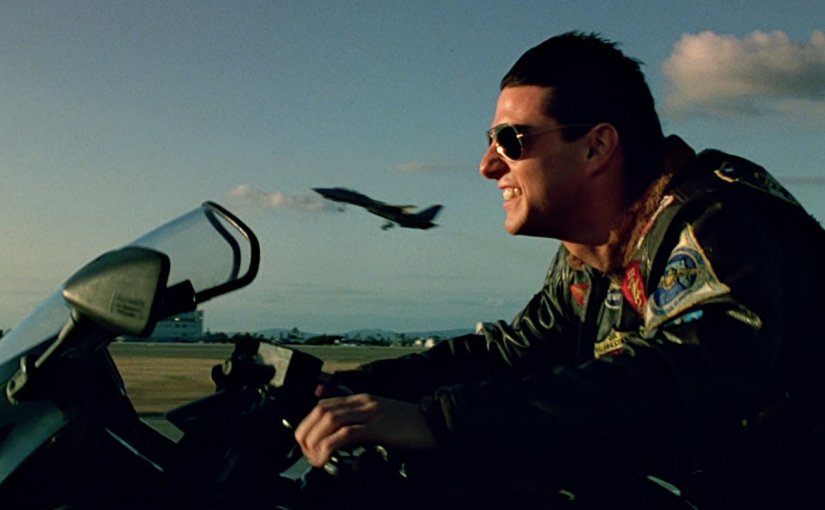
Top Gun remains a mainstay in 1980s pop culture.  If the VH1 channel is doing a documentary on the decade of Madonna, Michael Jackson, parachute pants and neon pastels, Top Gun is also brought up in the mix with a close up of Tom Cruise’s toothy grin and his aviator sunglasses.  We were never watching Oscar winning material here, but somehow the film that introduced all of us to Tom Cruise still feels like a day at the beach with the twenty something boy toy in his tight jeans and leather bomber jacket riding his Kawasaki Ninja motorcycle at top speed or breaking the sound barrier in his fighter jet with his shiny navy-blue helmet on his head.  Top Gun and Tom Cruise demonstrated that it’s a party to serve in the Navy.  Why not?  Vietnam was behind us and the decade was not embroiled in war.  Join the Navy!!!!  It’s fun and you get to shower with the best-looking guys in the world.  You’ll even get to play volleyball with them and date your sexy flight instructor.

A lot of the dialogue and the storyline may sound like an adult, military interpretation of Saved By The Bell, but you can’t break away from the sexy allure of what Tony Scott with Cruise, Kilmer, McGillis and Edwards put on the screen.  It’s always been there and somehow a sequel was never made. 

Wait a second!  WHAT??????

BULL DURHAM

By Marc S. Sanders

How Susan Sarandon did not even get nominated for an Oscar for Ron Shelton’s Bull Durham, I’ll never know. Shelton writes the character of the lustrous, Annie Savoy with grace, wisdom and silky sex appeal. It remains one of the best female characters to ever appear on a screen and no one else could have played the part other than Sarandon.

Shelton’s sensational script opens with Annie’s declaration that she believes in the “church of baseball” and from there it waxes poetic on the sport’s religion and traditions as Annie uses her charm to seduce the Durham Bulls’ newest talent, dim witted pitcher Eppy Calvin “Nuke” Laloosh (Tim Robbins) leaving the team’s experienced catcher Crash Davis (Kevin Costner) wanting more. That is until Annie realizes that she’s the one who wants more.

Davis is recruited to groom Nuke for the big leagues. Nuke has got a million dollar fast ball arm but he “…fucks like he pitches. Sort of all over the place.” Crash is the frustrated player with talent but the sun is setting on his opportunity for the big leagues. Dumb Nuke has a future that just doesn’t seem fair to Crash. Annie is no help when she chooses Nuke over Crash to hook up with for the season.

Shelton explores so many dimensions in his script. It does not solely focus on the three primary characters. The screenplay stirs in a mixture of what it’s like to serve on a minor league team with bats and gloves that are cursed, the urge for a rain out game or what present to get Bobby and Millie for their wedding. A call to the mound might settle some of these things.

Shelton directs his script with a very natural approach. Watch Crash and Annie flirt in a batting cage. Costner and Sarandon don’t even flinch as the balls whiz between them. Baseball is a part of these characters. They live and breathe baseball and they relish sex.

Shelton’s last 15 minutes of film offer a celebration of sexual release that appears pleasant, fun and somewhat religious as the chemistry between Costner and Sarandon remains strong. They rattle the whole house it seems and the kitchen will never be the same.

Robbins is great with his idiocy. He wasn’t as well known when this film was released in 1988. His surprise appearance of stupidity is so lovable and welcome. When he tries to think he gets himself in trouble. When he listens to his coaches, Annie and Crash, he excels. The pains he goes through upon their advice is ridiculously hilarious. Don’t forget to breathe through your eyelids, Nuke.

I also gotta recognize Robert Wuhl and Trey Wilson as the managers of the team. They are hilarious but not overt. Wuhl is great as he bellows out encouraging but incomprehensible cheers from the dugout. Wilson looks on with tired facial expressions.

This cast is invested in the cloth of America’s pastime. They know the batting averages. They read the signs. They play for the crowds. It’s as if Shelton moseyed into the town of Durham, North Carolina, put his camera up and watched how another season all played out. His lens could have been working with a documentary mindset.

Bull Durham is one of the best scripts ever written full of brilliant one liners and philosophies that I might not entirely understand what any of it is referencing. Yet when Annie or Crash carry on, I can’t help but suddenly get interested.

Bull Durham is the best baseball film ever made performed by an outstanding cast led by a director with a clear, wide-open vision.

Play ball!!!

ZATHURA: A SPACE ADVENTURE (2005)

By Miguel E. Rodriguez

Director: Jon Favreau
Cast: Josh Hutcherson, Dax Shepard, Kristen Stewart, Tim Robbins
My Rating: 9/10
Rotten Tomatometer: 75% Certified Fresh

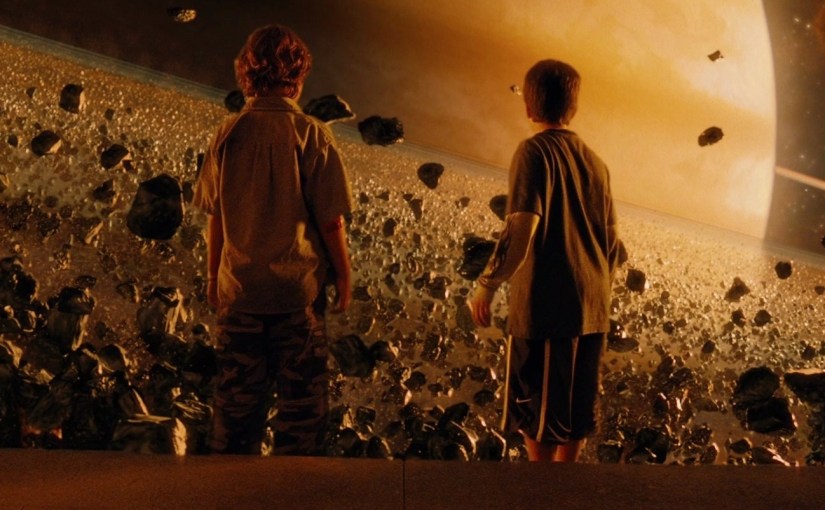
PLOT: Two young brothers (Hutcherson, Jonah Bobo) are drawn into an intergalactic adventure when their house is hurled through the depths of space by the magical board game they are playing.


If only all family movies were like this.

Too often, so-called family films are mealy-mouthed cream puffs that appeal to the short attention span of their target audience, leaving the parents either bored to tears or fatigued from sitting through 90 minutes of explosions.  The scripts are subpar and tend to treat kids as if they’re not all that bright.

Not Zathura.  With his third film (after the forgettable Made and the Christmas neo-classic Elf), director Jon Favreau proved that he’s the real deal.  Here’s a REAL family film with something for everybody: comedy, family drama, peril, thrills, a killer robot, fearsome aliens, and nostalgia.

The nostalgia part is especially notable.  The board game at the center of the film is constructed to look like something made in the ‘50s or ‘60s, which, to the kids in the film, is practically ancient history.  But for me, I found the film nostalgic in the way it captures the kind of fun I used to have at the movies.

Not that I don’t still have fun, mind you.  It’s just that, when I was a kid, sci-fi and fantasy films felt more real, you know?  It was so easy to imagine myself as a resident of the Goondocks, or discovering an alien in the cornfield behind my house, or building a spaceship in the backyard with my two best friends.  Zathura captures that kind of feeling like few other modern family films can.  It’s a movie that has the potential to live on in the imagination after countless other films have vacated your consciousness.

And the VISUALS.  I don’t know what kind of budget the movie had, but it looks like a $100 million movie.  The killer robot is absolutely convincing, as are the aliens.  Which brings up another great element of the film: danger.  The bad guys in this movie may occasionally look a little cartoony, but they are not to be trifled with.  That’s something a lot of kid’s movies tend to get wrong.  The filmmakers lose their nerve in creating real villains, for fear of pissing off too many parents.  In reality…dude, kids can handle it.  Give the bad guys fangs and spinning saw blades.  It just makes it that much more satisfying when the bad guys LOSE.

Zathura barely made its money back, and that’s including domestic AND worldwide grosses (okay, I looked it up).  I could be wrong, but I’ll bet too many people thought it was a Jumanji ripoff.  It IS based on a book by the same author as Jumanji (and The Polar Express, as it happens).  But it is possible, I think, to see Zathura in its own light.  It’s a fantastic movie that will please all ages.

THE SHAWSHANK REDEMPTION

By Marc S. Sanders

The purest form of humanity can be found in some of the most unexpected places. Frank Darabont’s first film, The Shawshank Redemption, based upon a novella by Stephen King is a perfect example of that truth. In a federal prison, the true test of a man’s character is established. Will a prisoner be as cold hearted as the crime he’s been punished for, or will he find a deeper meaning to his existence for himself and those around him? What if this particular man is actually innocent, wrongfully convicted? Will his innocence of crime be upheld?

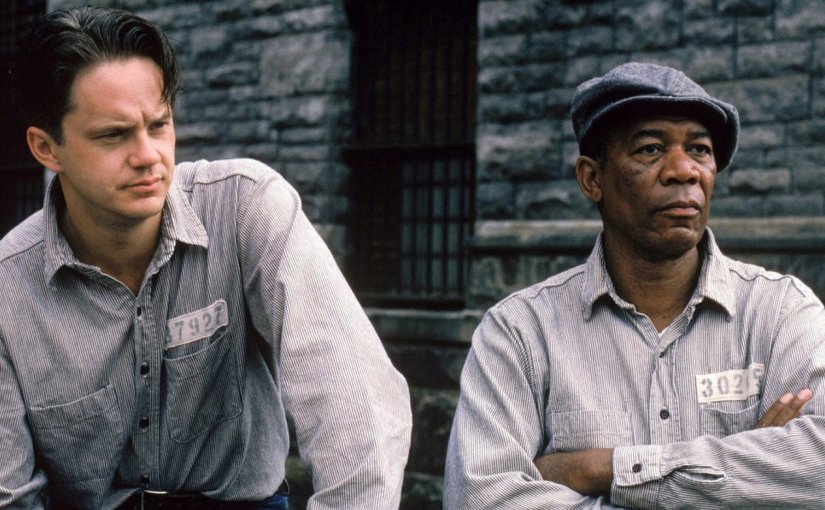
To experience The Shawshank Redemption is to learn about a community that I am completely unfamiliar with, and I’d bargain most of its viewers are as well. Shawshank prison is not a place I would like to check into. Though many of its residents display heart and comradery, nonetheless. These men likely didn’t know they were capable of such merit until Andy Dufresne (Tim Robbins) arrived to serve two concurrent life sentences for murdering his wife and her extramarital lover. Andy says he’s innocent without any desperation or urgency because none of that elevated showmanship would make a difference. The evidence and circumstances at trial unfortunately were coincidental to easily sentence Andy for a crime he didn’t commit. Everyone at Shawshank insist they’re innocent. Likely though, Andy is the only one who can genuinely make that claim.

Andy’s introduction to the prison is hard for the first couple of years. He’s consistently beaten and raped by inmates who need to exhaust their sexual tendencies. Fortunately, he sidles up with Ellis “Red” Redding (Morgan Freeman in maybe my favorite role of his career). Red is the go-to man for contraband resources like whiskey or as Andy requests a small rock hammer and a large poster of Rita Hayworth. Everyone is happy to know a guy like Red. Yet, Andy does not lose sight of his personal value. He was a banker by trade and when an opportunity opens up, he assists the viciously frightening prison guard Byron Hadley (Clancy Brown, who really should have more villainous roles in film beyond his voiceover as Lex Luthor in cartoons) with a legally accepted government tax exemption. More importantly Warden Samuel Norton (Bob Gunton) takes advantage of Andy’s talents to sustain his seemingly innocent money laundering schemes.

There is much education to be had from viewing The Shawshank Redemption. I learned what the term “institutionalized” means from Red’s experience. A man who has served a near half century has become accustomed to prison life. He offers little significance or purpose outside the prison walls. I also learned the value of music and literature and art. It’s needed to survive those lonely nights in a prison cell, or worse in the hole where you can wind up should you step out of line from the Warden’s strict guidelines of adhering to discipline and the Holy Bible. What you hear and what your read stay with you in your heart and mind, offering a most valuable commodity – hope. A life sentence will take away your liberties to walk freely among the masses, but nothing will take away what you’ve absorbed. If you can at least hold on to your memories, then you will never lose hope. Andy reminds Red and his fellow prison inmates of the hope you hold onto no matter how long you are held against your will.

Frank Darabont introduces a spectacular midway scene where Andy finally receives a donation of books and records for a prison library he envisions building for Shawshank. He uncovers a vinyl record of an Italian opera and with complete disregard for rules, he airs the music through the intercom. Darabont gathers gorgeous close ups of the hundreds of prison extras with overhead shots of the yard, woodshop and infirmary. The men freeze for a moment to look up in the sky from where the music is emanating from while mixed in with the soothing voiceover narration from Freeman. It’s a beautifully directed scene. A risky scene for late 20th century audiences who are used to quick cuts of action in their films with powerhouse soundtracks and pop music. Darabont found a way to connect the audience delicately to the film through Andy’s personal values and Red’s learned observations.

The Shawshank Redemption is an exceptional piece of writing. I can’t compare it to King’s source material as I’ve never read the story. Having said that, I’m typically hot and cold on the author’s books and screenplays. Sometimes they go too over the top for me. However, Darabont honed in on a perfect balance of likable characters and honest life within a prison; at least I feel that it’s honest. All men are created with good inside them. What they learn from day one is what can drastically change them and what can come of their sins can revert their instincts. Andy Dufresne is the instrument that redeems the men of Shawshank prison. Tim Robbins is right in this role; maybe his best role for his career as well. He does not underestimate any of the men in Shawshank and keeps to his personal enrichment which he also shares, despite the selfish hypocrisy of those meant to maintain order like the Norton and Hadley.

Morgan Freeman is the man who is becoming more and more institutionalized to prison life, always failing to get paroled for a murder he committed when he was a young and stupid kid. If not for Robbins’ melancholy performance as Andy, Freeman’s performance as Red would not realize a new kind of importance for himself. In fact, many of the inmates wouldn’t be able to acknowledge what they are capable of or what they mean in the world they live in without Red, but more importantly Andy as well. Morgan Freeman and Tim Robbins make for one of the best on screen couples in film history. Their chemistry is magical. Any scene between them can be studied for the weight of emotion or lack there of which the two actors carry. They both went on to win Oscars later in their career, respectively from a pair of Clint Eastwood projects actually, but the argument can be said that the awards should have come their way for Darabont’s film.

The ending to The Shawshank Redemption is an unforgettable and unexpected piece of storytelling that never seems to imply itself before the reveal and yet pleasantly makes so much sense. Maybe the one convenience to build to it’s winning conclusion stems from the location of Andy’s cell within Shawshank prison. Bah!!!! I dismiss that little contrivance to allow me to joyously appreciate this film over and over again.

There are ironies and unfortunate moments to see in The Shawshank Redemption. Still, there are revelations and opportunities to cheer and feel better about yourself when watching the movie. It’s one of the most uplifting films you will ever see. It’s inspiring and imaginative. Most of all it is smart and defiant. The Shawshank Redemption never believes in despair. It only grasps upon the hope of its characters. The Shawshank Redemption is a must see film.