RAMBO: FIRST BLOOD PART II

By Marc S. Sanders

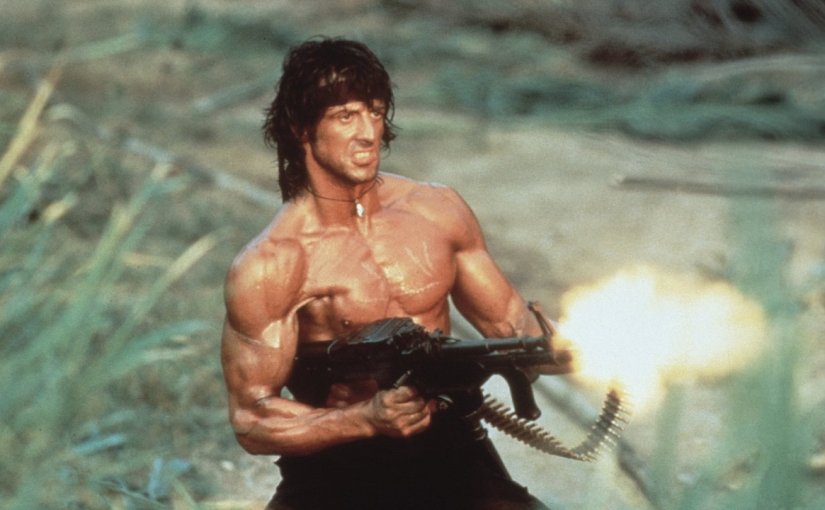
David Morrell’s literary character Rambo (no first name in the book, First Blood) cinematically survived his first post Vietnam adventure to spill buckets of bloodshed for many more follow ups.  Sylvester Stallone hit box office gold when he signed up for Rambo: First Blood Part II.  The Vietnam War was long over leaving an endless supply of storyline threads for Hollywood.  Who better to go back there with a ripped upper torso, a bow and arrow, a bayonet knife that won’t carve your steak but will hack up the cow, and a lot of firepower?

Green Beret John Rambo is specially recruited by his former C.O., Colonel Trautman (Richard Crenna) for a solo mission into a Viet Cong camp where American POWs might be held captive.  He’s got thirty-six hours to get in and out.  There’s a catch though.  A mercenary led operative named Murdock (Charles Napier), who hides behind a desk, a white collar and necktie specifically instructs Rambo to only survey the area and take photographs.  Under no circumstances is he to engage the enemy or escort any prisoners back to his rendezvous point.  Thing is that Rambo is not much of a photographer.  

James Cameron is credited as one of the screenwriters and apparently Stallone modified the script from there.  This bloody sequel is entertaining but I always found it a little mundane despite all the action.  

Just as the movie is about to grow a brain and intelligently debate with itself about how so many American soldiers were disregarded following the war, it stops talking and only resorts to one action set up after another.  Crenna and Napier potentially engage in a worthy debate focusing on government mistrust and moral servitude before the moment is cut short.  Trautman is the easily assumed ally of Rambo.  Murdock is the antagonist, but truly I have to ask why.  What is the motivation not to side with Rambo’s efforts to literally rescue half a dozen abandoned soldiers?  First Blood Part II cuts the argument short and never returns to settle the discord. 

There is perhaps only 5 or 6 lines in the last forty-five minutes of the picture.  There’s a melodramatic closing monologue from Stallone’s morose character.  Otherwise, this movie would prefer not to think.  Sadly, there is a lot to consider here, but the explosives and machine-gunning filibuster, insisting on holding the floor.

The action is categorized in a series of episodes.  A five minute section offers a variety of ways Rambo covertly takes out Russian military soldiers who are maintaining a stronghold with the Viet Cong.  It’s clever how one guy is taken by surprise when a mud caked Rambo guts him with his knife.  For another stooge, he’s literally sucked away into the mouth of a cavern.  You don’t even see Rambo.  How does the hero get around with enough time to set up these sophisticated traps?  This is all cool to look at but I would have liked to have learned more about how the Russian General (Steven Berkoff) formed an alliance with the Vietnamese.

Later, Rambo uses his endless supply of arrows to blow away acres and acres of marsh and tall grass.  I buy one man army tropes in movies.  Yet, I still question how a guy on two feet can set ablaze the equivalent of five football fields worth of territory.  How does he always manage to get in range? 

A war copter hovers over a river.  The henchman riddles the surface with bullets, and Rambo LEAPS from the depths INTO the chopper.  I mean he flies up like Superman.  Another moment has him submerged and then he pops out of the water with perfect aim to mow down a mob of men.  How did he know where to shoot?

I guess all of this is entertaining.  I just don’t relish it like I’m expected to because I’m asking too many “how does he…” questions.  My suspension of disbelief doesn’t have a high level of tolerance for what Rambo is apparently capable of.  David Morrell’s character was somehow blessed with superpowers, practically!  

With Rambo serving our country, how in the hell did we ever lose the Vietnam War? Seems damn near impossible.

First Blood embraced a common problem with veterans who were disregarded by the institutions they swore to defend and serve.  It’s a terrible blemish on our country’s patriotism.  An awareness was offered in that film amid all of the believably capable action scenes.  Part II clearly shows a lack of concern.  POWs get rescued but they are not even given an opportunity to reflect and speak.  Their bearded and malnourished figures speak for them in close ups.  I didn’t think enough was delivered for any semblance of a message that was asking to be heard.  Instead, we get a Stallone showing off a bronze, ripped chest, red bandana and a slew sophisticated weaponry. Rambo looks sexy here, and that does not sit right with me.

I can rewatch Rambo: First Blood Part II.  I just can’t feel for any of it.  I think I was entitled though.  Moreover, those that served in this awful conflict are deserving of a product that would better honor their sacrifices.

A CLOCKWORK ORANGE

By Marc S. Sanders

What is Stanley Kubrick attempting to demonstrate with A Clockwork Orange, arguably the most controversial and shocking film of his career?  The film is considered an almost precise adaptation of Anthony Burgess’ novel.  I never read the book, but the sources I found on Wikipedia and IMDb are consistent with their claims.  Kubick’s vision is never not odd or strange.  It’s almost always repulsive and I have to believe the director is proud of the finished accomplishments left in every caption and scene.  Yet even Kubrick was disgusted by some copycat attempts that spawned from what the story’s protagonist troublemaker executes within this context.  Regrettably, in 2025, it would be easier to ask what did you expect Mr. Kubrick?

In a dystopian future of England, young Alex (age 17, but 15 in the book) relishes on walking the streets each night, accompanied by his three droog companions, committing the worst atrocities imaginable.  They beat up a homeless beggar, engage in gang brawling, and brutalize and rape a wealthy couple in their own home to the celebrated tune of Singin’ In The Rain.  I’m curious how reminiscent A Clockwork Orange is to people who only wish to watch the cheerful and innocent fare of Gene Kelley.  Is their subconscious intruded by Malcolm McDowell as naughty boy Alex with the one eyelash, bowler hat, protective jock strap and erection mask?

Mayhem is the specialty of Alex and his degenerate friends.  However, Alex who is the leader of the pack is challenged to uphold his command on the gang of four, and once the others betray him, the poor boy is sentenced to a militaristic, concentrated prison where he must don an academy uniform while studying the gospel of the Bible.  

What happens though if the student sees himself more as the Roman with the harsh whip, and less as the savior willing to die for our sins?  Are people like Alex only inherently wicked, vile, and perverted?  Can nothing change their insatiable appetites for harm and evil doing?

I thought about One Flew Over The Cuckoo’s Nest while watching A Clockwork Orange.  McMurphy fakes an impression of insanity to be institutionalized. He operates under the presumption the circumstances will be more accommodating than a jail cell.  Alex campaigns to be a guinea pig for a new kind of therapy believed to eliminate all temptations of violence and cruel sexual escapades. This could be a means to free him from a forty-year prison sentence. I never believed he wanted to be liberated from his appetite of rape, torture and murder, though.

Following an abundance of sickening, visual exposition, Stanley Kubrick is ready to test some possible outcomes by forcefully prying open the subject’s eyes to witness footage of violence, extreme rape, harsh pornography, and Nazi propaganda.  Will this overexposure repulse Alex away from being the monster he used to be?

I’m not sure A Clockwork Orange provides any definitive answers but the weirdness of this off scale and ugly England is nothing but apparent.  Nothing is normal looking or relatable in this film.  Everything from the colors to the costume wear to the slang verbiage of the dialogue and even the furniture is completely twisted.  Kubrick would offer a similar approach in The Shining. No director is louder and more offensive with colors in a film. A green bedroom ceiling or a blue typewriter or even a glass of milk and stark white sexually posed mannequins used as furniture pieces in a hangout joint are so much more than discomforting.

Even the infamous rape scene is uncharacteristically done.  The Droogs happily sing while brutalizing this couple.  Before Alex commits his “push in, push out” he scissors the woman’s red jumpsuit around her individual breasts before cutting her out of the fabric to be entirely nude.  I’ve seen plenty of staged rape scenes but then there is what Kubrick envisions. Not to mention, how notoriously redundant he is with repetitively shooting his scenes over and over again. Kubrick is an auteur filmmaker but his desire for perfection in his shots are as twisted as many of his films.

A woman is brutally killed by being pummeled with a sculpture of a penis/taint/anus piece. (I don’t know what else you call this!) A typical baseball bat, stick or hammer is not the bludgeoning weapon of choice. Stanley Kubrick wants to ensure this perverted item of art owned by a wealthy woman is used to commit the crime. A mix of sinful natures ranging from sexual to violent.

Why go to all of these lengths to be so unusual?

A Clockwork Orange is deliberately shocking and thus everything on display is disorienting.  With all the movies and TV shows I’ve watched, on top of some of the most unusual fetishistic material I’ve witnessed, I imagine I’m like most viewers where I’ve grown accustomed to the violent and sexual debauchery on display.  I’ve seen so much I am practically desensitized to it all.  When I read about another school shooting in the news, regrettably and with sick sarcasm, I’ll think to myself, “Huh!  Must be a Tuesday.”  It feels so wrong but there is truth in this ongoing epidemic. Stanley Kubrick, back in the early 1970s, had to work that much harder to grab the attention of the viewer.  Nothing can prepare you for an initial viewing of A Clockwork Orange. Back in 1971, I’d argue no one was prepared for this film’s content. It’s a pioneering document of extreme violence and sexual perversion. Filmmakers, like Martin Scorsese, David Lynch, and Brian DePalma hereafter would push their own limits while bridging these activities with the natures of their challenged characters.

Is there a confidence to seeing if a heathen like Alex can be cured of his original nature? Can he be returned to a society where his once menacing threat is nonexistent?  Plus, can Alex live a peaceful and nurturing life?

Alex is not the only villain to this piece.  While we do not get to know his parents well enough, how sadistic are the individuals behind his therapy process? Alex’ “recovery” becomes politicized and treated like scientific doctrine at the expense of his own humiliation. He is used to prove a point by beating him up publicly and forcing him to lick the bottom of a man’s shoe and exposing him to a naked woman, as well. Those that he encounters again, like former victims and fellow Droogs, following his therapy are not perfectly complimented to this new Alex. Scenarios that re-introduce him to society imply that Alex’ conditioning process might have overlooked what was to come following his release. Were they truly “healing” their patient?

A Clockwork Orange is never a refreshing film.  It’s always alarming right down to its final frame.  The picture certainly does not endorse the merits of psychotherapy or psychological reform.  Maybe, that’s why I believe that anyone specializing in the field of mental health should watch the picture. See what works and what doesn’t. Kubrick is uncompromising with getting his cast to do what he wants, no matter how off putting the material is. If anything, I wonder if this movie is more relevant today. Can anyone who traps themselves in an impersonal and isolated environment of social media influence attain the capability to shed their destructive proclivities for a natural desire to live, care and cherish fellow human beings?

Like most of Kubrick’s films, A Clockwork Orange is not an easy watch.  I know a friend who describes the movie as a comedy.  I know what she’s talking about and why. Still, how can anyone allow themselves to guffaw at someone who is an agent of death, torture, destruction and chaos? 

I don’t know what else I can say about A Clockwork Orange.  I do not recall asking so many questions in one review as I demonstrate here. Watch the film on mute or with Alex’ voiceover against an assortment of classical music as Kubrick intends simply because Alex’ only friend, only ally, is “Ludwig.”  No matter how you observe the piece, it is likely your jaw will drop, and your eyes will wince.  You will cringe and you will unquestionably test your tolerance.  You may just turn the movie off.

Regardless of how you respond to the picture, be assured that Stanley Kubrick successfully completed what he set out to do.

OCTOPUSSY

By Marc S. Sanders

By the time Octopussy was released in 1983, I think part of the joke was that Roger Moore, on the latter half of middle age, can survive and triumph over insurmountable odds. The crow’s feet show around the eyes. The hair color looks faded. He doesn’t necessarily look physically fit anymore. Yet, 007 can still outrun a pack of hunters riding elephants and shooting at him with sniper rifles. If you just accept this standard and laugh at the absurdity, you’ll likely have enjoyed Octopussy.

Director John Glen’s movie is a mixed bag of really good action material and a regrettably choppy storyline involving jewel thievery and a Russian nuclear bomb. Only it’s not made clear how these two connect until very late in the picture. By that point I didn’t care much.

There’s some amazing footage in Octopussy. Particularly, a spectacular scene where Bond manages to get on top of an airplane and stay there. With the exception of close ups for Roger Moore, this is all stunt work and my jaw drops no matter how many times I see it. Bond is trying to prevent villain Kamal Khan (Louis Jordan) from escaping with his henchman. Khan tries to shake Bond off the plane by doing aerial maneuvers including flying upside down. Glen’s camera captures his stuntman doing it all at 30,000 feet. Then the henchman goes outside of the plane! It’s a sequence that must be seen. Another all time great stunt in the series.

Oh yeah, the story! Bond travels to New Delhi, India to uncover why Khan has spent an enormous fortune on a Russian Faberge Egg at a Sotheby’s auction. Following a backgammon match where 007 outwits his opponent’s cheating with loaded dice, Bond finds himself outrunning bad guys in a street market complete with sword swallowing, a bed of nails and running on hot coals. I was waiting for him to break into song like Disney’s Aladdin. (Ironically, Tim Rice wrote the lyrics to the film’s song “All Time High,” performed by Rita Coolidge.)

Eventually, he catches up with Maud Adams, making her second appearance in the series; this time as the title character. She’s a jewel smuggler working with Khan, only she’s got scruples that Khan does not possess. Consider the fact that once she realizes Khan is working with a renegade Russian general (Stephen Berkoff) to detonate a nuclear bomb during a circus located on an American military base in East Berlin, Octopussy has an epiphany that she has been double crossed. This really does not seem so surprising to anyone except Octopussy.

Bond has to endure a lot in this film. Besides contending with Khan’s turban wearing henchman, he also has to fight against deadly identical twins who are experts at knife throwing. Worse yet is when he has to don a clown outfit complete with rubber nose, floppy shoes and makeup.

The action of Bond making efforts to get to the doomed circus is great as he has to leap on to a train and follow after the locomotive with a Mercedes Benz on railroad tracks. Good automobile stunt work further in this extended scene also works well.

What leaves me feeling ho hum, though, is Octopussy and her lady soldiers in red jumpsuits, all skillful in fighting techniques and weaponry ready to take on Khan’s bandoliers. Looks like an old Batman tv episode really. It’s a little eye rolling to say the least.

Octopussy is watchable but it’s nothing special. This film and Roger Moore’s next and final adventure as 007 are certainly two of the weakest in the series. I must persist though.

BEVERLY HILLS COP

By Marc S. Sanders

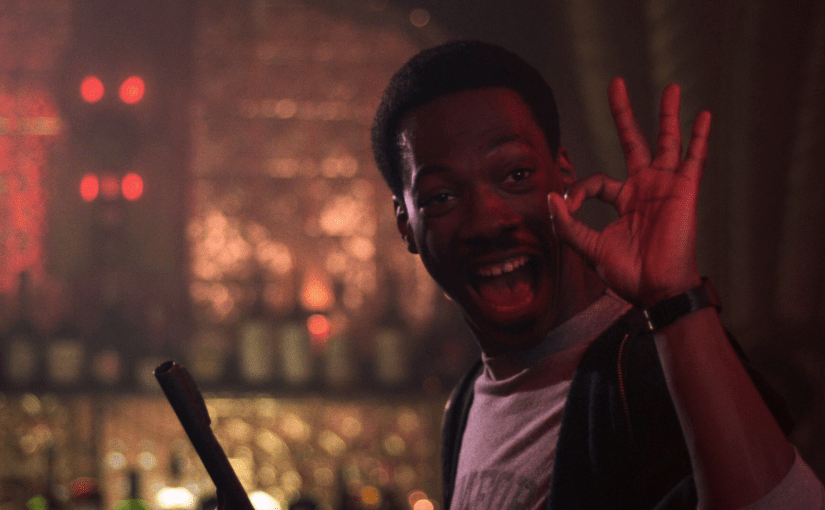
Who actually wrote the Oscar nominated script to Beverly Hills Cop? Daniel Petrie Jr and Danio Bach, or Eddie Murphy?

Murphy’s lines are delivered so fast and so naturally that it seems impossible they could ever rest on a page. Eddie Murphy is an enormous talent of word play and delivery. I miss this Eddie Murphy. I’m reluctant to welcome the Eddie Murphy of PG related fare of recent years. He just doesn’t look comfortable in that garb.

One of the first R rated films I ever saw in theatres (not THE first, as that honor belongs to the Clint Eastwood classic, Sudden Impact) still holds with its hilarity, and the credit does not belong to just Murphy but the whole cast including John Ashton, Judge Reinhold, Ronnie Cox and even early in career appearances from Jonathan Banks, Bronson Pinchot, and Damon Wayans.

I still haven’t forgotten this theatre experience when I joined my older brother, Brian and his friend Nick at the movie theatre in Ridgewood NJ. Never had I heard an entire packed room of people in the dark on a Saturday night laugh so hard together. It’s likely a moment that impressed my love for movies going forward. Movies could bring all sorts of joy and happiness and escape. Beverly Hills Cop was altogether another thing entirely.

Yes!!!! A foul mouthed cop from Detroit who becomes a stranger in a strange land while visiting Beverly Hills to solve his friend’s murder. That’s a film that’s had a great impact on me. As a writer, director Martin Brest’s film (later to do Midnight Run and Scent Of A Woman) offers a very simple blue print to allow Murphy to run wild. It cuts out a lot of complicated red herrings to just stay on a straight resolution. As Murphy’s Detective Axel Foley (great character name) comes across another development, in walks another great set up.

I compare the frame of Beverly Hills Cop and Eddie Murphy to the first Mission: Impossible film with Tom Cruise. The Cruise film makes a huge oversight. Early on it introduces a huge array of characters for an M:I team and then eliminates them all to hardly be used. It was wall to wall Tom Cruise. He was a producer on that film with much creative control and it felt to me as if he insisted on owning every scene, every line, every moment. It turned me off a little.

Murphy on the other hand plays along with his ensemble. Ashton and Reinhold have great moments all to themselves. I still die laughing out loud as Reinhold tries to subdue a situation by ordering an army of machine gun toting bad guys to lay down their weapons only to be silenced with another round of gunfire. The banana in the tailpipe! Ashton working with Murphy to stop a random robbery at strip joint, and then helping to save him later on from arrest. What about Ashton trying to climb a wall during a shootout?

Then there’s Murphy and Pinchot discussing a weird art piece (“Get the fuck outta here!”). Couldn’t you envision Pinchot and Murphy in another film together?  A shame it hasn’t happened.  (No, I won’t count the dreadful reunion in Beverly Hills Cop III.)

Brest provides great showpieces accompanied by one of the best film soundtracks ever. I will never not listen to “Neutron Dance” by the Pointer Sisters on Sirius XM’s 80s on 8 while recalling this film’s opening scene double rig truck chase. Brest directs a symphonic high energy blend of sight and sound. Plays like an awesome music video. Same goes for Glenn Frey’s “The Heat Is On.” If I ever get an opportunity to visit Detroit, that’s what will be playing in my head.

Orchestrator Harold Faltermeyer’s electronic keyboard deserves much credit as well. His covert, sneaky 5 note tune shaped the Axel Foley character. Faltermeyer only made Murphy even cooler during the heyday of “Miami Vice MTV Cops.”

Beverly Hills Cop remains one of the best films with the longest staying power of the 1980s. It’s a comedy. It’s an action picture. It’s music filled fun with great characters. It’ll always be Eddie Murphy’s best film. I can watch it again and again. I’ll never tire of it.