
ARLINGTON ROAD

By Marc S. Sanders

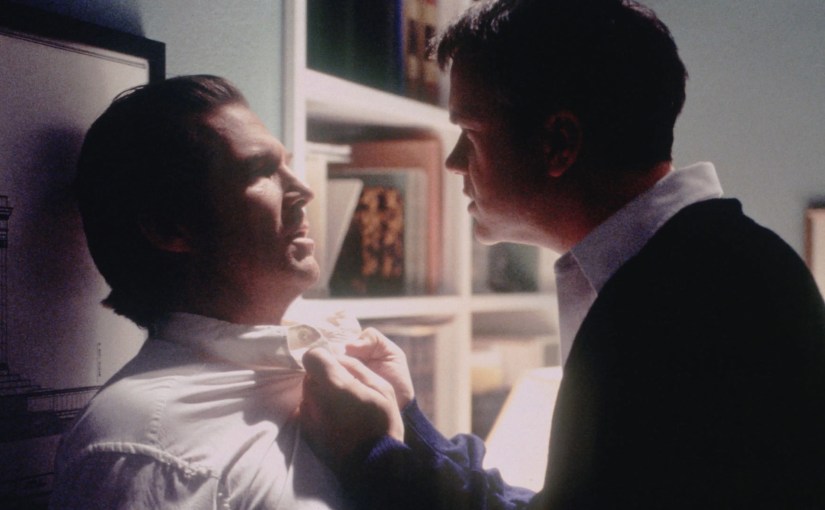
Arlington Road is a disturbing and all too real glimpse into how domestic terrorism in the United States operates.  The film from director Mark Pellington becomes more intriguing with repetitive views. Evening news shows and commentators’ programs airing nightly on outlets like FOX, CNN and MSNBC will delve ad nauseam into the hows, whys, and whos of a startling attack upon a populated area within the country.  Theories are pronounced, explored, and fault is found with someone, somewhere.  The protagonist of the film suggests that a name and face must be declared to ensure the country is at peace once again and punishment is rightfully delivered.

What surprises me about Pellington’s film is that it was released in 1999, two years before 9/11.  The worst, modern tragedy at that time was the Oklahoma City bombing.  School shootings were not even as prominent; practically unheard of.  We were only on the brink of Columbine High School’s terrible massacre.  At this precursor moment in time, I have to believe it was especially complex and required meticulous strategizing to bomb a government building.  

When I watched Arlington Road for the first time in theaters, I went with a last resort option for a ritual Sunday movie outing with dad.  We had seen everything else that was playing.  Title is lousy.  (Really lousy – Arlington Road??? That’s the best name they could come up with???) The marquee actors are meh to my twenty-seven-year-old psyche.  (Where’s Harrison Ford or Tom Cruise or Schwarzenegger???). Who’s the director????  Well, for dad and I this film was a huge surprise because of its taut, compelling screenplay and magnificent performances from Jeff Bridges, Tim Robbins and Joan Cusack.  The acting is what stands out the most while you forgive all of the conveniences that intersect to keep the story on its tracks.  

However, when I watch the picture on repeat viewing every couple of years, I realize that other than a random encounter in a parking garage for two characters, everything had been well planned ahead by the villains.  Roger Ebert and even the other unpaid critic, Miguel, took issue with minor happenstances that occur at just the right time.  Well, sorry to disappoint them but Arlington Road has an explanation for nearly every detail that seems contrived when in fact it was all part of a villains’ orchestrated construction.  The bad guys are especially smart in this movie.

Jeff Bridges plays Michael Faraday, a college professor who teaches a history class about domestic terrorism in relation to bombings, shootings, and assassinations.  He lectures his students about the faults and responsibilities of the FBI and other law enforcement departments.  He also provides insight into the people responsible for these heinous acts and often questions if these nefarious figures were lone wolves capable of such madness or were they scapegoats or were there others involved to help carry out these acts.  

Michael is a widower and a father to a ten year old son named Grant (Spencer Treat Clark).  After his FBI wife is killed in the line of duty, Michael has not fully come to grips with the loss.  He is dating Brooke, a former graduate student (Hope Davis), but he is clearly obsessed with what went wrong on that fateful day when his wife perished.

Oliver and Cheryl Lang (Tim Robbins, Joan Cusack) are the happy neighbors who recently moved in across the street.  Michael becomes acquainted with them when he saves their son’s life following a fireworks accident.  The Langs quickly become enmeshed within Michael’s space with child sleepovers, barbecues and evening dinners.  However, the friendlier the Langs seem the more suspicious Michael feels about them.  

Oliver’s backstory seems inconsistent with what Michael observes.  Soon, the professor’s hysteria becomes increasingly amplified.  As wholesome as Oliver and Cheryl are with big, toothy grins and neighborly charm, could they actually be plotting for an act of violence to occur?  As Michael becomes more skeptical around them, Grant, Brooke, plus his wife’s former FBI partner, seem all the more dismissive.  Whatever Michael is beginning to believe is nowhere near as apparent as his own expressive paranoia with big outbursts and unkempt appearances.  Jeff Bridges delivers a manic performance that leaves you breathless and uncomfortable.  He’s so focused on how unhinged this guy is even when he’s just trying to move on with a new normal as a surviving spouse and parent.

One of the many strengths of Arlington Road is reliant upon its ongoing build.  More is learned with each passing scene.  When you feel like you’ve grasped everything, new material presents itself and the actual truths may be more disturbing than what’s already been revealed.  

Joan Cusack is freaky frightening.  She performs to the camera with wool over the viewers’ eyes and she says so much by doing so little.  Before you die, the last thing you want to see is a Joan Cusack with a crooked, unwelcome grin. I salute the simple costuming of Tim Robbins character.  He dresses like Mr. Rogers with a lanky, thin build covered by earth tone sweaters and khakis.  He’s so plain and corny that its terribly awkward. These friendly neighbors hide in plain sight.  

On a first view, Arlington Road may feel like a paint by numbers formula with a few jump scares as the hero sneaks around for clues along with a high stakes chase through Washington DC.  However, I encourage anyone to watch Mark Pellington’s thriller more than once.  The first time you are focused on Bridges, Robbins and Cusack.  The second time you are likely to find what explains the conveniences of the characters and the story.  Then you realize that Pellington and screenwriter Ehren Krueger have done thorough research into what realistically upholds the actions of these characters and situations.

Arlington Road only suffers from a terrible and misleading title.  It’s simply unattractive.  However, the film is compelling and authentically conceived long before a dark trend of American terrorism and mass violence dominated social media and evening newscasts.  It’s a mixed compliment to suggest that the cast and filmmakers got so much right with a topical story that was not yet so commonplace.  

This is an absolutely engaging thriller that I only wish was more fictional and exaggerated than it actually is.
MYSTIC RIVER

By Marc S. Sanders

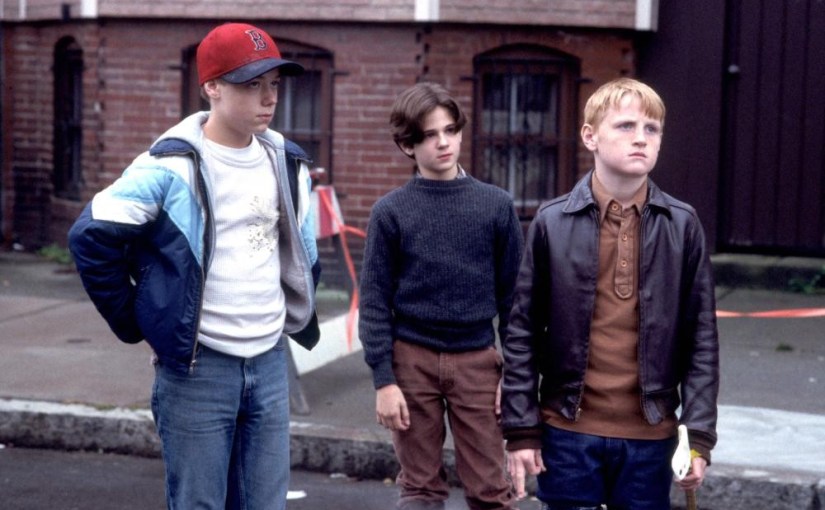
Two crimes, thirty years apart, pave the destiny for three childhood friends during their adulthood, while residing in the same Irish neighborhood of Boston.  Sean Penn is Jimmy, a former criminal.  Kevin Bacon is Sean, a police detective.  Tim Robbins is Davey, who was held captive and molested for four days following an afternoon when the guys were playing street hockey together.  Naturally, Davey was never the same but over the course of events in Clint Eastwood’s psychological crime drama, Mystic River, we learn that Jimmy and Sean likely changed too.

Jimmy’s daughter, Katie (Emmy Rossum), is found brutally murdered following an evening of bar hopping with girlfriends.  Sean and his partner Whitey (Laurence Fishburne) head up the investigation.  While the magnetic screenplay written by Brian Helgeland, based upon the novel by Dennis Lehane, relies on a who done it track, that seems to be less a priority as details unfold for the trio of men.  Jimmy and Davey’s wives (Laura Linney, Marcia Gay Harden) may be hiding some information.  A possible murder weapon invites some curious questions. There’s reason to question Katie’s boyfriend, and Davey’s odd behavior combined with his childhood trauma raises eyebrows as he was one of the last men to see Katie alive.

The less you know about Mystic River the better, but this engrossing cast which earned Oscars for Penn and Robbins, plus a nomination for Harden, is not the only stand out feature.  This film is one of Clint Eastwood’s best directing efforts; definitely one of my favorites.  

First, Eastwood hides many of his characters in dark shadows so the viewer never forgets that all these people have pasts they regret or would rather not resurface.  Sometimes, you hauntingly recognize the silhouettes of Sean Penn and Tim Robbins, each for different and unnerving reasons. Eastwood notably shoots himself this way often when he’s in front of his camera (Unforgiven, Sudden Impact, Million Dollar Baby).  It’s a brilliant photographic strategy that will make you fear or empathize with his flawed protagonists.

Second, Clint Eastwood shoots much of the Boston neighborhood with wide overhead shots in the daytime.  Interiors offer little light no matter the time of day.  Exteriors present the multi floor homes which are easy to see and showcase a labyrinth of crevices, yards and blocks where activity occurs.  

While the title of Lehane’s mystery is hardly spoken until a series of shocking revelations occur at the end, Eastwood ensures the setting of this Boston Irish populace is given much attention.  The more closely located these homes are up against one another, the less apt that any of the residents can truly see what’s going on under their nose.  These people live on top of each other with no room to spread out.  Their nearsightedness is practically blinding.

Furthermore, Eastwood composed the morose soundtrack for this piece. The director seems to speak to the audience because nothing good will likely arrive for any of these folks who grew up together like the generations before them.  Even a colorful Red Sox cap worn by Davey does not offer much cheer or Boston pride.  Eastwood’s musical compositions paint a modern-day setting encased in unimaginable heartache.  

Mystic River is not an easy film to watch.  Yet it’s not gory.  It’s not scary.  It’s the internal struggles of these characters that’s hard to imagine or observe. On the surface Lehane’s story seems reminiscent of most any other crime drama or Law & Order episode of the week.  The challenge is to watch these masterful performances, especially from Sean Penn, Tim Robbins and Marcia Gay Harden.  

We’ve seen moments where the father comes upon the crime scene of a murdered child.  However, Sean Penn delivers this staple with raw, unbearable heartache.  This actor invests his soul into the moment and reminds any one of us, whether we are a parent or child, of how wrenching it is to even imagine losing a loved one to senseless violence.  If I had to ever experience an episode like this, it might just take the entire police force to hold me down too.

Robbins and Harden are husband and wife, who get in over their heads when incidents of surprise occur.  Harden is especially ripped apart with what she knows and what she suspects.  Robbins embraces an inner child who has never outgrown a trauma that stubbornly stays attached to him, even if he’s a loving father.

As difficult as Mystic River is to watch, I’ll return to it on repeat because this cast and crew are at the top of their game.  Dennis Lehane has written other Boston crime stories (Gone Baby Gone with the film adaptation directed by Ben Affleck), particularly involving children, and he recycles his characters for future tales.  To my knowledge, I do not believe he’s ever written a sequel to Mystic River, but I’d love to see what happens to these people after the events of this film unfolded.  

Everything is revealed in Mystic River, except what happens next and I’m dying to know.  

GLADIATOR II

By Marc S. Sanders

With Gladiator II, you get two of everything.  Two heroes, two emperors, two great white sharks, but only one Denzel Washington which is plenty.

The sequel to Ridley Scott’s Best Picture Oscar winner takes place sixteen years after those events when we had the impression that Rome was left in a state of nobility, devoid of treacherous gladiator games. Not so.  

Two flamboyant young men named Geta and Catacalla have taken joint rule of Rome thanks to their continued worldwide conquering delivered by their General Acacious (Pedro Pascal).  The general fought for Rome, even if he didn’t agree with the rulers’ policies.  Now he wants to rest with his wife Lucilla (Connie Nielsen, one of two returning cast members of the original film).  Though it’s hard for Acacious to remain apathetic even while the two brats demand more widespread conquests.

Elsewhere is Lucius, Lucilla’s son, a child in the first film, now an adult whose African army suffers defeat at the opening of this film.  The opening naval sea raid upon an impenetrable fort is massively impressive with arrows, fireballs, swords, sea water drownings and gory bloodletting.  Lucius is played by Paul Mescal.   

Gladiator II is full of parallel stories.  Still, you can bet these characters’ paths will all intersect in coincidental soap opera fashion during the run time of the film.

There’s nothing new to this follow up picture that you hadn’t already seen in the original Gladiator.  In fact, the first hour follows a near exact blueprint of its predecessor.  Lucius, a once revered battle commander who lost his wife, is purchased as a slave by Macrinus (Denzel Washington) to fight in gladiator games throughout the Coliseums of Rome.  Because the violence of the sport is so well assembled and enhanced compared to the last movie, it’s easy to get caught up in the fun the film offers.  The action pieces are magnificent.

Though most of the movie is ridiculous.  Historians just close up your encyclopedias.  

Most absurd, yet deliciously fun, is when the emperors arrange for the ring to be filled with salt water and man-eating sharks at the ready as naval battles are reenacted.  Now I’m not sure if this was truly accomplished in Roman times with state-of-the-art plumbing to transport and hold all of this water.  I am also skeptical of bringing bloodthirsty great white sharks straight from the Mediterranean directly into the Coliseum, but I’ll be damned if anyone tells me this centerpiece of bloodshed is not giddy to behold.

Other moments that will have you clapping are match ups between the warriors and big ass mutant, buck toothed (I mean like BUCK TOOTHED) monkeys as well your typical rhino melee.  That latter match had Miguel thinking of Attack Of The Clones.  

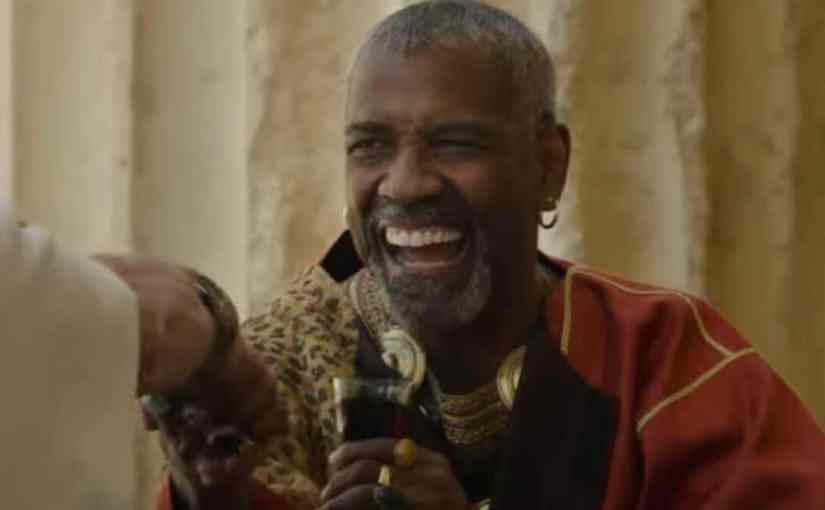
The best of the performances belongs to Washington.  As gleefully over the top (Miguel’s description) as Ridley Scott’s sequel is, Denzel Washington is doing scene stealing work on level with Jack Nicholson and Gene Hackman.  He’s playfully deceitful while appearing proudly respectable with his signature, toothy grin and colorfully eloquent robes that billow with his performance.  The film is not Oscar worthy, but Washington’s performance is because he masterfully works the mind-bending trickery of the character.  Macrinus worms his way through the Senators with conniving wagers placed on Lucius’ undetected fighting talents.  Actor Tim McInnerny is someone I’ve never heard of but as he plays a pitiful, gambling addicted weakling (think of Beaker from The Muppets) against Denzel Washington’s brash and conceited character, you can’t help but take pleasure in how things work out for each of the pair.

Joseph Quinn and Fred Hechinger are the cherub appearing emperors with extroverted cheekbones highlighted in bright rouge.  Combined,  these guys work really well as fill ins for the spoiled brattiness that Joaquin Phoenix left behind in the prior film.  Oh these kiddies are cruel and you just love to hate them.

The two heroes, Paul Mescal and Pedro Pascal, are what is left a little too bland.  They do not match the appeal that Russell Crowe delivered and it’s not simple to care for them or their outcomes.  Lacking any kind of dynamics, they occupy the athletic builds of these guys they’ve been cast to play and that’s where the script limits them.

Thankfully, Gladiator II is very entertaining.  It might not be wholly original when digging up tropes that have been used in many other sword and sandal epics, but Ridley Scott really committed to the carnage and gore we expect.  The director took much pleasure with the outrageous material and the smartest decision was to acquire Denzel Washington.  

Another actor would have slept his way through this role just for a paycheck.  Washington uses the twisted material at his disposal to own the picture all to himself.  I imagine the script documents an unforgettable monologue for his character in front of the weakling Roman senators.  This two time Oscar winning actor must have approached Ridley Scott and said let me try something.  Then the prop department made preparations for a sickeningly, grisly presentation that offers a marvelous image for the Roman Gods to behold, and one that’s hard to forget or not laughingly appreciate.  It may be a stomach-turning scene for some.  On the other hand, I applaud the brashness of the moment.

Our current Congress might be in disarray but with Gladiator II, Denzel Washington and Ridley Scott declare with confidence a resounding “HOLD MY BEER!”

GLADIATOR

By Marc S. Sanders

Ridley Scott’s Gladiator is a terrifically sweeping sword and sandal epic adventure.  It contains well drawn characterizations of its heroes and its one tyrannical villain, along with superbly bloody hack n chop violence and action that live up to its title. 

Rome has finally finished its campaign of conquer throughout at least one quarter of the world.  General Maximus (Russell Crowe) is ready to return to his wife and son to live out the rest of his days as a farmer and family man.  However, the dying Emperor Marcus Aurelius (Richard Harris) begs him to take over his position so the Roman Empire may carry forth with prosperity.  If Maximus does not take over, the empire is at risk of being inherited by Marcus’ spoiled son Commodus (Joaquin Phoenix).  While Maximus ponders the request, Marcus dies and Commodus quickly takes over, and orders the immediate deaths of the celebrated General and his family.  Maximus and Commodus will eventually circle back with one another, however.

Gladiator feels like an epic film in the vein of a David Lean picture that would require time and work to follow through its various developments.  Maximus certainly goes through a widespread arc.  One of the advertising bylines described it as the man who was General, who became a slave, who became a gladiator. Russell Crowe is right for this role.  Not only is he lean and built for the part, but he brings a empathetic approach to the character.  Maximus is loyal to his country, but he also carries pain and longing for his family and when he is wronged, Crowe does very well at displaying his character’s plot of  vengeance against Commodus with strategy and skill.

Joaquin Phoenix rightly earned his first Oscar nomination as a wonderful villain.  The screenplay from David Franzoni, John Logan and William Nicholson offer memorable pieces of dialogue for the bratty son.  “I feel vexed. I am very vexed.”  – a line that sounds so minimal and yet when Phoenix delivers it, it’s only more terrifying.  This little monster captured in an adult body can respond to anything that slightly irks him.

The battle between Commodus and Maximus is hardly physical.  Maximus realizes through his companions that a better and wiser form of revenge is to win Rome’s admiration away from its ruler.  Commodus lives off his ego.  So, when Maximus is encouraged by his slave owner to “win the crowd” amid the games performed in the famed coliseum, it not only lends to the gladiator’s ongoing survival, but it tears away at Commodus’ rule.  A great subplot is included focusing on the ruler’s nephew, Lucius (Spencer Treat Clark).  The expression on Joaquin Phoenix’ face when young Lucius role plays as the great Maximus works like a frozen moment in time.  Imagine a famed quarterback’s child cheering for the defensemen who performs an unforgivable sack during the final ten seconds of a game.  It’s terribly bruising.

When Gladiator was first released in theaters, I found the CGI to lack texture and it appeared very dark like a bad 3D film.  It looked too animated.  This most recent viewing was on a restored 4K transfer and the picture quality is astounding.  Every element of the broad landscapes within the battlefields and especially in the gold sheen photography of the coliseum battles blend perfectly.  If you still don’t understand the importance of 4K, turn to this film to uphold the argument. 

Ridley Scott does not waste a shot in this picture.  Reactionary sequences are just as effective as the cuts to the action.  Blades and barbaric weapons shed gorgeous splashes of blood. Every thrust and parry are easy to see. I’ve never forgotten when a chariot rider is cut in half at the torso from an oncoming blade attached to rolling wheel.  The choreography and editing of the battles are thrilling with sound editing that compliments the moments. 

Beyond Russell Crowe and Joaquin Phoenix, the cast is wonderful.  I’ve always admired Richard Harris’ quiet approach in the twilight years of his career.  He never had to do much to offer a presence.  Connie Nielsen portrays Lucilla, Commodus’ sister who he has affections for.  Her subtle resistance allows Joaquin Phoenix more opportunities to feel “vexed.”  Oliver Reed passed away during the making of this film. Fortunately, Ridley Scott and company did not opt to cut out his role as the gladiator/slave trader, Proximo.  He works well as a kind of mentor to Maximus and the band of other warriors, coaching them on how to stay alive and rise above Commodus’ monarchy.  “Win the crowd and you win your freedom.”  Djimon Hounsou is a loyal sidekick to Crowe’s character. Derek Jacobi is once again that guy you have seen before allowing his expert craft in Shakespearean performance to flesh out the political angle of the story among the Senators.  Every actor serves a valuable purpose in the film.  None of these performances feel like walk on roles.  So, the overall casting of the picture must be commended.

Gladiator is a crowd-pleasing film. Though it is based in ancient history, there remains a fantasy element to the movie when you look at grand designs of the settings, costumes, and dialogue.  Storylines of politics and tyranny hold relatable to modern current events.  What can occur when one man takes over everything for his selfish purposes?  Pointless displays of theatrics can occur at the behest of others who were once heroes, instrumental in placing a despot atop a throne.  I presume Ridley Scott’s film is just one more example of the inherent nature found in humans.  Some of us are destined to rule and control.  That alone is cruel and selfish.  It is even worse when this totalitarian mindset is unleased upon those that put these rulers in their place.  History and especially modern times demonstrate that loyalty is only fleeting.  The ability to possess totalitarian control, however, is hopefully even more short-lived.