INHERIT THE WIND (1960)

by Miguel E. Rodriguez

DIRECTOR: Stanley Kramer
CAST: Spencer Tracy, Fredric March, Gene Kelly, Dick York, Harry Morgan
MY RATING: 9/10
ROTTEN TOMATOMETER: 93% Fresh

PLOT: In 1925, two great lawyers argue the case for, and against, a Tennessee science teacher accused of the crime of teaching Darwin’s theory of evolution.  (Inspired by the real-life Scopes Monkey Trial.)


I have known about the movie version of Inherit the Wind for many years now, but it has taken me this long to get around to finally watching it.  One of the first shows I ever did in community theater was Inherit the Wind.  I played E.K. Hornbeck, probably one of the best-written characters I’ve ever performed.  I hesitated this long to watch the movie, or any of the other various TV/cable versions, because I feared it could never live up to the power of the stage play.  Boy, was I wrong.  Stanley Kramer’s film of the award-winning play is anchored by two of the greatest performances ever to grace the silver screen, courtesy of Spencer Tracy and Fredric March, both 2-time Oscar winners.

It’s 1925, and in the Bible-belt hamlet of Hillsboro, Tennessee, a young teacher, Bertram Cates, has been imprisoned.  His crime?  Teaching Darwin’s theories in high school.  In Hillsboro, you see, it’s against the law to teach anything but Biblical creationism in the classroom.  The arrest makes national headlines, most of them negative.  Example: “Heavenly Hillsboro: Does It Have a Hole in Its Head, or Its Head in a Hole?”  The despairing town fathers rejoice when they discover that the great Matthew Harrison Brady, lawyer extraordinaire and 3-time Presidential nominee, will volunteer to prosecute the case.  Brady is played by Fredric March with gusto, although I almost wish March had dialed it back JUST a touch every now and then.  He comes VERY close to becoming a parody of a character instead of a real person.

Covering the story in Hillsboro is E.K. Hornbeck (Gene Kelly!), a reporter from Baltimore.  Hornbeck is loosely based on the legendary newspaperman H.L. Mencken.  The screenplay reduces Hornbeck’s presence a tad as opposed to the stage play, but Kelly delivers the goods with all the appropriate flair and panache.

Hornbeck’s Baltimore paper uses its influence and checkbook to lure another skilled, big-city attorney to Hillsboro to defend Cates.  This is Henry Drummond, played by Spencer Tracy in arguably the best performance of his lengthy career.  Drummond is a shambling, good-natured fellow whose twinkling eyes disguise a sharp legal mind and a passion for the truth.  It’s a tribute to Tracy’s abilities that we get to see both sides of Drummond’s persona and there is never a sense of any disconnect between them.

After the first half-hour or so of exposition, the remaining bulk of the film takes place in the sweltering Hillsboro County Courthouse, as a jury is selected, witnesses are questioned, and both sides present their case to the judge (Harry Morgan).  In between court sessions, we get short scenes with Bertram Cates’s fiancé, Rachel, who just happens to be the daughter of the town’s religious leader, Reverend Brown (Claude Akins); a prayer meeting where Reverend Brown essentially damns his own daughter to hell; and pleasant interludes where Drummond and Brady sit on a front porch and reminisce how they used to be great friends, fighting for the same cause once upon a time.  But now Brady has combined his faith with his political ambitions, and Drummond dreams of a day when reason and science are not equated with heresy.

I won’t give you a play-by-play of the courtroom scenes here.  But if I were a film director, and I found myself directing a courtroom thriller, I would sit down and watch Inherit the Wind at least ten times before shooting a foot of film.  The scenes where Drummond and Brady butt heads and cross-examine and make objections are simply spellbinding.  I would be remiss if I didn’t mention the camerawork by the great Ernest Laszlo, moving around the courtroom and around each attorney, pushing in, tracking backwards.  I know great camerawork is supposed to become invisible while watching a film, but this was different.  Laszlo’s camera sometimes calls attention to itself, but it never, ever distracts from the story.

Of course, beautiful camerawork only works when it’s photographing something worthwhile, and Spencer Tracy and Fredric March do not disappoint as Drummond and Brady.  For nearly 90 minutes, they bicker, trade jabs, and put on a double-act of Hollywood professionalism and technique that would not be matched until the films of Newman and Redford.  Tracy is especially fascinating to watch.  It’s impossible to catch him acting.  There’s never a moment when he looks anything but authentic.  His speech patterns give the impression of a man whose mouth is just barely keeping up with his brain.  When he occasionally stumbles over a word, the odds are 50-50 whether it was a real slip up or if he just threw it in as a flourish.

If Tracy’s performance is a triumph of realism, or at least naturalism, Fredric March’s performance is one of the last great displays of old Hollywood, full of facial tics and vocal mannerisms and speechifying that would have made even Charles Foster Kane say, “Dude…dial it down.”  It’s still a powerhouse performance, but it’s a good thing Tracy didn’t try to match March.  Otherwise, the whole movie would have become a cartoon.  Because we have two such contrasting performances, the movie achieves a nice balance that makes time pass much more quickly than it might have with two other actors.

Regarding the TOPIC of the film…well, to be honest, if I started to write about all the things I felt while watching the film, about how so many people today, not just random folks, but people I know personally, would have felt right at home in 1925 Hillsboro, asking God to rain hellfire on the non-believers, chanting about hanging the accused teacher from a “sour apple tree”…I’d still be writing this review three days from now.

Besides, I believe the film makes its point much more eloquently than I ever could (especially when it comes to the discussion of how long that first day of Creation was, exactly).  One of my favorite lines from the movie comes when Brady accuses Drummond of attempting to destroy everyone’s belief in God and the Bible.  Drummond replies:

“That’s not true, and you know it.  The Bible is a book.  It’s a good book.  But it’s not the ONLY book.”

Inherit the Wind is not anti-Christian or anti-God or even anti-religion.  It is a plea for tolerance.  The fact that it was released over sixty years ago does not diminish the power of that message.  And even if it did not have that agenda, it would still be one of the most exciting, crackling courtroom dramas I’ve ever seen.

(Fun fact: A quick internet search reveals that, while all US states currently teach evolution, there are some that voluntarily pair it with creationism.)

GUESS WHO’S COMING TO DINNER

By Marc S. Sanders

Watching Stanley Kramer’s Guess Who’s Coming To Dinner had me reflect on a brief encounter I had many years ago.  I was a head teller in a bank and approached the drive thru window to collect a customer’s transaction.  The junior teller who was part of my team got there before me and as she reached for the checks and deposit slip she commented “That’s disgusting!”  I was so engrossed in a busy day that it didn’t register until later what she was referring to.  In fact, I’m proud it did not register.  The customers in the car were a mixed couple with two children in the back.  I guess I’m happy to be naturally color blind.  Sadly some others still live with such an ailment.  We’ve come a long way, but I think we have a lot further to go.

Guess Who’s Coming To Dinner is a classic American film that should be watched by anyone with a pulse.  If not for anything else, then to realize that somehow our human nature is held back by prejudices that we can not keep from considering.  So, let’s learn to overcome whatever foolhardy thinking stands in the way of happiness for ourselves and our loved ones.

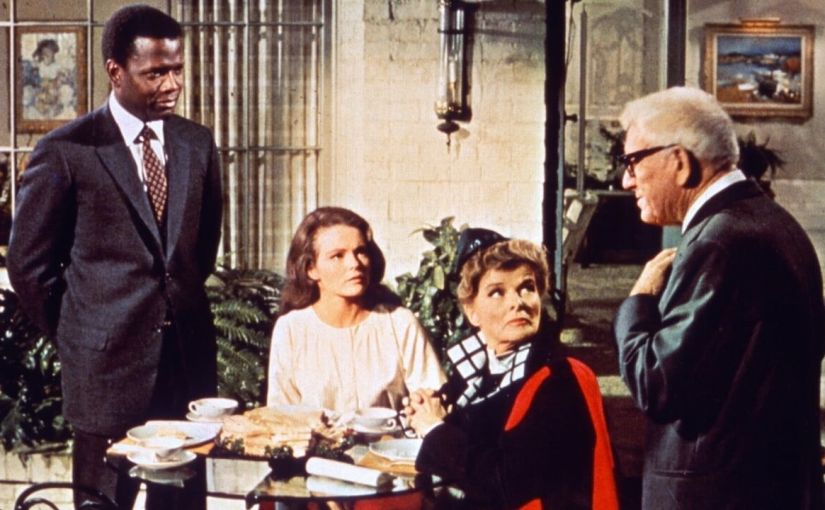
Sidney Poitier portrays Dr. John Prentice, a gentlemanly successful, polite, and brilliant physician with an educational background from Johns Hopkins, a professorship at Yale and internships with the World Health Organization in Africa and Asia.  He has just flown into San Francisco from a Hawaiian vacation with the young girl he has fallen madly in love with, Joanna Drayton (Katharine Houghton).  Joanna is the daughter of Matt and Christina Drayton (Spencer Tracy, Katharine Hepburn).  She is a highly energetic twentysomething with an optimistic view on life.  Everyone else has to take a second look at the fact that Joanna is paired up with a Negro or a colored man (as the movie indicates).  Even their cab driver has to offer an odd glance while the happy couple kiss in the back seat.  John is even aware that it can be a little startling at first.  Joanna doesn’t give it a second thought as she was raised by liberal parents who taught her that no race or creed is better than any other.  Everyone is equal.

The test for Matt and Christina however is whether a black man can be a husband to their white daughter?  It’s much different when you are on the outside looking in.  How do you respond when such a scenario occurs within your own household.  Even the black loyal housekeeper to the Draytons, Tillie (Isabel Sanford), takes a serious contempt towards the situation, more vocally than Joanna’s parents.  For Tillie, this is a hairbrained stunt by a wild-eyed young girl.  John’s parents fly up to meet Joanna and they have reservations as well.  It does not help that John doesn’t share with his mom and dad that Joanna is white ahead of meeting her in person.  Joanna also did not offer the same courtesy to Matt and Christina about John.  Curiously, for Joanna it should not even make a difference.  For John, he’s hesitant because he knows this will not play out well, initially. John is okay with his new, loving relationship.  He’s wise enough to know that his parents, particularly his father, will not be, however.

What caught my attention more than anything was the difference in age between John and Joanna.  He’s 37.  She’s 23. 

In Stanley Kramer’s film, there isn’t so much a prejudice towards whites or blacks.  It’s more so that there is a reservation toward a mixed race couple.  Should blacks only belong with blacks, and whites only belong with whites?  Of course not.  However, biting sarcasm is tossed into the script suggesting that what Joanna and John are doing would be considered illegal in 14 states.  It wasn’t at the time of the release of this film in 1967, but this was just ahead of when Dr. Martin Luther King Jr was assassinated amidst the civil rights movement spreading throughout the country.  Joanna even makes reference to the fact that she would not let go of John even if her mother was Governor of Alabama, who at the time was Governor Lurleen Burns Wallace, wife of notorious segregationist and former Governor George Wallace.  As well, let’s face it.  While it might be legal on the books, many in the United States were still intolerable of a living situation like this. Legally, a mixed marriage can happen.  Yet not everyone settles for just accepting what is law. 

Spencer Tracy as Joanna’s father Matt is the one who most prominently struggles with this situation.  He’s insisted upon to offer his blessing on John and Joanna’s upcoming nuptials.  However, he’s on a deadline to approve as they are flying out of town later that night and will get married in ten days while John is working in Geneva.  This is all contrived to contain the story within one day where a beginning is offered that must arrive at an end that provides closure.  It’s kind of sitcomy.  Christina warms up to the idea.  She likes John very much.  It’s Matt who has the problem.  It’s also John’s father (Roy Glenn) who takes issue as well.  His mother (Beah Richards) approves if the children are happy simply because she loves her son.

Spencer Tracy closes the film with his reasoning on the subject.  Arguably it is one of the most well thought out soliloquies in film history.  What I took away from it the most is that he stressed his concern for how hundreds of people across this country will look upon John and Joanna with unjustified derision.  Yet, the young couple will have to plow on and survive through those challenges. 

As a film, I could not help but account for a common theme in the picture which did not have so much to do with race as it did with a change in generations.  First, Kramer offers a quick escapist scene where a white delivery truck driver is bopping along to the latest rock music.  Tillie’s daughter joins in and hops in the truck for a ride with the fella.

Matt drives to a diner with Christina and orders an ice cream float.  Upon leaving, he accidentally backs his car into a young black man’s hot rod.  The older white man has to negotiate and accept fault with the younger, frustrated black man.  Once it is settled, Matt vents to his wife that he runs into one of them everywhere he looks.  Times have changed.  Matt has taught his daughter that no race is better than any other.  Does he realize that as well, though? 

Later in the film, Sidney Poitier as John has a stern conversation with his father.  John says in no uncertain terms that he owes nothing to his father.  He does not owe it to his father to not fall in love with a white woman.  His father owes everything to him for having him as a son, and he will commit that same mindset to his own children, if he should ever have any, regardless of the changes that come of that future generation.

There’s a reason Sidney Poitier is noted as a pioneer for black actors in cinema.  He was the first African American man to win an Academy Award for Lillies In The Field.  He also performed in Guess Who’s Coming To Dinner in the same year he made In The Heat Of The Night, which focused on a black Philadelphia cop headlining a murder investigation in the racist state of Mississippi at the time.  Both films were nominated for Best Picture. Heat won.  Poitier was well aware of the racist strife permeating throughout the country.  Per his insistence for his own safety, In The Heat Of The Night had to be shot primarily in the state of Illinois, away from the southern states that were not ready to accept a black man in an authoritative role.  I recall reading that Poitier refused to be cast in roles as the clown where the black man was treated as the punchline for white people’s entertainment.  He kept to a policy of adhering to roles demonstrating the intelligence of black men the same as other colleagues in his profession who were of the Caucasian race.  What an influence he was because of his doctrine.

Guess Who’s Coming To Dinner does not take daring risks with its story.  Every single character is likable, other than the racist colleague memorably dismissed early in the picture by Hepburn.  At times, the story does play like a sitcom ready to welcome a laugh track.  Nevertheless, it is an important film to see nearly sixty years later when racism and prejudice remain uninvitingly prominent.  The script, written by William Rose, is so sensible.  What is so wrong with a man, any man, in love with a woman, any woman?  Yes.  It feels unconventional when your household has consisted of one race for so many years or decades.  However, despite the difference in the pigments of two people’s skin, happiness is what is most important.  Matt testifies towards his unconditional love for Christina in his closing remarks and determines that is the one true factor in a relationship that must always be questioned whether it is the start of something new or something that has reached its twilight years.

As I come to my conclusion, again I reflect to that incident I had working in the bank with that teller.  What exactly was so “disgusting?”

NOTE: On this second viewing of the film, I specifically paid attention to Spencer Tracy’s closing monologue.  George Clooney recalled on Inside The Actor’s Studio with James Lipton, a story he heard.  Tracy was very ill during the making of this picture.  So ill, that Katharine Hepburn contributed financing to making this film to appease the insurance company that was concerned about the actor being unable to finish the project.  She drove him to and from the studio and often left early with him when she could see he could not go on much longer in the shooting days. During Spencer Tracy’s monologue, you can see him looking down frequently as he delivered his dialogue.  He was reading lines and blocking cues on the floor.  Clooney was just so impressed.  Typically, an actor would be directed to avoid looking down so much and focus on the camera in front of him or the other performers in the scene.  Spencer Tracy was just so impressive with his timing in this moment.  His glances down at the floor were embedded into the behavior of the character.  Sadly, Spencer Tracy passed away 17 days after filming was completed on Guess Who’s Coming To Dinner.  He received a posthumous Oscar nomination for Best Actor.  I like to think the challenge he endured lent itself to an adoring, beautiful and unforgettable performance.