THE PLEDGE

By Marc S. Sanders

The Pledge is a moody and bleak crime drama that follows a retired detective’s descent into obsessive madness.

Director Sean Penn opens his film with the gruesome discovery of a murdered nine year old girl found amid the snow covered woods outside a small Nevada town.  She happens to be discovered on the evening of veteran detective Jerry Black’s (Jack Nicholson) retirement party.  Upon receiving word of the crime, Jerry leaves his celebration to explore the scene that is carelessly compromised by the local sheriffs.  His protege partner Stan (Aaron Eckhart) rushes through a possible suspect’s (Benicio Del Toro) interrogation that draws a quick conclusion along with an unnecessary and bloody outcome.

Jerry surrenders his position with the police department, but he’s not entirely convinced the crime has been solved.  He obligates himself to uphold a devout promise he gave to the victim’s parents (Patricia Clarkson, Michael O’Keefe) that he will catch their daughter’s killer.

Time passes and rather than retire into a quiet life of fishing, Jerry purchases an old gas station located within the vicinity of the crime scene as well as nearby where two other murders with similar circumstances occurred.  Jerry is going to wait out the next attempt committed by “The Wizard” or “The Racoon Killer,” and catch him in the act.

The Pledge is a brooding and lonely film.  Sean Penn’s piece offers an impressive list of who’s who actors that appear in small roles to shape out the detective’s progress.  Amidst all of these familiar names in the cast, Jack Nicholson has never appeared so isolated or despondent before.  His character is limited on dialogue.  A thin mustache and a wrinkled complexion with a smoking habit hide any humor or joy.  Jerry Black knows he’s the last capable police detective in this area.  It pains him to abandon his post to the halfwits he leaves behind.

A promise is a dangerous gesture.  If you adhere to it, all obstacles become nonexistent.  Anything will be done to uphold a pledge and conclude your wild theories, even if proof is not conveniently supplemented.   Nothing stands in the way of pledge.  

The second half of The Pledge moves at a slower pace when Jerry welcomes an abused mother (Robin Wright Penn) and her daughter into his home.  A new life seems destined for these three people but at what cost?  Is the hero of this film at least as dangerous as the psychopath that supposedly remains at large?

Would you go to the great lengths that Jerry puts himself through?  Is the expense of his own sanity, and the safety of an innocent woman and her daughter worth this pursuit?

Sean Penn’s film does not operate on suspense. What action there is only fuels Jerry’s chase at a long-shot truth.  It’s a slow burn crime drama that makes the central murder a far second priority to how the initial discovery overtakes the main character.  Again, this kind of mania is a different breed from Jack Nicholson’s other crazed portrayals found in One Flew Over The Cuckoo’s Nest, Five Easy Pieces, or The Shining.  Nicholson is not as vocal or expressive in this role.  Yet, we all know what drives this guy with what few words he uses.

Robin Wright Penn and Nicholson share some effective scenes together. Their motive to be with one another stems from a misery loves company ideal. Good casting here, and throughout the film with small appearances from Helen Mirren, Harry Dean Stanton, Sam Shepard, Vanessa Redgrave, Mickey Rourke, Tom Noonan, Clarkson, O’Keefe, Del Toro and Eckhart.

Sean Penn is very good at creating visual moods to his film. The image of Nicholson standing within the pen of a crowded turkey farm with the anguished parents of the victim is truly haunting. Animals of all kinds seem to emote a cold harshness as well. The first image to appear consists of a swarm of large, winged birds soaring above this backwoods area where the biggest thing to happen is a town parade. Otherwise, as one girl tells Jerry there’s nothing else to do here. This remote Nevada area is unprotected from greater powers, and its only guardian is forced to accept retirement, leaving his community vulnerable. This formerly decorated Marine is now a formerly decorated cop, and the unseen animals-or monsters-still roam.

I won’t spoil the ending which I commend, but there is one moment that Sean Penn includes in the final cut that is objectionable.  For the first time in the picture since Jerry Black accepted the case, one moment near the end of the movie tells the audience everything they need to know while leaving Jerry in the dark.  I think it was a poor choice to go this way.  The audience is going along with Jerry’s pursuit until they are spoon fed a resolution they didn’t earn because Jerry never arrives at this conclusion.  A better route would be to leave the audience in the same dizzying haze that Jerry must live with.  Some hanging threads should be left untied. The Pledge is a pot boiling, well-made and disturbing film, but with minutes to go before the end credits roll, a less is more approach should have been adopted.

MYSTIC RIVER

By Marc S. Sanders

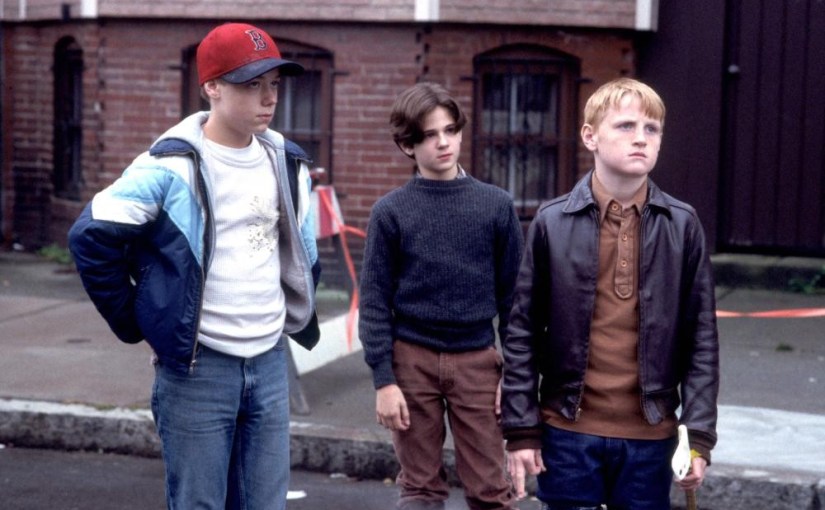
Two crimes, thirty years apart, pave the destiny for three childhood friends during their adulthood, while residing in the same Irish neighborhood of Boston.  Sean Penn is Jimmy, a former criminal.  Kevin Bacon is Sean, a police detective.  Tim Robbins is Davey, who was held captive and molested for four days following an afternoon when the guys were playing street hockey together.  Naturally, Davey was never the same but over the course of events in Clint Eastwood’s psychological crime drama, Mystic River, we learn that Jimmy and Sean likely changed too.

Jimmy’s daughter, Katie (Emmy Rossum), is found brutally murdered following an evening of bar hopping with girlfriends.  Sean and his partner Whitey (Laurence Fishburne) head up the investigation.  While the magnetic screenplay written by Brian Helgeland, based upon the novel by Dennis Lehane, relies on a who done it track, that seems to be less a priority as details unfold for the trio of men.  Jimmy and Davey’s wives (Laura Linney, Marcia Gay Harden) may be hiding some information.  A possible murder weapon invites some curious questions. There’s reason to question Katie’s boyfriend, and Davey’s odd behavior combined with his childhood trauma raises eyebrows as he was one of the last men to see Katie alive.

The less you know about Mystic River the better, but this engrossing cast which earned Oscars for Penn and Robbins, plus a nomination for Harden, is not the only stand out feature.  This film is one of Clint Eastwood’s best directing efforts; definitely one of my favorites.  

First, Eastwood hides many of his characters in dark shadows so the viewer never forgets that all these people have pasts they regret or would rather not resurface.  Sometimes, you hauntingly recognize the silhouettes of Sean Penn and Tim Robbins, each for different and unnerving reasons. Eastwood notably shoots himself this way often when he’s in front of his camera (Unforgiven, Sudden Impact, Million Dollar Baby).  It’s a brilliant photographic strategy that will make you fear or empathize with his flawed protagonists.

Second, Clint Eastwood shoots much of the Boston neighborhood with wide overhead shots in the daytime.  Interiors offer little light no matter the time of day.  Exteriors present the multi floor homes which are easy to see and showcase a labyrinth of crevices, yards and blocks where activity occurs.  

While the title of Lehane’s mystery is hardly spoken until a series of shocking revelations occur at the end, Eastwood ensures the setting of this Boston Irish populace is given much attention.  The more closely located these homes are up against one another, the less apt that any of the residents can truly see what’s going on under their nose.  These people live on top of each other with no room to spread out.  Their nearsightedness is practically blinding.

Furthermore, Eastwood composed the morose soundtrack for this piece. The director seems to speak to the audience because nothing good will likely arrive for any of these folks who grew up together like the generations before them.  Even a colorful Red Sox cap worn by Davey does not offer much cheer or Boston pride.  Eastwood’s musical compositions paint a modern-day setting encased in unimaginable heartache.  

Mystic River is not an easy film to watch.  Yet it’s not gory.  It’s not scary.  It’s the internal struggles of these characters that’s hard to imagine or observe. On the surface Lehane’s story seems reminiscent of most any other crime drama or Law & Order episode of the week.  The challenge is to watch these masterful performances, especially from Sean Penn, Tim Robbins and Marcia Gay Harden.  

We’ve seen moments where the father comes upon the crime scene of a murdered child.  However, Sean Penn delivers this staple with raw, unbearable heartache.  This actor invests his soul into the moment and reminds any one of us, whether we are a parent or child, of how wrenching it is to even imagine losing a loved one to senseless violence.  If I had to ever experience an episode like this, it might just take the entire police force to hold me down too.

Robbins and Harden are husband and wife, who get in over their heads when incidents of surprise occur.  Harden is especially ripped apart with what she knows and what she suspects.  Robbins embraces an inner child who has never outgrown a trauma that stubbornly stays attached to him, even if he’s a loving father.

As difficult as Mystic River is to watch, I’ll return to it on repeat because this cast and crew are at the top of their game.  Dennis Lehane has written other Boston crime stories (Gone Baby Gone with the film adaptation directed by Ben Affleck), particularly involving children, and he recycles his characters for future tales.  To my knowledge, I do not believe he’s ever written a sequel to Mystic River, but I’d love to see what happens to these people after the events of this film unfolded.  

Everything is revealed in Mystic River, except what happens next and I’m dying to know.  

AT CLOSE RANGE

By Marc S. Sanders

Sean Penn has been a gifted actor from the very beginning of his career.  Whoever thought the kid who played surfer dude Jeff Spicoli in Fast Times At Ridgemont High would go on to evoke such intensity in future roles afterwards?  Other actors who did that kind of sophomoric material went on to be in Police Academy movies.  Penn would never shake that surfer image, but he would at least equally receive accolades for his dramatic turns. In James Foley’s At Close Range the high stakes drama could not be more apparent. 

Penn portrays Brad Whitefore, Jr. in this film based on a true story taking place in a small, rural Pennsylvania town in 1978.  Brad Jr.  is going nowhere and that’s fine with him.  He’d rather be an intimidating, fearless kid who will defy his step father so he and his brother (Chris Penn, Sean’s real-life sibling) can get drunk and high.  When Brad opts to go live at his father’s, Brad Sr., house, he hopes that he will learn the ropes of becoming a career criminal like his dad.  Brad Sr. (Christopher Walken) specializes in ripping off tractors, farm equipment, cars, wealthy property owners, and safes carrying large amounts of cash.  He happily welcomes his son into his home with his misfit gang and his new young wife.  Dad will also express love to his son by giving him a car and support, while also welcoming in Jr’s new girlfriend Terry (Mary Stuart Masterson). 

There is a code among these criminals however, and it stretches to flesh and blood as well.  No one is to talk about what they do or how they do it.  Shortly after dad allows his son join in on a job, Brad Jr. learns of the consequences if anyone talks about their handiwork, especially if you are seen chatting with local law enforcement.

At Close Range came out in 1986.  Even by then, I don’t think it would be challenging to forecast where the story is heading.  What’s most interesting about the film are the cast performances from Penn, Walken, and Masterson.  James Foley sets up good scenes where loving trust works at one point, but when that is shattered, what is the detritus left over afterwards?  Christopher Walken plays a guy with no limits to upholding his code, and as I reflect on that motivation, I can’t help but think how relevant Madonna’s eerie ballad Live To Tell (from her True Blue album) is so very important to the picture.  The song should have received an Oscar nomination based on its significance alone.  I’ve only now just seen the movie for the first time.  Yet, I’ve been familiar with the song for nearly forty years.  It carries much more meaning now.

James Foley’s film could’ve been better, however.  The first hour is incredibly slow moving and doesn’t seem to offer much direction or exposition for what the film is truly going to be about.  At some points it is a boy meets girl storyline with Penn and Masterson.  They have good scenes together, but were they all necessary?  Couldn’t some of this material ended up on the cutting room floor?  Then in other areas it is a father/son coming of age piece where pals from both of their respective backgrounds get drunk together on any given night.  Brad Sr. is emulated for his leadership, the gun he carries, the money he flashes and the high-end muscle cars he steals, even gifting one to his son.  Brad Jr. is looked upon as the cool rebel (maybe a more aggressive modern James Dean) for not surrendering to intimidation from anybody. 

The movie also ends kind of abruptly.  It’s clearly understood what’s going to come of the father and son’s relationship.  Sean Penn and Christopher Walken stage a nail biting, very intense showdown in the kitchen.  However, what happens to them individually?  The final scene actually ends right in the middle of what could have been some good dramatic work, but it all goes to black.  Had I been in a movie theatre, I might have thought the projector broke down.  Business must have interfered behind the scenes.  A producer must have stepped in and pulled the plug.  It’s the best excuse I can think of, because the end credits intruded way too soon.  If the film was being edited for length, then there was much material to chop out of the first hour.  The filmmakers basically cut off the wrong leg.

At Close Range is not a steady trajectory of a movie.  It moves in too many sideways directions to stay focused on what it wants to be considered.  Is it a more genuine Rebel Without A Cause?  Is it a rural, backwoods interpretation with inspiration from Mean Streets?  Thankfully, what saved me from turning it off or falling asleep are the assembled cast performances.  At the very least, it got me interested to read up on the real story the film is based on.

LICORICE PIZZA (2021)

by Miguel E. Rodriguez

Director: Paul Thomas Anderson
Cast: Alana Haim, Cooper Hoffman, Sean Penn, Tom Waits, Bradley Cooper
My Rating: 7/10
Rotten Tomatometer: 92% Certified Fresh

PLOT: The story of Alana Kane and Gary Valentine growing up, running around and going through the treacherous navigation of first love in the San Fernando Valley, 1973.


You know that old saying, “You’ll either love it or hate it”?  I’m afraid that doesn’t apply to Paul Thomas Anderson’s latest film, Licorice Pizza.  At least not for me.

The plot: Gary, an impossibly precocious and business-savvy 15-year-old child actor, still in high school (the movie opens with him getting his yearbook pictures taken), develops a crush on Alana, a 25-year-old production assistant, and pursues her – and pursues her and pursues her – while she wrestles with her own emotions and the fact that, dude, he’s fifteen years old.  He calls a shaky truce on his emotions so they can remain friends, and in the process they…let me see if I can remember it all…go on several auditions, help Gary’s mom with her public relations business, open their own business selling waterbeds, fly to Texas (?) and back, fall in and out of “like” with each other several times by attempting to form physical relationships with people their own age, meet an actor who is clearly meant to be William Holden, and by the end of the movie they finally seem to be mutually in love with each other.  Sort of.  Maybe.  It depends on your point of view.  But moving on…

For all its faults, Licorice Pizza did keep me grinning for virtually all of its longish running time, and it also made me laugh out loud many times.  Only in a Paul Thomas Anderson – or maybe also a Tarantino movie – could you have a scene where a mixed-race couple (white husband/Asian wife) have a conversation in which the white husband speaks the most atrociously absurd, cringeworthy pidgin Japanese to his wife, and it gets an earned laugh for the sheer audacity of the scene.  Is it offensive?  Certainly, if this happened in real life, the husband would be cancelled faster than an all-Latino sitcom.  (Ba-ZING.)  But I’ve gotta be honest, that was one of the great belly-laughs in the film.  I found it funny in the same way that Robert Downey Jr. in blackface in Tropic Thunder was funny, in that the people committing the offenses are clearly dumber than sacks of sand and so have absolutely no idea they’re being morons.  But I’ll leave the Theory-of-Comedy discussion for another review…

In true P.T. Anderson fashion, the dialogue is as sharply written as anything by Sorkin or Mamet.  Not a second is wasted on unnecessary exposition or explanation.  (Although, to be fair, a LITTLE more explanation would have been preferred…more on that later.)  Each scene gets to the point, either directly or indirectly, with surgical precision.

There are some editing jumps that will keep a viewer on their toes.  The movie shows a scene of Gary testing a waterbed for the first time, then jumps to him hawking them at a “Teen Fair”, then suddenly he has his own storefront, sales reps, and a bank of telephone operators.  We can only assume that he had the capital, the licenses, and the business logistics to not only make this happen but to clearly be successful at it, at least for a while.  I mean, he is fifteen years old, so why wouldn’t he know how to do all this, right?

[Actually, now that I think about it, there IS a precedent for this plot: Rushmore, Wes Anderson’s 1998 film about another precocious 15-year-old boy who falls in love with a much older woman and spends most of the rest of the film attempting to woo her while she wrestles with her emotions and her desire for a relationship with someone who was born in the same decade as she was.  Do with that information what you will.]

When the age gap between Gary and Alana was explained very clearly at the beginning of the film, I was pretty sure the two of them could never be in a relationship, and I was taken out of the movie a little.  However, as the movie progressed, the film’s charm and effortless wit made me forget how far apart they were.  Gary behaves in such a way that I forgot just young he’s supposed to be, and I forgot just how old Alana is supposed to be.  The film expertly took me by the hand and got me rooting for them to be together, despite how – let’s not mince words – illegal it would be for them to be together.

SPOILER ALERT, SPOILER ALERT, SPOILER ALERT, YOU HAVE BEEN WARNED.

SPOILER ALERT.

So the movie does its job, that I’ll grant you.  But when the film ends, and Gary and Alana kiss and go running off screen together, and Alana finally says, “I love you, Gary”, and the credits started rolling…I stared at the screen, raised my arms in supplication to the scrolling credits, and said, “Say WHAT…?”  Because it was at that point, after the abrupt ending, that I started to have questions.  Lots and lots and LOTS of questions.

If Gary is a high school student – and he is a high school student – when did he ever go to class?  The film never shows us.  One could make the case of, well, you have to ASSUME he’s going to class.  Okay…but when?  In between auditions and plane flights to a live taping of a musical number in front of a live audience and opening not one but two small businesses where his employees seem to be composed entirely of his school-age buddies?  And one of these businesses involves him buying a large quantity of pinball machines to start an arcade.  Where is this money coming from?!  His acting paychecks?  He’s not a major star.  He’s a minor bit player, at best.  And yet, not only can he finance two small businesses on his own (he has a mother, but we only meet her twice), but the maître d’ at a local restaurant knows him by name and treats him like Hollywood royalty – he even has his own table at this place.

And let’s talk about that ending.  She says, “I love you, Gary”, and they run off screen.  What does this mean?  Does this mean she’s about to embark on a physical relationship with an underage boy?  One could say, “Well, of COURSE she’s not going to start going steady with him or anything.  She’s twenty-five and he’s fifteen!  The idea’s absurd and icky!  No, there’s no way anything like that can happen between the two of them, so this ending is just her affirming her love for him in a platonic way because that’s all they will ever be able to be to each other: devoted friends.”

Yeah, but…are we just supposed to make that assumption out of thin air?  The entire movie has been working on getting these two characters together, and it ends (quite suddenly) with that happening, and…we’re just supposed to think, “Yeah, but they’re not TOGETHER-together”?  If that’s the case, I feel there should have been a little more information to make that clearer.

I’m reminded of something I read where a college professor is teaching film students about Hal Ashby’s prescient film Being There.  MORE SPOILER ALERTS, kind of unavoidable here…but the film ends with a humble gardener with an IQ in the double-digits walking serenely out onto the surface of a lake.  The professor asks his students what this final scene means.  And the students say, well, there’s a sunken pier just out of sight under the water, or the water is quite shallow, or they even theorize that the scene isn’t really happening, it’s just in the gardener’s mind.

The professor pounds on his desk and says, “No, no, NO!  What you see is what you get.  The guy is literally walking on water.  Nothing in the film mentions a sunken pier or low water levels, and we’ve never seen any of his dreams before now.  Any explanations you’re giving for why he’s walking on water, aside from his ability to actually do it, is just you bringing something the scene that isn’t there.

That’s what I think about the ending of Licorice Pizza.  It’s problematic because, to me, it doesn’t matter what I think happens at the end when she proclaims her love and they run off.  The movie is clearly indicating they DO wind up in a relationship.  We can infer all we want about what may have happened after the cameras cut, but we are left with what the film has presented to us.  And that left me feeling weirdly uncomfortable.

To be sure, there are movies out there, acknowledged masterpieces, that depend heavily on the viewer doing some heavy lifting.  The one that comes to mind the most for me is 2001: A Space Odyssey, a film whose ending is suitably awesome and beautiful…but what in the Sam Hill does it MEAN?  Do enough reading and analysis and there are conclusions to be made that make sense and which elevate that film.

But Licorice Pizza is no 2001.  This is just not the kind of movie that lends itself to that kind of theoretical dissection.  If there are buried truths to be discovered, fair enough, but how much digging am I expected to do?  As the great man once said, “If you have to ask what something symbolizes, it doesn’t.”

First impressions are very important. And my first impression of Licorice Pizza is that, while it’s solidly acted and directed, and the dialogue is pitch perfect, the story itself leaves something to be desired.

[P.S.  A friend of mine said that if you were to switch the genders in this movie, it would never have been made.  I might agree, were it not for the fact that there have already been several films already made about that very topic, that is, an adult man in an inappropriate relationship with a much younger or underage woman.  American Beauty, Lolita, Lost in Translation, etcetera.  Maybe Lost in Translation is not the best example, as both characters are legal adults, but you get my point.  Frankly, I thought the gender switching in Licorice Pizza was kinda refreshing…up to a point.]

LICORICE PIZZA

By Marc S. Sanders

Can you ever imagine topping your pizza with licorice?  Seems weird, odd and just…well…no!  That’s the message of Paul Thomas Anderson’s winning film Licorice Pizza.

As I watched the picture, I knew that many would not get the point.  They may become bored or even think this is a weird movie.  That’s what I thought when I first saw Anderson’s 1999 film, Magnolia.  I loved that film, but that ending is…yeah…waaaaaay out there. 

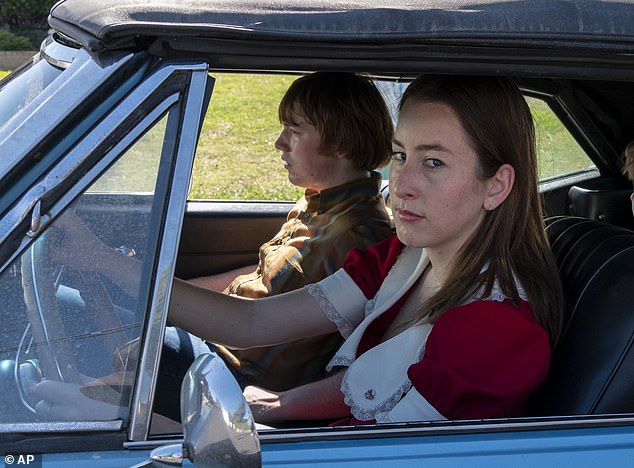
Anderson’s script centers on a 15-year-old boy named Gary Valentine (Cooper Hoffman; son of Phillip Seymour Hoffman) and the girl-SCRATCH THAT-woman, I mean, that he becomes enamored with named Alana (Alana Haim).  Gary approaches Alana at his high school where he is about to have his class picture taken.  She’s there working in a dead-end assistant position with the photographer.  Fast dialogue takes place in this opening scene where Alana can’t take this kid seriously even though he’s a seasoned child actor, known throughout the San Fernando/Encino, California landscape among known casting directors and agents.  Eventually, the relationship blossoms as Alana serves as an adult escort for Gary who has to go on a television program.  (Mom was not available to accompany underage Gary; hence the word escort.)  Soon after, it’s established that though Gary seems more mature than a typical 15-year-old because he’s had a career during most of his young life, Alana is in a limbo of not reaching adulthood yet, despite the number of her age.

Gary’s worth as an actor is expiring as he’s not the cute precocious kid that Hollywood is looking for anymore, and so he’s on his way to his next venture, never allowing himself to be set back.  Why not sell the newest innovation of the early 1970’s?  Waterbeds!  Meanwhile, Alana does her best to move on to her next life changing chapter by dating an actor her age.  However, things don’t work out.  He was born Jewish, like her family, but he defiantly announces he’s an atheist over Shabbat dinner and will not recite the kiddush prayers. 

The contrast in Gary and Alana’s progress through life in 1973 couldn’t be further separated from one another.  Anderson writes these two characters as they are going in opposite directions.  They are 10 years in age apart from one another.  Gary doesn’t allow himself to be defeated when one business venture after another doesn’t pan out.  Alana is short tempered and easily stuck in a rut, however, when things don’t go her way.  This is the running theme of Licorice Pizza.

Other folks that I’ve discussed this film with find it weird that a 15-year-old boy and a 25-year-old woman are hanging together and drawn to one another.  Yeah, it’s weird, but it happens.  Out there, there are unusual relationships or friendships.  Spend a month working in a community theatre like I have and then tell me weird relationships don’t happen.  Forget about whether they are legal or not.  Forget about if it’s perverted.  (Though, truly it really isn’t depicted in a perverted manner in Anderson’s film.) There’s a relationship between Alana and Gary where romance and attractiveness are certainly tested, but that doesn’t mean it’s ever consummated. 

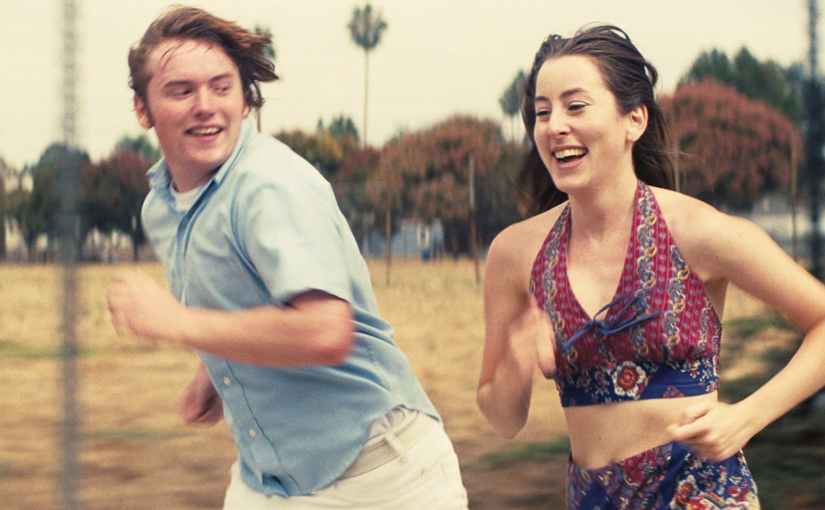
The fact that the relationship between the two characters is difficult on them and the audience is the point of Licorice Pizza.  Anderson is a brilliant writer/director here because he has an ongoing visual theme happening.  Often during the film, both characters are filmed running towards something.  They are either running towards one another or something else or they are running away from each other.  Gary and Alana seemingly know that this relationship could never come to an intimate, loving, romantic relationship.  After all, he’s fifteen!  She’s twenty-five!  Yet, what Paul Thomas Anderson demonstrates is that no matter how physically fast you can run or how far you can run, these two characters will never, ever catch up to one another. 

Gary yearns for Alana because lust interferes in most boys at age fifteen.  Alana needs Gary, however.  She tries and tries new opportunities to stimulate her daily lifestyle beyond Gary, like volunteering on a politician’s campaign or attempting to get in the good graces of a well-known Hollywood actor (a brief, yet memorable appearance from Sean Penn).  Dating a man closer to her age also doesn’t work out.  She’s outgrowing her Jewish home life that she’s still stuck in as well.  Alas, it doesn’t ever work out for her. 

The actress, Alana Haim, who takes on the role is surprisingly skillful.  She’s tough and sad and lost.  Anderson may have written the character, but Haim evokes the emotions that progress her listless story arc.  Each time, something happens to Alana, I couldn’t help but feel such despair for her.  I’ve been there.  When I graduated high school!  When I graduated college!  When I broke up with a girl!  When I had to move into an apartment!  When I became a father!  How many of us truly go on to the next plateau knowing exactly what to do?  Some folks like Gary, can do that.  Others like Alana just can’t.  I think more people have been in her spot than they care to admit.  Paul Thomas Anderson is brave enough to not present Alana’s triumph so easily or quickly.  Movies don’t always have to show the happily ever after ending.

Gary moves from one chapter to another as well.  Because he’s a well-known kid actor of yesteryear, he’s granted more resources than Alana, even though he’s ten years younger.  He always gets a table at the local restaurant.  He knows all the casting directors.  He knows how to get around and get things started.  Audiences are smarter and likely know that whether Gary is selling waterbeds in a run-down business shop or later turning the place into a pinball arcade (now that pinball machines are legalized; which I never knew they were illegal to begin with), he won’t become such a successful entrepreneur.  Yet, that never fazes Gary.  This is just the next big thing that occurs to Gary.  So, he’ll just give it a go.  The confidence Alana lacks in herself, Anderson gifts with the Gary character.  Cooper Hoffman makes a grand debut with Anderson’s direction and character foresight.  He’s definitely not performing in his father’s shadow here.

Licorice Pizza carries so much symbolism in the point to the story that you might not even realize how apparent it is until later when you reflect back on the film. Obviously, Paul Thomas Anderson is very careful to insist how far apart these two people are, not just in age, but in how they carry themselves and their lifestyles.  However, he does not stop with just the two main leads.  A side gag has a guy who’s the owner of a Japanese restaurant discuss an advertising campaign with Gary’s mother.  A suggestion is proposed by Gary’s mom.  The man then “translates” to the woman simply by repeating the same thing in English with a terribly awful Japanese accent and then the Japanese woman sitting next to the man speaks in her native tongue.  The man carries himself as if he understands the woman and translates back to Gary’s mom in his own Americanized dialect.  It’s shockingly funny how wrong and insulting this guy is.  This guy knows nothing about Japanese cuisine or culture or what they say or what interests them and yet he’s trying to make a business venture out of it.  It’s wrong and highly inappropriate (which makes the scene very funny), but it exists. It’s garish to watch this behavior, but there are thousands of insensitive people doing thousands of insensitive things every day; people who couldn’t be further apart from practicing what they truly were not destined to preach.  If you stop and think for a second, you can’t deny that this is one more weird thing out there in the world that’s odd and yet probably exists somewhere down the street or in another state or another time.  This guy has a connected with a Japanese woman without any concept of understanding or appreciation.

The title of Anderson’s film is never literally addressed.  (Later, I read that Licorice Pizza was actually the name of a popular record store in California way back when.)  Yet, my mind periodically went to its significance while watching the movie.  Try eating pizza with a thick, doughy crust and topped with tough, taffy texture like licorice topped on it.  I’ve never done it, but I’d imagine it’s hard, very hard, to swallow.  So, while Alana and Gary are certainly friends, the hormones of a fifteen-year-old boy and the lonely, lost nature of a twenty-five-year-old woman becoming involved with one another are hard to digest as well.  No matter how Gary and Alana approach their connection to one another it just does not work.  Alana falls off a motorcycle at one point. Gary runs to her.  We see that all the time in movies.  But what’s he going to do when he reaches her to offer aid?  What more can Gary do except to say “Are you okay?”  Gary gets arrested during another time in the film.  Alana runs after the police car Gary is handcuffed in, and tells him it’s going to be okay.  Yet, what is she really going to do?  She doesn’t know anybody like a lawyer or an adult that can help.  She doesn’t have the capability of helping him.

Run as fast as you want.  Run as far as you want.  Gary and Alana can never, and will never, catch up to one another.  They’ll never meet at an appropriate age, always living a decade apart.  They’ll never share a commonality with each other that promises a loving and intimate relationship.  So, while Licorice Pizza has a silly, comedic name, it’s truly a tragic story of impossible love. 

Licorice Pizza is definitely one of the best, most inventive and sensitive films of the year.

THE GAME

By Marc S. Sanders

David Fincher is a director always focused on playing tricks with the viewer’s mind. His earliest films from Alien 3 (a poor installment in a celebrated franchise) to Se7en (an unrealistic yet frighteningly suspenseful serial killer story) to his third motion picture The Game, a movie that throws you off from the beginning of each scene to the end of each scene are best examples of this technique. It’s a little jarring, and I’m happy to watch it that way.

This film only works if you mask what’s really happening by showing you what’s fake instead. I know I sound vague but those that have seen The Game would probably agree that is the point. It’s based off a screenplay (by John Brancato & Michael Faris) that strategizes itself like a Dungeon Master setting up a Friday night in the basement with some buddies to play some role playing games with a 20 sided die.

Michael Douglas is really the only guy who could play Nicholas Van Orton, a millionaire with everything but really has nothing; no friends, no spouse (any longer), no one to care about. Beyond his fortune, all he has are a weirdly estranged brother, played by Sean Penn, and his attorney only there to ask Nicky “Should I be worried?” The film takes place during Nick’s 48th birthday. Normally, the song would go “Happy Birthday Nicky.” However, for Douglas’ cold protagonist, the lyrics are “Happy Birthday Mr. Van Orton.” A man with everything, who really has nothing.

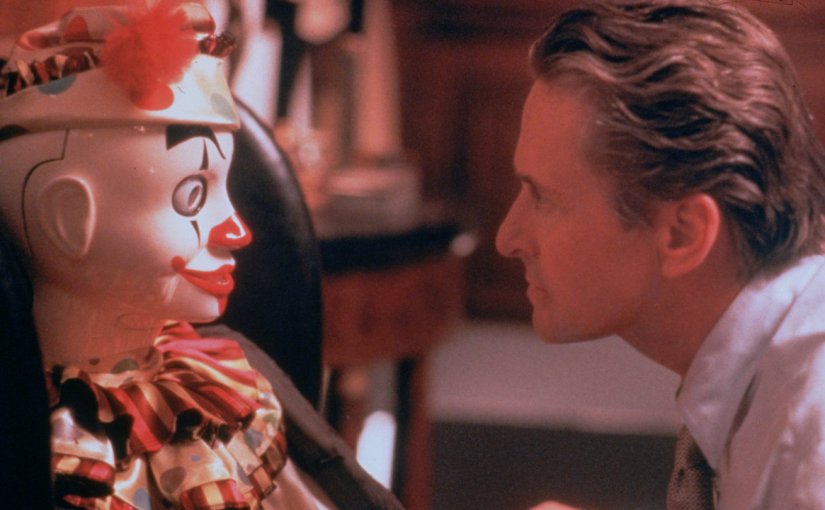
Penn gives him a card with a number to call. This is his birthday present to Nicky. Then the paranoia presents itself little by little; a wooden clown doll, a tv that talks to Nick, a leaky pen, spilled drinks, and soon Nicky’s life is threatened.

Why are these things happening? What’s with the keys? What’s with the waitress who keeps turning up, played by Debra Kara Unger so effectively that she arguably carries the riddles most convincingly? Unger is brilliant at twisting the story over and over. Another great player is well recognized character actor, the late James Rebhorn (also known from Scent of a Woman) who gets the ball rolling and then wraps up the answers later on.

Fincher plays with the mind quietly but never at a slow pace. There’s a consistent tinkling of piano keys that seem to work as puzzle pieces being matched up. It’s much more disturbing to go this route than with grand horns and bass.

When I saw The Game initially in 1997, I started to piece together how to write multi dimensional characters. There’s a past that gnaws at Nick’s psyche sprinkled with glimpses of his father committing suicide. Fincher offers up a background to Nick by means of grainy home movie footage. It all seems quick and taken for granted but it’s necessary to understand Douglas’ cold demeanor and it circles back beautifully towards the film’s unexpected ending. It works so well as a motivator for Nick that I often circle back to its presentation when I write my own scripts.

There’s a great, short scene that sets up the 3rd act. Probably Michael Douglas’ best scene ever in a film, in my opinion. Nick walks into a diner in a dirty suit with scratches on his face. He asks for everyone’s attention and offers up his last $18 to anyone who can offer him a ride. The character is humbled and changed. An arc is completing itself on the other end. It’s a scene that maybe doesn’t belong here until you realize it does. In another director’s hands, a scene like this would be cut or never shot. Fincher took advantage of Douglas’ technique for substituting intimidating power with humble gratitude to simply be able to just ask for a favor. A new character is born in a most efficient 90 seconds of film. It’s a great moment.

See The Game whether you haven’t seen it yet or to watch it again to remind yourself how all the pieces come together.

You might argue that this can’t be realistic but suspend your disbelief because that is what David Fincher always strives for. You’ll be glad you did. Trust me, or maybe…don’t trust anyone?!?!?!?