ABSOLUTE POWER

By Marc S. Sanders

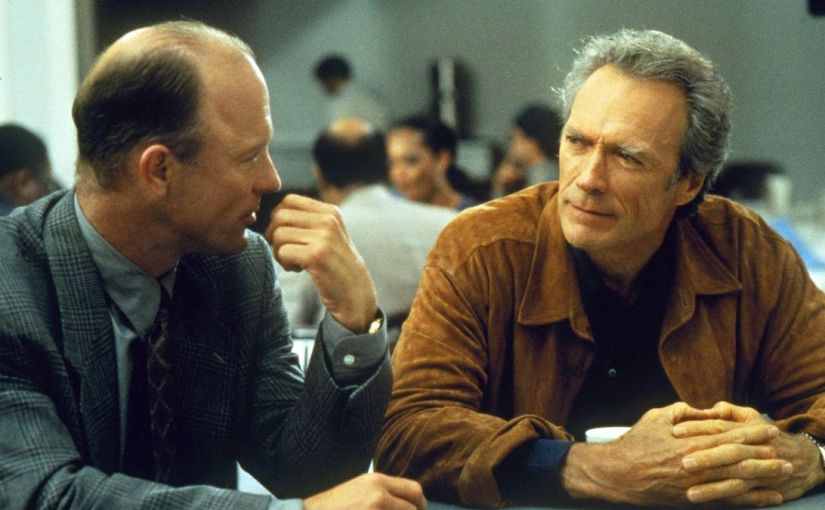
As Clint Eastwood’s Absolute Power was unfolding I started to think this plays like one of those hardcover bestseller political thrillers from the 90s that my dad would scoop up off of the neatly designed stack at the front of Barnes & Noble.  You know with the glossy book jacket that has the blood stain and a dead girl’s nail polished hand next to a bloody letter opener.  The graphics are elevated to feel the crime scene with your fingertips.  The intrigue is summed up on the inside tab.  You turn to the back of the book to see the picture of the author.  Then you buy it with your membership card.  Go figure!  William Goldman adapted the screenplay from a novel by renowned author David Baldacci. Absolute Power has an engaging set up, a who’s who of a cast, it’s directed, produced and starring Eastwood. Still, it evolves into utter eye-rolling preposterousness.

Eastwood directs his own portrayal Luther Whitney, an expert jewel thief.  He might be getting up there in age but he scopes out the mansion of a billionaire tycoon (E.G Marshall, in his final on-screen role) and locates the vault hidden behind a large two-way mirror.  Everything is going to plan as Luther bags up the valuables and a lot of cash but then a drunken couple enter with Luther hidden behind the mirror to watch their tryst turn deadly.  The President of the United States (Gene Hackman) avoids being stabbed to death by the young lady (Melora Hardin) when his secret service detail (Scott Gleen and Dennis Haysbert) enter to shoot the girl dead.  The President’s Chief of Staff (Judy Davis) arrives soon after.  Luther observes the four as they rush the Commander In Chief out of the house and alter the crime scene.  They get careless and just as Luther makes a quick exit, he retrieves evidence that will hopefully work to his advantage.  Now he’s in danger of the President and the other three as they work to permanently contain the situation.

Elsewhere is Ed Harris as the detective out to solve the murder and uncover everything we already know.  When he realizes a thief must have been at the scene of the crime, he actually approaches Luther for some guidance as to who could have been there.  Later, he will use Laura Linney, playing Luther’s daughter, for assistance as her father seems to be the prime suspect. 

The tycoon, the President’s biggest supporter, also wants to resolve his personal vendetta by hiring his own sniper (Richard Jenkins) to take out Luther. 

Absolute Power has all of these players, with recognizable actors in the roles, and yet cannot work the magic necessary to fix this outrageous conundrum.  I can believe that a President could get in more trouble than he needs with a one-night stand and a dead girl on the floor.  I can believe members of his staff will work to tie off all the loose ends, even if it means more murder and mayhem must occur. 

What is hard to swallow is how neatly the story wraps up literally within one afternoon leading into an evening.  It’s fortunate that window washers are present to throw off a couple of snipers with an inconvenient glare at the most inopportune time.  Otherwise, there will be no more movie.  It helps that a character with remorse happens to take his own life, thus exposing the conspiracy, just as Eastwood’s character is steering his own way to exoneration.  All in the same night!!!!

To ramp up the suspense, the bad guys go after Linney’s character, the one person Luther cares for the most.  She ends up in a hospital.  Message has been sent.  Luther better surrender himself along with what he knows to the President’s squad.  Yet, they try one more time to permanently eliminate her and I asked why.  What purpose does that serve to kill her now?  If you kill her, then Luther has nothing to protect or care about anymore.  He can just reveal the entire breakdown of what really happened complete with evidence and so on.

A few years earlier, Eastwood starred in In The Line Of Fire where John Malkovich played a master of disguise assassin.  Luther is also a craftsman at hiding in plain sight.  However, there’s no way I can believe that.  We are looking at Clint Eastwood here.  He’s got his own unique and very tall and square stature.  Put a white mustache and a pair of glasses on the guy, and it is still Clint Eastwood.  Put a hat and beard on him and it is still Clint Eastwood.  Wrap him up in a trench coat and have him walk the city streets in broad daylight where fifty cops are awaiting his arrival and you’ll be able to see the one and only Clint Eastwood.  It just can’t work.  James Bond can hide in disguise.  John Malkovich can hide in disguise.  Go anywhere in the world and Shaquille O’Neal and Clint Eastwood would never be hidden in plain sight. 

William Goldman (The Princess Bride, Butch Cassidy And The Sundance Kid) is one of Hollywood’s most celebrated screenwriters.  He did not think this story all the way through.  You may believe Gene Hackman (second billing behind Eastwood) would have had more of a presence in this picture but oddly enough he’s hardly there. The real bad guy roles belong to Judy Davis and Scott Glenn who are not nearly as exciting as what Hackman could have delivered.

There was a potential for a good conspiracy thriller. The problem is the audience knows too much following the first fifteen minutes of the film.  We know everything that happened and therefore I could care less about the progress that Ed Harris’ detective makes.  Absolute Power likely would have performed better had it opened after the crime had occurred.  Run the opening credits over the dead girl in the room and open the two-way mirror for Luther to enter the frame.  He makes a run for it and then the film can gradually reveal what precisely happened.  A mystery for the characters and the audiences who are watching them only works if the questions are offered before the answers are revealed.

Absolute Power offered a lot of promise with a lot of talent but it’s devoid of both.

THE RIVER

By Marc S. Sanders

A film like Mark Rydell’s The River only thrives on witnessing the misery of people living with the misery of others.  That’s not to say this is not how ordinary people are often forced to live.  There’s too much suffering in the world.  I can never deny that.  A homeless shelter or a prison are settings of great misfortune, hardship and sadness.  Yet for a movie, sometimes you must ask what the point is, especially when it is apparent that the heroes are destined to lose against the forces of nature while the villain is entirely correct in his own cause.  Sometimes in a no-win situation it is honorable to just give up.  I wish Tom Garvey, the corn farmer, would have just quit being a farmer and sought a better life for his wife Mae and their two young children.

Tom and Mae are played by Mel Gibson and Sissy Spacek.  He is the current generation who owns the Tennessee corn crop farm that his family lineage has passed down.  The first twenty minutes of The River depict the harshness of terrible rainstorms that flood the nearby river and wash away the family’s prized crops and land.  Tom, Mae and the children do everything in their power to recede the water as the rain continues to come down in buckets.  Mae fills up sacks of mud and water with their daughter Beth.  Their son Lewis works with Tom on the beat-up tractor against a never-ending battle of plowing the flood waters away from the land.  There’s no way to overcome this terrible plague of weather that comes at least twice every year.  As I watch the sopping wet struggle that opens the picture in the middle of a stormy night, shot very well by Rydell and his crew, I already ask myself what’s the point?  Get out of this situation Tom!!!!! Take up babysitting, tutor, become a fireman, go back to school.  Relocate for heaven’s sakes!!!!

What recuses the Garvey family and the farm, one more time, is when the rain finally stops.

Scott Glenn is Joe Wade.  He is a wealthy industrialist, who also grew up in these parts under a family legacy.  Joe is on the good side of the state politicians and is aggressive in buying out the farmers’ land so that he can flood the valley, build a dam and use the overabundance of water to power the utilities of the area in a more efficient and much less costly way for everyone.  And he’s the villain of the story????????

Joe makes sense.  Tom’s passion for holding on to what his family has owned does not.  I get the idea of grasping on to family heirlooms like my grandfather’s watch that he maybe kept hidden in an uncomfortable orifice while being held captive by the Nazis, or the prized jewel that survived a shipwreck generations ago.  I also understand the desire to carry the torch of the harsh labor a father and a father before endured and died for while allowing a farm to thrive.  Yet, there are children to feed and debts to pay. The ruin that comes from the acts of God do not empathize.  Therefore, I say again, sometimes the bravest and most sensible thing a person can do is actually quit.

Tom, along with most of the neighboring farmers, are adamant about not selling their land to Joe.  When auctions occur to sell off the equipment and leftover supplies of the few that do surrender, it is practically considered a gross violation of a sacred code in these parts.  I look at the stubborn folks who frown upon their peers as terribly disrespectful.  The script is expecting me to empathize with Tom and those who stand with him though. 

Midway through, The River takes a detour as Tom leaves to do hard labor elsewhere to earn much needed cash.  This is where misery does not love company.   He is one of many men selected to do factory work as an inexpensive replacement for the union workers on strike.  Tom, along with the other recruits, are threatened, called scabs, and in a glaring scene spit directly in the face.  A fellow worker is beat up in the middle of the night.  All of this is powerful footage and yet who am I supposed to empathize with?  These workers on strike are demanding better benefits and rights.  A guy like Tom, who values the survival of the Garvey farm, interferes in someone else’s just cause for his own welfare. 

I think about films like Schindler’s List and even The Lord Of The Rings fantasies and I witness the hardships and suffering of a collective people.  Those stories never expect me to value the misery of a select few over others.  I take stock in a whole populace.  In Mark Rydell’s film, however, I feel like I’m only asked to cry for Tom Garvey’s relief, the stubborn father who is defiant for an unlikely future of promise for the area he occupies while also ignoring the welfare of his family against the forces of nature.  Joe is offering Tom and Mae hundreds of thousands of dollars for their land so that he can enhance the state.  Joe’s bounty will rescue the family from insurmountable debt and the unforgiving floods that repeatedly destroy their crops.  Still, I’m supposed to believe that Joe is the asshole.

Sissy Spacek was nominated for Best Actress for her performance.  She competed against Sally Field (who won) and Jessica Lange.  Both were ironically featured in their own “farm life films” in 1984.  Spacek remains one of Hollywood’s finest actors.  However, I did not think there was much for her to do here.  A drawn-out sequence has Mae caught under a tractor with a nasty wound while the blistering heat bears down with no one around to help.  It has its moment of suspense because this film could go in many different directions of tragedy, but a development like this is more circumstantial than performance based.  If Katherine Hepburn or Laurence Olivier were under that tractor, the scene would not play out much differently.  It’s just a standard farmer accident destined to be included in a standard farmer picture.

The possibility of a love triangle is also implied during the film.  As soon as I saw the opening credits (Sissy Spacek, Mel Gibson, Scott Glenn), I hoped against all hope that the story would not go there, and yet…

Having hardly even used a rake or a shovel, I know that farming is a grueling life and still so necessary for our world consumption to survive.  The River attempts to demonstrate this message. I empathize with people like Tom.  I really do.  However, I empathize with the sacrifice they may need to take, not with their with their foolhardy stubbornness or their intrusion upon others’ challenges for gain.  If a doctor told me that no matter what efforts he performs he will not be able to save my arm or my leg, I’m going to have to believe him and accept that the limb must be amputated.  If an overflowing river and an unbearably long rainstorm affects my home, my farm, my family and my livelihood at least twice a year, eventually I’m going to come to my senses and tell myself that the bad guy is probably right. 

Contrary to the well-known slogan, sometimes money is everything.

APOCALYPSE NOW

By Marc S. Sanders

Francis Ford Coppola’s Vietnam War masterpiece, Apocalypse Now from 1979, focuses on a madman assigned to find another madman and assassinate him.  I look at the film as a spiral into a dark, demented psychosis.  Each section of Coppola’s film appears like some variation of insanity within an environment and period of time where there was no end in sight for a war that was going out of control.

Captain Benjamin Willard (Martin Sheen) is first shown in a hotel room that he has ransacked during a drunken rage, going so far as to smash his fist into a mirror.  His voiceover explains the horrifying experiences he has already endured.  Now he is at a point where killing is all he is capable of performing. He is summoned to a General’s lunch where he is assigned to seek out a highly decorated Special Forces soldier named Colonel Walter Kurtz (Marlon Brando).  Kurtz has taken his squad over to Cambodia without authorization.  It is believed that he has gone insane with his will to harbor people over there into a cult that he controls while engaging in his own actions against the Vietcong.  The army needs this problem contained and Willard has been selected to terminate Kurtz.

Apocalypse Now is primarily about the journey, rather than its destination.  Willard is to be escorted by patrol boat up the Nang River to find Kurtz and complete his mission.  Along the way he will encounter a variety of scenarios and characters. 

The standout character is Lt Colonel Kilgore (Robert Duvall) the commander of a helicopter calvary battalion.  Willard meets up with Kilgore early on as he will provide an opening on the river for the long journey to begin.  This is the most memorable section of Coppola’s film.  Robert Duvall is truly maddening as he relishes in the destruction he commands.  Kilgore is amused to blare Wagner’s The Ride Of The Valkyries as his choppers blast the shore line where Vietnamese villagers and farmers reside.  Duvall almost seems god like during this sequence because he does not even flinch as explosions and armory are set off mere inches away from him.  He’s crazed enough to even send his troops out into the ocean to surf while the mayhem is still occurring.  When he takes off his shirt while proudly wearing his calvary hat, sunglasses and yellow scarf around his neck, he utters the famous line “I love the smell of Napalm in the morning.”  There is no hint of sarcasm in that line.  Kilgore truly means it.  The commands of war are his absolute pleasure.  The only human feeling that Kilgore shows is when his personalized surfboard turns up missing.  Otherwise, the carnage he leaves behind is a job well done.

Why do I focus on this sequence so much?  First, it is a perfect construction of filmmaking and acting combined.  Coppola’s clear daylight shots of the choppers advancing on the surf are an amazing sight to behold.  To have that much control of so many vehicles in the air so that a select number of cameras can take in the sequence amazes me.  It is feats like these that show why I love movies so much.  The moment is more enhanced with Wagner’s piece accompanying it.  This could all be appreciated as simple documentary style filmmaking.  However, when you combine the mayhem Coppola stages with the proud march of The Ride Of The Valkyries, and Duvall’s crazed glee of commanding this episode of mass destruction, you start to see a pretense.  The hypocrisy of all the elements contained in this sequence tells the story. This country and its people are being obliterated by a crazed individual arriving from the heavens above.  As the scene progresses, my mind returned to the overall plot of the film; the mission of the protagonist which is to kill a lunatic.  At this point in the picture, I have yet to meet Colonel Kurtz.  So, how much of a madman must Kurtz be when compared to a maniac like Kilgore?

Later sequences carry on the insanity theme.  A trio of Playboy playmates are brought in to entertain the troops during one of Willard’s stop overs.  Yet, the crowd of soldiers gets out of control and the entertainers are forced to flee by helicopter with some of the men grasping on to the chopper as it takes flight.  My thoughts were you must be insane to continue hanging on while it gets higher into the air.  Let go for heaven’s sake before you plummet to your death.  Nevertheless, these half naked women are the purest, most angelic thing that these boys have ever seen since being recruited into this hellish nightmare. 

Willard’s crewmen on the patrol boat seem too green with the impacts of war.  They are not as battle weary as Willard.  There’s a guy named Lance (Sam Bottoms) who seems happy go lucky to play the Rolling Stones.  There’s a chef by trade (Frederic Forrest) and a young kid who goes by the name of “Clean” (Laurence Fishburne).  Chief Phillips (Albert Hall) drives the boat.  Willard must keep his mission classified.  These men are only supposed to get him to his destination no matter how far up the river it takes them.  These soldiers are riding into the unknown, escorting a crazed fellow who knows that a positive outcome is not likely.  Coppola provides moments where the men lose control of their senses.  These boys don’t come as informed about what is right and wrong within the parameters of war.  Innocent lives are taken as the patrol boat continues its horrifying tour.  Their lives might be taken as well.  The question is what is the worse cost?  Death, or the horrors they encounter, act upon, and live with thereafter?

It’s notable to watch Frederic Forrest’s performance as he transitions into a mindset with no other option but to slaughter as he dons camouflage makeup later in the film.  Albert Hall’s performance lends some sensibility to the picture.  However, how does Chief Phillips’ receptivity measure up to the crazed obsession that Willard has for completing his assignment?  It’s all quite tragic as the film moves from one moment to the next.

As expected, the third act of the film focuses on Willard’s encounter with Kurtz.  Before all of this, we follow along as Willard reads through the extensive files of Kurtz’ history and career.  This man seems like a giant among giants and in 1979 it seems only befitting that a giant of an actor portrays the mysterious Colonel.  So, that actor had to be none other than Marlon Brando.  Oddly enough, this portion of the film is where the film starts to wear out for me.  Kurtz is insane in a quiet and dark way.  Coppola shoots much of Brando’s performance in darkness.  I’m aware of the purpose with that kind of filmmaking, but it is a long section of film to watch an actor move in and out of the light.  Brando comes off mysterious with lines of dialogue that make little sense at times.  Some allegories work as he describes Willard’s purpose as that of a clerk delivering groceries.  Yet, Kurtz seems the least crazed of all the crazies provided within Coppola’s film. 

A babbling, hippie photographic journalist (Dennis Hopper) greets Willard upon his arrival.  He’s talking in circles with envy for Kurtz, his leader, who resides within the tomb like structure along the banks of the river.  The natives also seem to heed towards Kurtz’ influence.  Willard is taken captive and tormented.  Still, when Kurtz speaks he doesn’t come off so kamikaze like the others we’ve seen before.  I can only presume there are levels to insanity.  Madness is not a well-defined ailment.  I find it ironic that Kurtz, the great soldier and decorated war hero, is deemed the greatest threat to the armed forces’ image within this conflict.  Kilgore, on the other hand, has free reign to slaughter helpless women, children, and farming communities all in the name of victory while commanding his underlings to surf along the coastline. 

What is so mystifying about Apocalypse Now is how thematic the movie seems to be.  It follows this common pattern demonstrating how crazed the effects of war can have on people.  The killing and bloodshed are the most apparent of course.  However, the military declares early on that there is a loose cannon within their ranks that must be contained.  The only option is to kill this man, who has done his bidding for the progress of its army for so long.  This man, Colonel Kurtz, has sacrificed promotions in ranking and a return to a quiet life with his wife and children, so that he can continue with carrying out the agendas administered by his government.  Yet somehow, he crosses a border, and he no longer kills the way his superiors want him to, and now he must be terminated.  The hypocrisy is to send a madman to do a madman’s bidding, as if that will preserve some sort of sanity within this out-of-control conflict.

I could not get away from that impression during the whole three-hour running time of the film.  Practically every caption, scene, expression, or scenario is rooted in madness.  Francis Ford Coppola wrote the script with John Milius and it’s been said that much of the filmmaking was done on the fly.  Still, with Coppola’s direction along with a strong cast, particularly from the quietly, reserved Martin Sheen, the message comes through clearly.  War begins with a difference in politics and a need for further control.  Pawns are the collateral damage used at will to settle the argument.  Rules of engagement may appear formally on paper.  However, is anyone with a gun in his hand or facing the end of a loaded barrel going to pause and consider what’s just and appropriate before taking action? 

Apocalypse Now speaks to an end of days where the soldiers sent to do the bidding of others respond by doing what they ask of themselves.  Therefore, I’ll end this piece on a vague note. 

There is no organized effort when it comes to war.

NOTE: This article is based on my viewing of Coppola’s third iteration of his film, entitled Apocalypse Now: The Final Cut.

THE BOURNE SUPREMACY, THE BOURNE ULTIMATUM, THE BOURNE LEGACY, JASON BOURNE

By Marc S. Sanders

Sometimes the same old thing is all we want, right?  It’s like comfort food.  That’s what the Jason Bourne films offer.  The first time (The Bourne Identity) it is original.  The second time (The Bourne Supremacy) it is familiar.  The third time (The Bourne Ultimatum) it is what we expect.  When you get to the fourth and fifth time (The Bourne Legacy and Jason Bourne), well then perhaps you’ve overstayed your welcome.

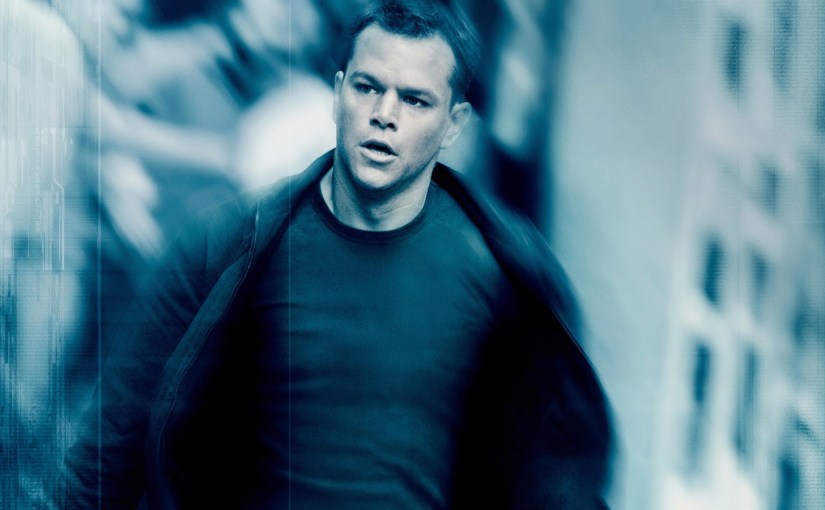
The second and third films in the Matt Damon action series function as one long four-hour film.  They are absolutely gripping in high octane, fast cut editing, pulse pounding music from James Newton Howard, and taut direction from Paul Greengrass.  They work because at least two thirds of the material is shown through the eyes of the former assassin Jason Bourne who is trying to learn of his past and who he worked for and why.  Plus, though he may hide deep undercover on the other side of the world in places like populated India, he only resurfaces when he discovers someone is trying to kill him.

The other third of these two pictures function on the other side of the coin with clandestine departments within the CIA who only consider Bourne being alive as a threat to the integrity of their black operations.  He must be eliminated.  There are great acting scenes with Joan Allen first up against an intimidating Brian Cox, and later she’s going toe to toe with David Strathairn.  If you are not part of the chase for Bourne, then you are engrossed in the cause these three supporting players offer with government politics and debate.  With each passing film, it’s an old, grey haired white gentleman in a suit who is insistent on eliminating Bourne and anyone who he associates with.  This started with Chris Cooper in the first film followed by Brian Cox (my favorite) over to David Strathairn.  The baton is then passed to Albert Finney.  A new film moves over to Edward Norton and then Tommy Lee Jones.  Scott Glenn and Stacy Keach are in the recipe too, but they are not as prominent.  All these guys start to look alike and when you watch the films in succession, one after the other, like I recently did, you start to question when this actor and this actor entered the fold.  Best way to describe it is that it is a ladder climb.  There was one guy in charge, then another above him and so on.

The appreciation for the Bourne series comes mostly from its action and the absolute cleverness of its hero.  Jason Bourne functions with ease about staying one step ahead of those trying to kill him.  They think they have a lead on him, but in reality, he has the lead on them.  Do you know how satisfying it is when he calls these people to talk to them and they play dumb? Jason will simply say “If you were in your office right now, then we would be having this conversation face to face.”  Moments like this are what gets an audience to clap and cheer.  The old white guy has been duped.

The action works because, once again I lay claim to the lack of CGI.  So, the overabundance of car chases seems nerve wracking like they are supposed to.  That door on that car is actually getting bashed in.  That taxi cab is really getting t-boned and turning into a 360 tailspin.  Jason can grab a seatbelt, lie down on his side and when the car careens over the barrier onto the landing fifty below, upside down, I’ll believe he gets out with only just a slight limp and a dribble of blood on his brow.  Only Jason Bourne can drag a wrecked rear bumper on a stolen police car through a busy Times Square and bash an SUV into a concrete barrier.

Fight scenes are not just fight scenes in the Bourne films.  It’s not just fists and punches and karate kicks.  Creatively speaking, the films construct their fight scenes to have the hero arm himself with a ball point pen or a magazine that’s wrapped up ready to wallop an opponent in the nose.  I’ll never forget when my colleague Miguel and I saw Ultimatum in the theatres and witnessed Jason punching a book into the face of a dangerous bad guy.  How many times have you seen a guy get punched in the face?  How many times have a seen a guy punch a book into the face of another guy?  There’s a difference. 

Matt Damon has been quoted as saying he believes the Bourne films carried the least amount of dialogue for him to memorize.  Yeah.  That’s likely true.  These films are visual feasts.  They rely on watching Damon move.  They are paced by how he walks, drives a car or tinkers with props.  Even how he listens and observes move with a kinetic progress. 

The locales are spectacular, spanning the globe from India, to Russia, to London, to Morocco, to the Philippines, and on to New York City and Las Vegas.  Following the first film, Paul Greengrass directed three of the next four.  (Writer Tony Gilroy directed the fourth film, The Bourne Legacy with Jeremy Renner taking the lead while Damon’s character was only talked about.) Each film takes every advantage of the atmosphere, using the overpopulated extras as obstacles and means to hide and weave away from the antogonists while on foot, behind a steering wheel or saddled upon a motorcycle.  Greengrass practically invents the concept of putting the viewer so much within the environment, you can almost smell the diesel or the food trucks within the area.  Zoom in overhead shots offer quick glances of the playground and traffic we are engrossed in.  Approximately twenty-five minutes within the center of The Bourne Ultimatum go by with no dialogue as Jason Bourne pursues a bad guy through a labyrinth of apartment tenements and rooftops, while the bad guy pursues actor Julia Stiles.  Finally, when all three catch up to one another, with a leap through a window, do you let out the deep breath you never realized you were holding on to. 

The first three films in the series (Identity, Supremacy and Ultimatum) work as a tight trilogy.  Each film ends with hanging threads to consider and lend to the next film.  By the time Ultimatum concludes, you feel as if all that needed to be told has been covered.  The next two (Legacy and Jason Bourne) function as cash grabs for the studio.  Legacy is entertaining and it boasts a good cast with Jeremy Renner and Rachel Weisz trying to outrun the government adversaries.  It hinges on operating as parallel material that occurs in the prior Damon installment.  While Jason Bourne is being pursued, this is happening over here.  It’s not unwatchable, but it is also truly unnecessary as it doesn’t advance the universe of the series at all.  A thrilling motorcycle chase closes out the film, but it’s a retread of what we’ve seen before.  It gets old quickly.  The film demonstrates that guys like Jason are trained to become dependent on drug enhancements for their highly trained arts of warfare and instinct.  Renner’s character is just another kind of Jason Bourne.  I was more impressed when I thought Jason was just a highly skilled fast learner to all that he’s capable of.  If you tell me blue and green pills lend to what he’s capable of, well then, he’s not much of a superhero in my eyes anymore.

With the final film, Jason Bourne, Greengrass returned to the director’s chair and Damon agreed to come back (paycheck had to be right, I’m sure), though he was significantly greyer and older than his prior films.  It was a weak return.  Just when we think Bourne has learned everything he needed to know and he could now live comfortably underground as a street brawler for bucks, he is informed that his deceased father knew and did some things for these secret agencies that put Jason on this path of special operations.  It doesn’t hold much weight and the payoff is nothing special.  Another car chase occurs in Vegas that appears nearly shot for shot similar to what we already saw in Damon’s prior installments. 

I wrote in an earlier review of The Bourne Identity, that Matt Damon works so well in the role because he’s such an unexpected surprise.  He’s not the muscle guy like Stallone or Schwarzenegger.  He comes off common.  In the first three films, he’s simply a kid.  When you place him in action or see how he gets the drop on a bad guy who is surveilling him, it is so satisfying.  The Bourne films work best with the locales they choose to shoot from.  Bourne will spy on his pursuers from a rooftop building across the street from where they are.  This is inventive filmmaking not just found in the pages of the script.  Paul Greengrass strategically shoots his players.  Director Doug Liman planted the seeds for this series’ potential (The Bourne Identity), very loosely based on the Robert Ludlum novels with creative adaptations from Tony Gilroy, primarily.   Greengrass enhanced the characters and their motivations by use of scenic locales, skillful shaky cameras to make it look like the audience is running at the same pace of Bourne and his adversaries, and quick cut, real time editing.  He applied this approach to his 9/11 film United 93.  The last two films are good even if they seemingly peter out the series, but overall, the four sequels hold up very well. 

If you’re asking, the best of the series is The Bourne Ultimatum, followed very closely by The Bourne Supremacy.  Either way, no matter which film you’re watching, you’re in for a good time when Jason Bourne shows up on the grid.

THE HUNT FOR RED OCTOBER

By Marc S. Sanders

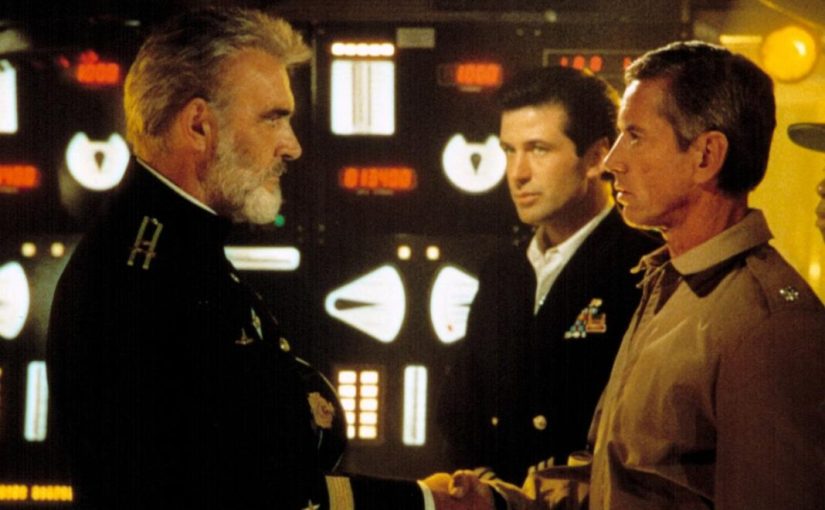
John McTiernan’s adaptation of Tom Clancy’s first bestselling novel, The Hunt For Red October, might seem dated but it’s still a crackling good thriller. It’s one of those films where you truly feel like you’re walking through the secretive hallways of DC government buildings with their elevators accessed only by an Admiral’s key. Soon you’re in a dark, underground boardroom. You’re also there on the various naval crafts and submarines with alarming lights, shiny steel and glowing monitors. The biggest treat is being in the command center of the titled sub, Russia’s Red October, commanded by their captain, Marko Ramius (Sean Connery). All in all, Terence Marsh built a convincing production design.

Clancy’s story takes a different approach than most thrillers involving Cold War politics. Ramius might have been a James Bond villain in another film as he hijacks Red October, but there’s more to him actually. Rather, Ramius wants to defect to the United States. Most of his command crew is in agreement as well. America doesn’t necessarily see it that way; a Russian, missile equipped submarine quickly approaching the eastern seaboard with other subs following him?!?!?!? Let’s not polish the tea set so quickly.

Fortunately, one man had the pleasure of meeting Ramius once and doing extensive research on the General’s background; Jack Ryan (appropriately cast with a young Alec Baldwin). Ryan is given three days to catch up to Ramius and guide him safely to the United States while avoiding getting the famed submarine shot down by either power nation.

I must point out my favorite scene and it actually takes place in that secret boardroom where it dawns on Ryan of Ramius’ true plan. Baldwin is great here. The young guy who is green when it comes to military and political protocol. McTiernan gets his company of generals and high ranking officials into a large quarrel over what to do and then he zooms in on Baldwin thinking for the close up before he calls Ramius a SON OF A BITCH. It’s at this moment, that the movie going consensus and fans of Clancy overall determined that Alec Baldwin was the best of the cinematic Jack Ryans. (No slight to Harrison Ford, who was too middle aged for the role when he took the part).

Connery at least has the commanding appearance of Ramius’ stellar reputation. He is not very exciting or charismatic. Then again, I don’t think Clancy built the character that way. Connery plays the role as silent, yet wise and experienced as implied by his well groomed, white beard and hairpiece plus his square stature. If this man is standing in your presence, you better give him an update. You shouldn’t have to ask if he wants one.

Good moments are made available to Scott Glenn, James Earl Jones, Sam Neill and Stellan Skaarsgard as well. It is the talking scenes among all these fabulous actors that really build tension. The underwater scenes…not so much. The subs look like long, black blobs weaving their way through depths and avoiding missiles coming their way. It’s forgivable because McTiernan always keeps the characters at play. This isn’t a film that relies on the dog fights depicted in Top Gun or Star Wars. McTiernan keeps his audience away from drowning in the underwater murkiness.

The makers of this yarn really are a great combination of imagination. We got Tom Clancy and John McTiernan to thank for a gripping tale from 1990 that still holds up today. The Hunt For Red October is definitely a film worth revisiting.

THE SILENCE OF THE LAMBS

By Marc S. Sanders

Everyone remembers Anthony Hopkins’ memorable turn as the infamous Dr. Hannibal Lecter in The Silence Of Lambs.  He was “Hannibal The Cannibal;” a renowned and brilliant psychiatrist who was eventually captured for being the one who ate his victims with sophisticated glee.  The real attraction, though, is how director Jonathan Demme delivers the film adaptation of Thomas Harris’ best selling novel through a lens that only finds one strong heroine amid a sea of intimidating men.  The heroine is the intuitive, but petite Clarice Starling.  The men are nearly everyone else cast in the film, and I mean everyone all the way down to the extras; the extras, here, are a perfect example how necessary they are towards any film’s palette.

Ever since the film was released in 1991, the dialogue of Ted Tally’s script is worthy of repeating and mimicking in social circles.  Lecter remains spoofed in nearly every pop culture medium.  Hopkins’ character is unforgettable and he’s been ranked among the greatest film villains of all time with the likes of Darth Vader and Harry Lyme.  It’s a worthy honor.  His timing is subtle and mischievous while he remains silently dangerous.  You can’t take your eyes off the actor and you can’t erase the devilishly fun and evil character from your sub conscious.  Opposite this performance though is Jodie Foster in a top billing role as an FBI trainee named Clarice Starling, assigned to interview and maybe study Lecter as a means to a solid lead in finding a serial killer that has been identified in the media as “Buffalo Bill.”  Bill has been skinning and killing girls with large physicalities, around the east to mid-west portion of the United States.

So, there is a detective story at play here as Hannibal aids Clarice in her search for the killer, but only under his rules.  Demme paints the film with Clarice ably performing her job no matter the towering strength or perverted fantasies found in nearly any man.  An outstanding image early on shows her small frame entering an elevator.  She has been summoned to her supervisor’s office from the outdoor obstacle course.  She is sweaty, and looking tired.  The elevator is full of a dozen men in red uniform polo shirts that hug every muscle; they are strong, fit and healthy.  Clarice stands front and center and she has no reluctance to stand among this exclusive group.  Later in the film, Clarice is invited by her supervisor, Jack Crawford (Scott Glenn in a deservedly dark and quiet performance), to investigate one of Bill’s victims that turned up in the swampy waters of West Virginia.  The coroner’s examination room is filled to the max with sheriffs who believe they serve a purpose to stay there to witness what’s uncovered.  The strength of Clarice is really shown here as she shoos them away.  The men’s facial expressions tell us they don’t care for this request, but Clarice isn’t going to allow them to remain.  Most importantly are her encounters with the head of the Baltimore psychiatric ward that houses Lecter.  He is known as Dr. Chilton played by Anthony Heald.  Chilton – a great character name that clearly colors in the twisted perversion of this guy.  Chilton is happy to boast of his prized attraction, Lecter, as if he’s a rare tiger and he has no reluctance to hit on Clarice when she comes to visit with Lecter.  Always, Clarice will not allow herself to be succumbed, patronized or victimized by any of these towering figures of masculinity in what is unfairly regarded as a man’s world in law enforcement, crime or psychiatry.  Starling easily reminds Chilton that she was a student at the University of West Virginia, not a charm school.  With Tally’s script, Jodie Foster uses these deflective techniques of her character without effort.  Her methods of fencing with these men are a natural ability.  Even when she’s in film transition periods of training at the Academy, Clarice can maintain her stance against a hard-hitting male boxer pounding away at her boxing shield.  She just won’t fall over. As well, she doesn’t wince as the male students give her a glance from behind when she’s jogging on the grounds. 

Demme is an outstanding director who uses these interpretations of this woman to drive his film.  This very same year, 1991, Ridley Scott directed Thelma & Louise.  In that film, the title characters had to realize that they didn’t have to take any shit from a man.  They started out weak, though, and had no choice but to eventually get stronger.  Here, it’s already part of the woman’s instinctive nature. 

Hannibal Lecter is shown to be well versed in the finer things of art, literature, music and, forgive me, cuisine.  At one point, Demme focuses on a picture Lecter has sketched depicting Clarice in an almost angelic nature.  I’ve never forgotten that image.  Nearly all of the settings in The Silence Of The Lambs include stairways that always lead us in the down direction, to an assortment of various hells.  Clarice, the pure angel with nary a fault beyond limited experience as an FBI agent peels the onion away on her quest for a killer by entering into the treacherous depths beneath her; pits of hells.  The opening shot of the film has Clarice pulling herself up with a rope on an obstacle course as if she is ready to enter the heavens, ready to stand above everything, but then she is summoned to Crawford’s office located at the Department of Behavioral Sciences at the FBI.  She has to take an elevator down and then various stairways further down into a labyrinth of claustrophobic offices with no windows, surrounded by cinderblock and populated with men in uncharacteristic suits that don’t appear warm or cuddly.  Crawford may seem like her ally, but really, he’s using her as a sacrificial pawn on a chess board putting her in an arena with psychotically dangerous prisoners, in particular, the worst of them all, Hannibal The Cannibal. 

When Clarice goes to visit Hannibal, she is escorted by Dr. Chilton, who relishes in describing how careful he handles his prized thing, and willingly shows what this monster is truly capable of by providing an unwelcome photograph of how Lecter brutalized a female nurse.  This conversation is played upon a much more frightening descent of unlimited stairways and bars that clang loudly and are painted red and rusted, eventually leading to a stone walled dungeon for these unimaginable beings of death and perversion.  Clarice is left all alone to navigate her way down a long corridor until she reaches Lecter’s cell.

Yet, an even more frightening third descent into hell occurs in the final act as Clarice’s pursuit leads to Buffalo Bill.  Bill’s home is dark, lurid, filthy and maze like; but always seeming to go down further and further into one doorway after another and down one staircase after another, including a deep well where his latest victim is kept.  Like the other descents, Clarice uses her femineity as a tool of strength to survive.  I can claim without any hesitation that Clarice Starling is one of the greatest heroines in the history of film. 

The one man who rattles her, and weakens her, though is Hannibal Lecter.  Watch their tete a tete when they meet for the first time.  Starling demonstrates some overconfidence against Lecter’s seemingly polite demeanor.  With her white trash Virginia dialect, she even gets a little smarmy with the Doctor, but then he disarms her immediately with a comeback that shakes her very core.  Demme’s reliance on close ups for both characters serve this scene and others so well.  Clarice’s encounters with Hannibal are the most important and vital moments in the film because they are the only opportunities for Jonathan Demme and Ted Tally to show the main character’s weakness.  Every hero has to have a weakness if they are to remain compelling.  Clarice is not, in fact, undefeatable. 

The film could have simply worked as a basic detective story.  Put up the clues and the narration of the picture will eventually assemble all together for a resolution where the bad guy is captured.  Yet, Thomas Harris’ character creation uses Hannibal as a defiant obstacle blocking the path for Clarice.  Hannibal lacks much stimulation in a cold, specially designed prison cell.  He’s maybe only honored with impenetrable plexiglass to contain him as opposed to traditional bars.  He needs to be enthralled.  On the surface, Clarice appears as a frail prey that he can take his time munching on.  He’s happy to help Clarice catch Buffalo Bill with the case files she provides, but in exchange he wants to uncover what haunts her psyche.  Such a strong character Clarice is, but she has to be willing to weaken and expose herself to desperately find a dangerous killer.  Can she do it?  She’s never allowed herself to do that before.  And thus, we come to comprehend the obscure title of this film and the book it stems from.  (Anthony Hopkins actually thought it was a children’s fantasy when he was sent the script to read over.)

This write up is not necessarily a review, but a means to honor the careful film and storytelling technique that Jonathan Demme strives for with The Silence Of The Lambs.  You might say, yeah, there’s a lot of walking in this picture, but pay attention to the direction of the walking.  Always going down, somewhat reminiscent as Little Red Riding Hood entering a dark and spooky forest and encountering the biggest and baddest wolf.  Jodie Foster might be in a company of men here, but the film works as a dual of femineity vs masculinity.  It’s strange to believe that Demme actually had Michelle Pfeiffer in mind for the Starling role initially, a more than capable actress, but one who at the time was more glamourous (The Fabulous Baker Boys and The Witches Of Eastwick).  Beyond the silly Disney films, Foster was known for lurid pieces like Taxi Driver and her first Oscar winning role as a rape victim in The Accused.  Clarice Starling is a character beyond a pop culture appearance of the time, and Jodie Foster emanates that portrayal.

The writing of The Silence Of The Lambs is so intelligent.  There’s a witty, yet deliberately poor taste, of sarcasm to Hannibal Lecter as he thrives off his superior intellect over Jack Crawford and the FBI.  It’s only enhanced when he’s dealt a lowly, formally white trash female student to play with.  Ted Tally offers precise timing in the dialogue with Clarice and Hannibal.  Thomas Harris’ drive to further a cameo appearance of Lecter in a prior novel (Red Dragon) with this book is a gift to readers and eventually movie watchers.  The Silence Of The Lambs doesn’t follow formula with a Law & Order technique of ballistics and witness interviews.  It drives into other directions to feed its development. 

Jonathan Demme’s film is pioneering.  I recall seeing it in theatres with other high school friends.  I was not enthused to see it.  The title was too odd.  The picture was primarily a talking piece.  There were gross and unwelcome images within the film.  It’s very ugly at times.  I was frankly accustomed to the likes of Dirty Harry and Lethal Weapon films for my cops pursuing the robbers ideals.  I recall not even liking the film when we left, and I couldn’t comprehend its appeal that followed for the remainder of nearly an entire year, all the way up to when it was awarded the five main categories of Oscar wins (Actress, Actor, Screenplay, Director and Picture).  I definitely wasn’t accustomed to a strong character like Clarice.  Later that year, I saw Thelma & Louise and fell in love with their eventual triumph.  I needed to be spoon-fed their initial weaknesses at first.  Who was this Clarice in this picture, though?  I could not identify her strength that displayed right from the get go.  I wasn’t even 18 years old at the time and now I can say I just wasn’t mature enough for this film back in 1991.  Now, it’s thankfully clearer, though I still appreciate its subtlety so much. Jonathan Demme had such a clear vision of where he was taking this film and because it’s not dated, The Silence Of The Lambs stands as thriller, and an intelligent thought provoking piece that stays with you for a long time after each viewing.