PULP FICTION

By Marc S. Sanders

No one can deny that Quentin Tarantino’s classic film, 1994’s Pulp Fiction is one of the greatest screen accomplishments of the latter half of the 20th century. It’s strange, lurid, scary, unforgivingly funny and altogether different from practically anything that came before it. How did the Weinstein brothers with Miramax films prophesize the energy it would surge in mainstream audiences?

When I first saw the film I was apprehensively going with two college friends who insisted I see what they experienced from a prior viewing. Suddenly, I realized that alternate surf 70s rock, black suits, and a kinetic visit to the restaurant known as Jack Rabbit Slims could entertain and make me look further than just a facial close up.

Tarantino entertains the lens of his camera by making his audience the camera. A drug dealer scrambles to find a medical book to awaken a boss’ wife who is dying from a potent heroin overdose, and the camera stands in place only frantically swinging left and right. The camera doesn’t move while everyone in the scene remains in a panic, frightened of administering an adrenaline shot. The camera stands still to allow the audience to stand in the room as well. It’s very unusually funny, but unnerving and suddenly we are amid the clutter of crime and drugs frightened of a terrible fate.

Another scene follows two gangsters down the hall as they debate whether a foot massage equates to fellatio on a woman. They look serious as they earlier regretted bringing shotguns to their destination but here they are having a debate likely reserved for men’s locker room talk. Is a foot massage really worthy of dropping a guy out of a four story window into a glass enclosed garden below? I mean, apparently the poor guy developed a speech impediment.

Tarantino used Pulp Fiction as an excuse to show how criminals inadvertently lead their lives to the unexpected, beyond a cliché cop bust. Two guys might be settling a personal vendetta, but somehow get interrupted by a redneck gang rapist and his chained up “gimp.” Two other guys might be trying to deliver a briefcase and yet somebody’s brains splatter all over the inside of a car. Another guy might have left behind a family heirloom gold watch as he and his girlfriend run for their lives, or they might suddenly acknowledge a moment of clarity when death seemingly walks out of a bathroom door.

Some might not agree but I always consider Tarantino’s colorful film characters to be rather two dimensional. What you see is all you see. There are no hints at an underlying motivation or a background to anyone you meet in Pulp Fiction, or any of his other films. Normally, that’s a negative in my book but with Quentin Tarantino it is what’s expected. He’s a masterful script writer of the situation. A well known fan of kung fu and lurid crime movies of the B variety, gangsters like Vincent Vega, Jules Whitfield, Marsellius Wallace, Butch Coolidge and Winston Wolf (even the names are entertaining) get caught up in just a random moment in time. Beyond the incident nothing else matters, and just to make it fun Tarantino uses his favorite editor, Sally Menke, to scramble everything out of order. I like to think the script was assembled this way to demonstrate that what happens in one instance doesn’t reflect what happens in another. Every brief moment is bookended. Again, two dimensional characters who don’t reach an intended karma. It doesn’t matter what’s been done before or what will be done next. It only matters in the moment.

The cast is great. Likely, you know who all the players are by now. The best compliment is that they obviously listened closely to the director’s vision. They spoke his language which had yet to be very mainstream before this film’s release. They are a pioneering cast of great talent and many owe quite a bit to Tarantino for jump starting and reviving their careers.

Pulp Fiction is a rousing expedition in sin and surf music symphony with endless quotable and un-PC dialogue that revolutionized filmmaking and brought about risk taking movie makers. It’s just exciting and fun and wild and it especially became a favorite upon seeing one of my favorite kinds of scenes-a dance sequence. If you incorporate dancing into a non musical film, you’ll likely win me over.

Spoiler alert: Vincent & Mia win the dance contest, and right they should. Chuck Berry’s “You Never Can Tell” became that other popular film song once Pulp Fiction hit the scene.

Thank you Quentin Tarantino.

CAPTAIN MARVEL

By Marc S. Sanders

Anna Boden & Ryan Fleck directed the Captain Marvel installment of the Marvel Cinematic Universe. The film has some successes, but some failures as well. Fortunately, where it lacks happens early on and then the film continues to get better.

Boden & Fleck must have directed a film that was never released because this Captain Marvel begins in the middle of a story with exposition that’s terribly hard to follow. I’ve seen it three times now, and it’s still hard to piece the first 40 minutes together. The title character is known as “Vers” (pronounced “veers”) played by Brie Larson. She dons a green uniform space suit and is part of a civilization called Kree. Her mentor is Yon-Rogg played by Jude Law. They head a team on a mission to rescue a spy of their own held captive by the shape shifting Skrulls. The mission goes awry and Vers is captured. Small snippets of a life lived on Earth flash in her subconsciousness as the Skrulls study her mind. When Vers manages to escape, she ends up on Earth in 1995. Gradually, with the assistance of a young Nick Fury (Samuel L Jackson with hair, a clean CGI complexion and no eye patch), Vers learns of her true history that she seems to have forgotten. Reader, I just summed up the first third of this film better than the movie ever did.

Boden & Fleck have some nice touches to this film but only in the second and third acts. Captain Marvel salutes the grunge music of the 90s while also taking inspired narratives from films like The Terminator. There’s some nice twists in the film too.

However, the whole first act should be thrown away and redone. It’s terribly confusing with dark cinematography on what is to be an alien planet at night and a dimly lit unfamiliar space ship. Hardly any characters are fleshed out yet but they talk in conversations that lose me. The Skrulls are shape shifters that can adapt the image of another person or creature but because it’s all so dark, it’s difficult to decipher who is who. Not much payoff comes when you are finally able to piece some material from this whole sequence later on, based on what Vers uncovers about herself, the Kree and the Skrulls.

Brie Larson is fine in the role while primarily playing it straight. Nothing special, but nothing terrible either.

Samuel L Jackson plays this Nick Fury with more naivety than seen before. He’s a younger version of himself after all. So that’s somewhat humorous, especially his chemistry with an odd cat called Goose.

Ben Mendelsohn continues to break into these mainstream film franchises as an antagonist of some sort but sadly no one remembers him, I would think. He needs to be regarded in the same league with guys like Gary Oldman and Christopher Walken. What’s next for him? How about a James Bond villain?

Annette Bening is a welcome presence as the “supreme intelligence” for Vers. Accompany her sashaying to Nirvana’s “Come As You Are,” and I’m entertained.

There was a better film here. Due to a weak beginning, I can only mildly recommend Captain Marvel. Pop culture references and a redeeming two thirds of the film rescue it from utter confusion. Still, if I have to pause the film on occasion to explain to my wife and daughter what is going on, I think that is more an issue with the film than with the viewer.

SPIDER-MAN: FAR FROM HOME

By Marc S. Sanders

Spider-Man: Far From Home is a good movie for all the wrong reasons.

People, it’s not much of a super hero movie. Rather, it teeters more on a teen angst comedy. The teen angst material works very well. I laughed a lot and I found all of this material very touching. Peter Parker struggles with a “like,like relationship” with MJ. His pal Ned is getting in good with another classmate, and his European vacation is getting upended because Nick Fury keeps getting in the way. Again, this is all funny and really cute material. I laughed often. Really enjoyable.

That being said, where’s Spider-Man? He’s hardly in the costume and he’s truly fighting a rather subpar villain. Then again, when I read the comics Mysterio (Jake Gyllenhall, doing the best he can here) was never a favorite of mine. Mysterio’s nefarious ways are a bit implausible. I don’t want to spoil what he’s exactly up to but I wasnt exactly feeling the suspense or admiring his schemes. It’s a little too over the top ridiculous.

The other hero, Nick Fury does not really live up to his character as well. He makes dumb decisions and believes the preposterous storyline a little too easily. Fury had never been written this way before. He’s not this stupid. It irritated me.

I like Tom Holland in the Peter Parker role, and the rest of the cast is good, especially Peter’s pals, Ned, Betty Brant, Flash and MJ. Jon Favreau is likable, and Marisa Tomei makes for a good younger Aunt May.

If only the producers went with a different villain in Spidey’s rogue gallery. Where the heck is Kraven The Hunter already????

I like the whole cast, but there was much to be desired here in the script. The 2nd act is a mess which left me wondering how could this be…if that just happened, and again….where is Spider-Man???

So yeah, Spider-Man: Far From Home is not what it could’ve been but rather something else altogether. That’s maybe good…and bad.

GLASS

By Marc S. Sanders

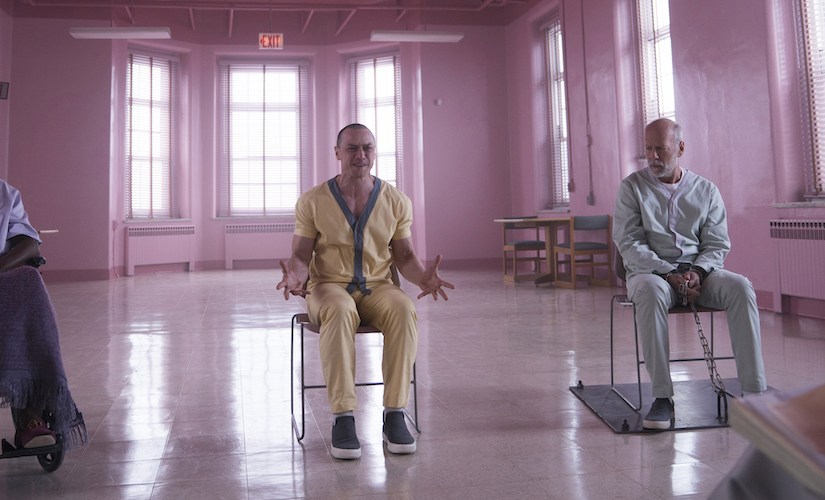
M Night Shyamalan’s Glass is mind numbingly stupid and unbearably boring. A slow moving slog of a movie that scrapes the bottom of a barrel of wasted, rejected plot devices.

This is apparently the 3rd in a series of super hero comic book inspired movies from Shyamalan, but it seems to lack the research into the true construction of a standard comic book or graphic novel. If Samuel L Jackson as the title character declares this is an “origin story,” when it’s clearly not, well then Shyamalan expects you to believe that at face value.

The three central roles played by Jackson, Bruce Willis and James McAvoy are meant to be super human beings. Sure, Willis as the hero David symbolized in green with a poncho has evident powers. Jackson as a villain in purple, however, does not possess any powers. He just masterminds disasters that in other films would be regarded as sabotage and terrorism. Where’s the super power in that? McAvoy as “The Horde” is just mentally ill who hulks out and climbs walls when his beast persona takes over. Yeah, that’s superhuman but for me it’s seems overshadowed by the mental ailments befalling McAvoy’s role as Kevin and 23 other personalities.

Shyamalan is ridiculously overconfident in being a comic book aficionado but has he ever read a comic book? Sorry but I didn’t recognize much in the form of a standard monthly super hero yarn here.

His script has no bite. It has no memorable moments and it has a 2nd act of 4 total that is simply Sarah Paulson sitting in a chair playing a psych doctor offering an explanation for the purpose of the three men. READER, this one has four characters sitting (never standing, never walking, never even turning their heads) in a large room listening to Paulson speak. I’d rather be at an insurance seminar. This scene goes on for a good 20 minutes and I dozed off and on. I literally could not keep my eyes open. Shyamalan typed a long monologue, for Paulson’s character to explain a theory, on a word doc and proudly never edited it.

Revelations are slapped on at the end because god forbid Shyamalan concludes a story without a twist. The ending is as dumb as the film’s 4 note string background which is as dumb as Shyamalan’s script and the film as a whole. It comes from nowhere. It offersno irony and it’s never implied anywhere.

There’s nothing that McAvoy, Willis, Jackson or Paulson should feel proud of here. They stare. They grimace. They make claims on a misguided screenwriter’s behalf that what’s presented is something grander than the absence of storytelling this film suffers from.

Glass is poorly written, poorly edited and poorly directed. It’s a film that’s about as necessary as a sequel to Top Gun.

(Oh shit!!!! Now I’ve done it!!!!)

KILL BILL VOL. 2

By Marc S. Sanders

Kill Bill Vol. 2 offers an entirely different narrative than Volume 1, and that is why Quentin Tarantino is an electrifying storyteller. No two moments seem similar, even if the elements of the scenes (or chapters) seem the same with samurai swords, quick close ups, snap of the finger changes in cinematography and gonzo music cues.

I do prefer Volume 1 over 2 simply because it is a leaner film. This installment has just a little too much fat layered in, such as a storyline focusing on Michael Madsen’s “Budd” character. Not sure it was necessary for a scene where he is getting docked work hours from his boss because he was late. Not sure I needed a scene close to the third act where The Bride meets up with a South American contact before going to meet Bill. The dialogue in a few scenes like these offers nothing and didn’t even bring me the typical smirk I naturally get from QT’s films. They seemed more catered for bathroom breaks during the run of the movie.

Still, there’s a lot of glee and atmosphere in this picture, from a rehearsal wedding in gorgeous black and white with a nice Samuel L Jackson appearance to an enclosed, flashlight lit interior of a buried coffin. Best of all is the centerpiece of the film, The Cruel Tutelage Of Pai Mei (the best scene of both volumes and the salute that sends Tarantino’s love letter for Kung Fu cinema home). I love the Kung Fu Master Pai Mei, easily one of Tarantino’s best characters in all of his films combined. Tarantino works in the extreme close ups that Japanese filmmakers might have used for EXTREME DRAMATIC effect. Everything about Pai Mei is graciously recognizable and hearken back to these movies I’d catch while flipping channels on Saturday afternoon. Frankly, I never stuck with those flicks until the end, but for the fleeting seconds I watched, I got a white robed Kung Fu master Pai Mei to now fully appreciate in Kill Bill Vol. 2.

The Bride could arguably be Uma Thurman’s best role of her career. She’s a great carrier of the Tarantino heroine. The fighting skills she offers and what are deceptively edited in (thanks to Sally Menke) look so natural with her at the lead. You can’t take your eyes off of her, and you love to look at her.

David Carradine is another attraction. It’s rumored that Warren Beatty was up for the role of the sadistic, yet charming, Bill. No way could I see that working out. Carradine was the star of the series Kung Fu. How do you go with anyone else but David Carradine???? Carradine has a gorgeous, gravely stiletto voice that sounds awesome in stereo; deep and guttural. His facial features lend to a history of a villainous, but wise leader.

SPOILER ALERT: I’d be remiss if I didn’t mention QT’s smart imagination for disarming Daryl Hannah’s one eyed deadly assassin, Elle Driver. Find me another movie where an enemy is left in a trailer located in the desert with her remaining eye ripped out while a deadly black mamba snake slithers somewhere nearby. Tarantino closes this storyline by leaving her screaming alone with no eyes…in a desert…WITH A DEADLY BLACK MAMBA SNAKE. Does the audience need to see her die? Definitely not. Use your imagination of this being worse than stranded, and worse than dead. Pardon me but that’s fucking brilliant!

Again, QT’s characters are two dimensional. The Bride and Bill might have a little history behind them but that’s about it. It’s okay though, because this is pulp fiction (pun intended) that comes alive on the screen. No writer/director has ever elevated this kind of material so well.