
FLAGS OF OUR FATHERS

By Marc S. Sanders

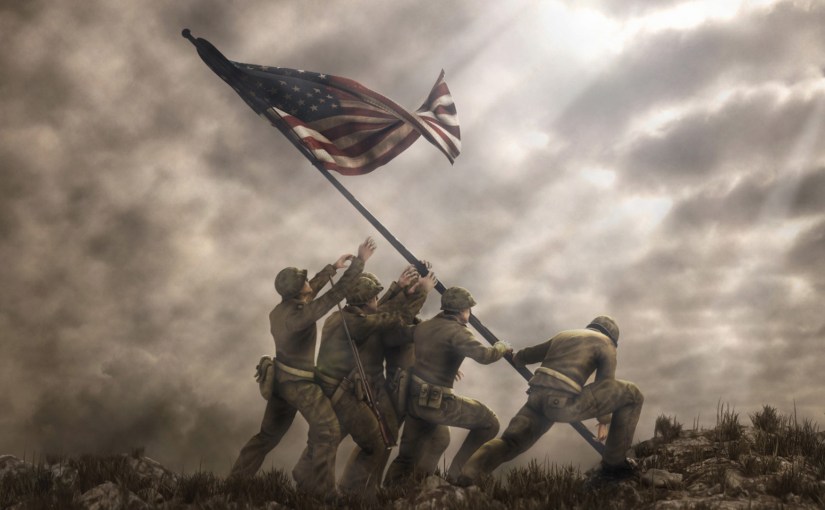
Arguably the most famous photograph in American history is that of the six soldiers raising the flag on the island of Iwo Jima while battling Japanese forces during World War II.  I remain fascinated by the image.  

I recall visiting the landmark statue in Washington DC when I was traveling by myself.  I took countless pictures of the piece.  I got close ups, wide lens shots, pictures of the flag and pictures of each sculpted soldier.  It’s heroic in any aspect.  It looks like something out of a Superman comic book.  As it turns out, the famed image was just a happy accident during a violently terrible time in twentieth century history.  Photographer Joe Rosenthal didn’t even realize what his camera captured until his film was later developed.  Turned out this was the second attempt at raising the flag.  Furthermore, this occurred on the fifth day of the conflict – with thirty-five days still to go before the Americans could claim victory over the bloody crisis.

So, while Rosenthal’s image seems to declare American patriotism at its finest, the real story is not as romantic.  In fact, one of the narrators of Clint Eastwood’s film, Flags Of Our Fathers, suggests that there are no heroes to celebrate.  Whoever the men in that picture were, they were not so much fighting for their country as they were trying to stay alive and look after the comrades ahead and behind them.

Flags Of Our Fathers has a very reminiscent feel to producer Steven Spielberg’s Saving Private Ryan with unforgiving battle scenes of blood, death, bombings and young soldiers storming a beach while screaming for their buddies.  Spielberg might have impressed me first, but Clint Eastwood masterfully shoots wide landscapes and up-close turmoil with his reliable strategies of shooting in shadows and silohouettes.  Eastwood’s film, scripted by Paul Haggis and William Broyles Jr veers into a unique direction though as Rosenthal’s picture takes on a life of its own back in the states.  It makes the front page of every paper.  Harry Truman stands proud of it along with all the decorated military leaders.

Now that America has entered the war, it is appropriate to ignite a propaganda campaign.  This picture of the Stars and Stripes getting elevated into the sobering, smoky war-torn skies will motivate citizens to buy war bonds to further fund the war effort.  The spokesmen will be the ones believed to be the remaining surviving three of the six in that image.  Ryan Phillipe is Navy enlisted John “Doc” Bradley.  Jesse Bradford is Rene Gagon, and Adam Beach plays Native American Ira Hayes, both of the Marine Corps.

I believe Flags Of Our Fathers embraces what every enlisted person did to serve the efforts of America during the war, and the picture mourns the countless sacrifices and losses that occurred.  However, it frowns upon the domestic response to what really went on overseas.  Those that returned carried terrible and unforgettable trauma based on their experiences.  Yet, the three thought to be part of the flag raising were pushed to celebrate their achievements summed up in a split-second image.  Bradley, Gagon and Hayes were skeptical if they were the ones in that picture.  Government Bureaucrats could care less.   There were others on that hill who cannot speak for themselves, but officials in suits and ties will insist otherwise to uphold a countrywide tour complete with recreations of the hill they ran up on that fateful day.  Even desserts are crafted like the famed image.

Ira Hayes is the one who is especially conflicted with his new responsibilities to the governing body that historically acquired his ancestors’ territory.  Adam Beach portrays a torn individual who is limited in celebration by the United States and certainly patronized.  Who he stems from does not matter.  He represents a false interpretation of the English acceptance of his Native heritage.  His obligation to this machine of propaganda only doubles the exaggeration that his other two peers are coerced to parade with marching bands and fireworks.  All that the ongoing extravagance does is keep him absorbed in the Japanese lives he brutally slaughtered and the bloodshed that surrounded him.  It’s a heartbreaking performance told with an absence of true appreciation for what Hayes gave up on that battlefield.

I learned much from Flags Of Our Fathers, but I had issues with comprehending everything.  While the immense war footage is chaotic with sharp editing and camerawork, it’s challenging to match names with faces in the picture.  There are two elderly men who are recounting what occurred and what happened to these men and their families long after the incident was over.  It was hard for me to line up which older man was who, on top of who they are talking about at times.  Paul Walker is one famous face in the crowd.  So is Barry Pepper but I could not identify the names of their characters until the film was arriving at its conclusion.  It was not until the epilogue of the movie arrives that it became a little clearer.  I also had to later reference what is listed on IMDB.  

The entire design of Eastwood’s movie is authentic from the battles staged for the Iwo Jima conflict to what mid-1940s domestic life looked like back home.  Truly absorbing while both storylines seem so different.  Clint Eastwood also wrote the soundtrack composition, and it is truly sobering.  His son Kyle performs with the orchestra.  

Flags Of Our Fathers partnered with Clint Eastwood’s follow up later in the year, Letters From Iwo Jima, which offered the Japanese perspective of the incident.  Bridge the films together and you get an incredible cinematic experience.  So many war pictures are one sided.  In all fairness, most movies do not have the time, luxury or finances to expand their palettes from one side to the other.  Because these two films are companion pieces, the viewer gets a fair account of how this battle, located on a tiny island, treated the men on the ground while their governing bodies celebrated their stands for patriotism, victory and monetary funding.

Eastwood demonstrates that the war destroyed practically everyone who was engaged in it regardless of the countries these soldiers served.  Many were slaughtered, but the innocence of those that physically survived died with everyone else during this period of time.  Clint Eastwood directed two films that explain this never-ending atrocity.  These men eventually laid down their weapons, but they never left the war.
CRASH (2005)

By Marc S. Sanders

Paul Haggis’ vignette themed script for Crash should not have won Best Screenplay. The film he directed should not have won Best Picture. Could it be that because this picture is masked as that special movie with that especially poignant message that it got the recognition I don’t think it ever deserved? I can appreciate the attempt at bringing hot button social issues like racism and injustice to light, but it does not need to be as immaturely contrived as this picture.

Crash occurs over two days within the city of modern day Los Angeles. A select group of characters of different social classes and ethnicities are covered, and the film circumvents back and forth among their perspectives. For the most part, all of these people have major social hang-ups with people outside their race. The first example shows us that if a white woman who is simply cold on a winter night hugs her husband tightly for some warmth, apparently a couple of black men will automatically believe this woman is fearful of their approach.

Especially today, I know that prejudice exists, but to this extreme and this contrived…I’m not sure. I guess I’m not sure because I have not experienced it enough to be convinced yet. When I read a friend’s testimony of falling victim to racial prejudice I lean towards believing everything they tell me. I guess it’s this movie, Crash, that left me feeling dubious and maybe that’s because the circumstances seem way too forced.

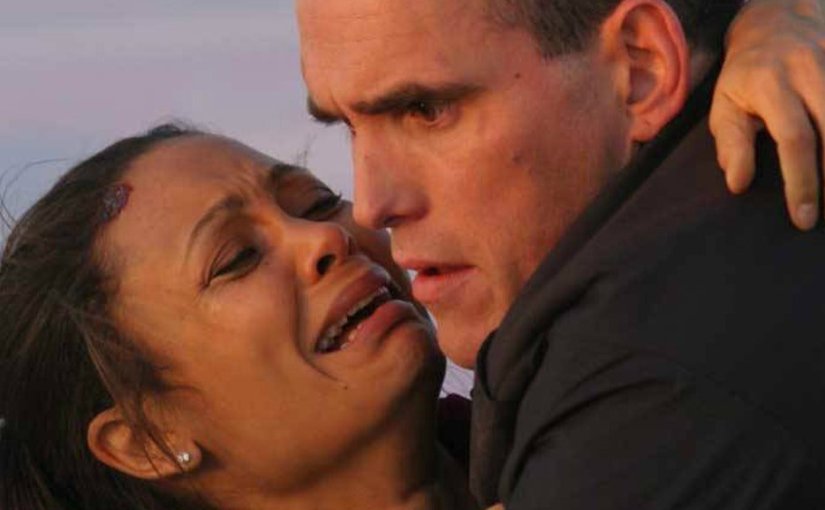
A racist cop (Matt Dillon) will pull over a well to do Muslim man (Terrence Howard) driving a high priced SUV and perform a sobriety test for no reason. Then the cop will deliberately frisk the man’s wife (Thandie Newton) with digital penetration. The next day, it’ll just happen to be that this woman will have no choice but to be rescued from a burning car by this same racist cop. Now I’m supposed to believe that the racist cop is not so bad, and the woman learns to become more tolerant. Well gee, thank heavens for coincidences!

The Muslim man (a television show director) gets car jacked the following day, and in a tense pull over moment he’s mistaken as the criminal. Fortunately, the partner of the racist cop (Ryan Phillipe) is there to subdue the situation. I’m sorry, but life doesn’t work out to be this tidy. Call me cynical, but more often than not we are not given a second chance at first impressions.

One of the real car jackers (Chris “Ludacris” Bridges) gets a moment of clarity and suddenly he’s generously giving out his last forty dollars to a group of Asian people being held in a van for human trafficking. Forgive me. If I want to begin respecting this car jacker who has held multiple people at gun point and even runs over a man, only to toss him out on the drive up to the Emergency Room, I’ll be more apt to do so if the criminal turns himself in.

I dunno. Maybe I’ve got a personal issue with Crash. It could not be more apparently preachy in how it patronizes me to simply understand the seething hate and criminal violations of its characters. I’m supposed to empathize with the racist cop because his ill father can’t get the health care he’s entitled to? I’m supposed to understand the prejudicial anger that the WASP wife (Sandra Bullock) of a District Attorney (Brendan Frasier) expresses because she no longer trusts her dedicated Hispanic housekeeper or the locksmith (Michael Pena) changing the locks on their house following a car jacking?

No. Paul Haggis didn’t earn that response from me in almost all of the short story scenarios his film offers. Maybe it’s because I tend to compartmentalize my episodes. I like to think that I don’t allow one experience with one kind of person cloud my judgement on the next person I encounter. A waiter can totally screw up my order and can even mouth off to me in a heated moment. Yet, I’ll return to the restaurant on another occasion because it’s likely I’ll run into a different waiter.

Haggis depicts people who appear to have a blanket opinion of other people with different backgrounds. These are all extremely prejudiced people with next to no understanding of where each of them stem from. An angry Persian man (Shaun Toub) puts blame on the locksmith after his convenience store is ransacked. The locksmith was only trying to explain that the back door needed to be replaced. The Persian refused to listen because his English is limited. So he just gets angry and curses the locksmith out. Haggis opts to insert a language barrier between the two men to serve up an eventual tense and dramatic moment in a neighborhood driveway with a loaded gun and a little girl. A loaded gun and a little girl! Yup, I think they teach these are the true ingredients for effective drama on the first day of screenwriting class. Again, it all comes about a little too forced.

The conveniences and ironies that bubble up at times are surprising. “Oh that guy is that guy’s brother! I see.” Things like that. However, I don’t think that is necessarily the strength of the picture.

In a film like Magnolia, we are treated to the vignettes of a handful of people too. However, not every single one of those people are sketched by means of their prejudiced natures. They are drawn by a variety of different elements whether it be a traumatic past or an inclination to do good. Then it’s kind of fun to uncover how each player is connected to one another.

In Crash, the players are only connected by the hate they carry within themselves, and Paul Haggis forces a redemption upon most of them with small gestures or a line of dialogue or the purity of a welcome snowfall to close out the film. Sorry, life is lot more messy and complicated than that. I guess I’m saying I may have learned a lot more about human nature from a downpour of frogs than a downpour of snow.

THE LINCOLN LAWYER

By Marc S. Sanders

Michael Connolly authored a series of best seller legal thrillers featuring his famed character Mickey Haller. His most favored book of that series was adapted into a 2011 film called The Lincoln Lawyer with Matthew McConaughey in the role and directed by Brad Furman. I only wish more of Connolly’s books were adapted thereafter, because this movie is at least as good as the novel.

McConaughey is well cast as Haller, a defense attorney who operates out of his Lincoln Town Car working to get low level criminals off on technicalities or by easy settlements with the prosecution. His clients range from prostitutes accused of possession to notorious motorcycle gang members. When these clients can’t pay, Mickey wisely becomes resourceful with favors they can provide later on. One of his former clients drives the car while Mickey works in the back seat making calls out of his mobile office.

Louis Roulet (Ryan Phillippe) has just been arrested for beating up a prostitute at knifepoint. Roulet is a spoiled, preppy thirty something who is protected by the vast wealth of his mother (Frances Fisher) and their successful real estate enterprise. So it’s surprising that Roulet turns to street lawyer Mickey to be his legal counsel. At the same time though, this is a big score in legal fees. So Mickey is enthusiastic to accept the case, and go to trial. Louis doesn’t want it any other way to prove and insist upon his innocence.

It wouldn’t be fair to reveal much more about The Lincoln Lawyer because it’s got a lot of welcome surprises and twists along the way. What I can reiterate is how good an actor Matthew McConaughey is as I’ve written before. He just performs with a relaxed and confident swagger about himself. Mickey Haller is written as a smart and very strategic attorney. He knows the ins and outs of the courtrooms. He not only uses his clients for additional help, but he also sidles up to the bailiffs so he gets his clients cut ahead of the line to quickly face a judge. McConaughey is really good at not glamorizing the intelligence of Mickey Haller, but rather the charming personality of the guy. The character doesn’t come off as having all the answers at his fingertips, even though he likely does. It makes the film that much more dynamic to see McConaughey’s personality ahead of a Sherlock Holmes or Perry Mason kind of lawyer who might telescope everything five steps ahead of what’s eventually going to happen.

The supporting cast of The Lincoln Lawyer is also magnificent with Marisa Tomei, Bryan Cranston, John Leguizamo, Bob Gunton, Michael Pena, Trace Adkins, Josh Lucas and William H Macy. These are just great character actors. Everyone serves a purpose, even if it is just for a few moments.

Again, Mickey Haller is a great, modern day crusader. Like other literary characters such as Alex Cross and Jack Ryan, based on this film, I always hoped McConaughey followed up with at least one or two more additional films. I’d sure as hell be there to watch. Heck, the eventual Oscar winner went on to be a spokesman for Lincoln automobiles. So why couldn’t he have continued to carry the torch on the big screen?