
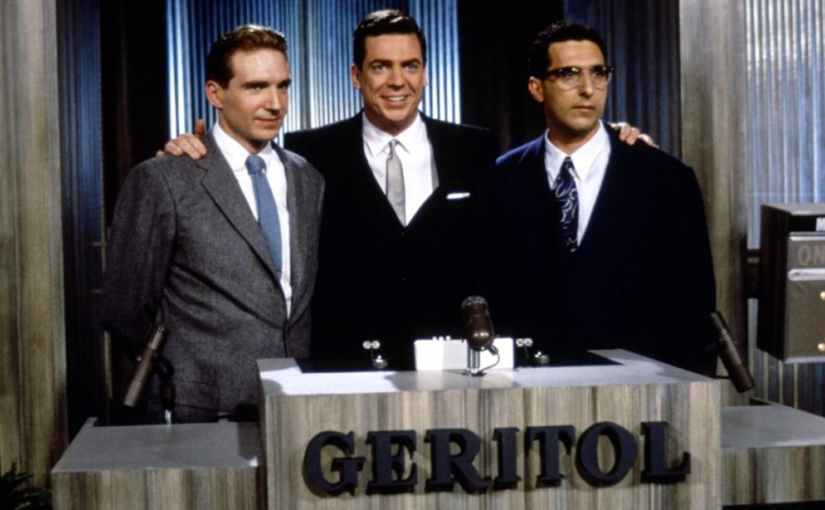
QUIZ SHOW

By Marc S. Sanders

Robert Redford’s 1994 masterpiece deserves much more recognition than it ever got.

Here, he produced and directed a stellar cast that showed how America was always in it for the competition and for the glory and for the fame and naturally for the money.

Redford opens his film with a car salesman describing the regal elegance and perfection of a 1957 Chrysler convertible. It’s a gorgeous car. Then the potential buyer turns on the radio. The car isn’t so fascinating anymore as a news announcement reveals that Russia beat the United States into space with its launch of Sputnik. All America has now is just a car.

Opening credits roll and the next American sensation is presented, “21,” the most popular show displayed on the greatest invention, a home television set. However, the show is all a lie, and yet by the end it’ll survive along with its network, NBC, and its wealthy sponsors.

Quiz Show foreshadows the cost of fame and attention. It’s a wonderful sensation until it’s stripped away in personal disgrace. John Turturro (how did he not get an Oscar nomination?) is Herb Stemple, the champion, nerdy schlub who is growing tiresome among producers and audiences. He is forced to take a dive and be replaced by the handsome Charles Van Doren played Ralph Fiennes, a member of one of the country’s most intellectually gifted families. The difference in appearance is obvious. So is the desire for a change in programming. What’s obvious is how the two men are exploited as pawns for gain in corporate America. Cheat, but if you call it television, what harm is there really?

The harm falls in public perception. Disgrace comes to these men, and worse, to their families. It mirrors modern stories like Harvey Weinstein, Joe Paterno, Bill Cosby, Kevin Spacey and Matt Lauer.

It’s a very calm film that debates the ethics of these men and necessities to uncover the truths and reveal the falsehoods.

Redford only gets aggressive in his period settings and I’m thankful for it. Nothing looks out of place, including the large enthusiastic grins of a 1950s American viewing audience dressed elegantly and innocent. Even nuns and pajama clad children are invested in “21.” This clean cut appearance will soon fade , however, after the quiz show scandal dies down.

Ugly lies and denials were committed against Redford’s beautiful backdrops. Therein lies the necessary conflict of another fascinating story.

Was this country ever innocent?

THE STING

By Marc S. Sanders

Find me a better combination of script, cast, direction, score, art direction and costume and I guarantee it’ll take you some time and effort.

The Sting, directed by George Roy Hill and written by David Ward, is the kind of movie where you uncover something new every time you watch it. It’s because the film is all in the minute details to assemble the beginning to the middle to the end. The film is wisely edited in step by step chapters; The Set Up, The Wire, The Shut Out and eventually on to the satisfying The Sting.

The audience is even set up but you’ll have to watch to see how. I dare not spoil it.

Cars, trains, drug stores, diners, a carousel, dames, gangsters, Bunko Cops, Grifters; all are elements needed for the best confidence men superbly played by Robert Redford and Paul Newman, along with a supporting cast like no other, Eileen Brennan, Harold Gould, Charles Durning, Ray Walston, Jack Kehoe and the best villain, or rather “mark,” Robert Shaw.

This is one of my favorite movies. When I first saw it, I was probably age 10 or 12. I understand next to nothing of what was going on. It was the music that drew me in first followed by the sharp suits designed by the legendary Edith Head. The movie’s script is its greatest asset but visually it is just as fun. The 1930s Chicago setting is a character in and of itself. Newman cheats beautifully at poker against a temperamental Shaw, and gets him!!! “You owe me 15 grand pal.” When I first saw it, I didn’t know what he was doing or how he did it. How did he switch hands? I was enamored with the hands that were dealt and the poker chips on the table, but I loved it when the better cheat won out.

The second iteration of the Hill/Newman/Redford trifecta (following “Butch…& Sundance…”) is just plain fun. It was the fun that earned it a Best Picture Oscar.

No other film has come close to duplicating it. Maybe the Clooney/Pitt/Damon version of “Ocean’s 11”? I don’t know. However, if you love that film, you owe it to yourself to watch “The Sting.”

The Sting is…”the quill!”

THE CANDIDATE

By Marc S. Sanders

A politician’s career isn’t being elected. A politician’s career is getting elected. Once it is all over, what does the politician do now?

I’m not sure I understand why Jeremy Larner’s script won the Oscar in 1972; only because I didn’t gather much from this Robert Redford star vehicle. What exactly was the point of what I was watching? Redford plays Bill McKay, an idealistic lawyer recruited to run for the California senate on a Democratic ticket.

He’s sure to lose and I guess he’s okay with that because it’s acknowledged that way early on, and yet he just follows through with the campaign. He’s a kid compared to his seasoned Republican incumbent opponent. So he’s got that to deal with, and he’s remorsefully living in the unwanted shadow of his father, a former good ol’ boy governor. He also occasionally brushes past a girl that follows his campaign. Bill is happily married. Sounds like a good set up, right? Maybe it is. Yet I’m not sure any of this is the set up of the film. There is rarely any conversations in The Candidate. Hardly any dramatic pauses occur either. Nary a scene with his wife. The televised debate midway through is generic cliche really. One good moment occurs when the Republican candidate steps on Bill’s toes during a threatening brush fire. Now here’s some conflict. Now we’re cooking. Except…we’re not. The film returns to its established theme from earlier. For some reason in the last half of the film, it throws two or three punchlines at you, and…well, I guess it’s a comedy now.

The Candidate fills a majority of its two hours with McKay doing a lot of handshaking, baby holding, celebrity meets (Hi Natalie Wood!) and autograph signing. When that’s not happening, we are treated to repetitive close ups of members of his campaign and voters. I felt like I should have known these people. Did I fall asleep during their big introduction in the film, or were those scenes deleted from the finished product? Bill doesn’t say much except to make generic statements that no voter would ever disagree with. That’s okay, I guess, yet really it’s just boring. None of this packs any punch.

Larner was a speechwriter for Eugene McCarthy in 1968, and Redford recruited him to write and tailor this script for him to produce and star, in response to his own dismay with the political climate at the time. Maybe The Candidate is supposed to be narrated in a documentarian sense but even if that’s the case, it fell short for me. Scenes here seem about as interesting as someone who unwraps a stick of gum and chews it.

Perhaps the Oscar was merited due to the political climate at the time. Redford’s character told audiences what they wanted to hear and magically Larner’s screenplay is now brilliant. If that’s the case, then I guess The Candidate is now dated. There’s no way this film outshines other political films like Wag The Dog, Primary Colors, Mr. Smith Goes To Washington, or from what I hear Bulworth (never saw it).

The Candidate carries no drama, no comedy, no shock value. I’d say no message either, but the unexpected ending (unexpected only because I didn’t know the end scene was actually the end scene) finally told me something that I laboriously waited a long two hours for. The wait wasn’t worth it.