
By Marc S. Sanders
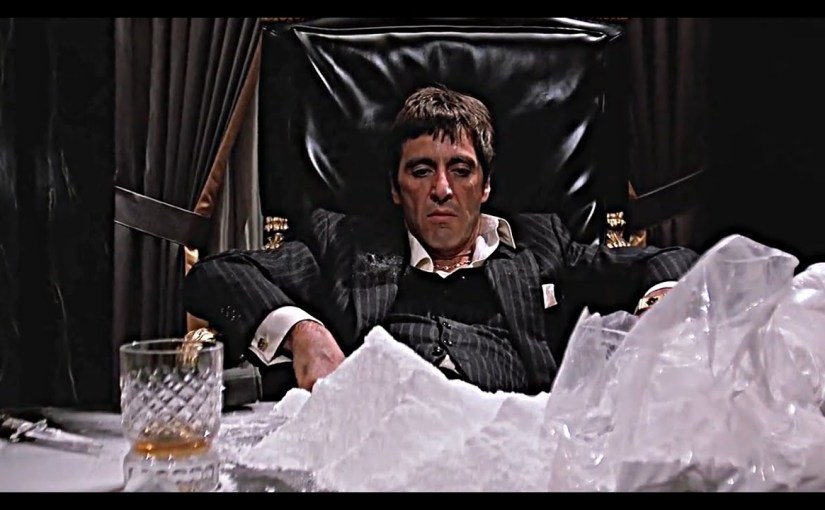
On Thanksgiving Day when we glutton ourselves with an abundance of food, it seemed highly appropriate to watch one of the most self-indulgent pieces ever put on film. Brian DePalma’s Scarface with a script written by Oliver Stone and featuring Al Pacino. This is a movie that brags about its boastfulness. I mean look at everything that is mashed into this thing. Blood, bullets, lots of cocaine and too much Al Pacino.
Pacino is Cuban refugee Tony Montana. He is one of a handful of small time criminals who is shipped over to the United States when Castro wanted less people to oversee. Refugee camps are fenced up under the highways of Southern Florida where no law is enforced among the tented populations.
Soon after Tony arrives he’s hot on the scene of pushing the newest underground product through Miami – cocaine. With his buddy Manny (Steven Bauer) the two men get in good graces with a well dressed sleaze named Omar (F Murray Abraham), who is second in command to an established drug kingpin named Frank (Robert Loggia). For Tony and Manny it’ll only be a matter of time before they take over as the numbers one and two bad guys. That’ll include Tony marrying Frank’s blond trophy girlfriend Elvira (Michelle Pfeiffer in her breakout role) and winning a trusting partnership with a South American drug czar named Alejandro (Paul Shenar). If you ever expect to get killed, you don’t want to be by the orders of Alejandro. A helicopter serves much more of a purpose once it takes flight.
Scarface is a step-by-step movie or a climb up a three-hour ladder and then a gradual drop down off a balcony into a bloody fountain below. There’s no depth and it works like a shopping list that you check off as it moves along. Props and houses and suits and jewelry and cars and cocaine and cash have more significance than what anyone has to say. Other than Tony, none of the people in this film matter. What Tony acquires and what he says about himself is all that is important.
This is a big ass movie with bloody graphics and killings, mountains of drugs and money, a lot of fucks, a gaudy estate home, a way over the top Al Pacino and lots and lots and lots of bullets and guns to go with them. The film only settles for one chainsaw killing, though. At the time, I recall that scene was up for big debate on the film’s MPAA rating. Brian DePalma wanted to up the ante on brutality to grab moviegoers’ attention. The scene remains quite stomach churning.
DePalma’s best work is at the beginning of the Scarface. Following the establishing real life footage of the Cuban refugees arriving by boats in search of an American dream, Tony is taken into custody and questioned by a batch of immigration agents. DePalma only keeps one steady camera focused on a very tan Pacino with a faint signature scar on his left cheek, sitting in the middle of the room and putting on a Cuban accent that only he could uniquely own. Pacino’s concentration in this moment is admirable as he responds to questions from all different directions. It’s all done in one take with the director’s camera circling around Pacino. After this introduction is over, the tone of the movie changes for the next two hours and ten minutes into a gritty interpretation of Lifestyles Of The Rich And Famous.
Oliver Stone’s dialogue with Brian DePalma’s set ups don’t require much of the other actors. It’s like everything caters to an always inebriated, hyperactive Al Pacino doing his Tony Montana with the gold chains and wide collared shirts over the linen suits. He’s a motor mouth of endless f-bombs, with a slinky Michelle Pfeiffer in a blond bob-cut, dressed glittery evening gowns, at his side. She has nothing of significance to say. This is all you learn about Elvira; what you see of her materialism and all the coke she snorts. She never smiles or exudes any connection to the Pacino character. It’s all eye candy. In fact, there’s never a clear answer of what becomes of this character. That’s a problem because the movie is so much about Tony Montana, nothing else matters.
Other characters not given enough attention are Tony’s sister Gina (Mary Elizabeth Mastrantonio) and their mother (Miriam Colon). Momma despises Tony for the criminal thug he is while Gina becomes enamored with the wealth and drug night life. Unfortunately, Momma only has one meaty scene and Gina’s purpose to the script is to lend reason for another character’s eventual demise. Both of these actresses are very good with what little they have. Yet so much is devoted to Tony’s indulgence and the mania that Pacino brings that they are sidelined as well.
Brian DePalma seems to be more proud with how excessive he can make this guy than actually turning him into a guy. Wait until you see the mansion that Tony gets. His office alone is of black, gaudy exuberance. His master bedroom contains a small swimming pool size tub right in the middle of the carpeted floor. That setting occupies a fifteen-minute-long scene of Tony in a bubble bath, watching his five TV screens while not talking about anything meaningful except himself as he chastises Manny. Elvira is only there to uphold her dread for her husband as she snorts coke off of her vanity. When they both leave, an Oliver Stone monologue ends with a now recognizable sound byte of “Well say ‘allo to da bad guy!” Ah! Big deal! Tony never seemed so bad ass as he does feel obnoxious.
Again, Scarface is about not much else except the conceit of sleazy criminal.
When someone has to die it becomes a long drawn-out process as Tony, aka Pacino, puts on a performance or delivers a sermon. Tony will meet with kingpins from Columbia along with other South Americans and dirty government officials. There will be 5-7 guys in the room but for the most part it is only Tony talking.
“Say ‘allo to my little fren!” is one of the most memorable lines to come out of the 1980s decade of excess and it arrives during the ongoing and endless bloody shootout that closes the film. There’s buckets of blood and truckloads of ammunition fired off. These machine guns seem designed to kill things twice the size of elephants. Little Al Pacino, with a ginormous cannon gripped in one hand, gets hit in all places and extremities except the head so that he can keep ranting – I mean this guy never shuts up – and going as he fends off the armies of goons coming at him from all directions. Truly, it’s laughable and nowhere is it ever absorbing. It’s like I’m watching someone else play a first-person shooter video game during a sleepover. My friend is entertained while I’m just watching him be entertained.
Scarface comes to an abrupt halt when the final shootout stops. There’s no footnote to ponder or real news story to follow up on. The credits roll and the orchestral strings of the soundtrack cut in. You get the idea that DePalma, Stone, and Pacino became exhausted over this monster of a movie and simply declared “Okay! That’s enough!”
Considering the later insightful pieces that Oliver Stone delivered like Platoon and JFK, I wish he explored more of the politics and Cuban dealings affecting the United States. As this film arrived in 1983, soon after there would be more of an intellectual standpoint to make us aware of a very real drug epidemic in this country. It may appear to be sending some kind of message, but Scarface doesn’t challenge the brains that flourished this contraband industry. Forty five minute episodes of Miami Vice tell more than this three-hour opus.
Plenty of gangster films like Chinatown, The Godfather, and Goodfellas offer up the greed and ego of the criminal mind, but the men of those pictures are never as self-indulgent or off putting as Tony Montana.
Besides, what does it say about a movie called Scarface when no one calls the main guy Scarface, and you hardly ever see the scar graced across his profile? The real Scarface, Al Capone, would be very disappointed in Al Pacino.

 2 UNPAID MOVIE CRITICS!!!!