THE SECRET OF MY SUCCESS

By Marc S. Sanders

Reader, it has been a hard week.  Hard because my flat screen has been on the fritz.  Finally, today at last, the Best Buy Geek Squad will be paying me a visit and working on a repair. In the meantime, I have had to relegate myself to one of the smaller flat screens within the household.  I feel dirty.  Cheap.  I can’t even look at myself.  Just look away!!!!  Considering the dire circumstances, I could never look at my next big film to review during the absence of my 9.0 sound system and 65 inches of viewing pleasure.  It would be a sin to watch a Christopher Nolan or Steven Spielberg piece anywhere else (unless it’s in the cinema).  Therefore, I settled, and I hit rock bottom.  I opted to for Netflix meh! 

All I have, all I can give you, all I can offer, all I can claim for you during this dark, sad time is Herbert Ross’ attempt at shaping a Michael J Fox thirty second MTV style 1980’s music video into a film.  The “film” is The Secret Of My Success

I recall seeing this movie at age 14 during a field trip to Washington DC with my eighth grade Yeshiva class.  Every time the dimply cute yuppie Canadian sensation from Family Ties and Back To The Future graced the screen, the girls in my class screamed with puppy love glee.  I liked Fox at that time.  I still do.  He was a bright guy and while not an actor like Brando or Olivier, he had a unique charm that defined the clean cut 1980s with knit ties and Benneton sweaters.  His unforgettable Alex P Keaton was the fictional cheerleader for the era of Ronald Reagan, and no one protested.

I recall the promise of The Secret Of My Success as being the vehicle that would elevate his tv persona to the big screen since he already had luck with Marty McFly and a healthy B-movie following with HBO airings of Teen Wolf (a much better movie than it ever deserves to be). Regrettably, this film never landed.  It’s most glaring failure is that it never even lives up to its title.

The assembly of Herbert Ross’ romantic, New York, yuppie comedy occupies itself so much with music montages.  It’s as guilty of its own indulgence as Rocky IV.  How many times must we see a grinning Michael J Fox hustle through the concrete jungle of the city and then through skyscraper cubicle hallways within a white collared business world?  Night Ranger is the ‘80s hair band who provides most of the movie soundtrack and they owe much to Michael J Fox as the face that accompanies their work with trinkling keyboards and electric guitars with the raspy roar of their lead singer.  If Michael J Fox is not walking down streets where apparently supermodels live to turn their heads (I saw you Cindy Crawford), he’s got a pen wedged between his teeth and he’s pulling huge three ring binders off of shelves while doing an all nighter.  This is oh so boring.  In 1987 however, it is all a couple of Teen Beat readers needed in their lives.  I can watch Meryl Streep or Gary Oldman read a three-ring binder.  Michael J Fox just doesn’t have a knack for this skill.

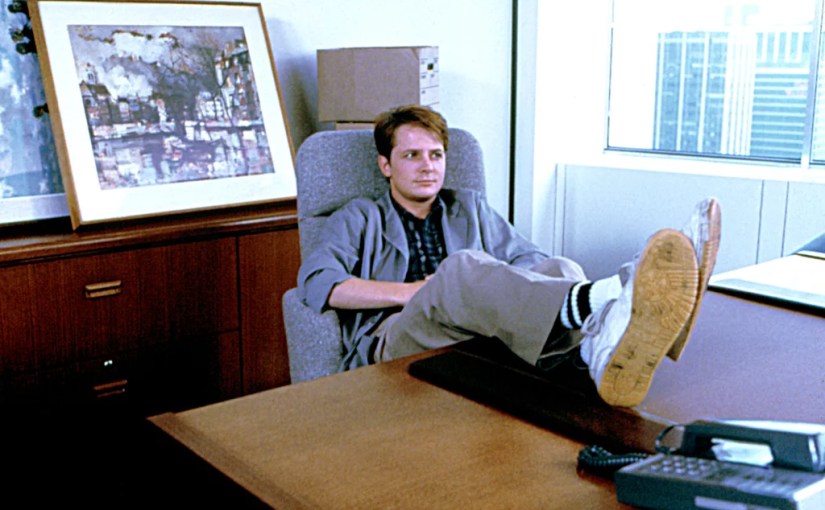
Fox plays Kansas farm boy Brantley Foster.  Now that he has earned a business degree, he has enormous aspirations to climb the top of the New York corporate ladder and make a success of himself with a “beautiful secretary.”  Because, you know, you can’t make it without a secretary, much less a beautiful secretary. 

Upon relocating into a roach infested apartment, Brantley’s plans fall through, and he has to beg his super rich Uncle Howard (Richard Jordan) into giving him a job in the mail room of his building.  Brantley encounters a beautiful blond executive named Christy (Helen Slater) amid a sea of uptight middle-aged men.  The depth of this attraction only goes so far as fantasizing about her walking towards him in a cheesy, glittery pink evening gown with a keyboard and saxophone chiming in.  On the side is Howard’s bored trophy wife Vera (Margaret Whitton) crowding young Brantley in an illicit Mrs. Robinson kind of affair.  Let me clarify.  Vera is married to Brantley’s Uncle Howard.  So, Brantley is being terrorized by Aunt Vera.

For the purposes of ridiculous farce, that might be funny for a moment.  However, The Secret Of My Success takes forever to arrive at the farce it could have hinged on.  Instead, Brantley has to discover a way into the white-collar world when he comes upon an empty office and bears the fictional name of Carlton Whitfield to justify his suits and his motivation to work in the heart of the corporate world.

I noted that the film does not live up to the title.  When Brantley is working the persona of Whitfield, we never get an idea of his brilliant ideas for business success and operations.  We never learn what turned Uncle Howard’s high-rise building into the towering reputation it apparently stands upon.  We never understand the threat of a shareholder’s takeover that Howard and his team fear is imminent.  Where’s the value in anything that Brantley is doing to be that corporate hero and what is he trying to improve or salvage?

Instead, we are left with a very poor chemistry pairing between Helen Slater and Michael J Fox.  Slater is flat out boring with no dynamic to her.  If you want to see how to deliver any variation of a line in a flat, monotone way, then observe what she has to offer.  Fox is on another level of energy that Slater cannot match and Herbert Ross and the script from Jim Cash and Jack Epps Jr (Top Gun, Legal Eagles) chooses to occupy itself more with this romance than the corporate world at play.

The following two years after this film’s release would do better for this hustle and bustle setting with Oliver Stone’s cynical Wall Street and Mike Nichols romantic comedy Working Girl.  The latter film follows a near exact blueprint of The Secret Of My Success.  Yet, it wins because we actually see the main character, portrayed by Melanie Griffith, actually demonstrate her prowess for the cutthroat world of business power and politics.  By comparison, Michael J Fox just wants to play hooky and make out in the back of a limousine.

A last-ditch effort is made though when the big wigs assemble for a weekend getaway. What seems like an attempt at bedroom farce barely gets started with the players climbing staircases and tip toing behind doors and hopping into bed together and blah blah blah.  It doesn’t serve, however, because the idiot plot intrudes where everyone has to act as if they have no idea of who is sleeping with who and who is Brantley and who is Whitfield amid the fast-talking dialogue edited within.  You want to scream at the screen and tell everyone to shut up because this can all be explained in sixty seconds.

Again, as Mike Nichols’ Oscar nominated film eventually proved, there was a better film to be made here for Michael J Fox.  It could have included all of the cynical realities that go with the natures of a corporate American beast.  Instead, The Secret Of My Success relies on music video montages with the teardrop keyboards and the yearning saxophone that seemed like a requisite for the adoring Michael J Fox of the 1980s. 

Enough already!!!!  I need to cleanse my palette.  GEEK SQUAD, WHERE ARE YOU????? 

THE FRIENDS OF EDDIE COYLE (1973)

by Miguel E. Rodriguez

DIRECTOR: Peter Yates
CAST: Robert Mitchum, Peter Boyle, Richard Jordan, Steven Keats, Alex Rocco
MY RATING: 9/10
ROTTEN TOMATOMETER: 98% Certified Fresh

PLOT: After his most recent arrest has him looking at a long prison sentence for repeat offenses, an aging Boston gangster must decide whether or not to snitch on his friends to avoid jail time.


When scrolling through movie titles online or on your favorite streaming service, you might be forgiven for thinking that a 1973 movie with a title like The Friends of Eddie Coyle is a dialogue-driven character study by John Sayles or John Schlesinger, about a group of friends gathered at a hunting cottage or a class reunion or something.  Imagine my surprise when I watched it, and it turned out to be a nearly-forgotten gem of early ‘70s crime films.  (I’d call it a neo-noir, but it was released over fifty years ago now, so I’m not sure the term “neo” applies anymore.)  Featuring spare, economical storytelling reminiscent of other crime classics like Rififi [1955] or The Killing [1956], The Friends of Eddie Coyle is indeed a character study, but one that manages to downplay even Robert Mitchum’s heroic persona.

Eddie Coyle is getting old, and he knows it.  He’s currently facing up to 5 years in jail when he goes in front of a judge in a few days, but his old associates still rely on him to obtain “clean” firearms to use in pulling bank robberies.  The first time we see him doing this thankless job, he tells his cocky young supplier a story about why he has extra knuckles on his left hand, a speech that might have been written by a multiverse version of Quentin Tarantino.  (In fact, the bank robberies are accomplished when Eddie’s friends hold the bank manager’s family members hostage, so he’ll open the vault without question, a method paraphrased by “Pumpkin” in the opening scene of Pulp Fiction.)  Mitchum delivers this mini-logue with his trademark brand of world-weariness and menace, leading us to believe at the outset that he’s a man not to be trifled with, when in fact he’s little more than a glorified gofer for his bosses.

The film oozes a 1970’s atmosphere in every frame, but somehow it doesn’t feel all that dated.  There are no long zooms or extended chase sequences.  The most suspenseful scenes are the two bank robberies and one aborted car chase that is over as soon as it starts.  (I actually thought that was pretty clever, subverting our expectations by ending the chase after about fifteen seconds; this method was also put to good use in 2003’s not-as-bad-as-you-think S.W.A.T.)  The dialogue feels more modern, laced with f-words and racial epithets that, again, feel more at home in a Q.T. film than in a Robert Mitchum movie.  For my money, there may be a few movie-watching experiences that can top hearing Robert Mitchum telling someone to go f— himself, but I can’t think of what they are right now.

Director Peter Yates (Bullitt, Breaking Away) never once strains for effect, never showboats.  Like John Huston’s The Asphalt Jungle, it is content to merely set the stage and observe what happens, letting the events and the characters drive the plot instead of contrived action scenes or fancy camera movements.  Instead of becoming bored, I was drawn into Eddie’s dilemma, his conflict between loyalty to his so-called friends and his desire to stay out of prison.  Complicating matters is the fact he has a wife and three school-age kids; they all live in a tiny townhouse where you can touch both walls of the kitchen with your arms outstretched.  This is a wrinkle uncommon in most gangster films, where the heavies lead unattached lives.

When Eddie approaches a federal agent (Richard Jordan) and asks if the New Hampshire judge will look favorably on Eddie’s sentencing if he agrees to squeal on his gunrunner friend, I felt a little sorry for him, and that’s a neat trick.  Because of Mitchum’s presence, you almost automatically want to root for him to do the right thing, but because of the character he’s playing so well, I just got the feeling that things were not going to end well for him, and I was right.  After getting a taste of what Eddie has to offer in terms of high-profile arrests, the federal agent leaves him dangling, telling him the judge will keep him out of jail if he keeps ratting on his buddies.  Poor Eddie is in an impossible situation, and the irony is, when he finally makes his decision, it’s already too late…but I don’t want to spoil anything.  It’s a brilliant catch-22 that left me feeling even sorrier for Eddie than I did before.

The whole movie is like that.  We’re shown right up front that Eddie is a criminal.  But the hands-off filmmaking approach allows the viewer to make up his own mind.  You could, I suppose, watch this movie in one of two mindsets: either you empathize right away with Eddie and his predicament, or you can take him at face value and watch the movie waiting to see if he gets what’s coming to him, both for being a crook AND for squealing on his friends.  Either way, I think the movie’s resolution satisfies both interpretations, which is not an easy task.

If you sit down to watch The Friends of Eddie Coyle, just remember that it’s not The French Connection or Heat or anything splashy or flashy.  It’s a grim, gritty crime drama with a bona fide legend playing a petty thug instead of a crime lord.  Mitchum fits the bill, and the movie fits Mitchum.  The Boston environments – all shot 100% on location – mirror the way Eddie walks and talks: gray, blank, tired.  Beneath that grimy coating, though, is a rather brilliant character study of a man whose life has brought him to a crossroads where he must decide what’s more important to him, his friends or his life.  (His decision kinda surprised me, I’ll be honest.)

THE MEAN SEASON

By Marc S. Sanders

I get caught up in movies focused on serial killers.  As an actor, I imagine it must be fun to portray a deranged psychopath like Norman Bates or Hannibal Lector, or maybe even John Doe from Seven.  On the other hand, maybe not because an effective screenplay needs to be nearby.

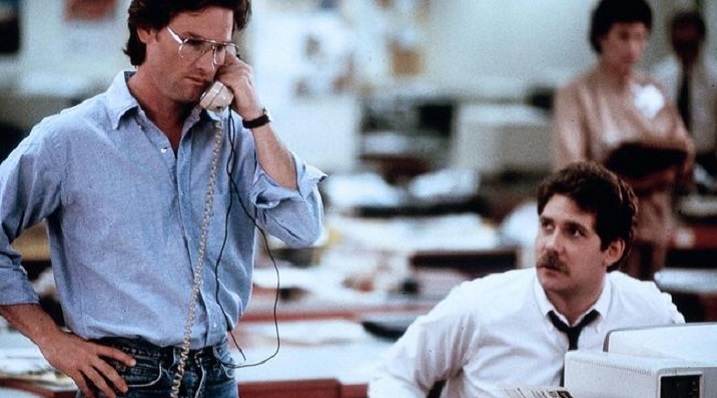
The Mean Season from 1985 has an effective premise but that’s where the positives of the picture stop.  Kurt Russell portrays Malcolm Anderson, a burnt-out reporter for the The Miami Journal.  He is the paper’s most reputable writer but just as he is ready to resign and move to Colorado with his loving girlfriend, Christine (Mariel Hemingway), he’s tasked with writing an article about the murder of a teenage girl on the beach.  Soon after, he’s getting phone calls from the killer himself, played by Richard Jordan whose face is concealed through most of the film by his hand holding a telephone.  The killer insists on only maintaining communication with Malcolm and no one else, especially not the cops.  He relays that the city of Miami can expect four more murders.

The title of the film stems from south Florida’s well known weather variations that occur at the start of hurricane season, primarily in July.  That does nothing for me, but the title alone sounds marketable enough for a thriller.  Almost sounds like a Stephen King novel.  The Mean Season!!!!!  Unfortunately, that’s all that this movie has to rely on, even if Kurt Russell is doing his best like he always does in better suspense movies like Unlawful Entry and Breakdown.

The fault with The Mean Season resides with the director’s amateurish approaches.  Fifteen minutes into the film, with the story hardly in motion, a nude Christine is taking a shower.  The haunting music begins and suddenly the shower curtain is pulled for Malcolm to deliberately startle his girlfriend.  So, we have the Psycho salute.  Check!  Later, following an argument between the two lovers, Malcolm gets in his car and is startled by Christine coming up from behind in the backseat. Ha!!!! Okay and there’s the Halloween nod.  Another check!  I bet these cheap tactics were not even written in the script.  Director Phillip Borsos (never heard of this guy before; doesn’t surprise me) must be so insecure in his skills behind a camera that he just goes for duplicative tripe.

Threats to the couple elevate as the film moves on and when Malcolm gets wind of Christine being in danger, he’s in his Mustang racing to her.  The cops (Andy Garcia, Richard Bradford) are right behind him, and no one thinks of summoning a squad car to where Christine is expected to be?  Of course not.  If they did, then we wouldn’t be treated to a clumsy sequence where an elevated bridge gets in Kurt Russell’s way forcing him to make a leap across the gap and come down on the steep other side and continue his foot race.  Kurt Russell really looks stupid in this moment, and I’m sure he was thinking I can not believe I agreed to this.

As with any of these movies, there is a just when you think the bad guy is dead, there he is again.  No wonder we didn’t get a long enough closeup on the corpse found in the dense Everglades.  However, we get treated to seeing a long, meaningless sequence of Kurt Russell being a passenger on a swamp buggy.  Big deal.  Does this enhance any kind of suspense?  Does it move the story along?  The director got access to a couple of swamp buggies and a day of shooting in the Everglades and said we gotta get this in here.

The final fight is as moronic as the rest of the picture.  Richard Jordan and Kurt Russell are going at it in the living room while a hurricane rages outside.  Mariel Hemingway just sits on the sofa and watches.  She just watches.  She doesn’t reach for a kitchen knife or a vase to smash on the bad guy’s head and help her poor boyfriend.  We just get a sad excuse of a damsel who is not in distress. 

Thankfully, Kurt Russell’s career survived this junk of standard jump scares and shortness on intellect. 

As I’ve said before in other columns, there was a better movie here.  There could have been a movie that explored the endless hours that an investigative reporter must endure.  His editor and photographer (Richard Masur, Joe Pantoliano) could have shared the heightened fear and suspense.  The cops on the case could have applied more pressure and/or assistance to the reporter.  They don’t even tap his phone to trace where the calls are coming from.  In 1985, I think they already had the technology to do that.  A tape recorder was used though, and the audience not only gets to listen to the conversations once as they are happening but then again as the characters listen to the tape.  Why?  Is there something I missed the first time I heard Kurt Russell say hello?  This is filler crap. 

A better movie would have pursued what motivates this killer we hardly get to know.  We should have learned more about this guy because he’s the one making the phone calls.  So, it is obvious he wants to be heard.  However, the guy has nothing to say of any significance.  Even a psychologist who’s recruited for one scene doesn’t make any observation that gives me, or the characters in the film, pause. 

The Mean Season is an “I got it!” film.  It’s where the director gets his big break and declares “I’ve got it!!!!  We’ll do Psycho and then we’ll do Halloween.  Gotta make sure we see Marial Hemingway topless.  That’s definitely at the top of the list. Oh yeah, and then we’ll get swamp buggies and can we get some wind and rain machines for a really, really, really mean—I mean very mean—season!”

THE HUNT FOR RED OCTOBER

By Marc S. Sanders

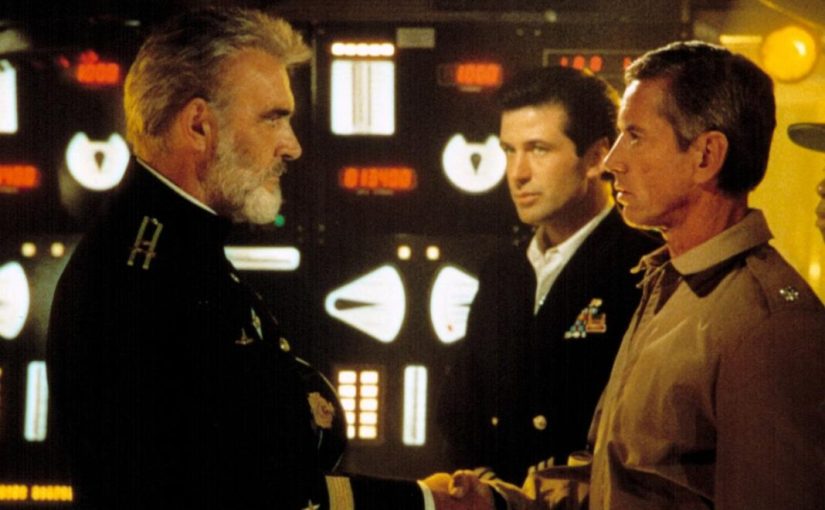
John McTiernan’s adaptation of Tom Clancy’s first bestselling novel, The Hunt For Red October, might seem dated but it’s still a crackling good thriller. It’s one of those films where you truly feel like you’re walking through the secretive hallways of DC government buildings with their elevators accessed only by an Admiral’s key. Soon you’re in a dark, underground boardroom. You’re also there on the various naval crafts and submarines with alarming lights, shiny steel and glowing monitors. The biggest treat is being in the command center of the titled sub, Russia’s Red October, commanded by their captain, Marko Ramius (Sean Connery). All in all, Terence Marsh built a convincing production design.

Clancy’s story takes a different approach than most thrillers involving Cold War politics. Ramius might have been a James Bond villain in another film as he hijacks Red October, but there’s more to him actually. Rather, Ramius wants to defect to the United States. Most of his command crew is in agreement as well. America doesn’t necessarily see it that way; a Russian, missile equipped submarine quickly approaching the eastern seaboard with other subs following him?!?!?!? Let’s not polish the tea set so quickly.

Fortunately, one man had the pleasure of meeting Ramius once and doing extensive research on the General’s background; Jack Ryan (appropriately cast with a young Alec Baldwin). Ryan is given three days to catch up to Ramius and guide him safely to the United States while avoiding getting the famed submarine shot down by either power nation.

I must point out my favorite scene and it actually takes place in that secret boardroom where it dawns on Ryan of Ramius’ true plan. Baldwin is great here. The young guy who is green when it comes to military and political protocol. McTiernan gets his company of generals and high ranking officials into a large quarrel over what to do and then he zooms in on Baldwin thinking for the close up before he calls Ramius a SON OF A BITCH. It’s at this moment, that the movie going consensus and fans of Clancy overall determined that Alec Baldwin was the best of the cinematic Jack Ryans. (No slight to Harrison Ford, who was too middle aged for the role when he took the part).

Connery at least has the commanding appearance of Ramius’ stellar reputation. He is not very exciting or charismatic. Then again, I don’t think Clancy built the character that way. Connery plays the role as silent, yet wise and experienced as implied by his well groomed, white beard and hairpiece plus his square stature. If this man is standing in your presence, you better give him an update. You shouldn’t have to ask if he wants one.

Good moments are made available to Scott Glenn, James Earl Jones, Sam Neill and Stellan Skaarsgard as well. It is the talking scenes among all these fabulous actors that really build tension. The underwater scenes…not so much. The subs look like long, black blobs weaving their way through depths and avoiding missiles coming their way. It’s forgivable because McTiernan always keeps the characters at play. This isn’t a film that relies on the dog fights depicted in Top Gun or Star Wars. McTiernan keeps his audience away from drowning in the underwater murkiness.

The makers of this yarn really are a great combination of imagination. We got Tom Clancy and John McTiernan to thank for a gripping tale from 1990 that still holds up today. The Hunt For Red October is definitely a film worth revisiting.