
By Marc S. Sanders
I get caught up in movies focused on serial killers. As an actor, I imagine it must be fun to portray a deranged psychopath like Norman Bates or Hannibal Lector, or maybe even John Doe from Seven. On the other hand, maybe not because an effective screenplay needs to be nearby.
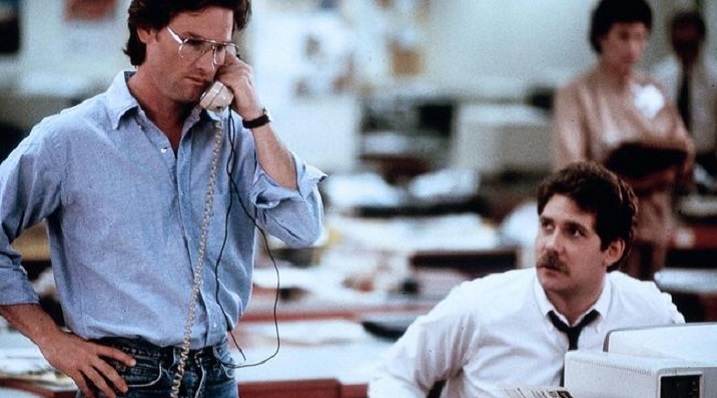
The Mean Season from 1985 has an effective premise but that’s where the positives of the picture stop. Kurt Russell portrays Malcolm Anderson, a burnt-out reporter for the The Miami Journal. He is the paper’s most reputable writer but just as he is ready to resign and move to Colorado with his loving girlfriend, Christine (Mariel Hemingway), he’s tasked with writing an article about the murder of a teenage girl on the beach. Soon after, he’s getting phone calls from the killer himself, played by Richard Jordan whose face is concealed through most of the film by his hand holding a telephone. The killer insists on only maintaining communication with Malcolm and no one else, especially not the cops. He relays that the city of Miami can expect four more murders.
The title of the film stems from south Florida’s well known weather variations that occur at the start of hurricane season, primarily in July. That does nothing for me, but the title alone sounds marketable enough for a thriller. Almost sounds like a Stephen King novel. The Mean Season!!!!! Unfortunately, that’s all that this movie has to rely on, even if Kurt Russell is doing his best like he always does in better suspense movies like Unlawful Entry and Breakdown.
The fault with The Mean Season resides with the director’s amateurish approaches. Fifteen minutes into the film, with the story hardly in motion, a nude Christine is taking a shower. The haunting music begins and suddenly the shower curtain is pulled for Malcolm to deliberately startle his girlfriend. So, we have the Psycho salute. Check! Later, following an argument between the two lovers, Malcolm gets in his car and is startled by Christine coming up from behind in the backseat. Ha!!!! Okay and there’s the Halloween nod. Another check! I bet these cheap tactics were not even written in the script. Director Phillip Borsos (never heard of this guy before; doesn’t surprise me) must be so insecure in his skills behind a camera that he just goes for duplicative tripe.
Threats to the couple elevate as the film moves on and when Malcolm gets wind of Christine being in danger, he’s in his Mustang racing to her. The cops (Andy Garcia, Richard Bradford) are right behind him, and no one thinks of summoning a squad car to where Christine is expected to be? Of course not. If they did, then we wouldn’t be treated to a clumsy sequence where an elevated bridge gets in Kurt Russell’s way forcing him to make a leap across the gap and come down on the steep other side and continue his foot race. Kurt Russell really looks stupid in this moment, and I’m sure he was thinking I can not believe I agreed to this.
As with any of these movies, there is a just when you think the bad guy is dead, there he is again. No wonder we didn’t get a long enough closeup on the corpse found in the dense Everglades. However, we get treated to seeing a long, meaningless sequence of Kurt Russell being a passenger on a swamp buggy. Big deal. Does this enhance any kind of suspense? Does it move the story along? The director got access to a couple of swamp buggies and a day of shooting in the Everglades and said we gotta get this in here.
The final fight is as moronic as the rest of the picture. Richard Jordan and Kurt Russell are going at it in the living room while a hurricane rages outside. Mariel Hemingway just sits on the sofa and watches. She just watches. She doesn’t reach for a kitchen knife or a vase to smash on the bad guy’s head and help her poor boyfriend. We just get a sad excuse of a damsel who is not in distress.
Thankfully, Kurt Russell’s career survived this junk of standard jump scares and shortness on intellect.
As I’ve said before in other columns, there was a better movie here. There could have been a movie that explored the endless hours that an investigative reporter must endure. His editor and photographer (Richard Masur, Joe Pantoliano) could have shared the heightened fear and suspense. The cops on the case could have applied more pressure and/or assistance to the reporter. They don’t even tap his phone to trace where the calls are coming from. In 1985, I think they already had the technology to do that. A tape recorder was used though, and the audience not only gets to listen to the conversations once as they are happening but then again as the characters listen to the tape. Why? Is there something I missed the first time I heard Kurt Russell say hello? This is filler crap.
A better movie would have pursued what motivates this killer we hardly get to know. We should have learned more about this guy because he’s the one making the phone calls. So, it is obvious he wants to be heard. However, the guy has nothing to say of any significance. Even a psychologist who’s recruited for one scene doesn’t make any observation that gives me, or the characters in the film, pause.
The Mean Season is an “I got it!” film. It’s where the director gets his big break and declares “I’ve got it!!!! We’ll do Psycho and then we’ll do Halloween. Gotta make sure we see Marial Hemingway topless. That’s definitely at the top of the list. Oh yeah, and then we’ll get swamp buggies and can we get some wind and rain machines for a really, really, really mean—I mean very mean—season!”

 2 UNPAID MOVIE CRITICS!!!!