
By Marc S. Sanders
Having recently read John Grisham’s fifth novel, The Chamber, I opted to watch the film adaptation directed by James Foley.
First, allow me to say that Grisham’s novel is primarily stale and boring. That’s only because his nearly five-hundred-page best seller is occupied with a lot of legal procedurals and tactics necessary to get a convicted, racist murderer off of death row before his scheduled date of execution. Grisham permits moments where his characters can bond, become forgiven or get even more revolting with each other. In between though are efforts of appeal after appeal. It’s likely how it works. A motion is carried out. It’s rejected. On to the next in line. In fiction though, this is terribly redundant.
James Foley’s film does not work that way, however. In fact, it’s a much worse experience.
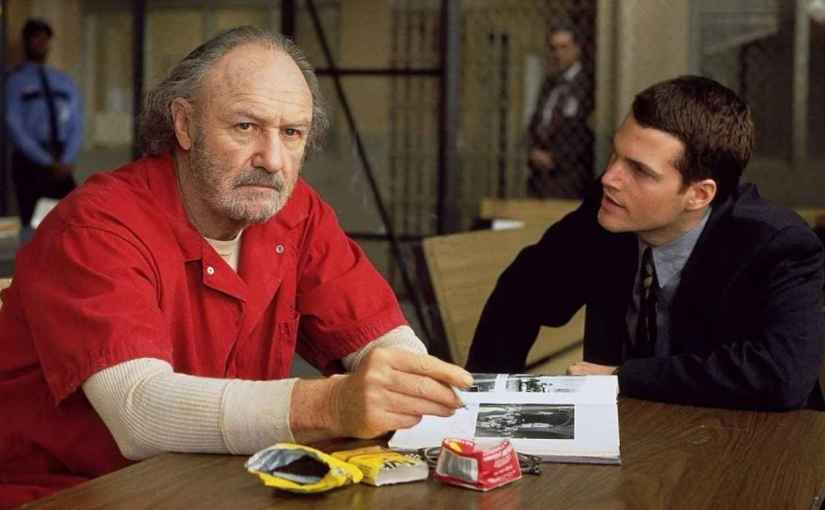
A grey bearded Gene Hackman with oily, stringy hair and tobacco-stained teeth is Sam Cayhall. He’s a former member of the Ku Klux Klan who is sentenced to the gas chamber for the murder of two young Jewish boys who accompanied their father, a Mississippi civil rights attorney in 1967. The father lost both legs and years later he took his own life. Sam is considered solely responsible for bombing the lawyer’s office building.
Chris O’Donnell plays Adam Hall, a twenty-six-year-old attorney eager to take on Sam’s case and get him off death row. Sam will finally meet his grandson but he won’t be very welcoming. Adam is adamantly against capital punishment and he’s repulsed by his grandfather’s past, but that is not enough to send the old man to the chamber.
IMDb trivia documents that screenwriter William Goldman (Butch Cassidy And The Sundance Kid, The Princess Bride) walked away from the film after six drafts. Another credited screenwriter used a pseudonym to keep his name disassociated with this picture. John Grisham considers The Chamber the least favorite of his film adaptations thus far. I can imagine the suffering with trying to assemble something compelling on film. Frankly, I don’t think it could ever be accomplished. This stuff is either boring or ugly or both. Try and project it on a screen and it will not deliver a message like Schindler’s List or Do The Right Thing.
Gene Hackman suffers the most from this film. His character is clearly there, but the script and directing and even his primary scene partner, Chris O’Donnell, are not up to par. Hackman puts in the energy with an old man white trash dialect. He has the expected hateful outbursts of a Klansman. His appearance is convincing too. However, nothing he has to say is important. He’s actually not hateful enough, even if he’s freely uttering the N-word or being derogatory towards the Jewish people who run the legal firm that Adam works for. As well, the script does not offer empathy for him or enough remorse of his past sins.
Chris O’Donnell is supposed to be the idealized grandson in the mid-1990s who feels shame for his family’s history of Klan participations and crimes going all the way back to his great, great grandfather. Hardly any opportunity is offered for the young actor to feel this way. He barely gets angry or empathetic when he shares scenes with Hackman. Instead, his moments are wasted with a young staff member of the Governor, played by Lela Rochon. She has too large a role, especially when Gene Hackman could be doing more. The two prattle on about topics that result in no consequence.
Faye Dunaway plays Hackman’s daughter, now a wife to a Southern aristocratic banker. She’s a recovering alcoholic, which is assumed to be a residual cost of her father’s misdeeds. Dunaway, this once great actress, has no connection to either Gene Hackman or Chris O’Donnell. It’s as if she is not listening or properly responding to either of them when she appears. Then again, O’Donnell is not lending his best towards Hackman either. He’s very flat, very plain. His character from Scent Of A Woman went on to legally represent his racist grandfather. His Robin, the acrobatic DC superhero, has more personality and drive than this guy.
Thematically, John Grisham builds his thrillers off of what southern American law mandates. Precedents become obstacles for his protagonists to overcome, or the characters have to learn to embrace what’s at their disposal. However, it’s tempting to hinge on racial divides to serve as antagonism. That’s tricky because if you emulate the hate and racism too much, then it looks glamourized.
James Foley provides many exterior shots of uniformed modern-day Nazis and Klansmen marching outside of Sam’s penitentiary. Others are there to applaud the death penalty for the old coot. These are just visuals though. They say nothing except enhance the image and platforms these sects stand for. If a film is to bring prejudice to the forefront, then the screenplay or book better have something important to say. Let’s study the science of hate and where it stems from. Let’s focus on those who fight against such cruelty. The Chamber just marches itself towards an inevitable conclusion with nothing gained in the process.
Fortunately, the author’s novel uses its five hundred pages to span the last four weeks before Sam Cayhall is to be executed, and in that time his grandson learns more of what transpired in the convict’s past. Then the author delves into how Adam grapples with what he learns. James Foley’s film only flashes back to one very ugly incident. From there, it’s hardly discussed and it is definitely not focused on enough. Foley stages the murderous events but his film has nothing to say about any of these things afterwards. Adam hardly ever gets disgusted or even a little angry. Sam never regrets or even champions what he’s responsible for. These are just scenes from a book reenacted for a Hollywood film, and devoid of any emotional weight. Do something guys!!!!! Shock me!!!!
I have to credit what Gene Siskel and Roger Ebert observed about the film. The racist, former Klan member, Sam Cayhall, steps out of his cell and walks down the hallway. A series of hands belonging to African American prisoners shake Sam’s hand through the bars, and they pump their fists in allegiance for their fellow prisoner. In what world would this happen where the black occupants applaud the cellmate racist buddy? Forgive the term, but I’d expect they would lynch this guy for what he did before entering this prison. This kind of staging is an insult to the intelligence of what hate stands for in this country, where it was back in 1996, or nearly thirty years after the movie was released. Why is The Chamber whitewashing what really happens?
I was not fond of either the novel (a boring drag of a read) or the film (an insult lacking insight or sensitivity), but at least John Grisham did his homework. Racism is not to be sugar coated for what is genuinely ugly in this world.
 2 UNPAID MOVIE CRITICS!!!!