THE MAJOR AND THE MINOR (1942)

by Miguel E. Rodriguez

DIRECTOR: Billy Wilder
CAST: Ginger Rogers, Ray Milland, Rita Johnson, Robert Benchley
MY RATING: 9/10
ROTTEN TOMATOMETER: 100% Fresh

PLOT: A frustrated city woman disguises herself as a 12-year-old girl to get a cheaper train ticket, but her plan backfires when she winds up befriending a very adult Major on the train.  Risqué hilarity ensues.


Billy Wilder’s The Major and the Minor, contains big laughs, true love, and comic/cosmic misunderstandings – in other words, it’s a classic farce from the fledgling career of one of Hollywood’s true legends.  However, there are certain plot elements that I suspect would make this movie virtually unfilmable today, at least not without tinkering with the structure here and there.  I think the plot points in question will be glaringly apparent to any reasonable viewer, so if I acknowledge them with only the occasional eye roll in my review, I hope readers will forgive me.  It is not my intention to prepare a compare/contrast treatise on prevailing attitudes towards women during the 1940s versus today.  You don’t need me to tell you that the very concept of an adult male bunk-bedding with a strange 12-year-old girl he just met (among other plot devices) raised my eyebrows.  It is firmly a product of its more innocent time. But the whole endeavor is so breezy and carefree that I think it would be a shame to give this film a pass without hearing more about it.  So, here goes.

Ginger Rogers plays the lead, Susan Applegate.  Having only seen Rogers in the occasional dance film with Fred Astaire, I was bowled over by how naturally comic she is.  Based on this movie alone, she could have given Lucille Ball or Rosalind Russell a run for their money.  Anyway, Susan Applegate is fed up with living in NYC.  Tired of being besieged by lechers at every turn, she quits her job – her 25th in a year! – and tries to buy a train ticket back home to Iowa.  When she finds herself short on cash, she dresses up as a 12-year-old girl to get a ticket at half price.  Her real troubles begin when the train gets underway, as the conductors are not movie-dumb enough to fall for her act.

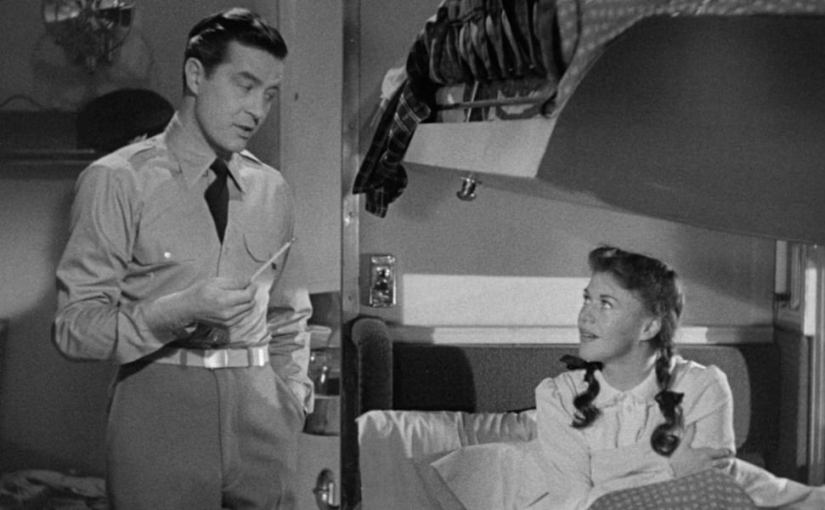
She winds up hiding in the compartment belonging to Major Philip Kirby (Ray Milland in a mildly uncommon comic role).  Because he has a bum right eye, he falls for Susan’s story (she calls herself Su-Su to complete the façade) and takes it upon himself to be her impromptu guardian.  Through an unfortunate series of events – a blocked train track, the unexpected arrival of Kirby’s beautiful fiancé, Pamela, and some ill-timed misunderstandings – “Su-Su” finds herself being whisked away to a military school with Major Kirby promising to get her on the next available train back to Iowa.  Trust me, it all makes sense, I’m leaving a lot of details out, otherwise we’d be here all night.

The rest of the film involves Su-Su’s misadventures on the military school campus, surrounded by three hundred school-age boys who are inexplicably attracted to this girl who somehow has the presence of an adult woman.  They like her, but they’re not quite sure why.  The same phenomenon begins to afflict the Major himself, which makes him extremely uncomfortable (understandably so), which makes things more complicated for Susan because SHE’S beginning to fall in love with HIM, and meanwhile Kirby’s future sister-in-law sees right through Susan’s disguise and wants Susan to help her break up the impending marriage, and 20 different cadets show up to escort Su-Su to the school dance, and so on and so on and so on.

This was only Wilder’s second film, but already we can see ideas and situations that he would return to in some of his future films.  The woman disguising herself as a girl is a funhouse-mirror version of the men disguising themselves as women in Some Like It Hot.  We get the reverse situation, a girl becoming a woman, in Sabrina.  The idea of how tough it is to live in the big bad city is echoed in The Apartment.  And if you really squint, you might even see an early forerunner of Norma Desmond in Major Kirby’s beautiful but devious and controlling fiancé…it’s a stretch, but I think it’s valid.

The performance by Ginger Rogers in this movie was a revelation to me.  I had absolutely no idea she could play this kind of character.  She plays everything so believably, whether she’s Susan or “Su-Su.”  In scenes where she’s near Major Kirby, her longing for him is palpable, but her outward reactions are perfectly subtle: a slight pause before a reply, a constant gaze, only occasionally a little mugging when he’s not looking at her, and always making sure to keep her brassy voice in a higher register to sound more girly.  I learn from IMDb that she was anxious to play this role because she was able to draw from her own experiences: as a younger woman, when she toured vaudeville halls with her mother, she would often make herself appear younger to get cheaper train tickets.  Who knew?

Ray Milland had a trickier time of it in this movie.  He manages to pull it off, but imagine the minefields he had to navigate.  He plays a grown man who is the self-appointed guardian of a 12-year-old girl who, by his own admission at one point, looks like a full-grown woman in the right light.  There’s a scene where he feels compelled to at least try to explain the facts of life to Su-Su so she’ll understand why all the cadets are attracted to her like a moth to a light bulb.  (In one of the less-enlightened moments of the film, he advises her: “Maybe if you made yourself a little less attractive…”  HUGE eye-roll.)  Now, we as audience members know there’s really no problem with his mild flirtations because, of course, Su-Su is really Susan.  But HE doesn’t know that.  Wilder has the good sense to pull everything back from the brink before anything unsavory occurs.  It’s one of the best high-wire acts I can think of in a comedy.

(I’m itching to relate all the hilarious Wilder-esque bits peppered throughout the movie, like finding the occasional burnt end in a delicious brisket, but I am anxious to avoid spoilers.  There’s the tap dance, the Veronica Lake look-alikes, “the Maginot Line”, the cigarette on the train…oh, too many to list.  They’re wonderful.)

As with the best farces, a crisis occurs and it seems as if all is lost, but fear not.  Wilder is not known as a genius for nothing.  If you think this romantic comedy from the early forties is not going to have a happy ending, you need to see more movies.  The Major and the Minor is a delight from start to finish.  And if the last line doesn’t quite come up to the standards of “Well, nobody’s perfect!”…well, I mean, what does?

[Note: It’s also interesting to know that The Major and the Minor was filmed and released in 1942, it’s set very specifically in May of 1941, before Pearl Harbor.  Here and there are in the movie are references to Kirby’s desire to be stationed abroad in case war breaks out.  There’s a moment when he confesses that no woman would want to marry a military man stationed overseas, only getting a letter from him once every two weeks.  The reply he gets is very direct, clearly indicating where Wilder stood on the matter: “I think you underestimate us, Mr. Kirby.  Perhaps all a woman wants is to be a photograph a soldier tacks above his bunk or a stupid lock of hair in the back of his watch.”  Sexist?  Or patriotic?  Discuss.]
THE BIG CLOCK (1948)

by Miguel E. Rodriguez

DIRECTOR: John Farrow
CAST: Ray Milland, Charles Laughton, Maureen O’Sullivan, George Macready, Elsa Lanchester, Harry Morgan
MY RATING: 10/10
ROTTEN TOMATOMETER: 100%

PLOT: A harried magazine editor finds himself in the unique position of trying to track down the person who murdered his boss’s mistress…when all the clues lead back to him.


I have been a fan of 1987’s No Way Out since first seeing it on cable umpteen years ago.  The marvelous twists and turns in the script – yes, including that improbable ending – kept me guessing from the moment of the murder to the final pull-away shot.  Having seen it multiple times, I always noted the fact that it was based on a book with an odd title: The Big Clock.  Since No Way Out takes place mostly at the Pentagon, I always wondered what the story has to do with a clock, but I wasn’t motivated enough to track down the book, so I just let it go.

Imagine my surprise when years later, I discovered that No Way Out is not just based on a BOOK called The Big Clock, it’s also a reboot of an earlier film-noir from 1948, also called The Big Clock.  For years I had never been able to track down an affordable copy of the movie until recently.  I just finished watching it a couple of days ago, and wow.  It has all the snappy pacing of a Howard Hawks screwball comedy, the witty dialogue of a Thin Man film, and the coiling suspense of Hitchcock at the height of his powers.  The Big Clock is a forgotten film that deserves to be rediscovered by the public.

The story opens in typical noir fashion with our hero, George Stroud (the dour-but-likable Ray Milland) avoiding security guards before hiding inside a giant mechanical clock located in the lobby of the office building where he works.  His voice-over narration wonders how he got into this mess and tries to figure out where it all began…and we’re on our way.  So far, pretty stereotypical, not very promising.  But once the prologue ends, the surprises start rolling in.

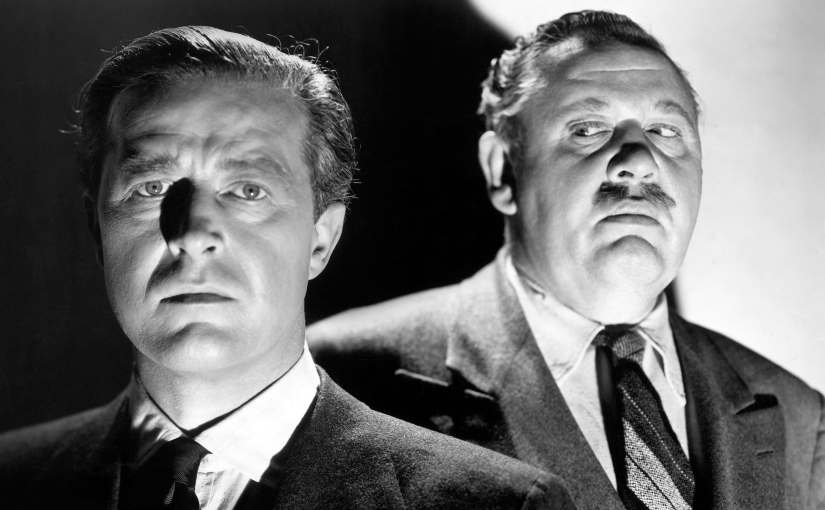
George’s boss is Earl Janoth (Charles Laughton), a clock-watching, penny-pinching tyrant who doesn’t hesitate to fire an employee who leaves a light on in a broom closet, for example.  George is the editor of a magazine called Crimeways, one of many magazines in Janoth’s publishing empire.  Crimeways specializes in investigative reporting like tracking down murder suspects, allegedly to assist law enforcement, but mostly so they can publish attention-grabbing headlines about captured criminals to boost circulation.

Through a series of events too circuitous to list here, George winds up missing a very important train (he was supposed to finally give his wife a long-delayed honeymoon) and spends a drunken night carousing with Pauline York (Rita Johnson), a blonde bombshell who also happens to be Janoth’s mistress.  He winds up passing out on her couch at her apartment (having NOT slept with her, mind you), but is forced to skedaddle when Janoth unexpectedly shows up.  Janoth catches a glimpse of George in the hallway but cannot see his face.  When Janoth confronts Pauline, things get heated, and Pauline winds up dead.  Instead of going to the police, Janoth confides in his second-in-command, Steve Hagen (George Macready, whom you may or may not remember as the slimy general in Paths of Glory [1957] who charges three men with treason for not following a suicidal order).  Hagen returns to the scene of the crime, “amends” the crime scene, and comes up with a brilliant plan: use the magazine’s considerable resources to track down the mystery man Janoth saw outside Pauline’s apartment.

And who better to lead the investigation than George himself, whose investigative skills are second to none?

There is a delightful thrill of suspense when George receives his assignment and realizes that he cannot reveal the truth of his whereabouts without implicating himself, but he is compelled to lead the investigation as thoroughly as possible.  There is an amusing but highly-charged moment when an investigator reaches a witness on the phone and starts dictating the suspect’s vital features…and they match George almost to a T.

The beauty of the film is the head-fake.  We are shown the details of the drunken night George spend with the dead woman, but we are never tipped off that what we’re watching will eventually come back to haunt him.  Green mint martinis.  The hunt for a green clock.  A sundial.  An antique painting.  An eccentric painter.  A radio actor.  All disparate elements that are almost thrown away while they’re happening, but all of which come back to neatly bite George in the ass at just the wrong moments.

I cannot stress enough how ingeniously the screenplay is constructed.  One of the greatest joys of watching The Big Clock is admiring how airtight it is, how George is forced to fly by the seat of his pants from one moment to the next, putting on a show of doing his job while simultaneously trying to find a way to sabotage the investigation without showing his hand in any way.  I won’t give away how he manages this high-wire act, but it’s brilliant screenwriting.

Eventually, the building gets locked down with George still inside and two or more witnesses who can identify him prowling the hallways, including one who is drawing a sketch of his face.  At this point, even though I’ve seen No Way Out many times, I was 100% sucked into the story: “How can this guy possibly get out of this?”  The answers will be just as unexpected to you as they were to me.

(I should mention a small role played by an impossibly young Harry Morgan.  It’s one of the most sinister performances by a mute character that I’ve ever seen.  One shot in particular feels out of time, like it was shot in a movie from the ‘60s or ‘70s.  Creepy stuff.)

The Big Clock deserves a place among the great noirs like The Maltese Falcon, Out of the Past, and The Big Sleep.  It’s filled with great performances, the visuals are suitably moody and shadowy when necessary, and the plotting is impeccable.  What more can you ask from a great film noir?

THE LOST WEEKEND

By Marc S. Sanders

Ever wonder why I write so many reviews?  It’s because I yearn to be a successful playwright/screenwriter.  I’ve directed three original plays that I’ve written over the years.  I will be directing a fourth for the holiday season later this year.  Had a few short plays I wrote performed locally as well.  Still, I suffer from a terrible ordeal that often grinds me into bouts of depression and internal rage.  Writer’s block! 

My father always told me that he stayed away from gambling and casinos. He said it was because he could have an addictive personality and he was not confident he could stop if he started.  I know what he means.  I have an addiction.  One that’s not commonly recognized, but I obsess over something every single day. Without fail, every damn day.  It’s my weakness.  Sorry.  I must keep that to myself, though.  Yet my pursuit of what preoccupies my mind taxes on my motivations to write and stretch the imagination needed for churning out one script after another.  So, a remedy is to write about movies that speak to me in lieu of my next great play. 

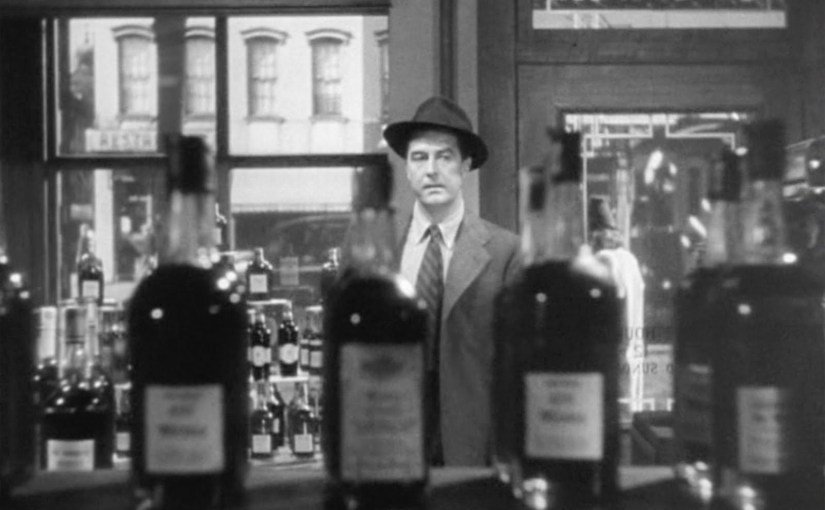
Billy Wilder’s Oscar winning drama The Lost Weekend demonstrates a writer’s inability to exercise his talent when an endless need for alcohol consumes his every waking moment.  Ray Milland delivers an Oscar winning performance as Don Birnam, an alcoholic wannabe writer of the worst kind.  When Wilder’s film opens, Don seems healthy and spry.  He’s clean shaven, well dressed, and ready to pack a bag for a weekend getaway that his brother Wick (Phillip Terry) has arranged for him along with Don’s girlfriend Helen St. James (Jane Wyman).  Wick implies to Don that this trip is just what his brother needs after what he’s recently been through, and he’ll have his typewriter with him to write in calming solitude.  Eventually we get an idea of what Wick has been referring to as Don attempts to sneak a bottle of rye that is strung outside the window of his New York apartment.  Wick catches Don in the act, pours the bottle down the drain and assures him that he won’t find another drop of liquor anywhere.  He doesn’t even have money to go to the corner bar.  So, Wick and Helen leave Don alone for a few hours before it’s time to depart. Don gets ahold of some cash though, and thus begins a spiral into a drunken binge over a four-day weekend.

I read that when this film was released, test audiences laughed at it.  I guess in 1945 people were not attuned or prepared to witness an account of a very real disease like alcoholism.  I’m not certain it was even diagnosed as a disease at that time.  Surely, the addiction was an ailment though, and Billy Wilder uses some effective cinematic devices to demonstrate the journey into madness and desperation for even just a tiny shot glass of gin or rye. 

A repetitive device is to show a tormented performance from Milland within the shadow of bars or fences.  He’s trapped in his own need for swill.  A telling moment occurs when Don is desperately trying to pawn off his typewriter just for some money to buy more alcohol.  Every store in the city is gated and closed on this particular Saturday though.  It’s the Jewish holiday of atonement for past sins, Yom Kippur.  I found that little detail to be interesting.  Surely, it’s a sin to harm yourself whether by alcohol or suicide, for example, and the holiday is a time for speaking to your inner self and Hashem (G-d) for your past transgressions.  Yet, that is no matter to Don.  He’s not ready or wanting to climb out of his dark hole.

Inanimate objects or props are also given much focus.  Early on, Don is seen at the local bar and Billy Wilder brings an inventive visual to explain just how much this character has consumed in under two hours.  The camera focuses on the wet rings on the bar top left by Don’s shot glass.  First there are two rings, then four and soon, fifteen.  Wilder also zooms his lens into the very bottom of the small glass filled with liquor to show how much the audience will drown in Don’s despair over the course of the film.

Other props also work towards Don’s paranoia such as a ceiling lamp bearing the shadow of a hidden bottle.  Milk bottles left in front of his apartment are not collected from one day to the next showing the passage of time for this weekend, and how even the most basic chore is dismissed so Don can extend his stupor.  A lady’s unguarded purse offers temptation.  A tossed lamp shade seems to glare at Don like a hole that he’s in, as he gets weaker and weaker. 

A magnificent scene, one that I can envision a skilled director doing today with quick cuts on digital film, occurs as Don recalls sitting in a crowded opera house watching the toasting scene of La Triviata; one of the most recognizable operas of all time.  Don is one of many in the audience, and yet he’s the only one alone with the production’s props of various drinking glasses and champagne bottles being used on stage that are mere inches away.  Very quickly into the scene, Billy Wilder skillfully draws focus from the opera singers and diverts towards the immense amount of liquor adorning the stage and the cast with quick cuts of Don salivating and perspiring alone in a chair of a crowded theater.  Everyone else is watching the performance.  Don is gazing at the alcohol.  I wouldn’t be surprised if Martin Scorsese had much admiration for such a sequence.

Phillip Terry is very good in his performance.  I’m surprised he’s not promoted as much as the other two stars of the picture.  Wick cares for his brother, but he’s ready to give up on him after six years of this ordeal, with one more transgression played out. He’s exhausted from lying to cover for Don’s weakness.  He represents the outsider of the dilemma who’s been affected by someone else’s ailment. Jane Wyman as Helen serves a nice purpose as well.  The one last hope for Don.  She’s the only one left who holds on to the faith that she can pull Don out of this nightmare.  Wilder presents these characters as side effects in the Oscar winning script written by him and Charles Brackett. 

Another haunting, but effective dimension comes when Don finds himself in the alcoholics’ ward at Bellevue Hospital, shot on location, and the first film to ever do so.  With an eerie use of a theremin in the soundtrack from Miklós Rózsa, Don is surrounded by dark shadows and tormented victims suffering from drying out just like him.  A nurse explains that he still has the DTs to experience like envisioning being surrounded by horrifying images like bugs crawling on him or something comparatively worse.  I recall from childhood seeing this symptom used on an episode of M*A*S*H.  Wilder invents his own kind of imagery and it’s pretty shocking in its grotesqueness.

I ask for forgiveness when I say that The Lost Weekend seems a little melodramatic. Maybe that’s because movies have built themselves into much more graphic and honest depictions of alcoholism since 1945.  The ending seems to welcome a stringy violin to accompany Ray Milland’s final scene with Jane Wyman.  However, I’m completely impressed with how pioneering this movie must have been for its time.  Billy Wilder didn’t shy away from the dramatic side of drinking. 

The Lost Weekend is certainly an effective and important piece on the study of alcoholism.  I’d recommend it as a visual reference to what can happen to the one who suffers, as well as those around him, including the bartender who deals with the regulars he easily knows by name.  While it’s certainly a movie of its time, the message remains the same.  Though I’m no expert on the effects of alcohol, I’ve seen enough friends who deal with the problem to know that the message in Wilder’s film still rings true.  An addiction to drink will dominate a life.

I always say that movies offer another valuable avenue to learn from.  There’s much to learn from The Lost Weekend.