By Marc S. Sanders
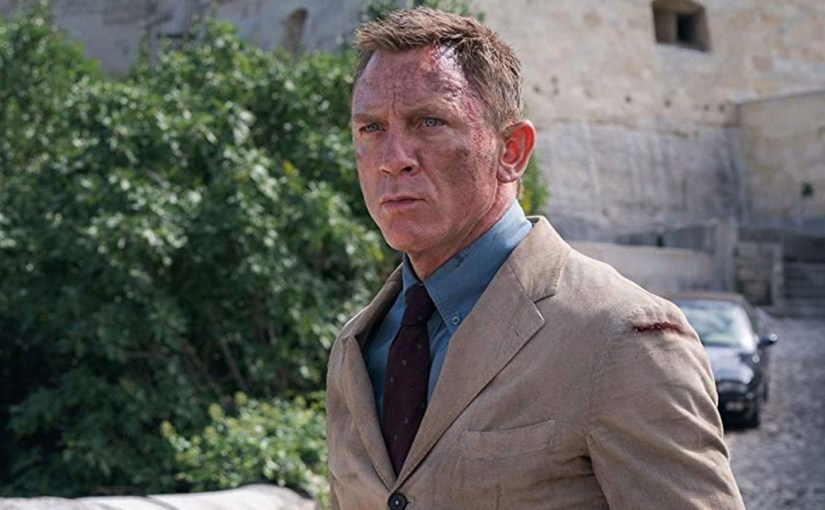
Any die-hard James Bond fan should absolutely love Daniel Craig’s final outing in No Time To Die. Not only does the film work as a salute to the more serious aspects of past Bond films (not just Craig’s installments), but it is working with its tongue placed firmly in its cheek. That is not to say that I still did take issue with a few narrative choices the film steers into.
Years have gone by for Craig’s interpretation of the famed secret agent. He’s comfortably in love with Madeleine Swann (Lea Seydoux) from the prior film Spectre, and known daughter of Mr. White, one of Bond’s prior adversaries. Suddenly though, Spectre seems to be back with a vengeance. The imprisoned Blofeld (Christoph Waltz) somehow seems to be involved and 007 puts his guard back on opting not to trust Madeleine or anyone ever again. The story jumps to five years later and Bond’s CIA friend, Felix Leiter (Jeffrey Wright) has convinced him to come out of seclusion and assist with recovering a kidnapped scientist who holds the formula to a deadly nanobot virus manufactured through plant life. Bond travels to Jamaica to complete the mission. From there, the story gets more complicated and more interesting. Though I dare not spoil what comes next. This film has a lot to tell in the near three hour running time.
Daniel Craig always had some sort of challenge with the general public while playing James Bond. First, how dare he be blond? James Bond is not blond. He survived that ordeal to continue to make more films. His second film suffered in storytelling due to a writer’s strike. During press junkets for his fourth film, Craig was quoted out of context noting that he’d rather “slit his wrists” than play the character again. As well, his films broke convention in the long running EON Production series, as each film served as a continuing story with much more serious, dramatic and sorrowful undertones than was ever presented before. None of these challenges seemed fair to me. After 25 films, you gotta stir the pot a little bit on a character that has been on screen for nearly 60 years. It’s not enough that his gadgets change with the times of technology.
I divert into this observation because No Time To Die offers some shocking developments for the Bond character, but when you return back to Craig’s first film, Casino Royale, you really start to understand why this latest picture goes in this wildly off direction. In other words, the four films Craig performed in prior to this 2021 installment seemingly spell out the inevitable conclusion of his tenure as James Bond. So, reader, when you go to see this last film from arguably the most controversial actor to play 007 to date, give some thought to what has already been covered before and maybe you’ll agree it beautifully makes a lot of sense.
As an action film, No Time To Die works solidly. There’s amazing stunts and vehicles with car chases galore and nail biting shootouts. I think this film has the longest pre-credit sequence of all the films and it’s amazing where one of the feature attractions is the famed Aston Martin DB5 against a slew of Range Rovers and motorcycles.
Rami Malek fills in as the lead villain eerily known as Safin, complete with the signature facial deformity, a shattered kabuki mask and a hell bent determination to destroy the world by means of turning people’s DNA against themselves. Just go with it. There’s not much weight to this dastardly mission. It’s Malek’s performance that works.
A new agent is also in the works and what’s this? She is identified as 007???? Again, the newer films bravely go against convention to keep it interesting. Lashana Lynch plays Nomi. This character was angled extensively in trailers and press junkets but honestly doesn’t live up to the hype enough. The actor is fine. She’s just not given much to make any kind of impact. Ana de Armas is the actor who really makes a splash in a brief moment dressed in a gorgeous evening gown while giving high kicks to bad guys and armed with an adorable naivety about her and a killer machine gun. Her character is reminiscent of the Bond girls who elevated the tongue and cheek elements of the series. In a three hour film, more room should have been left for de Armas to play.
Moneypenny (Naomie Harris), Q (Ben Whishaw), Tanner (Rory Kinnear) and M (Ralph Fiennes) all return making for a solid support team for Bond. It needs to be noted how well cast the Craig films always remained. During the five film series, each one of the characters had their memorable moments for sure.
The regrettable ingredients in No Time To Die lie in the lacking treatments of Lashana Lynch and Ana de Armas for sure. Forgivable for the most part however. Still, the story steers into one angle that I wish it didn’t when a young child is brought into the fold. Children in serious peril was never part of the Bond formula. So, while this is another new convention for the long running series, I think it was a poor choice. I see the necessity of the young character to the story, but was it ever really necessary to put a child amid massive gun play, car wrecks and explosions. There was something a little unsettling about that aspect of the film and the imminent danger to the girl really isn’t needed to heighten any kind of suspense. Rather than play dramatically, it moves a little too disturbing. Early on in the film, another child is placed in disturbing peril as well. The story options here just don’t seem altogether appropriate.
No Time To Die is an appreciated conclusion to Daniel Craig’s version of the character. There are great puns for Bond to deliver. His interactions with Q and M are biting and fun. His love story portrayal with Madeleine works more solidly here than in the last film they shared together, and his tete a tete with the villains, Blofeld and Safin, are equally strong. These different relationships broaden the dimensions of Bond. He’s no longer a cookie cutter character. There’s a motivation to the guy.
Having seen the film twice, I have an even further appreciation for this new film. Hans Zimmer comes in to do the original score and particularly salutes the unexpected favorite among fans, On Her Majesty’s Secret Service with select notes and rhythms from that film. Granted the script for No Time To Die makes obvious references as well. I also appreciated the wink and nods to Bond’s very first adventure, Dr. No. There was just a lot of smart, subtle honors presented here.
Still, the best reference is left for one of the best lines in the film. When Bond meets Felix’ partner ahead of a mission, Daniel Craig as 007 has to ask “Who’s the popular blond?” After five hugely successful films, over a fifteen-year span, any one of us better know that the only blond that matters is “Bond. James Bond.”

 2 UNPAID MOVIE CRITICS!!!!