
AIR FORCE ONE

By Marc S. Sanders

On the day I write this article, July 12, 2024, the new trailer for Captain America: New World Order premiered and Harrison Ford (whose birthday is tomorrow; Happy Tiding Dr. Kimble, Dr. Jones, Captain Solo, Mr. President, Dr. Ryan) is back in the Oval Office playing the President of the United States.  Don’t know what kind of Commander In Chief he’ll be this time around.  He might be as heroic as James Marshall from Air Force One. Then again he could be a challenge of hulk like proportions.  However, let’s at least fantasize that we have Mr. Marshall running for the top job this year against both the criminal buffoonery and geriatric disqualifications we are left to choose from.  Just look at James Marshall’s qualifications. 

Following an American Special Ops capture of a Russian radical, Marshall is bestowed an honor from the Soviet government. His acceptance speech insists his administration will never negotiate with terrorists.  Now that the line has been drawn, away he goes with his staff, his wife (Wendy Crewson) and pre-teen daughter aboard the most protected and safest plane in the world, Air Force One.  Yet, an element of careful process does not go according to plan and Gary Oldman’s team of Russian radicals hijack the plane with demands to free their leader from captivity.  Oldman’s screaming hysterical character, Ivan Korshunov, won’t have it so easy though because his team of men failed to capture the President.  As well, it requires the Vice President (Glenn Close) and Secretary of Defense (Dean Stockwell) who are on the ground to coordinate with Russia to free the prisoner.  Oldman’s response is to kill a hostage every half hour and if that does not work, then just blow up the plane.

This is not good.  BUT WAIT!!!!!  Is that…?  Could it be???  Is the President alive, sneaking around the bowels of the plane while taking out one terrorist at a time?  Raise your fist for Harrison Ford!!!!

‘Murica!!!!!!

There are two narratives going on with Air Force One.  One is the standard Die Hard formula action onboard the plane.  Then there is the endless debates of authority between the Vice President, the Secretary of Defense and the military leaders about if the President is in a proper state of mind to lead and act upon his aggression with a high level of threat to the country at stake, and more personally his wife and daughter in harm’s way?   None of this is nothing new.  It’s all familiar from the likes of many late 80’s and 90’s action pictures.  The politics are much more simplified than what you’d find in a Tom Clancy novel.  There’s even time for a which color wire to cut scene.  Yet, the movie is entertaining.

Director Wolfgang Peterson is best at showing the real star of the picture and that is Air Force One itself.  He’s got long shots down endless corridors and aisles. Within the underbelly, as well as the hollowed-out cockpit, there’s more for us to explore amidst the gunfire.  We see where the weapons are stored as well as the luggage and food supply.  We get to watch the football game in the President’s office too.  Heck, before the terrorists reveal themselves they are given a tour of the massive plane as their guide boasts that it is even impervious to a nuclear blast.  Color me impressed in Patriotic Red, White and Blue.

I think some of the acting is a little overdone at times. Not by Ford, but by almost everyone else.  Watching the debates within the government conference room, I’m seeing a little too much melodrama around the table.  A little too much hand clasping, pacing around the room, whispering,  and deep sighing.  On the plane, Oldman goes over the top but he’s one of our best character actors and its expected from him.  He’s the evil villain after all.  On the ground though, Dean Stockwell has done better work elsewhere, with much more complicated material. 

I like the idea of including political debates and a response to an unfathomable crisis like this, but a lot of the dialogue from guys like Stockwell, Phillip Baker Hall and Bill Smitrovitch comes off as textbook boring.  Same goes for Close, but she fits the role perfectly.  Let her be Ford’s running mate and they got my vote.  The only thing that upholds these scenes are due to Peterson’s hyper Steadicam.  So, when one more person in a suit makes a mad dash into the room, the director sweeps his camera right over there to get the latest news. 

Harrison Ford is doing his standard everyman/tough guy routine, always knowing how to stay one step ahead of the bad guys. President Marshall is much more capable than his entire trained Secret Service Squad and it’s fortunate that he gets the convenient shard of broken glass to cut the tape that binds his hands.  How often do we see that in movies?  The film definitely belongs to Ford, but it’s also nice to see some familiar faces participating like Xander Berkley, William H Macy and Paul Guilfoyle. 

The most unforgiving moment of the film occurs in the final minutes.  I don’t spoil everything by saying the plane nosedives into the sea, but this crash has to land at the top of some of the worst CGI ever assembled.  Yes, I know this was back in 1997, two years before what George Lucas accomplished with, at the time, pioneering effects on his return to Star Wars.  However, the final climax to Air Force One looks so obscurely animated and unfinished, it begs for the screenplay to find another way to wrap up its simplistic story.  It is downright terrible.  I recall it looking terrible on the big screen.  It looks just as bad on a 65” flat screen.  A toy plane crashing into a bathtub would look more convincing.

Air Force One is solid action.  Nothing more.  It’s not a thinking picture or one needing deep concentration and analysis. It does make you yearn for Harrison Ford to at least consider a run for the Oval Office, though.  He’d still be better than what will be on the ballot this year.
BOOGIE NIGHTS

By Marc S. Sanders

Boogie Nights was director Paul Thomas Anderson’s second feature following a very different and very quiet film debut with the gambling addiction piece Hard Eight.

Heck, it’s fair to say all of Paul’s films are very different; here is the seediness of porn while later in his career he will focus on the ruthlessness of a wealthy and angry oil man and then an obsessed dressmaker devoid of care for the models who parade his accomplishments. (See There Will Be Blood and Phantom Thread.). Paul was definitely striving for recognition with his familial depiction of life in the California pornographic film industry.

What I’ve always liked about Boogie Nights was Anderson’s intent to show the naive innocence of this large cast of characters. Filming blatantly oblivious awful porn scenarios can still be regarded as very proud efforts by its talent.

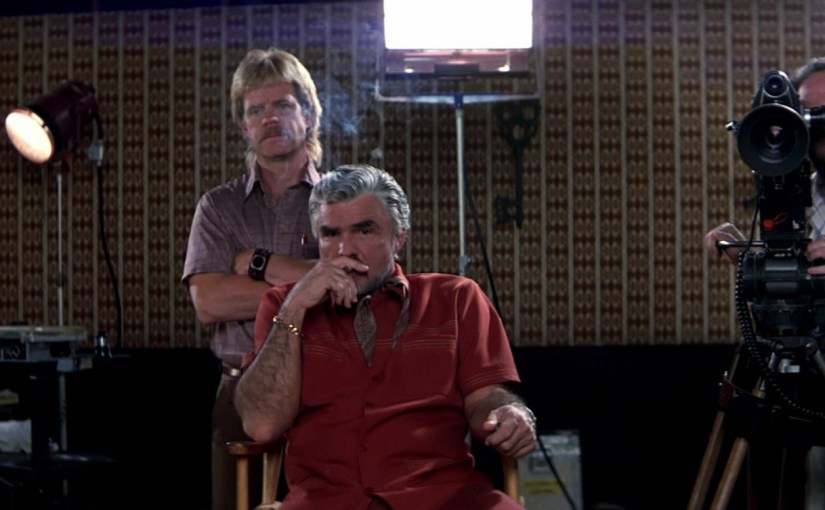
The main character is Eddie Adams (aka the amazing Dirk Diggler) played with macho pathos by Mark Wahlberg. It’ll likely be the best role of Wahlberg’s entire career. Dirk is proud of his natural talent in front of the camera. He’s even more proud of what God has gifted him. Don Cheadle is another porn star named Buck. He’s also proud of his accomplishments and simply a kind fellow looking to make country cowboy a trendy look for a black man while selling the “Hi-est Fidelity” in stereo equipment on the side. Julianne Moore is Amber Waves, the maternal porn mom of the bunch; very affectionate, very comforting and very reassuring when Dirk shoots his first porn scene. The one individual who really holds all of these misfits together is Burt Reynolds as Jack Horner, the porn film director. He’s the paternal one who believes in his artistic merits of shooting porn but with a story, and only with the integrity of film, and never the cheapness of videotape. So, Jack is like any artist who insists on a certain type of canvas. It might be smut, but he has principles, and he has pride.

Anderson is wise in how he divides up the developments. The film begins in the late 1970s during evening night life and decadence and everything seems fine and innocent and right despite the endless debauchery of reckless sex and drug use on a Disco backdrop. Wahlberg’s character is welcomed lovingly into this world, and nothing appears wrong. It all seems to stay that way for Dirk until New Year’s Eve, 1979. The 80s begin with a gunshot and then Anderson’s cast must pay for the revelry of their sins. A great moment presented on this night is where Amber Waves introduces Dirk to cocaine. Dirk has been thriving, making money, developing a following and now it is jeopardized in one moment thanks to his naivety. Julianne Moore is superb in this particular scene against Wahlberg. She’s the mentor with the peer pressure to pass on her high and keep it running.

Drug addiction, violence, sexual abuse and even changes in pop culture lead to hard times for these likable people.

It’s a hard life. It’s a complicated life. Yet it’s not all necessarily illegal. Morally, it might appear wrong, but it’s a life nonetheless.

Anderson was wise to use (at the time, relatively new) filming techniques of Martin Scorsese with rocking period music and fast edits along with savored moments of great steady cam work. One long cut especially works when the film first begins on the streets of Reseda and on into a crowded night club. This industry doesn’t sleep. So, neither will the camera that follows it. The music must also be celebrated. I do not listen to Night Ranger’s Sister Christian without thinking of firecrackers and a dangerously drug addled Alfred Molina playing Russian roulette. Though I know which came first, I also wonder if Three Dog Night’s Momma Told Me Not To Come and Spill The Wine by Eric Burton & War was written to enhance the celebratory introduction for Dirk when he attends his first party at Jack’s house. It’s another great steady cam moment from a driveway, followed by steps in and out of Jack’s house to simply a bikinied girl’s dive in the swimming pool. As a viewer I was absorbed in the California haze. Superior camera work here.

The cast of unknowns at the time were a blessing to this film. Anderson writes each person with care and attention and dimension. They have lives outside of this world like Amber’s child that we never get to meet, thanks in part to her lifestyle. She might be maternal but that doesn’t make her a good mother. Julianne Moore should have won the Oscar she was nominated for. Burt Reynolds’ own legacy seems to carry his role. His distinguished silver hair and well trimmed beard earn him the respect of every cast member and he performs with a quiet grace of knowledge, and insight, even if he will inevitably be wrong with how things turn out. Phillip Seymour Hoffman plays the dumb kid Scotty insecure and unsure of his homosexual attraction to Dirk. It’s not easy to play a dumb character when you are not doing it for laughs. Hoffman makes a huge impact with little dialogue but Anderson is wise enough to capitalize on him.

Boogie Nights offers one of the best cast of characters and assembled talents in any film ever made. An individual movie could be made about each of these people, and it’d be interesting and entertaining.

Try to avoid a blush and mock at the industry depicted because then you’ll see how another walk of life truly lives day to day. It might be porn. It might be smut. Yet, it’s still a thriving industry.

MAGNOLIA

By Marc S. Sanders

Ernie Anderson was the cool voiceover for the ABC television network that would introduce upcoming programs for years. He was a staple of the television industry from the 1970s through the ‘90s. I promise that you or your parents know his sharp, recognizable tempo. So, it makes sense that his son Paul Thomas Anderson would center his multiple story crossover film Magnolia around the television industry, within a 10-block radius in the Hollywood Area. Magnolia presents the off-chance coincidences that somehow happen and the unusual phenomena that can occur when never expected.

Anderson’s three hour epic offers storylines centered around former and present day game show quiz kids (Jeremy Blackmon, William H Macy), the game show host stricken with cancer (Phillip Baker Hall), the drug addicted daughter he’s estranged from (Melora Walters), the dying game show producer (Jason Robards), the producer’s son who is a motivational speaker for men to sexually conquer women (Tom Cruise), and the producer’s gold digging wife (Julianne Moore).

Because the narrative of the film has a biblical theme specifically referencing Exodus 8:2, there are also two good natured guardian angels involved. John C Reilly as a sweet but clumsy police officer proud of his work, and a sentimental hospice nurse played beautifully with bedside sympathy by Phillip Seymour Hoffman.

Anderson’s film opens with three stories of random coincidence that resulted in the deaths of three different men. More than likely most people would say these tall tales of legend could only occur in a movie. Yet, the voiceover narrator , Ricky Jay, says they did not, and thus begins one specific day with torrential downpours of rain, where all of these random characters will come in contact with a personal experience of monumental impact that will change their individual lives forever. Oddly enough, all these people are somehow connected to one another and are within blocks of each other located near Magnolia Blvd in the Hollywood Hills.

Like Boogie Nights, Paul Thomas Anderson directs a film of very weighty emotions that thematically focuses on the sins of fathers that carried over to the futures of their children. The game show is titled “What Do Kids Know?” which likely symbolizes what they didn’t know while at the behest of their parents during their youth. What they know now about their fathers is a burden to bear in insecurities, drug abuse and outright cruelty for the opposite sex. Every character represents some aspect of this ongoing theme during Magnolia. It’s a lot, a whole of information, but fortunately it moves at a very swift pace with an energetic steady cam and dramatic notes of instrumental soundtracks.

Anderson consistently shows different references to Exodus 8:2 by either using the numbers in clocks or decks of cards or temperature readings of the weather or on marquee signs. It’s almost like a scavenger hunt when seeing the film on a multiple viewings.

MAYBE A SPOILER ALERT:

“But if you refuse to let them go, behold, I will plague all your country with frogs.”

Sure. Most recognize the Bible verse as Moses’ decree to Pharaoh to release the Jews from Egypt. I like to think Anderson used Magnolia to release his beloved, but damaged, characters from their own sins or the sins of their fathers. Set them free even if it could be by means of confession, judgment, offering and begging for forgiveness, or journeying towards a personal salvation.

The smart device that Anderson uses is the angelic music of Aimee Mann. Often I talk about how I love when film characters would spontaneously dance. In Magnolia, the cast surprisingly breaks into song with Mann’s confessional number entitled “Wise Up.” It more or less summarizes each individual plight that all the various characters must endure. Magnolia is only an even better film because of Mann’s music.

Magnolia is a beautiful film that I draw many personal parallels from, especially having now lost both of my parents and being by my father’s bedside during his difficult final days of illness.

It is very touching, sometimes funny, and sometimes a difficult film to watch with a belief in random coincidence that is only stronger after watching it.

Like the film insists “we may be through with the past, but the past ain’t through with us.” After Magnolia finishes, you won’t be through with Paul Thomas Anderson’s film. It’s a film that will stay with you.