
by Miguel E. Rodriguez
DIRECTOR: Bill Forsyth
CAST: Burt Lancaster, Peter Riegert, Fulton Mackay, Denis Lawson, Peter Capaldi
MY RATING: 8/10
ROTTEN TOMATOMETER: 100% Certified Fresh
PLOT: An American oil company has plans for a new refinery and sends someone to Scotland to buy up an entire village, but things don’t go as expected.
Local Hero is not normally the kind of movie I gravitate to. It’s not slow, but it’s deliberate. It’s not hilarious, but it’s funny. It’s not plotless, but it meanders and skips around. It’s not flashy, it’s not glossy, and it’s not kinetic. I can easily remember a version of myself that might have turned this movie off after the first thirty minutes.
But today, at this time in my life, for whatever reason, something made me look at this movie in a different way than I might have once upon a time. The movie started to resemble a memory. Not one of my memories, but like someone else’s memory, like I was listening to someone tell a story about this one time when he went to Scotland and something happened that didn’t exactly change his life, but it made him look at the world differently. Fiction or not, Local Hero plays not as a movie, but as a recollection. Its charm carried me through the entire film.
And I’m not talking about the kind of charm you might see in any 2 or 3 movies set in Scotland or Ireland. Normally, in films set in and around the British Isles, the villages one might find there are laid back, yes, but filled with eccentric characters who know each other’s business, are friendly but cautious around outsiders, and who are loud and boisterous at the local pub. In Local Hero, the most eccentric characters are the Americans, and the village pub might fill up, but you’ll never have to raise your voice to be heard. It’s an interesting switch.
The story: A Texas oil company wants to buy the entire village of Ferness in Scotland so it can turn the surrounding area into a giant oil refinery. The company’s CEO, Felix Happer (Burt Lancaster), sends a junior executive, Mac (Peter Riegert), to Scotland to facilitate the deal. When Mac arrives, he gets his first taste of culture shock, not due to all the eccentricities he finds, but due to how quiet this town is. He is checked into the local hotel by Gordon Urquhart (Denis Lawson, aka “Wedge Antilles” in the Star Wars films), who also turns out to be the town’s bartender, the town treasurer, and the head chef in the hotel’s kitchen. Mac is accompanied by an eager Scottish assistant, Oldsen (an impossibly young Peter Capaldi), who develops a crush on a local scientist and runs from one assignment to another as if his arms were on fire.
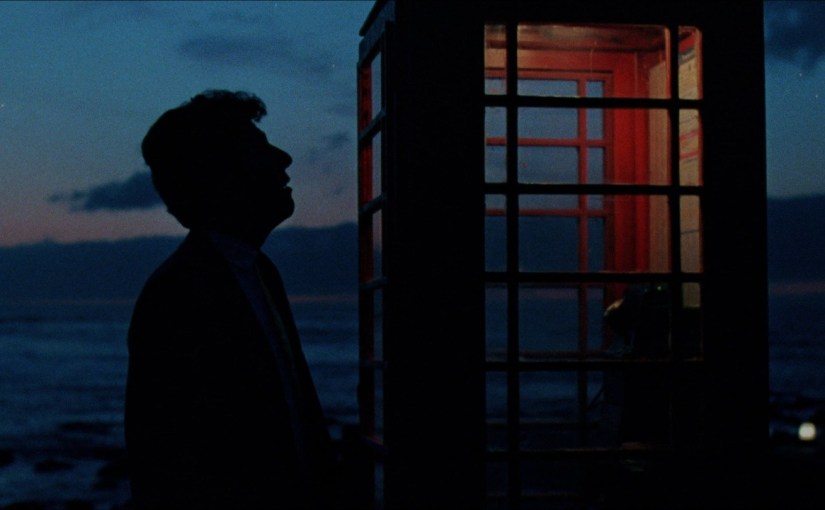
Local Hero throws curveballs every chance it gets. You’d expect the citizenry to get indignant at the idea of an American mega-corporation wanting to buy their town. But when the locals get an idea of how much each person would get, they become instant supporters. When they all convene at the local church, the Reverend is not an inexperienced youth or a crusty old soul, but an African gentleman who, according to the story he tells Mac, came to Scotland to learn the ministry and just…never left. Happer, the CEO, insists on periodic updates from Mac, and since this is 1983, Mac has to call Texas from a red phone booth just outside the hotel. But Happer seems less interested in the deal than in the potential discovery of a comet, somewhere in the constellation Virgo.
All of this is told in the laid-back manner of someone telling a story around a campfire. There are little jumps forward that omit what might seem to be key information, but we pick up on it right away. Little details emerge, like the motorcyclist who always seems to be roaring down the town boulevard just in time to nearly run Mac over. There’s a moment when Mac encounters a group of men near the beach, has a pleasant conversation, then notices a baby in a stroller. “Whose baby?” His question is met with an uncomfortable silence as the men slowly look at each other, and Mac wonders what just happened. And the beautiful thing is, that’s it. That’s the end of the scene. No one ever answers the question, and we never find out why not.
That kind of thing would normally infuriate me, but in this movie, it reinforced the idea of a fond memory. I can easily imagine someone telling the story and saying, “And that was it! No one ever said whose baby it was! I still don’t know whose baby it was!” It has the ring of real life, it’s not played up for laughs, and there’s no punchline at the end. The punchline is that there IS no punchline.
There is a nice moment when Mac has had one or two whiskeys too many one night, and he gets on the phone with Happer in that red phone booth. Suddenly, the sky starts to glow and glisten – the aurora borealis. Mac gets excited and tries to explain to Happer what’s going on, but he lacks the vocabulary. “I wish I could describe it to you like I’m seeing it!” I know how he feels. It’s how I felt when I went to Alaska for the first time in decades and traveled on a cruise ship through a narrow fjord and saw towering cliffs covered in trees and intermittent waterfalls cascading over rocks so everything looked primeval, like something out of The Lord of the Rings. Just describing it doesn’t convey how it felt. It’s a short moment in the movie, but I felt the reality of it in my bones.
In an interview on the Criterion Blu-ray, the film’s producer, David Puttnam, talks about how, when this movie was made, the general public’s idea of comedy was Airplane! and Blazing Saddles. If it wasn’t zany, it wasn’t considered a comedy. He wanted to help make a film that tried to remind audiences that comedy doesn’t automatically mean pratfalls and fart jokes. Comedy can be gentle. Local Hero is as gentle as they come. It’s marvelous closing shot speaks volumes, and it wouldn’t have had the same impact if the story had been told any other way.

 2 UNPAID MOVIE CRITICS!!!!