
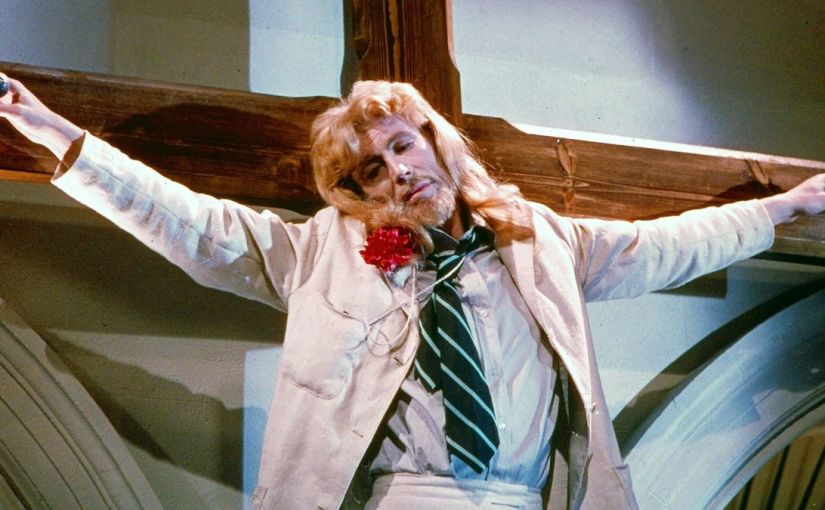
THE RULING CLASS (United Kingdom, 1972)

by Miguel E. Rodriguez

DIRECTOR: Peter Medak
CAST: Peter O’Toole, Alastair Sim, William Mervyn, Carolyn Seymour, Arthur Lowe
MY RATING: 8/10
ROTTEN TOMATOMETER: 77% Fresh

PLOT: A member of the British House of Lords dies, leaving his estate to his son. Unfortunately, his son thinks he is the one true God made flesh.  Murder and mayhem ensue.


Re-watching The Ruling Class for the first time in some fifteen years, I came up with a great but still imperfect way to describe it: Being There directed by Terry Jones and written by Terry Gilliam.  It has more religious blasphemy than Life of Brian – not a great example because Life of Brian is not technically blasphemous, but whatever – and more exuberant overacting than any two Nicolas Cage movies put together.  There’s nudity (but no sex), a little cross-dressing, murder, auto-erotic asphyxiation, impromptu musical numbers, and more jabs at organized religion and class structure than you can poke a burning cross at.  It feels a little too chaotic for its own good at times, but I am willing to forgive those transgressions because I am so grateful for its periodic flights of fancy and for the deliciously hammy performance from Peter O’Toole.  Is it a masterpiece?  Not quite.  But you just can’t turn away from it.

One day, the veddy-veddy proper 13th Earl of Gurney dies after a mishap involving a silken noose, a tutu, and a dislodged stepladder.  His brother, Sir Charles Gurney, is dismayed to learn that the heir to the Gurney fortune and name is none other than Jack (Peter O’Toole), the 14th Earl of Gurney.  We see the reason for Charles’s dismay when we see Jack for the first time…dressed as Jesus Christ, in a brown robe and white rope belt and long golden locks down to his shoulders.  He tells everyone he is God.  Someone asks him, “How do you know you’re God?”  He answers with unassailable logic: “Simple.  When I pray to Him, I find I am talking to myself.”  He also says things like, “For what I am about to receive, may I make myself truly thankful.”

Charles realizes he must have Jack committed to wrest away control of the family fortune, but he cannot do so until Jack has an heir.  But Jack (who insists on being referred to as “J.C.”) refuses to marry because he says he’s already married to the Lady of the Camellias, which everyone knows is the name of a less-famous novel by Alexandre Dumas fils.  To get around this inconvenience, Charles arranges for his own mistress to impersonate the Lady.  Meanwhile, Charles’s wife, Lady Claire, puts the moves on Jack’s psychiatric doctor to distract him because he opposes the marriage, citing Jack’s condition.  And always in the background is Tuck, the family butler, who received 30,000 pounds from the 13th Earl’s will, but stays in service apparently just to blow raspberries and say exactly what’s been on his mind for the last several years.  I would say he’s the comic relief, but he’s more like a demented court jester.

Peter O’Toole’s performance as Jack must be seen to be believed.  Imagine, say, Daniel Day Lewis or a young Robert De Niro, dressing up as Jesus Christ, talking animatedly to flowers, and taking a nap while standing on a life-size crucifix, arms outstretched.  At one point, Jack woos the faux Camille by impersonating a bird, and she follows suit.  You haven’t lived until you’ve seen Peter O’Toole dressed in an impeccable white ensemble, strutting across the lawn, head bobbing like an oversize pigeon, and literally cooing.

The Ruling Class is clearly a jab at its namesake, the upper-class nobs and snobs of England who firmly believe they rule their country simply because they are more suited to it than anyone else.  They never suffer from the same human foibles as the lower classes do, and if they do, it’s never acknowledged, or acknowledged and hushed up, or blamed on someone or something else.  The film is based on a stage play, which explains the occasional fourth-wall breaks and the frequent interruptions for short musical numbers, which further enhances the Python-esque feel of the movie.  I would imagine it was much more notorious upon its release than it might be today, but the message itself hasn’t dated.

That message is especially brought home when Jack is ostensibly cured, after a fantastic sequence involving a second psychotic patient, a lightning storm, and a vision of a gorilla wearing a top-hat and a tux.  However, his “cure” has an unintended side effect.  To everyone else, it looks like he’s back to being himself: Jack, the 14th Earl of Gurney.  But a creepy monologue in the attic reveals his secret.  He no longer believes he’s God, nor does he believe he’s Jack, the 14th Earl.  He believes he’s another historical “Jack,” the one who stalked prostitutes in 19th-century London.  He has visions of old London streets.  In one masterful scene, he is in the sitting room of his country house, and as he crosses the floor, the house magically transforms into an old London cobblestone street at night, in an uncut take with no visual effects.  I can imagine Terry Gilliam nodding approvingly at that absurdist touch.

What will become of the “new” Jack?  Will he remain a member of the ruling class to which he was born, whether he deserves it or not?  Will his former doctor, or his wife, ever learn of Jack’s new persona?  With his newfound purpose, he delivers a speech to the house of lords in favor of capital punishment, quoting no fewer than three verses from the Old Testament.  Their response to his words serves as the macabre capper to the film.
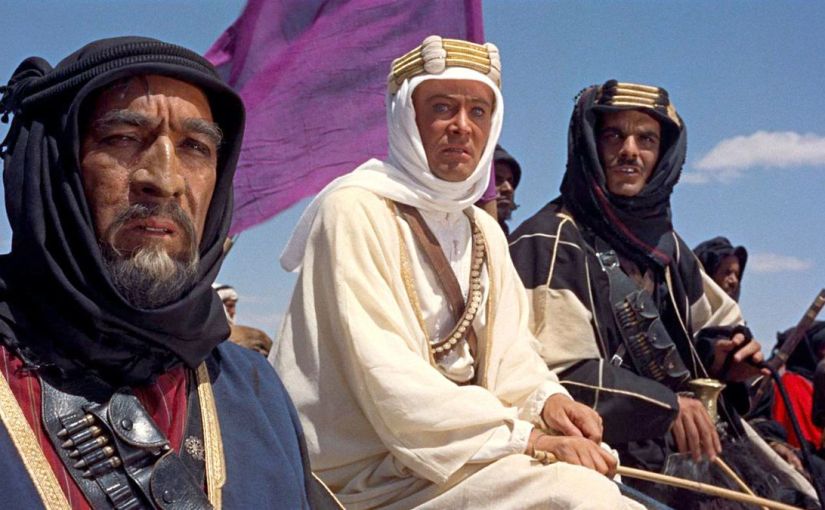
LAWRENCE OF ARABIA

By Marc S. Sanders

The moment finally arrived where I was able to see David Lean’s epic, also regarded as my colleague Miguel’s favorite film, Lawrence Of Arabia.  It truly is an eye-opening spectacle, and one of the most beautiful pictures I have ever seen, especially enhanced by an up-to-date Blu Ray restoration.  With a near four hour running time there is hardly an element or sliver of film that does not appear out of place.  Far ahead of the conveniences of dazzling special effects and CGI to arrive later in the twentieth century and beyond, Lawrence Of Arabia must be one of the greatest cinematic achievements ever created. 

When you factor in what David Lean made with an earlier picture, The Bridge On The River Kwai, it is fair to say that he was the James Cameron of his time – a bold, daring film director who did not surrender until every shred of a masterpiece was included in a final cut.  What puts a man like Lean ahead of Cameron perhaps, is that he depended on the resources of thousands of human extras and animals, broad desert landscape locations, painstaking architecture to set designs and buildings, along with authentic explosions and battlegrounds while delivering the story of British Lieutenant T.E. Lawrence and his efforts to aid an Arab nation into battle against the Turks during World War I. David Lean was persistent in bringing as much natural quality to his finished product as possible.  In fact, Miguel informed me that Lean was seeking out any possible way to point his cameras at the desert sun to heighten the feeling of the sweltering, unimaginable heat endured by his cast of characters.  It likely pained Mr. Lean that he had to settle for an optical illusion.  Nevertheless, when I was watching the movie, it did not occur to me once.  I was still appreciating his strive for absolute authenticity.

Peter O’Toole is the title character in his unforgettable film debut.  A daring, handsome, charming blond leading actor poised for adventure.  Lawrence is assigned to ally with the Arabs during the war to hold on to the necessary access of the Suez Canal which is a through way for oil, supplies and territory.  His determination for crossing wide, endless desert plains under a sun drenched open blue sky turn him into a leader, and a hero to the Arab soldiers, particularly represented by Sherif Ali (Omar Sharif).  They are a small band of fifty men, but Lawrence proceeds with the intent of gaining fifty more as he begins a long trek from one side of the desert to the other with persistent walking or by riding camel.  Lawrence won’t even leave a single man behind.  His resolve is courageous but could be costly later.

The technical construction of Lawrence of Arabia is likely what many notice and remember first, but the film comes with a well-set character arc for its protagonist.  Peter O’Toole was a perfect casting selection for this role.  Lawrence changes over the course of the film and it’s not a celebratory transformation.  Oft times, it seemed ironic to consider him the villain; perhaps a hero who falls from grace.  His derring-do is impressive, but likely also his undoing.  Lawrence allows strength and confidence to awaken a weak Arab nation who only survived for themselves with what little they held onto before their encounter with him.  Yet, the monster Lawrence creates within his own psyche may have also spawned a challenging threat from the Arabians for many years to come, long after this war is over and further generations come into play.  Bless a people with power but be aware of how that gift is used thereafter.

Lawrence accomplishes what has been regarded as seemingly impossible and now the Arabs adorn him in heroic white cloths (which must be one of the memorable costumes in film history).  He is who they look up to as the giver of their strength and confidence.  However, like most heroes that we find in the best of stories, T.E. Lawrence is weighed by fault, particularly his own hubris.  After his conceit gets him captured and tortured, it is not so easy to return to his home country who insist he continue to carry out his leadership.  Madness is invading his mindset and the hero we have borne witness to for well over two hours of film is now significantly diminished.  Parallel to that is the overconfidence and newfound freedom a political leader like Prince Faisal (Alec Guinness) absorbs for his Arabian people.  The end of David Lean’s film seems to imply what came of T.E. Lawrence’s contributions to the Arabs.  Was the world better or worse for what he achieved with his pioneering, yet dedicated military efforts?  What about Lawrence?  How did he fare, personally?

Forgive my incessant urge to compare David Lean to James Cameron.  I look at a film like Avatar and I see the monies and efforts invested to make that piece.  Yet, I feel like I walk away with little substance.  The films of Cameron not only fall short of story, but often lack texture as well.  I could never reach out and shake the hand of a “Pandoran.”  When I see Lawrence Of Arabia, though, I can feel the sweat and heat that O’Toole and Sharif experience.  Both are big films, not made on the fly. Rather, time and stress and a means to improve and show what’s never been seen or done before are offered.  David Lean might have been given all the monies in the world or the keys to kingdom to make his masterpiece.  However, it’s how he used these resources to painstaking perfection that lend to longevity in reputation for his career and Lawrence Of Arabia.

A train explosion near the start of third act is very impressive.  Lawrence and his men detonate a planted bomb on the tracks, and we see the locomotive derail onto its side, plowing into the hot desert sand.  We feel the immense weight of that steam engine.  We can detect the sand cloud that forms from the crash.  The collision of the cars being ripped apart and burned black thus create a new setting as Lawrence’s Arab followers rush to loot the train.

Grand battle scenes on horse and camel backs are meant to be seen at least ten times over in order to capture every piece of activity from the numerous extras and animals occupying a thousand different corners of the screen.  The bigger the screen, the better enhanced is the viewing experience. 

Long walks and camel rides in the desert may seem tedious for some, but not for me.  I was accompanying T.E. Lawrence and Sherif Ali on this journey.  This is another film where its running time affects what Lean set out to accomplish.  A trek through the desert is impossible to rush and this film is a testament to that notion.  I can’t say I’ve hiked through a desert plain that bears no end in near sight, but now I can lay claim that I’ve watched Lawrence Of Arabia.

Having only seen David Lean’s picture once thus far, I know that on repeat viewings I’d likely see something new each time hereafter.  This film is so alive of its period setting and backdrop and the unforgettable original score from Maurice Jarre give definition to the sweeping adventure that awaits with T.E. Lawrence’s travels.  The cast is marvelous as well.  Peter O’Toole is positively engaging.  Omar Sharif and Anthony Quinn are scene stealing character actors, much like Robert Shaw would become known for a decade later with Jaws.  Alec Guinness may be doing a brown face appearance as an Arab leader, but I’ll just salute the performance.  A charming actor of grand, yet subtle, skill.  I’m glad I’ve discovered him all over again from beyond …River Kwai and Star Wars.

Movies like Lawrence Of Arabia must remain at the top of the broad lexicon of films to watch.  It’s length and scope may be challenging, but its edits, its score, its immense visuals, and the performances therein, are unmatched by most anything else available to watch. 

THE LAST EMPOROR

By Marc S. Sanders

Finally, I invested myself in watching Bernardo Bertolucci’s Oscar winning Best Picture The Last Emperor. Honestly, as breathtaking as the undertaking to make this sweeping epic is, it was the first and likely last time I will ever watch the film.

This three hour plus biographical picture focuses on a young child named Puyi, plucked from nowhere to become the next Emperor of China. He is destined to reside in Peking, The Forbidden City amid rich tapestries and deep Chinese culture at the start of the twentieth century. Oddly enough, the would be Emperor is a prisoner of his own surroundings for nearly his entire life. He is forbidden to go beyond the walls of Peking. Later in his adult life, he is a political prisoner and war criminal in the now regarded People’s Republic of China. Puyi was never granted an opportunity to think for himself or act upon his devices. He is forced to become an adaptable symbol to ongoing representations of the country that harbors him.

I watched this film with my wife. The next day we discussed it with my colleague Miguel who regards the picture as one of the best films he’s ever seen. I can not dismiss his viewpoint, but personally the depth of Betolucci’s efforts for maximum authenticity pushed my interest away from the film.

I embrace character arcs in films. It’s what keeps each passing moment of a movie refreshingly interesting. I do not deny the change in the Emperor’s story arc. Puyi changes as his country changes on both a political or militaristic platform. Yet, the film has vague segues in its changes as well.

Characters appear and disappear. Moments in history occur with no build up or explanation. It was challenging to follow who is who, and what has just happened.

Early on, we see how Puyi as a child interacts with his younger brother, Pujie. Much later in the film, Pujie reappears when they are adults. I am not going to pretend I’m a sophisticated enough moviegoer to realize this is the brother we saw as child over an hour earlier in the film. It took some time to realize who this guy was.

I’m also not going to pretend I know enough about Chinese history and culture to comprehend the traditional customs and ceremonies that occur, or China’s relationship that developed with Japan, or China’s significance during World War II.

That’s my problem with the film. Was I supposed to take a college course on Chinese history before watching The Last Emperor? The film is expository for sure, but it presumes the viewer will recollect at what point in history this moment or that moment occurs.

The film flashes forward and back to when Puyi was a prisoner of war in 1952. In prison, he eventually becomes reformed, but it became frustratingly complicated to understand exactly why he was even sentenced.

Following the film, I referenced Wikipedia to grasp the sequence of events. The historical change of this one man certainly merits a film to be made, much like Malcolm X or Born On The Fourth Of July. However, those films had a more comprehensive narration for me and the ongoing changes that the central figures experience are more well defined as the years pass and the people around them change.

The Last Emperor felt unclear to me in its storytelling while still immersing me in a land I’d imagine is unfamiliar to most viewers. For centuries “The Forbidden City” was not open for a public to encounter. If that’s the case, I believe Bertolucci needed to define what he captured much more clearly. Who’s to know what we are looking at, or what significance this setting has if most of the world population has yet to see what is here?

The Last Emperor requires a high threshold of patience and focus to grasp what it presents. It should be seen for the locales that are filmed, which were completely unseen by me personally. You’ll also get some tidbits of Chinese history, for sure.

All I can recommend is not to be so hard on yourself, when you find yourself lost at times in the film.