
COP LAND

By Marc S. Sanders

You need look no further than the HBO series The Sopranos to see that the state of New Jersey is often regarded as a red headed stepchild in comparison to the empires of crime found in New York.  In fact, two years before that series debuted, many of the varied cast members (Edie Falco, Frank Vincent, Robert Patrick, Annabella Sciorra, and Arthur J Nascarella) appeared in writer/director James Mangold’s second film Cop Land, which carried the same kind of regards for the two thirds of the known Tri State area.  Tony Soprano always had to surrender to Johnny Sack and his crew if you know what I mean.  There’s Jersey…but then there is New York!

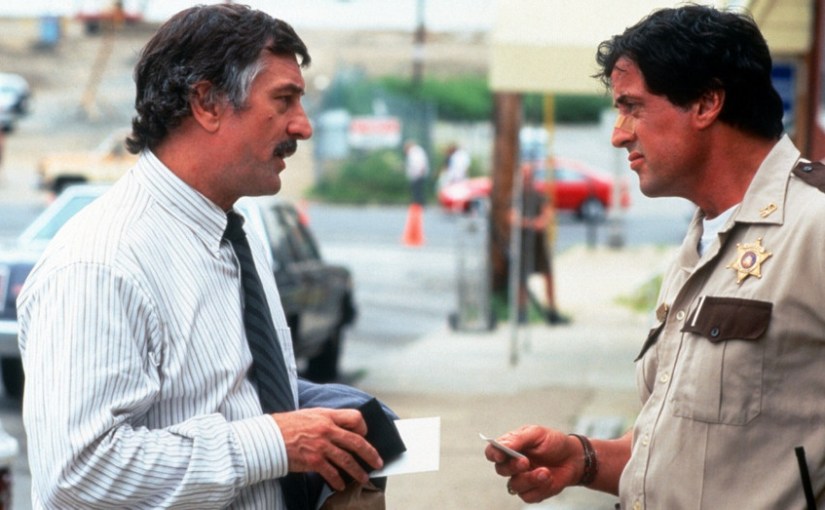
A whose who of staple actors for New York crime and corruption films take center stage including Harvey Keitel, Ray Liotta, and Robert DeNiro.  Yet, the spotlight belongs to Sylvester Stallone in what is arguably the most unsung and best role, next to Rocky Balboa, of his entire career. 

Stallone portrays the pot-bellied schlub Freddy Heflin.  He is the Sherrif of small-town Garrison, NJ where the cops who work within the city, across the bridge, reside comfortably here.  Freddy aspired to be one of those celebrated officers dressed in pressed blue uniforms, but he could not get past the physical due to a loss of hearing in his right ear.  He got that when he was kid and rescued someone from a sinking car that crashed in the river.  Perhaps Freddy wished that never happened.  Maybe his life would have been much more colorful like these New Yorkers.  I can understand the poor guy’s self-reflection.    

An internal affairs investigator named Moe Tilden (another of many convincing New York variations for Robert DeNiro) brings reasonable suspicions of corruption to Freddy’s attention.  How do these guys live so well based on the salary they earn on the police force?  Too often they have been connected with reputed mobsters, and incidents are quickly swept under the rug and kept quiet.  It stands to reason that the cover ups they commit happen in the home state of Jersey, outside of Moe’s jurisdiction.  Moe needs Freddy to quickly offer up anything he knows or witnesses. 

In particular, the leader of these guys, Ray Donlan (Harvey Keitel), might have something to do with the disappearance of his nephew Murray (Michael Rapaport) who was regarded as a young hero cop but is now at the center of a shooting incident gone wrong while driving across the bridge.  Donlan and gang fake a suicide for the kid, but with no body turning up in the river, it’s not so far-fetched to believe that perhaps he’s still alive and hiding out somewhere.

Cop Land works like an Us vs Them observation.  Freddy is the pawn for these guys to keep up appearances while this friendly town operates on other levels.  He’s the guy they can rely on to look the other way and mind his own business.  What I like about Mangold’s script is the dilemma with Stallone’s character.  Who could ever intimidate Sylvester Stallone after Rocky II?  He’s one of the biggest muscle men in film history. Yet here he is the weakling.  Most importantly, he’s utterly believable in this role that’s nowhere in the same league as Rambo or Rocky. 

The cast is as magnificent as you would expect.  Harvey Keitel looks like the family man but he’s got other nefarious ideas bubbling under his exterior.  Robert Patrick fills a role as Keitel’s heavy in a frazzled departure from his anal-retentive evilness that premiered in Terminator 2.  Ray Liotta is the second star of this picture sharing some good scenes with Stallone.  You’d think Liotta was the more seasoned actor even though Stallone came on the scene a few decades before.  Liotta is playing a guy who maybe once lived with a good soul but is now checkered and weary.  How I wish Ray Liotta had more significant screen time during his film career.

The setting works like an intimidating character here. The other supporting players flesh out the environment of Stallone’s sheep herding through a bed of wolves.  Those actors consist of Cathy Moriarty, Annabella Schiorra, Peter Berg, John Spencer and of course Frank Vincent who is a regular in these kinds of pictures.

Cop Land teeters on what Martin Scorsese or Sidney Lumet might have done with this picture.  It only falls short due to a wrap up ending with an unsurprising shootout.  What works so well as a pressure cooker crime drama devolves into blood and bullets and that is a letdown because it’s an easy way out.  In Lumet’s hands for example, the film would have taken advantage of at least an additional half hour to drive the piece into the arena of the public court system (a welcome opportunity for another all-star cameo from the likes of Al Pacino or Sean Penn.   I think the film would have been even smarter for doing so.  The avenue that James Mangold takes with his film is not terrible.  It just feels a little unrewarding or worthy of everything that was wisely executed before.

Cop Land should be seen for the dilemmas it hinges on and then for the various acting scenes among this terrific all-star cast.  Usually, actors will boast that they got to share screen time with Robert DeNiro.  I’m sure guys like Robert Patrick and Michael Rapaport place those experiences high on their mantles.  However, I bet all of these guys said what an honor it was to share the screen with Sylvester Stallone in a performance uncharacteristic of his usual criteria. 

James Mangold’s Cop Land is a terrific crime drama.

COLLATERAL

By Marc S. Sanders

A salt and pepper haired gentleman in a knitted suit with sunglasses arrives at LAX before the sun sets.  He exchanges bags with a man he runs into, played by Jason Statham. Elsewhere, a driver does a polish and check on his taxi cab before beginning his evening shift.  He picks up an attractive, overworked attorney named Annie (Jada Pinkett Smith) and before she hands him her business card, the driver has at least convinced the woman to re-examine her life’s purpose and consider simple ways to escape reality.  The man in the suit is Vincent played by Tom Cruise.  The cab driver is Max played by Jamie Foxx.  They are about to collide with one another on this night and put Michael Mann’s film, Collateral, into play.

Following being a massive fan of the TV show Miami Vice, and the films Thief, Heat and The Insider, I remember my anticipation sky rocketing when I saw the trailers and write ups for Collateral.  Mann, Cruise, Foxx, and crime in a cool looking L.A. with a symphonic soundtrack? I’m there!  It seemed like a perfect formula.  When I finally saw the movie, I think I was let down because it was too formulaic following a step-by-step recipe.  The editing for Collateral is abundantly cookie cutter, never taking any risks with its story.

Vincent chats with Max as soon as he gets in the cab.  He offers eleven hundred dollars to occupy Max’ evening, transporting him from one location to the next. Max has dreams of running his own limo company one day and this easy money is too good to resist.  It’s only when Vincent tosses someone out a fourth-floor window to land on the roof of the cab that Max realizes there’s a hitch to this arrangement.  

Vincent is a hitman out to check off a list of targets before sunrise, and he needs Max as a cab escort.  Threats to Max’ ill mother in the hospital will keep the driver in check, and if inconveniences like a shattered windshield draw the cops’ attention then Max will have to abide by Vincent’s demand for no interference with his plans.  

The two hour running time of Collateral is structured on one stop after another.  Mann abides by side scenes from Stuart Beattie’s script to look at the undercover night detective (Mark Ruffalo) who is one step behind the pair’s frequent stops within the city.   I guess it’s fortunate for this guy that ballistics and coroner’s reports are quickly and readily available within minutes and hours to connect some dots.  

In between the kills, Vincent and Max chat in the cab.  Standard stuff really where Tom Cruise is at one time charming and other times sociopathic.  Jamie Foxx is the bright but frightened guy with dialogue that doesn’t amount to much in convincing this unwanted passenger to either let him go free or to give up on his mission.

Ironically, the many scenes shared between Tom Cruise and Jamie Foxx are the least interesting parts of the film.  When the sound editing isn’t failing by making their dialogue sound like incoherent mumbling, neither guy is ever convincing the other to look in a new direction or consider another idea.  Therefore, the conversations never go anywhere.  Look at films like The Silence Of The Lambs, Cape Fear, Seven, and especially Mann’s best picture to date, Heat by comparison.  Those films work when either the antagonist or protagonist allow themselves to consider the arguments, even if it’s just for a second, against the ones they are debating.

There is action and violence in Collateral, but it’s really a talking piece.  Still, the best exchange of dialogue occurs with Foxx and other cast mates besides Cruise.  A great scene occurs when Vincent insists that Max act under the guise that he is Vincent when he has to report to the drug kingpin employer who originally hired him (a surprise welcome from an at the time unknown Javier Bardem); great acting and writing happening here.  The early scene between Jada Pinkett Smith and Jamie Foxx also works at a thought provoking and interesting level.  These scenes are short one act plays that belong elsewhere.  Jamie Foxx is doing some great work in these moments.

Unfortunately, when Foxx and Pinkett Smith reconnect later in the film, they are not written with the same kind of intelligence during a run and hide third act climax.  The suspense is absent here because the setup is ridiculous.  While standing on the top level of a parking garage, Max can easily see Annie in a fourteenth-floor office window, blocks away across the city, and specifically direct her where to run from the dangerous killer who is a few floors below, all while using a dying cell phone.  

More to the point, why is Annie still wearing a suit and heels, with her hair and makeup done up, at four o’clock in the morning? I know an aggressive lawyer never stops working, but don’t they go home, pour a glass of white wine, get into sweats and pop open the laptop while Miles Davis plays softly on the stereo?  How would these guys even know this is where Annie would be at four in the morning? Reader, you might tell me to dismiss what’s merely circumstantial here, and normally I would.  Yet, if I’m an expert hitman like Vincent is supposed to be, my first instinct is to go to Annie’s home first before the office in the middle of the night.  It’s the circumstances that negate the believability of the main character.  

As expected, Los Angeles looks moody and cool like in any other Michael Mann picture.  He’s got blazing overhead shots that emit a white glow in the thick of night.  The wolf is holding a fang and claw to the neck of the sheep as they careen through this endless city maze.  In that respect, the environment of this film works like a great character game master. What turn or straight avenue or bridge is going to work in either saving Max or getting him killed?

The technique of this filmmaker, who I usually favor, is here.  It’s been seen many times before for the other sharp, well-dressed killers in Michael Mann’s worlds. I welcome it back, but it’s not new or inventive in Collateral.  I guess that’s why the film is ordinary.  It lacks the depth that other productions from Mann rely upon.  The setups are quite amateurish and most of the talking is wholly uninteresting.

In spite of a phenomenal and reputable cast and crew, it’s a shame this Michael Mann installment is only ho hum in its finished product.  Collateral needed another script rewrite, followed by some additional reshoots.  There was a better movie to made here.