
DISTANT VOICES, STILL LIVES (United Kingdom, 1988)

by Miguel E. Rodriguez

DIRECTOR: Terence Davies
CAST: Freda Dowie, Pete Postlethwaite, Angela Walsh, Dean Williams, Lorraine Ashbourne
MY RATING: 10/10
ROTTEN TOMATOMETER: 80% Certified Fresh

PLOT: A brief family history told in two parts. Distant Voices focuses on the father’s role, while Still Lives follows the children into adulthood and marriages of their own.


About a year-and-a-half ago, I was challenged by a friend to compile a list of my 100 favorite films.  If I were asked to do it again today, Terence Davies’ masterpiece Distant Voices, Still Lives would be on that list.  Here is a movie that is not even ninety minutes long, but it encompasses as much emotion and history as any epic by Bertolucci or Bergman.

The film’s strategy of dividing itself into two distinct sections is crucial.  The first half, Distant Voices, gives us the fragmented, free-associative memories of three children remembering their abusive father and long-suffering mother.  The second half, Still Lives, follows the children as they mature, marry, and cope with their buried emotional issues.

I’m going to attempt to describe how the film works, but it’s a miracle and a mystery to me why it works.  It does not lend itself well to a verbal description.  It’s something you have to see for yourself.

First, music and song play a huge role in both sections.  The movie is by no means a musical, but I’ll bet there aren’t five minutes strung together in the movie where someone isn’t singing or listening to a song on the radio.  Music is either a trigger for distant memories or a catalyst for creating new ones.  I could say the same thing about myself and movies.  Ask me when or where I met some of my oldest friends and I may not remember accurately, but I can tell you exactly when and where I saw Star Wars for the first time, or what my first R-rated movie was (Fort Apache: The Bronx) and who I saw it with.  Distant Voices, Still Lives taps into the mystery of memory and employs an editing strategy that brings it beautifully to life.

In the first section, Distant Voices, time shifts freely back and forth between the ‘40s and ‘50s, between when the three siblings – Eileen, Tony, and Maisie – are young children and adults.  A shot will show the three of them and their mother dressed as if for a wedding.  One of the daughters wishes her dad was here.  The next shot shows a hearse pulling up outside.  It’s the father’s coffin.  The family solemnly piles in.  The next shot we’re back to the wedding preparations as one daughter thinks to herself, “I don’t.  He was a bastard and I bleedin’ hated him.”  Then we flash back again to the past as the father (Pete Postlethwaite) viciously torments her and beats her with a broom.  Then forward again, and back and forward, and so on.

By that description, I worry that some readers will think the movie is chaotic and impossible to follow.  Not so.  It follows the same kind of free-associating logic as our own memories.  I was blessed to have a mother and father who never abused me in any way, but they weren’t perfect.  As I sit here, I am remembering all the good things and bad things that happened years ago, and if you think those memories are streaming through my consciousness in any linear way, you’re fooling yourself.  Memory only takes a linear form after careful editing.  When you’re in the actual process of remembering, everything is jumbled, out of order, but you always come back to yourself in the present.

That’s what this movie evokes, better than any other movie I can remember: the simultaneous juxtaposition of good memories on top of bad ones.  One brilliant sequence shows the three kids sleeping in bed on Christmas Eve as their father tenderly places their meager presents in a stocking at the foot of the bed.  The very next shot appears to be the following morning, the three children sitting nervously at the breakfast table, a meal spread out, and the father sitting at the head of the table, his hands trembling with rage before he pulls the tablecloth to the floor, plates, food and all, and yells off camera, “CLEAN IT UP!”  What a loathsome man.

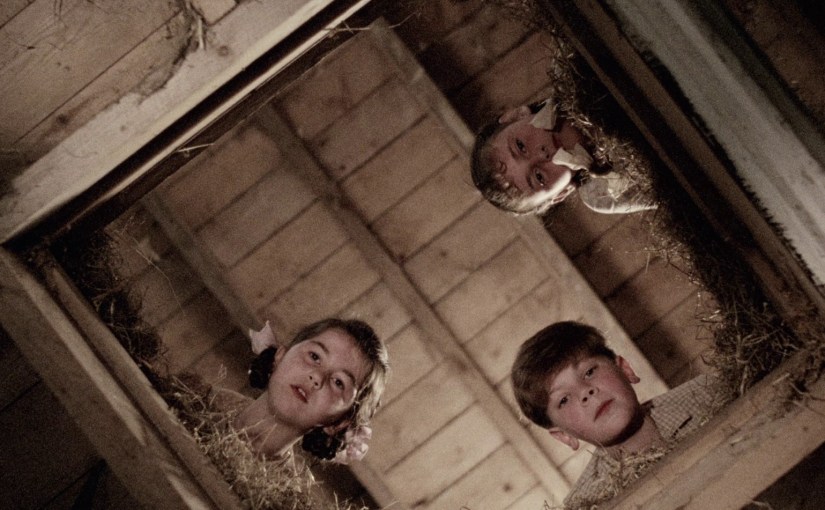
Another brilliant scene: the father sings softly to himself while grooming a horse.  The three young children quietly climb to the hayloft and watch him silently from above.  What’s going through their heads?  I can remember doing something similar when watching my father work under the hood of his beloved Coronet 500, or when he was stretching before his daily runs.  It was a glimpse of a man at peace with himself when he thinks no one else is watching.  The attention to detail in each little scene is meticulous and absolutely accurate.

All these scenes and more build up a precise image of the man who will loom large in the memories of all three children and their mother during the second half of the movie.  A daughter marries and has a child.  The other daughter marries and is happy at the ceremony, but her husband reveals himself to be a selfish man.  The son fends off marriage as long as he can.  A baby’s baptism and the ensuing celebration at the local pub becomes the focal point of the story as memories and flashbacks branch off to flesh out their personal lives.  A moment occurs that is worthy of comparison to Scorsese or Coppola, but I don’t even want to hint what it is because of its immense visual power.

And always, in at least every other scene, are people singing: gospel tunes, hymns, drinking songs, Broadway tunes (“Buttons and Bows”), Bobby Darin, children’s songs, until it gets to the point where a scene feels almost incomplete when someone isn’t singing.  I may be exaggerating a tiny bit, but not much.  It’s almost like the songs release any tension that existed in the scene before it.  It’s one of the best uses of music in a non-musical that I’ve ever seen.

And what of the mother in all this, whom I just realize I’ve barely mentioned?  Despite all the abuses heaped upon the children by the father, she is clearly the one who suffers most of all, both physically and emotionally, but you’d never know it.  When the angry adult son demands to have a drink with his father, and his father refuses, the mother’s voice tenderly urges him to do so.  When her adult children ask her why she married such a man in the first place, she says, “He was nice.  He was a good dancer.”  She suffers in silence, never saying a bad word about her monster of a husband, not even to her children, and when she sings, any happy words are tinged with regret.

When this film was over, I felt like I had watched an epic miniseries.  I don’t mean that in a negative sense.  I mean that, through the economic storytelling and direction, I felt like I knew every sibling, the mother, and most of their friends inside and out.  I may not remember all their names, but I remember their faces, their personalities, their hopes and dreams, their regrets, and how their father’s memory affects them even now.  For eighty-four minutes, they were people as real as you or me.

One of the last shots of the movie shows the son, on the brink of marriage, standing in the pub’s doorway, weeping.  We do not get a contrived scene where a sister or the mother comforts him and asks him what’s wrong and he tells us.  The static camera shot just shows him as he weeps while behind him, in the pub, people sing and sing.  There is more emotional depth in his silent weeping than in fifty monologues.  Distant Voices, Still Lives is one of the best family dramas I’ve ever seen.
THE USUAL SUSPECTS

By Marc S. Sanders

There’s something inviting – or maybe intriguing – about seeing a person in a hat with a dark trench coat on.  Just the person’s silhouette will leave you asking for more.  What is it to this guy?  Steven Spielberg does that in the first few minutes with Indiana Jones in Raiders Of The Lost Ark.  Before Indy, there was Orson Welles as Harry Lyme in The Third Man.  Guys like these have a danger to them, and we can’t look away.  In The Usual Suspects, one of many variations of a legend called Keyser Soze has a dangerous reputation that carries him, and we want to know more about the figure in the hat and coat.  In the first few minutes of the film, we see this mysterioso extinguish a kerosene flame by urinating on it.  Who is this guy?  Maybe we, as the viewers, are Icabod Crane looking at an updated inspired spawn of The Headless Horseman.  Perhaps, we are actually catching a glimpse of that boogeyman who hid in our closets or under the beds.

Bryan Singer’s modern day film noir, masterfully written with inventive riddles by Christopher McQuarrie, works towards its ending as soon as the opening credits wrap up.  Each scene hops from a different setting or time period and as a viewer you feel like you are sitting at a kitchen table turning puzzle pieces around trying to snap them together.  Not all of it makes sense by the time the picture has wrapped up.  That’s okay though, because one of the players in the story perhaps played a sleight of hand and we can do nothing but applaud when we realize we’ve been had.  Magic is fun when you never quite realize where or when the deceit began.

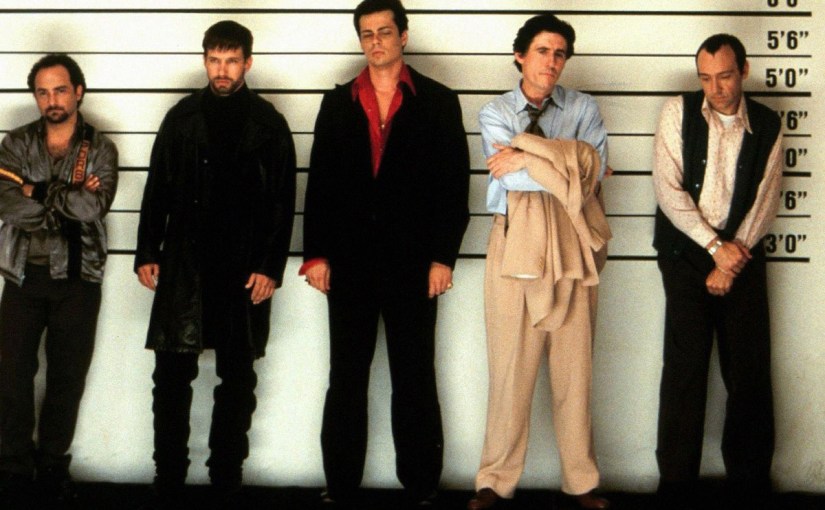
A scenario is set up early on that assembles five different kinds of criminals in a police lineup.  It works as a device to team these guys together to pull off additional heists.  A prologue to the film depicts the aftermath of their last job together.  One holdover, a hobbled cripple named Verbal Kint (Kevin Spacey) is brought into a police precinct to be interviewed by a determined detective named Kujan (Chazz Palminteri).  Verbal might ramble on endlessly in circles about nothing, but Agent Kujan is going to get to the bottom of what happened the night prior on a shipping dock that turned up several corpses.  How did it all go down, and where is the money and cocaine that was expected to be there?

Verbal was one of the five in that lineup, along with McManus (Stephen Baldwin), Hockney (Kevin Pollack), Fenster (Benicio Del Toro) and Keaton (Gabriel Byrne).  Each carries a different specialty or personality, but Keaton is the guy that Kujan is really after.  He’s a master criminal who’s been known to fake his own death, supposedly turn legitimate while dating a high-priced lawyer, and now may be the lead suspect in an armored truck heist.  On the other hand, maybe it was one of these other four guys. 

Amid all of this back and forth and side stepping stories, there is mention of a name – Keyser Soze.  Whenever he comes up in the vernacular of the script, the mood seems to change.  These criminals, usually comfortable in their own cloth of transgressions, get noticeably frightened and concerned if there is even a remote possibility that this Soze character is the engineer behind what follows them. 

It’s fun!  The Usual Suspects is fun.

McQuarrie’s script will toss out names of people we never meet.  It will quickly imply an anecdote from another time.  It’ll share a bunch of short stories with how these five guys work together, like upending a secret criminal sect of the New York City police force while robbing them of their fortunes. Yet, a tall tale of lore will intrude on their typical heists to derail what we may normally be familiar with in other crime dramas or noir films.   

Spacey is the real star of The Usual Suspects.  He earned the Academy Award for Supporting Actor because Verbal Kint is so well drawn out as a weak, unhelpful, and frustrating man.  Often, you ask yourself what the heck is this geeky looking crippled guy even talking about. 

On other occasions, I’ve noted that sometimes with movies I can not determine if I just watched a superior film or dreadful nonsense until I’ve reached the final five minutes.  The final five minutes of a movie can be the verdict.  Sometimes you’ll claim the journey getting there was great, but the conclusion was a big letdown.  If you have never seen The Usual Suspects, then you likely won’t know if the path towards its end is good until you’ve reached the culmination. 

Roger Ebert couldn’t stand this picture, and I’m not going to say he didn’t know what he was talking about or that he was wrong.  Bryan Singer and Christopher McQuarrie’s assembly of scenes don’t make for a well-defined picture, even after the movie is over.  Ebert was less than fond of that technique.  I think that was their intent, though.  Everything you have seen doesn’t have a suitable answer.  Certain parts don’t link well with others.  However, the director and screenwriter were always working towards an ending while piloting the film in swerves and unexpected knee jerk turns.

Unlike Ebert, however, I’m wholly satisfied with the film.  In fact, the first time I saw the movie, I cheered for the conclusion that got more than just one over on me.  On repeat viewings, knowing how the picture wraps up, I treasure the path towards its finale. 

If you study Verbal Kint, you’ll realize that he doesn’t offer easy answers and explanations for what’s occurred, thereby lending to the frustration of Agent Kujan who only demands cookie cutter, fall-into-place arrangements. What can I say Roger Ebert?  How else should I lay it out for you Agent Kujan? Life is messy with no easy answers sometimes.  Especially, in film noir.  

Ironically, one of Ebert’s favorite cinematic characters is Harry Lyme.  So, I guess Keyer Soze couldn’t live up to that threshold or repute.  If that’s the case, then I forgive you Roger.

THE LOST WORLD: JURASSIC PARK

By Marc S. Sanders

The Lost World: Jurassic Park contains a batch of characters making a lot of stupid decisions all in the name of being stupid for stupidity’s stake.  That doesn’t make it a bad movie though.  Just somewhat…unsophisticated…and stupid.

In the sequel to the monster smash adaptation from Michael Crichton, Steven Spielberg reunites with Jeff Goldblum, now at the top of the credits list, as smarmy mathematician Dr. Ian Malcolm.  It really doesn’t matter if the guy is a doctor of any kind of specialty though.  Malcolm doesn’t utter one scientific fact or theory or observation this time around.  Whatever shred of debate regarding the resurrection of dinosaurs that existed in the first film is completely abandoned this time around.  Carnage, mayhem and outrageous ridiculousness take center stage, stage left, stage right, downstage, upstage, off stage, and over a high cliff.

In an early scene, Malcolm is summoned by wealthy entrepreneur John Hammond (Richard Attenborough, in a welcome cameo).  Hammond tells Malcolm that his paleontologist girlfriend (isn’t that a coinkidink), Sarah (Julianne Moore) is on a nearby island to the original one from the first film, and studying the behaviors of the dinosaurs that were developed there.  She will soon be meeting up with a photographer (Vince Vaughn) and another associate (Richard Schiff; I don’t recall the script explaining his specialty).  So, Malcolm sees no choice but to go after Sarah and rescue her from the island.  This is one Daring Mathematician.

One point of order, because this is a Spielberg adventure, a kid has to be involved.  Malcolm’s pre-teen daughter and gymnast extraordinaire Kelly (Vanessa Chester) stows herself away on the excursion. Thank god she’s gymnast.  That may come in handy.

At the same time, Hammond’s greedy nephew, Peter Ludlow (Arliss Howard) is leading a large expedition crew on the island to recover representatives of each breed of animal to bring back to the mainland in San Diego for show and tell.  The leader of this pack is also the best character in the whole film.  He’s a game hunter named Roland Tembo (Pete Postlethwaite).  Tembo’s price is to hunt down one Tyrannosaurus-Rex for his own game pleasure.  Aaaaand that’s where the story stops. 

I just ticked off a lot of actor names, didn’t I?  Well, this is a sequel and in a monster movie sequel there’s a demand for more casualties of course.  If that’s what you are looking for, you won’t be disappointed. 

You also won’t be disappointed in the assortment of dinosaurs on hand.  This time there are two T-Rex’s and they are used beautifully in a very daring, albeit long for the sake of maximum suspense, scene that involves our heroes dangling within a double RV trailer that has been pushed off a cliff.  When Sarah lands face first on the back windowpane of glass, try your best not to bite your nails.

Another exceptional scene is when the expedition runs into a tall grass raptor nest.  This is like Jaws on land.  With the help of much CGI, but also puppetry from Stan Winston’s imagination factory, Spielberg gets great overhead shots of fast forming black lines that quickly cut through the meadow taking out one poor soul after another where beast overcomes man. These moments occur in the large second act of the film where it’s nothing but action done with Spielberg’s skill to oversee. 

The third act is questionable, but I found a nostalgic admiration for it.  Spielberg goes for the salute to King Kong, the grand daddy of all monster movies.  Ludlow’s hubris and what remains of his expedition team trap and bring back the male T-Rex to San Diego aboard a large freighter.  In the dead of night, garbed in his finest suit, he’s ready to give a speech to a press junket that must work a graveyard shift introducing the marvelous attraction.  Naturally, we know things will not go as planned.  Now, we know this is not New York City and the Empire State Building is not nearby, but this T-Rex will naturally run amok anyway and settle for destroying a suburban dog house, about a dozen cars and a 76-gas station.  No, it is not King Kong, but the salute is appreciated nonetheless.  There’s even a wink and nod to Godzilla.  I laughed.

Pretty stupid of Ludlow to do this, right?  Well, he’s the villain.  So, let’s give him a pass.  On the other hand, the heroes are dumb as rocks.  Sarah takes a baby T-Rex away from its quarters. Ian gets up into a high area platform with his daughter as an escape to safety…but then he comes down again!!!!!  The hunters simply think they are hunting kittens no matter the stature of any of the game they are pursuing.  The telephone doesn’t get answered when it really, really should.  You’ll find yourself shaking your head and outstretching your arms at the screen (palms up) as if to say “WHY????????”. 

It really doesn’t matter.  The first Jurassic Park film never had a fully developed brain.  This installment, unabashedly, never even stops to think.  It’s as if a collection of characters in a shoebox raised their hand for volunteer slaughter. 

My wife watched this with me recently, and at times she would ask “Why are you doing this or why not just call such and such?”  I’d have to remind her it’s not that simple.  Cuz if it were that simple, then they would have picked up the phone.  We all have a destiny in life.  I truly believe that.  The destiny of the cast of The Lost World: Jurassic Park was to run and maybe or maybe not get chomped on and eaten.  This is what they were groomed for their whole lives. So, let’s not interfere with the laws of nature.