

by Miguel E. Rodriguez
DIRECTOR: Robert Redford
CAST: John Turturro, Rob Morrow, Ralph Fiennes, Paul Scofield, David Paymer, Hank Azaria, Christopher McDonald, Mira Sorvino
MY RATING: 7/10
ROTTEN TOMATOMETER: 97% Certified Fresh
PLOT: In the late 1950s, a popular TV quiz show, along with its current champion, falls under federal investigation following allegations of rigging.
I imagine there will be no shortage of people more than willing to tell me how wrong I am, but while Robert Redford’s Quiz Show was well-directed, well-written, and well-acted, I never fell completely under its spell. For that matter, it never felt like it had the director’s stamp on the material; a lot of it felt like a Ron Howard film. No doubt the story captured a lot of attention when it happened in the late ‘50s, but it failed to grab mine, at least to that same degree. It’s too well-made for me to skewer it mercilessly, but neither do I consider it a masterpiece. It’s…okay.
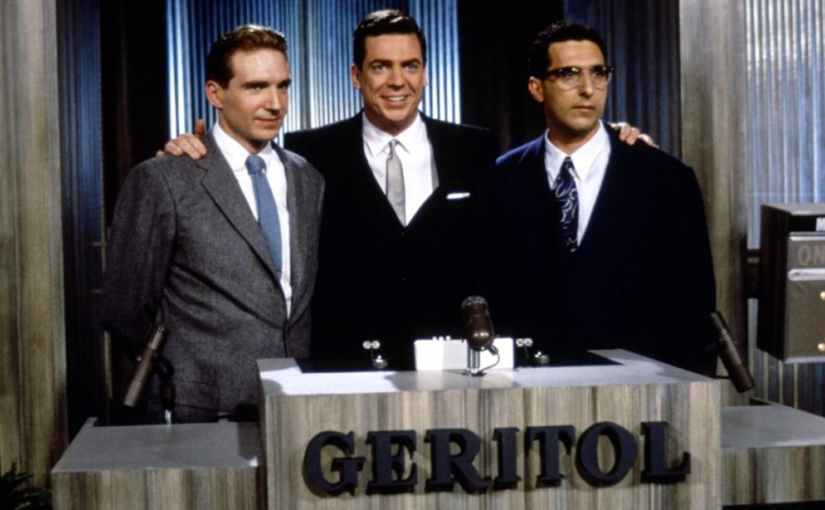
It’s 1957, and Sputnik captures the world’s attention at (or at least near) the height of the Cold War. To distract themselves from Sputnik’s implications, Americans tune their TV sets to the most popular game show on the air: Twenty-One, in which competing contestants are asked random trivia questions while isolated from each other. These questions are something else. One multi-part question includes: “Who rode with Paul Revere? Who lent him his horse? Was it a mare or a stallion? And what was the horse’s name?” I mean, really? The current champion, Herbie Stempel (John Turturro), knows these answers and many others and has become something of a local hero, but he’s not terribly photogenic, with his oversized shoulders, those nerd goggles, and that one rotten bicuspid that you can’t take your eyes off.
Twenty-One’s showrunners decide Stempel’s run has come to an end and hatch a plan to throw the next episode to handsome young Charles van Doren (Ralph Fiennes), a Harvard professor who in real life did not look quite as handsome as Ralph Fiennes, but whatever, this isn’t a documentary. Both Van Doren and Stempel comply with this plan, but the scenes in which they make their decisions felt contrived, or false, or something. I was never convinced of their motivations. Stempel needed the money but was supposedly swayed by the possibility of being awarded his own “panel show.” Van Doren clearly didn’t need the money and even turns the offer down at first, but then he changes his mind because…I guess he needed a way to live up to his Pulitzer-Prize-winning father? All the pieces are there, but it’s never fully explained until his final speech in front of a Congressional committee.
The story engine involves a young DC lawyer named Dick Goodwin (Rob Morrow) who gets a whiff of potential scandal and, eager to make a name for himself – as a possible parallel to Van Doren himself – does some independent investigating. His digging leads inevitably to Stempel, who is more than happy to name names, but whose irascible personality makes him a less than ideal witness. Things get interesting when he interviews Van Doren. He is clearly suspicious, but no hard evidence appears…until he watches an old clip of a previous Twenty-One contestant who appears to give an answer the host was not expecting…
I don’t know how relevant this is, but I feel compelled to observe that director Redford seems to have phoned in a lot of favors when it came to casting Quiz Show. In addition to the fine performances from the leads (Rob Morrow is outgunned by Turturro and Fiennes, but he holds his own), the supporting cast reads like a Woody Allen picture: David Paymer, Hank Azaria, Christopher McDonald (perfectly cast as the smarmy, superficial host of Twenty-One), Mira Sorvino, Martin freaking Scorsese, and walk-ons by Timothy Busfield, Ernie Sabella, Barry Levinson, Mario Cantone, Illeana Douglas, Calista Flockhart, and a blink-and-you’ll-miss-him Ethan Hawke. Redford clearly wanted to make sure his canvas was deep and well-drawn, and not just with the impeccable period production design.
But to what end? I went into Quiz Show thinking it would involve a much deeper conspiracy than just two showrunners who, following orders from corporate, simply bribed several contestants to follow a scripted playbook. About halfway through the movie, I realized there was not going to be much more to that part of the story, and we were going to follow the lawyer on his quest to uncover the truth, and I was like, “…that’s it?” Does that make me guilty of criticizing the movie that I wanted it to be, instead of criticizing the movie itself? I’m not sure. Rightly or wrongly, I felt the movie wanted me to empathize or sympathize, or one of the -izes, with Van Doren. But I was not moved to goosebumps by Van Doren’s final speech at the end of the film. I found myself siding more with the committee member who says, “I don’t think an adult of your intelligence ought to be commended for simply, at long last, telling the truth.”
(I suppose a case could be made that the whole film is a parable for Watergate, still several years in the future; Nixon is name-dropped a few times. The end credits inform us that NBC and Twenty-One’s sponsor, Geritol, were never indicted because their underlings claimed full responsibility for their actions, much like Haldeman, Ehrlichman, and the rest. Does the buried subtext of America’s lost innocence make Quiz Show a better film? Maybe a little, but only when you stand back from it, not while you’re watching it.)
 2 UNPAID MOVIE CRITICS!!!!