THE COLOR OF MONEY

By Marc S. Sanders

The Color Of Money is the first and only time that director Martin Scorsese tackled a sequel of sorts.  Paul Newman returned to the screen as Fast Eddie Felson, the hustling pool shark from thirty years prior in The Hustler.  That movie established his career on a bigger scale going forward.

Fast Eddie is older now, and wiser.  He’s much more humbled as a bar owner with a conservative amount of cash on the table to stake younger pool players for small time wagers.  A young John Turturro is who he relies on and quickly loses faith in when a brash, cocky kid named Vincent Lauria (a perfectly cast Tom Cruise) easily undoes his opponent. 

Eddie sees the talent in the kid.  He’s got a helluva break and clears a game of nine ball with as much speed as he has conceit.  What he lacks for in brains and instinct is made up in Vincent’s cool and mature girlfriend Carmen (Mary Elizabeth Mastrantonio in an Oscar nominated role).  It does not take long for Eddie to coach her into realizing that together they can make a lot of money off of what Vincent can do in pool halls across the country.  If only he’d listen to them and do what they tell him to do. Vincent can’t comprehend how sometimes you win a whole lot more, when you lose first.

Scorsese works his camera like a swinging Steadicam.  When he gets close ups of this trio of actors, it’s never just a close up.  He’ll position his lens in a northward direction and then swing around east.  Newman, Cruise and Mastrantonio trust the eye of the camera to follow their performances.  There’s an energy to this kind of shooting.  It makes for a great style.  Scorsese was doing this novel kind of filmmaking, going all the way back to 1971 with Alice Doesn’t Live Here Anymore.  The director is so favored because as typical as a script might seem by its title or its prose, he’s going to find an exhilaration to its narrative.

Along with the director’s resident editor Thelma Schoonmaker, there’s a crackle and quickness to the many variations of pool play – much more playing than I believe was featured in The Hustler.  Schoonmaker makes sure to cut in the cracks of the pool balls as they collide with one another.  The blue cue chalk snows off the tip of the cue sticks.  Reflections of the players appear in the shine of the balls.  Close up profiles of Cruise and Newman lower down into frame just before they take their shots.  Before the kinetic energy found in later films like Goodfellas and The Departed, Scorsese and Schoonmaker were already putting their tag team best at play in The Color Of Money.

Yet, all of this is style with not so much substance.  What kind of story does this next installment in the legacy of Fast Eddie Felson have to say?  Not much really.  While the three actors are doing top notch work, the conversations run very repetitive and do not build toward higher stakes or developments.  Time and again they argue over Vincent’s refusal or naivety to understand the hustling strategies that Eddie has in mind.  Carmen gets it but she goes her own way more often than cooperating with Eddie.  Simply, this is a story of the protégé not grasping what the mentor is trying to teach, and it never evolves from that problem.  It gets stagnant.

What changes within the second half of the film is the introduction of a championship pool tournament in Atlantic City.  Therefore, it’s easy to expect a showdown between Vincent and Eddie.  It happens and there is a twist of a dagger included, but then when the real competition is about to begin, Scorsese concludes his film.  Does it matter who is the better player?  I don’t know, but as the film is wrapping itself up, one character gets short changed.  When that’s discovered, the film opts to also shortchange the audience.  I didn’t think that was very fair.

I think about the notorious ending to the HBO series The Sopranos.  Sure, it’s an ending no one will ever forget but for all the wrong reasons, and I defiantly believe it is because the storyteller ran out of imagination or lost his confidence in upholding an ending that he really wanted.  I feel the same way with The Color Of Money.  The film establishes the skills, intelligence and capabilities of these characters.  Yet, when you take the tool kits away from them, the building never gets completed; only left abandoned.

I’m drawn to watch The Color Of Money.  Michael Ballhaus’ photography is smokey and colorful. I can’t get enough of Paul Newman’s gravelly vocal inflections or even how he unfolds hundred dollar bills from the roll in his pocket.  Tom Cruise humbles himself to look like an idiotic jerk and it works well against the maturity of his scene partners.  Mary Elizabeth Mastrantonio oozes sexual appeal with a lot of brains to uphold the cons.  She has sensational scenes with Paul Newman.  There’s a coolness to the picture because of the cast, the settings, the sounds, the visuals, the editing and the direction. 

This film arrived in 1986 with rock music from the likes of Eric Clapton and Phil Collins.  Beyond Miami Vice and an assortment of John Hughes teen flicks, these artists were making for effective needle drops of atmosphere in films from the 1980s.  Scorsese’s use of the camera keeps me engaged, but when I look at what the characters are anchored to only do, and never rise above, the film does not hold the weight of other character studies that several of Newman’s and Scorsese’s pictures were so astute at achieving.

One scene transcends the arc of Newman’s character and it works beautifully within or out of the context of the picture.  A relatively unknown Forest Whittaker portrays an unlikely kid who goes up against Fast Eddie. As the long scene evolves over their pool competition, the writing hearkens back to the weaknesses and torment that defined Eddie Felson’s character in The Hustler.  If you watch the first film and then jump over to this scene, you recognize a connection for the protagonist of both pictures.  Beyond that The Hustler and The Color Of Money stand a long distance apart from each other.  This scene though is always a favorite of mine for the eventual Oscar winner, Forest Whittaker.  Watch how Whitaker holds his cue stick when he exits the scene.  Think about how he picks the cash up from the table after Newman drops it.  Consider, what his character Amos really means when he asks Eddie: “Do you think I need to lose some weight?”

Had The Color Of Money used more of Whitaker’s character in the film along with the other three, there might have been something more solid to say and introduce within the world of pool hustling with a 1980s barroom vibe.  Same could be said if John Turturro’s character was utilized more.

Paul Newman received the Oscar for this picture.  The actor was nominated seven times before, having never won and the irony is by the time this nomination arrived, Newman opted not to attend the ceremony.  Roles in films like The Verdict (for which he should have won the award) and Cool Hand Luke were much more memorable and fleshed out.  I’d argue Newman likely knew this was not his best performance because it was not the best written of his long-established career, and so he genuinely did not expect to win.  Because he won, it became a celebration of his legendary status as an actor who should have been taken much more seriously, much sooner.   (Two more nominations would follow in Newman’s career.)
THE HUSTLER

By Marc S. Sanders

To get inside the turmoil that Fast Eddie Felson feels requires witnessing his highs and lows, all within a forty-hour time span, which equates to about thirty minutes in movie time.  Fast Eddie is The Hustler, and he was famously portrayed by Paul Newman, arguably his breakthrough role as a top billing super star.

Felson is a cocky, hard drinking pool player.  He’s got talent, but no matter how much he wins he’s always the loser because he has no discipline.  Eddie and his partner Charlie (Myron McCormick) travel from town to town, entering pool halls and setting up a bait and catch for some quick cash.  Charlie keeps his cool and treats the act like a profession.  Eddie has no subtlety.  Because he’s so how high on his expertise and what it earns him, he now only has his eye on dethroning the best in the country.  Eddie wants to take on Minnesota Fats (Jackie Gleason, in his only Oscar nominated role).

Fats sure looks intimidating.  Gleason handled his extra weight beautifully throughout his whole career, whether it be with his outrageous Ralph Kramden comedy, or when he was just being stand up Gleason for a live audience.  As well, his large frame appears kingly when he enters the pool hall.  He’s dressed to the nines with his hat, overcoat, silk tie, cuffs and studs, a cigarette in his hand, and the red carnation confidently tucked in his lapel.  The movie is in black and white, but that little flower had to be red if adorned by Minnesota Fats.  No question about it.

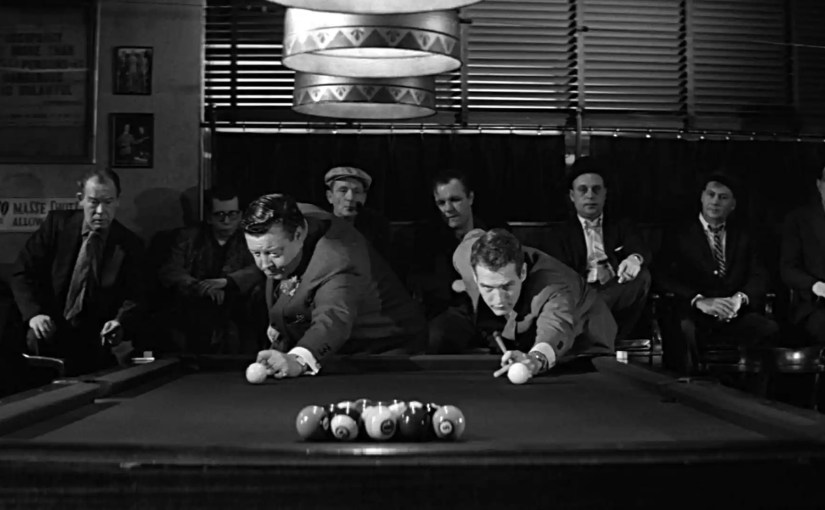
Newman versus Gleason in the first section of Robert Rosen’s drama is stunning to witness.  Like the actors who portray these characters, the antagonist was already a legend, while the up and comer was on the brink of higher class.  Both are the best of the best at pool, but as this scene progresses, with the regulars at Ames Pool Hall watching with their burning cigarettes and stained whiskey glasses in hand, the competition becomes a fierce and eerily quiet test of endurance.  Fast Eddie can keep on winning and winning, round after round, hour after hour, taking thousands of dollars out of Fats’ pockets, but if the fat man doesn’t surrender, has anyone really won or lost?

The Hustler isn’t so much about pool playing as it is about being a hustler or a con man who has no way to be genuine with himself or others in his life.  After the showdown between the two has finally concluded, Eddie gets acquainted with a woman who frequents the nearby bus depot.  Her name is Sarah (Piper Laurie), another hard drinker and someone who is not looking for love or companionship but will get trapped in Eddie’s charm.  What’s at play though is if their relationship, based initially on sex and booze, has anything more substantial to uphold their quick connection.  That is about to get tested by another member of this cast.

Bert Gordon (George C Scott) is the high stakes investor ready to front Eddie with a lot of money to go on the road and clean up on other wealthy players at the table.  Bert recognized a thoroughbred when Eddie went against Fats.  Now he wants to use him, but will Sarah serve a purpose or become a distraction in Bert’s plans for himself first, and Eddie second?

There’s a lot to think about when summing up The Hustler.  It’s not a typical sports film with the standard training montages.  The protagonist doesn’t necessarily get a beat down, only to triumph by the end.  Rosen’s film goes deeper than the pool playing that rests on the felt table surfaces.  Rosen co-wrote this script based on a novel by Walter Tevis, about a man overcoming the demons pecking at his attributes and skills.  When he’s not the trickster, he must ensure that he’s not getting tricked.

I was first introduced to Fast Eddie Felson with Martin Scorsese’s follow up picture called The Color Of Money, released twenty-five years after this film.  I like the coolness and rhythm of that film, but it’s mostly an exercise in Tom Cruise machismo.  It was only later that I saw The Hustler per my dad’s advice.  I didn’t care for it the first time I saw it.  Once the first act was over between Newman and Gleason, I found the picture to be slow moving and devoid of much energy.  I could not relate to the long sequence of Eddie getting involved with Sarah.  Unlike Scorsese’s film, Rosen does not rely on much music and quick edits to keep you alert.  It felt more like a movie drowning in the characters’ own drunken stupors.

Now that I have seen the film for a second time though, many years later, I can’t help but recognize the themes that carry over to The Color Of MoneyThe Hustler works better than its sequel because it functions as a character study in maturity and endurance.  The Color Of Money sets itself up that way for the Cruise character. Yet, I’m not sure it reaches a conclusion to any of the arcs or transitions for either an older Eddie Felson or for the hot shot 1980s kid, Vincent, the Tom Cruise character that Eddie mentors.

The Hustler has triumphs, but it has some shocking heartache for several characters as well.  Eddie has much to overcome internally as well as physically throughout the course of its narrative.  This fictional story had to be captured within this certain section of time (six months to a year, I think) to show how these appealing, yet cursed, individuals forever change one another.  After the film has closed, Rosen brings up the closing credits in the quiet pool hall allowing his characters to pack themselves up and walk out of frame.  There is something open ended to when the film chooses to stop. The viewer may think for a while after it’s over.  Rosen allows the viewer to take his last gulp of whiskey or bourbon and put out his cigarette and throw on his overcoat before stepping out into the cold late hours on the wet sidewalk below.

There are many impressive pool shots on display, thanks especially to the professional Willie Mosconi.  Shots are also done beautifully by Newman and Gleason.  Absolutely amazing to watch what they accomplish with a cue stick.  However, you don’t watch The Hustler for just trick billiard shots.  Rather you look at this intense drama to see a man struggling to be a winner or remain a loser.  What you realize very early on is that the outcome is never measured by how much money is wagered or what lines a man’s pockets.  Instead, The Hustler is assessed by what these people choose to do next.  Play or not play.  Bet or not bet.  Hustled or not get hustled.

SLAP SHOT

By Marc S. Sanders

Slap Shot is to hockey what Caddyshack is to golf.  It is rude, crude and unapologetically harsh in its language, its temperament and with the memorable fraternal trio known as the Hanson brothers unforgiving with punches, slugs, checks and body slams.  The wardrobe looks dated (some of the ugliest plaids you have ever seen) and it was produced during a time when hockey players could opt not to wear helmets but it is still outrageously funny.  Best of all, Paul Newman, the guy from more upscale, sophisticated fare like Cat On A Hot Tin Roof, The Hustler, and Hud, leads the cast.  Some of the best actors are also the best comedians.  (Look at Robert DeNiro, Donald Sutherland and Clint Eastwood as well.)

The Charlestown Chiefs are the worst hockey team in the Federal League.  When the local Pennsylvania mill has announced that it is closing, it does not look good for the team as attendance will drop lower than what it already is.  The coach and oldest teammate, Reggie Dunlop (Newman), reaches for a few last-ditch efforts to elevate a demand and an appreciation for the Chiefs. 

First, he turns to reporter pal Dickie Dunn (M Emmet Walsh) and drops a made-up rumor that a Florida retirement community is interested in buying and relocating the team down south.  Then, it dawns upon him to antagonize opposing players which will lead into a series of goon fights.  His three newest recruits, the four eyed Hanson Brothers work best at bloodshed.  The enhanced violence lead to wins and suddenly the Chiefs have a new fan base that follows them on the road and sells out their home games.  Only one player, Ned Braden (Michael Ontkean) is against this new approach.  He’s college educated with a love for the game and refuses to stoop to Reggie’s level. A side story has Ned struggling with his marriage falling apart with his alcoholic wife (Lindsay Crouse).

In the meantime, as the rumor of the buyout stays alive, Reggie does his best to find who exactly owns the team.  He wants to convince that party to keep the organization running. 

Paul Newman owns this film despite a collection of fantastic characters that embody the team.  There’s the French-Canadian goalie who is not sharp at delivering proper English.  Killer Carlson (Jerry Houser) quickly develops a knack for being more of goon than a hockey guard. The team’s manager played by Strother Martin (a regular mainstay co-star in a series of Newman films) has to get the team to catwalk model the latest in fashionwear furs, and there’s Francine (Jennifer Warren).  She’s Reggie’s ex-wife, who still shares a thing with him but will not recommit while he continues to play hockey.

George Roy Hill (The Sting, Butch Cassidy And The Sundance Kid) is the unlikeliest of directors for a foul-mouthed film like this and just knowing that seems to make Slap Shot all the more rebellious and appealing for repeat views.  It’s as if Newman and Hill decided to lift their veil of innocence and join the ranks of the worst obscene.  These guys just said “Aw fuck it.  Let’s make the movie.”  I smile each time a sharp guy like Paul Newman delivers an F bomb.  It’s shocking, but it also works so perfectly.  Hockey is anything but delicate fare.

There are dozens of fight scenes in Slap Shot and normally I might claim exhaustion with its repetitiveness.  Thanks to Hill’s direction, every check or punch or wallop is caught differently.  No one is safe; the fans, the radio announcer, the referees, the organ player, the players.  All of them are in the line of fire of a puck or a punch.  While it should, none of what you see ever looks the same.  So, every contact in this contact sport brings one more laugh after another.  Absolutely hilarious!

The Hanson trio (played by real life hockey players – Jeff and Steve Carlson, David Hanson) became a pop culture sensation in cinema with the release of this film.  The image of these three goons, who look like nerds playing with racing car toys, is as uniquely identifiable as Arnold Schwarzenegger in his Terminator get up.  You can never forget the Hanson Brothers.

Screenwriter Nancy Dowd came up with the idea for Slap Shot after listening to her brother’s experiences of being on a minor league team.  Most of the characters she developed were based on actual players that Ned Dowd played with or against. 

I always like when a movie can teach me how an industry works.  With Slap Shot, as slapstick and raggedy as the material proudly is, there’s a mentality to witness and realize.  These guys are literally this brazen, crude and unrepentant, but like Newman’s character Reggie, they’re not stupid or unlikeable either. 

The conclusion of the picture is the championship game. It works because it performs against the grain of what the characters did to get to this point in the story.  The first period break in the locker room is hilarious with Strother Martin going off the rails while Paul Newman is muttering hilariously in the background.   What eventually sends this final game into the stratosphere is unexpected and hilarious. 

Slap Shot triumphs because it was never careful in its comedy.  It’s obscene, prejudiced by today’s standards and yet I do not believe most audience demographics would be offended because there’s an understanding in what it means to be a goon on a hockey team. 

Slap Shot may be a movie of its time from nearly fifty years ago, but it still holds up with big laughs and hilarious set ups. If I need to be more formal in my praise, it’s one hysterical fucking movie with a great fucking script.

Now cue the National Anthem because I’M LISTENING TO THE FUCKING SONG!!!!!

THE VERDICT

By Marc S. Sanders

Sidney Lumet is a master filmmaker at shooting predominantly talkie films. In The Verdict by David Mamet, his best special effect is, at least, the just as legendary Paul Newman as washed-up alcoholic attorney Frank Galvin. Lumet opts to shoot Newman for the screen talent he is. Occasionally, his camera points up at Newman, who looks as if he will fall over. Lumet also makes Newman look great as he runs down a hallway, or with a stare of his familiar blue eyes. The chemistry of camera and performance are blended rhythmically.

Alcoholism has been depicted countless times, but Newman’s interpretation ranks at the top of the list. He can’t function without his drink whether it’s gaining a high score on pinball, flirting, reading a brief or even getting a fast protein fix by dropping an egg yolk in a beer. Paul Newman makes you wonder if Frank Galvin is going to pass out or fall asleep even while he’s barely practicing legal brilliance. He toes the line beautifully between coming undone and barely squeaking by. This is one of his best roles ever.

Frank is given a chance to salvage himself as goes up against the Boston Archdiocese and the hospital it owns in a case of medical negligence, who are represented by a conniving antagonist in the form of James Mason with his limitless resources, power, strategies and army of lawyers. If this were a silent film, I’d buy it with Mason twisting a handlebar mustache. He’s absolutely a man you love to hate.

The dialogue crackles against simply the inflection of vocals from Newman, Mason, an unexpected Charlotte Rampling as Galvin’s sudden love interest, a difficult judge played by Milo O’Shea, and Frank’s assistant played Jack Warden. The delivery of lines, the twisty double crosses, and conflicts play to the precision of great Shakespeare. So much so that when on the rare occasion these characters curse or the ominous cue of music steps in, it’s all shocking and applauded.

The settings are great for atmosphere too. Worn in leather chairs, polished cherrywood tables and courtrooms with their squeaky floors. This is a well-worn Massachusetts backdrop of legal reputation and intimidation.

Every member of the filmmaking team from Lumet to the cast, to the composer,Johnny Mandel, and David Mamet’s fantastic script have been thought out and measured to completion.

Some will say this film is dated (rotary phones, ladies’ hairstyles, wardrobe; year of release was 1982). I say its themes are still significant. Power is something that must always be overcome by a weak, flawed protagonist. Whether or not Frank Galvin can do it, matters not. It’s the struggle that’s important to follow in a film like The Verdict.

THE TOWERING INFERNO

By Marc S. Sanders

The kid who played Bobby Brady of TV’s The Brady Bunch and Gregory Sierra (Julio from Sanford and Son) star alongside OJ Simpson and an Oscar nominated performance from Fred Astaire in The Towering Inferno. This is one of the best films to be churned out of the Irwin Allen disaster machine of 1970s movie making.

William Holden is the proud builder of a beautiful new skyscraper in the heart of San Francisco. Paul Newman is the sensible architect who manages to acknowledge what’s wrong the construction of the building. Namely, a jerky Richard Chamberlain, as the building’s electrician, opted for faulty, less expensive wiring that conveniently overheats on the eve of the building’s grand celebration that includes a Senator (Robert Vaughn) and the Mayor with his wife in a loud, baggy Pepto Bismol colored dress. Seriously, it’s never hard to make this woman out among a sea of formally dressed extras who are celebrating on the grand opening located on the building’s promenade floor. Floor number 135 to be more precise. Because it’s so high up, we are treated to a scenic, outside elevator that’ll eventually not make it to the ground allowing a couple of screaming extras to be held in treacherous suspense. Good stuff here, for sure.

Steve McQueen’s coolness eventually arrives as the main fire chief leading the high rise charge against the blazes. His Thomas Crown Affair co-star, Faye Dunaway, is here to cue the romantic rhythms of John Williams’ score, and to hop into bed with Newman for some afternoon delight.

The story is that Newman and McQueen were at odds for who was getting top billing. Watch the very beginning of the film for the inventive compromise for the name placement in the credits.

The real stars of this who’s who cast are the special effects. Now I truly mean this. Nearly fifty years later, and the visual effects of the massive fires, explosions, helicopter sequences, and enormous heights still hold up. There’s lots of good footage that burns up, crushes, floods and drops a handful of extras for a fast paced three-hour epic disaster flick.

Astaire might have been the sole acting nominee but I just can’t get over how the debonair, prime for a Love Boat appearance with no hair out of place Robert Wagner didn’t get any recognition. This man puts just a damp washcloth on his head, promises his half naked sweetie that he’ll “be back with the whole fire department,” and sprints straight into the flames for the grandest death scene in film history. It’s a glorious scene for sure when Wagner buys it. I cheer every time I see it. The dude just face plants into the flames. Doesn’t even bend down or kneel to pray. This guy just topples over like a Jenga tower, with the washcloth remaining on his head.

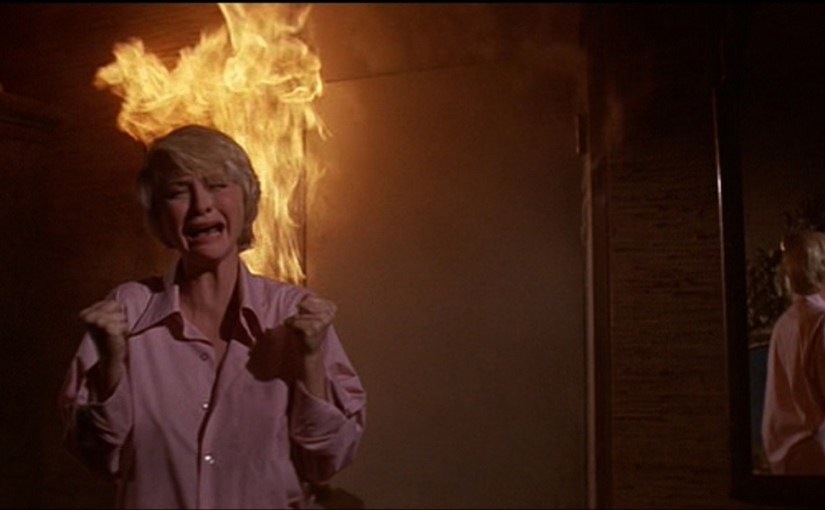
The Towering Inferno amazingly did not beat out The Godfather Part II for Best Picture. I know. I’m stunned as well, reader. Uh huh! Nevertheless, it’s still worth a watch all these years later. If anything, you get to see some pretty eye-popping visual effects and action scenes directed personally by Irwin Allen. You also get to familiarize yourself with the best talent in Hollywood that was working at the time. There are also lots of great moments amid the soapy cheesiness of the script.

Most of all, and this is where I finally get sincere, it’s a film that does not make light of our country’s firefighters who continue to risk their lives everyday so that any one of us can survive. Not enough films embrace the proud men and women who stand between us and danger. The Towering Inferno salutes that immeasurable bravery.

THE STING

By Marc S. Sanders

Find me a better combination of script, cast, direction, score, art direction and costume and I guarantee it’ll take you some time and effort.

The Sting, directed by George Roy Hill and written by David Ward, is the kind of movie where you uncover something new every time you watch it. It’s because the film is all in the minute details to assemble the beginning to the middle to the end. The film is wisely edited in step by step chapters; The Set Up, The Wire, The Shut Out and eventually on to the satisfying The Sting.

The audience is even set up but you’ll have to watch to see how. I dare not spoil it.

Cars, trains, drug stores, diners, a carousel, dames, gangsters, Bunko Cops, Grifters; all are elements needed for the best confidence men superbly played by Robert Redford and Paul Newman, along with a supporting cast like no other, Eileen Brennan, Harold Gould, Charles Durning, Ray Walston, Jack Kehoe and the best villain, or rather “mark,” Robert Shaw.

This is one of my favorite movies. When I first saw it, I was probably age 10 or 12. I understand next to nothing of what was going on. It was the music that drew me in first followed by the sharp suits designed by the legendary Edith Head. The movie’s script is its greatest asset but visually it is just as fun. The 1930s Chicago setting is a character in and of itself. Newman cheats beautifully at poker against a temperamental Shaw, and gets him!!! “You owe me 15 grand pal.” When I first saw it, I didn’t know what he was doing or how he did it. How did he switch hands? I was enamored with the hands that were dealt and the poker chips on the table, but I loved it when the better cheat won out.

The second iteration of the Hill/Newman/Redford trifecta (following “Butch…& Sundance…”) is just plain fun. It was the fun that earned it a Best Picture Oscar.

No other film has come close to duplicating it. Maybe the Clooney/Pitt/Damon version of “Ocean’s 11”? I don’t know. However, if you love that film, you owe it to yourself to watch “The Sting.”

The Sting is…”the quill!”

ABSENCE OF MALICE

By Marc S. Sanders

Maybe more often than not, the films I see about journalism seem to convey the reporters as heroes seeking the truth despite the threats and the strict laws of the first Amendment and so on.  They meet informants in dark garages and outrun speeding cars trying to run them down before the story hits the papers.  They accept being held in contempt of court to avoid revealing a source.  They’re heroes!!!! It’s movie stuff, right?  We’ve seen it all before.  What about films where the newspaper writer gets it wrong from the start, and then sees the ramifications of the recklessness committed?  Absence of Malice, from 1981, is that kind of picture.

Sally Field is a hungry thirty something reporter named Megan Carter with connections in the Miami prosecutor’s office.  When she gets a whiff of a story that implies a man named Michael Gallagher (Paul Newman) is the prime suspect in the disappearance of union head, she runs with it and her editor is happy to make it front page news.  However, just because Mr. Gallagher is the son of a deceased and reputed bootlegger with mob connections doesn’t make him guilty of anything.  Also, has an investigation into his affairs even begun to happen yet?  Just because it walks like a duck, well….

Sydney Pollack goes pretty light on a serious subject matter here.  It’s just awful to see a film legend like Newman be a cold blooded killer.  Worse, it’s beyond reason to see Sally Field as a woman without scruples.  They’re too likable.  So, Pollack with Kurt Luedtke’s Oscar nominated screenplay, play it safe.  Forty years ago, when this film came out, I might have accepted what’s on the surface with Absence of Malice.  Today, however, I appreciate the conundrum, but the residual effects offered up by the film never seem to carry much weight.  The stress doesn’t show enough on Newman and Field.  A suicide of another pertinent character hardly seems monumental to either of them.  Heck, there’s even time for romance between the two leads despite the slander committed by one against the other.  Another film by Pollack, Three Days Of The Condor, committed this same mistake.  It’s hard to accept a romantic angle when the characters barely know each other and what they do know of one another is hardly favorable for each of them.  I can imagine the marketing campaign for this ahead of the film’s release.  If you got “Blue Eyes” and “The Flying Nun” in a film together, well then, they gotta hook up and never, ever make them ruthless.  Audiences would hate that!!!!

The film reserves the shiftiness of the situation for other actors in the film like Bob Balaban.  He certainly plays the part well as a manipulator in search of a guilty party, even if it means indicting an innocent person.  The best surprise is the appearance of Wilford Brimley in the big close out scene who sums what has occurred and then lays out who is responsible for what and who is not responsible.  It’s the best written role in the film and it reminds me what a shame it is that Brimley did not get any Oscar recognition during his career.  (I still say he was one of the greatest unsung villains in film for his turn in Pollack’s The Firm.)

Even the soundtrack music from Dave Grusin feels inappropriate here.  It’s too energetic and full of life with piano and trumpets.  When you consider the term “absence of malice” and what it means to a reporter questioning her journalistic integrity, and then furthermore what significance it has to a newspaper article’s bystander, it seems to hold a lot of weight with disastrous repercussions.  Grusin’s music says otherwise.

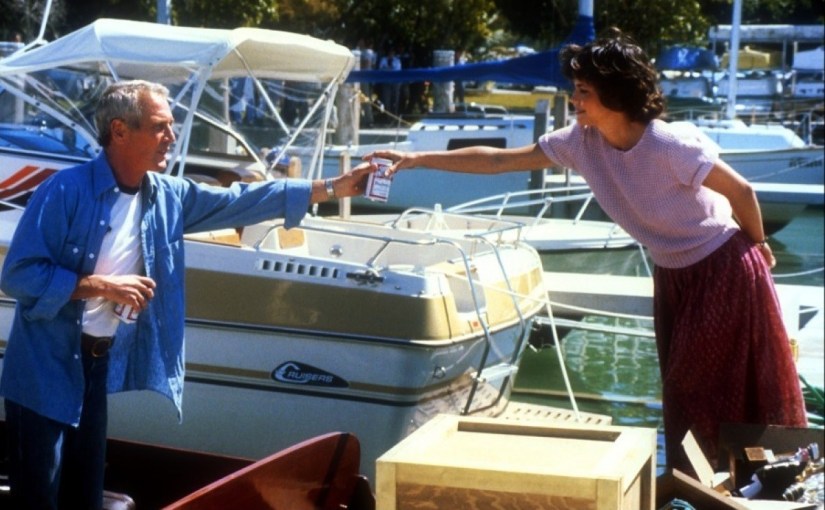
It’s always a pleasure to go back and watch Paul Newman, and Sally Field in her early career.  These are great actors.  They do fine here, but the material is not sharp enough for what they can do.  They’re too relaxed.  On the other hand, the subject matter is perfect for heightened movie drama.  I can only imagine what Sidney Lumet would have done with this picture, considering films like Network, Serpico and The Verdict.  The execution of Pollack’s film simply does not live up to the terrible dilemma of an innocent man being publicly smeared.  Think about it.  At the end of Absence of Malice, I don’t think the intent is to wish and hope and yearn for Paul Newman and Sally Field to sail away on his beautiful boat into the sunset.  Yet, that’s what Pollack and Luedtke seem to have left us with.