UNCOMMON VALOR

By Marc S. Sanders

In the decade following the Vietnam War a common denial (or ignorance, maybe) went towards American soldiers who were missing in action.  Many men were theorized to be prisoners of war long after the armed forces left the country, ending a losing battle with record numbers of casualties.  A handful of films of the 1980s brought focus to this topic, as a means for adventurous entertainment.  Chuck Norris had a series of Missing In Action films.  Even light action fare TV shows like The A-Team and Magnum PI brought attention to this issue.  Most predominantly, the possibilities of POWs were ingrained within Sylvester Stallone’s box office bonanza of Rambo pictures.  In 1982, Ted Kotcheff directed the initial entry of that series, First Blood, and he zeroed in much more precisely the following year, with Uncommon Valor.  

Gene Hackman is retired Marine Colonel Jason Rhodes who begins a decade long campaign convincing the U.S. government to seek out those who were left behind and are likely being held as prisoners of war.  His motivation stems from his belief that his son Frank is likely being held captive in a camp located in northern Laos.  

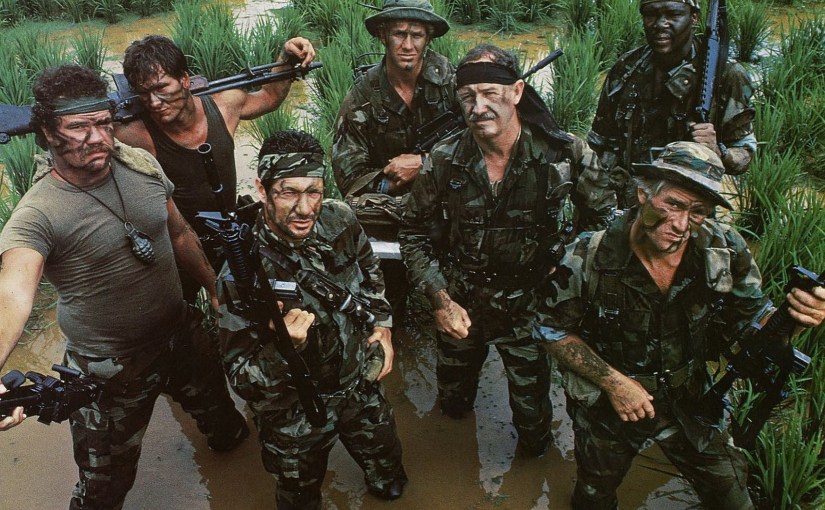
By the time 1983 arrives no action of recovery or rescue is taken.  The Colonel is committed to bearing the responsibility.  He appreciatively accepts financing of his own mission from an oil tycoon (Robert Stack) whose son might be with Frank.  The Colonel also recruits members of Frank’s unit who made it home (Fred Ward, Reb Brown, Randall “Tex” Cobb, Harold Sylvester, and Tim Thomerson). Patrick Swayze is a young guy named Scott who never served in the conflict but is an expert combat and weapons specialist who will get these men retrained for the upcoming rescue.  He also has his own reasons for partaking of this mission. 

Uncommon Valor is sporadic on humor and focused on the adventure and resourcefulness.  The first half provides footage of how the squad gets reacquainted with each other and the jungle elements they left behind in Vietnam.  They practice routines outlined by the Colonel with ground patrols, detonators, hand to hand combat, artillery, sabotage, and chopper rescue.  The second half follows them back into the Asian country where they have to obtain weapons and supplies, while making connections with locals who will escort them through the dense jungle area towards the camp.  

This is a rare occasion where Gene Hackman is not applying much of his acting craft. He is primarily going through motions of Kotcheff’s film direction with a script rumored to be co-written by Wings Hauser (also a producer on the film).  The trauma of the war is primarily carried by Fred Ward who struggles with PTSD long before it became so widely attributed to service men and women after returning from combat.  In First Blood, Stallone offered a much more substantial and convincing demonstration.  Yet, Ward does a serviceable job with a script that never goes terribly deep.

Uncommon Valor is better described as a present-day adventure picture.  It’s never boring.  There are fireball explosions and machine gun shootouts. The action set pieces still hold up with good art designs staged off the Hawaiian Islands in place of a sweltering Vietnam.  The prisoners who are recovered, supposedly held for over a decade, are chilling to look at with obvious malnourishment and dead-blank expressions.

Randall “Tex” Cobb and Reb Brown (the TV movie Captain America) are mostly doing wacky A-Team material here.  Gene Hackman, Fred Ward and Harold Sylvester are the straight characters.  

It’s not as grand as a Rambo film, but Uncommon Valor never lampoons or minimizes what was a horrifying experience for those enlisted soldiers who never came home, while their next of kin never obtained closure.  

For the 1980s, which feels like it had just passed yesterday, it’s fair to say that all those missing in action during that terrible and bloody war are no longer alive over fifty years later.  The opportunity to search and negotiate for their freedom has long expired by now.  While movies like Missing In Action, Rambo and Uncommon Valor focused on fictional triumphs that were never factually replicated, at least these films can serve as reminders for the sacrifices these people served at the behest of their country.  I’m not writing to ease lifelong pains.  All I can do is recognize, remind and be forever grateful.  These movies still serve a purpose beyond the pulpy Saturday afternoon adventures. 
POINT BREAK (1991)

By Marc S. Sanders

Stop me if you heard this one before.  Richard Nixon, Gerald Ford, Jimmy Carter and Ronald Reagan walk into a bank…

Yeah.  That’s right.  I’m talking about Kathryn Bigelow’s Point Break.  There’s a line in the movie where the rookie FBI hero, Johnny Utah (Keanu Reeves), is described by his new supervisor as being young, dumb and full of cumb.  Pretty fair assessment.

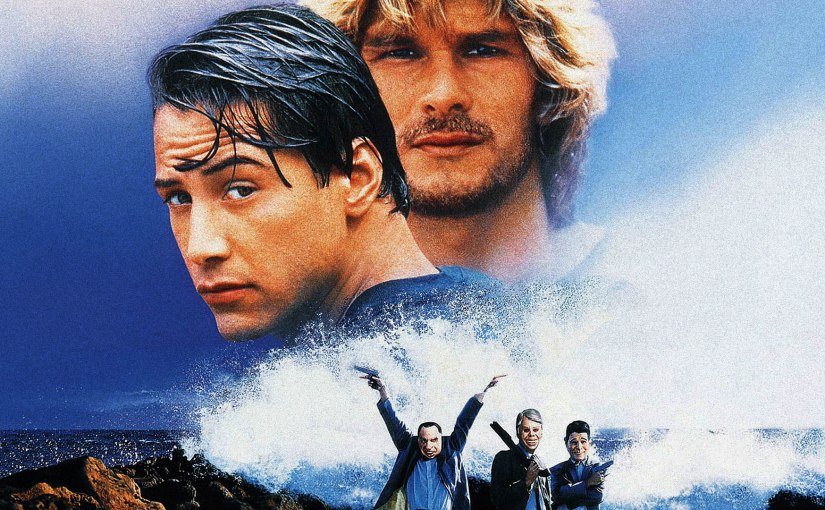
Much of this crime caper works despite the silly summary.  Agent Utah’s seasoned partner Pappas, played by Gary Busey, believes that a series of coastal California bank robberies are being committed by surfers who roll into town each year when the waves are at their most tubular.  They don silly looking rubber masks in the appearance of the Ex-Presidents of the United States to commit their ninety second smash and grab.  Fortunately, Johnny Utah looks and talks like Keanu Reeves who was raised in Hawaii and has experience playing a gomer like this in two other movies that were headlined by some dudes named Bill & Ted.  As well, don’t forget what he hilariously did in Ron Howard’s Parenthood.  Yes, Johnny Utah should fit right in with the California surf.

Point Break does not take itself seriously in its first half.  Johnny has to learn how to look the part of a surfer with a neon pink board amid the colony of saltwater dwellers.  Standard stuff pops up like the angry supervisor (John C McGinley) who screams about no progress being made.  Unfortunately, a romantic love interest named Tyler has to enter the fold played by an actor I’ve never been fond of, Lori Petty.  I’m supposed to believe that she is going to teach Johnny how to ride the waves and chastise him when he’s doing it wrong, and then he’s going to fall hard for her when she delivers one arbitrary piece of dialogue after another.  “What’s this pig board piece of shit?”  “Too much testosterone around here. Later!” Also, for those intimate scenes in the dark calm waters with the moon and stars gleaming in her eyes, Tyler has to ask Johnny something along the lines of “What’s that strange look you got?”  and “There it is again.”  Maybe it’s not all Petty’s fault.  The script doesn’t give her much to work with honestly.  Nothing Tyler says is relevant.  How it is delivered by Petty is not the least bit intriguing and honestly with only few nip/tucks, this character storyline could have been saved for special edition DVD featured deleted scenes that you’ll only watch once and never share on You Tube. 

On to the good stuff. 

You can see how amazingly talented a director like Kathryn Bigelow really is and it is no surprise that a couple of decades of experience led her to a well-deserved Oscar for directing The Hurt Locker.  Going all the way back to films like Blue Steel and Point Break demonstrated that Kathryn Bigelow made a name for herself based on stellar filmmaking skills.  Just look at the sky diving footage alone.  You see all the tricks as the camera follows the daredevils out of the plane and into the sunny blue sky with genuine close ups and acrobatic flips to relish in.  Sensational work.  Gorgeous photography and smooth, unshaking camera operations. Nothing artificial in these sequences.

Moreover, there is the surfing of course.  The checkered bag guy of this action picture is another variation of a dashingly handsome Patrick Swayze with shaggy dirty blond hair, dirty blond facial whiskers and his distinctive voice that if it could be described as dirty blond it would be dirty blond. Plus, a chiseled chest to show off during a karate fight scene.  He plays a guy named Bodhi.  I guess Walter, Melvin, Murray and Jack would not be cool enough.  (My dad, uncle, and grandfathers by the way.)  While Johnny maintains his undercover investigation with Pappas watching from the outside, he becomes enamored with Bodhi and his crew.  They like him in return.  Yet are these those Ex-Presidents who are robbing the banks?

Point Break is a smarter thriller than I think the filmmakers even realized because other than Lori Petty it is cast very well with Reeves and Swayze in the lead roles and a fun cooky Gary Busey on the side.  These actors are game for the quick moving adventures that Bigelow strives for.  There’s a fantastic foot chase through the back streets of Santa Monica following one such bank robbery.  This scene alone is eligible for a Best Editing Oscar with handheld Steadicams following the running players in and out of houses, around flaming gas stations and backyards with barking dogs and dense red light running traffic getting in the way.  Amazing film work.

The surfing would have to be stellar if the antagonists are in fact surfers. The photography is magnificent with narrow waves curving over the cameras directly pointing at Swayze, Reeves and cast coming right towards the screen while balanced on their boards with golden suns hovering overhead.

While Point Break does not seem to know when to end because the credits could have rolled up on three or four different occasions, at least the film insists on having fun with itself. 

I recall in The Predator Olivia Munn’s character went to MIT with a science major that somehow also included military trained special ops in its elite curriculum. I’m expected to believe that nonsense.  On the other hand, when I see Bill’s friend Ted has graduated in the top two percent of his FBI class at Quantico, Viginia, I can buy it.  I don’t have to dwell on it. Now I can enjoy the ride from a sky diving standpoint or a choppy mariner’s perspective.  My suspension of disbelief is bought, sold and paid for. 

Point Break is a smart thriller with a dangerously fun, zippy edge to it.

THE OUTSIDERS

By Marc S. Sanders

As we are about to embark on a trip to New York City to celebrate my wife’s half century milestone (wish her a Happy Birthday, please), we decided to watch the film adaptation of S.E. Hinton’s celebrated novel The Outsiders, read by many high school juniors and seniors, and now a beloved Broadway musical.  The play has to be better than the movie.  It truly would not take much.

Francis Ford Coppola is the director of this very amateur piece that is best known for introducing a who’s who of the brightest actors that would go on to occupy some of the biggest films of the 1980s and 90s.  One of these guys, someone named Tom Cruise, is still a money maker elite. Ironically, he’s got one of the smallest roles in this film.

I can see the potential talent of C Thomas Howell, Ralph Macchio, Patrick Swayze (age 29 here), Emilio Estevez, Rob Lowe and Matt Dillon.  Diane Lane is likely giving the best performance in a next to nothing role as a could’ve been puppy love interest.  However, I said potential.  Had they been directed with just a little bit of passion, it’d be nothing but apparent. Coppola didn’t put enough work into getting this cast into shape.

Hinton’s story focuses on two factions of kids from small town Oklahoma, the greasers dressed in jeans with slicked back hair and tough guy attitudes all portrayed by the gang listed above and the Socs (pronounced Sosh), who are the spoiled rich kids dressed in school letterman jackets and khakis.  Their leader is Leif Garrett, the only known celebrity name at the time of this film’s release.  The antagonism between the groups is as evident as the Jets and Sharks.  The greasers flash their switchblades, curse and strut, particularly Matt Dillon as the fearless tough guy leader Dallas. Yet, within this screenplay, and among the performances by the whole cast, Coppola often relies on hokey, cornball drama that is on par with an after school special.  This is a lousy, rejected Hallmark card come to life. I’ve cried more at “Deep Thoughts With Jack Handy.”

The edits of the picture hide much of the bloodshed until a climactic rumble in the pouring rain presents itself with many endless, overdramatized punches and kicks that clearly don’t make contact.  Yes.  I heard Tom Cruise broke his teeth from a slug to his jaw. Otherwise, the ballet boxing of West Side Story has much more threatening smacks and cracks. 

C Thomas Howell is Pony Boy and Ralph Macchio is Johnny – the sixteen-year-olds who are overtaken by the Socs in the middle of the night. One of the prep kids turns up dead as the two young greasers defend themselves.  They hop a freight train and hide out of town, only to be brought into the spotlight when they rescue a group of little kids from a burning church. Pictures are smack dab on the front page.

The Outsiders is a very brief ninety-minute film that does not do enough to establish relationships among these kids.  Howell has the most fleshed out role.  With his two older brothers (Swayze and Lowe), Pony Boy dresses the part but his appreciation for literature and poetry by Margaret Mitchell and Robert Frost says that his life as a greaser is not for him.  His current situation does not allow for any other opportunities, though. Howell is just mediocre in his performance.  I cannot say I related to his supposed anguish and conflict.  He’s a body saying the lines and standing on his mark for the camera.

Just as in The Karate Kid, Ralph Macchio is an annoying over actor.  His character has an abusive relationship with his parents. However, we never see the parents. Frustratingly speaking, I’d question if this kid Johnny is simply a storyteller looking for attention. Why would Coppola leave out this dimension of one the main character’s home life that is frequently mentioned? Macchio looks more concerned with making sure the collar on his jean jacket is popped up with his bangs hanging down just right for a cover photo on Seventeen Magazine.  The profile that has the cute scar imbedded in his tan complexion is front and center. He always looks like he’s posing for a still shot in front of Coppola’s movie camera.  Macchio delivers the final monologue of the piece, and it’s near impossible to believe the actor truly embraced any of the dialogue of the script.  His performance appears mechanically memorized. 

Matt Dillon looks like he was genuinely trying to turn in a tough guy performance, but his moments on film, especially his final scene, look terribly edited and off kilter.  The cutaways that Coppola uses are awful, like a TV movie that is interrupted by commercials.  Only someone axed the ads from the final print and did not tape the film reel properly together.  

The Outsiders is a coming-of-age story hinged on tragedy and the yearning for a better life, particularly for Pony Boy.  Hinton’s book remains essential reading for young adults needing to relate to characters their own age.  It also serves as an effective homework assignment.  Francis Ford Coppola’s film though offers little focus on what makes any character tick or why there’s a conflict between the rival groups.  Where’s the history and backstory?  Most of the actors, especially Estevez and Cruise, come off as if they are high on sugar with incomplete sentences for lines. What are you guys doing here if not to look anything but hyperactive?

West Side Story and Stand By Me quickly found their footing for adolescent boys with insecurities and uncertain futures.   The respective settings of those films knew these misfit kids, and they in turn interacted within the environments. Coppola went the wrong route because there is hardly any bond between the kids and the other folks who reside in this picture.

From a technical standpoint, The Outsiders is a muddled mess of poorly timed original scores, from Carmine Coppola, wedged into scenes that do not call for anything to enhance the emotional heft.  The director often puts one actor’s close up at a zoom in, while a buddy will be in the foreground. This technique looks like an Olan Mills family photograph you get in the mall.  It’s cringey.  It’s hard to take seriously as well.  

The Outsiders simply does not work to acquire an emotional punch of despair and loss.  These pretty boy tough guys have no effective humor even with Tom Cruise behaving like an ugly, incomprehensible wild man and Emilio Estevez donning a Mickey Mouse t-shirt with his signature cackle.  There’s just too little to relate to anything in this picture that S. E. Hinton magnetically achieved within her pages.  Her book was published when she was age seventeen by the way. What an amazing accomplishment!

Regrettably, the filmmaker who upped the scales of the war picture (Apocalypse Now) with terror and disillusionment, and successfully delivered two of the greatest, most operatic films of all time (The Godfather movies), not to mention his smaller but shocking films like The Conversation offered little attention to what S.E. Hinton captured and impressed upon young readers.  If anything, Coppola was more concerned with shooting picturesque, midwestern sunset landscapes that honestly have an artificial texture to the eye.  Nothing from the music to the photography to the editing to the overt contrivances or the acting seems natural here.

The Outsiders is equally regarded as assembling one of the most impressive groupings of eventual male box office stars, as it is for Francis Ford Coppola’s lazy and uninspired film work.

GHOST

By Marc S. Sanders

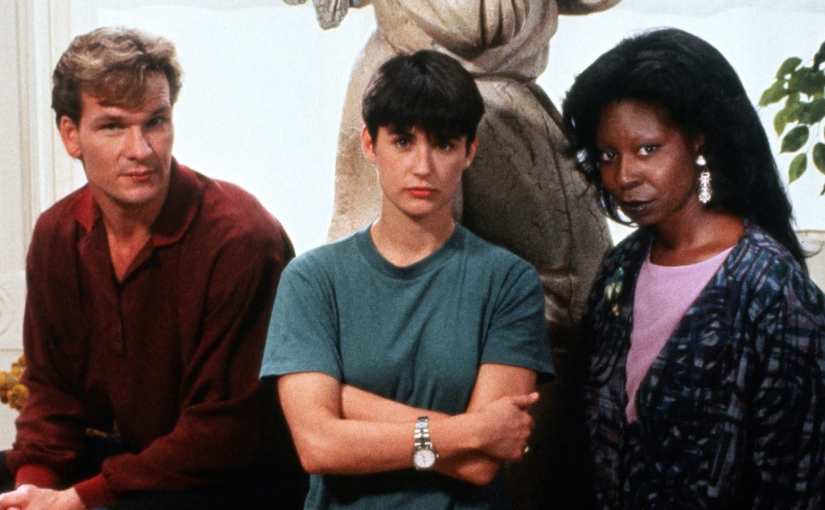
For a perfect blend of the supernatural, suspense, mystery, drama, romance and comedy, the first film that will always come to mind is the surprise hit film Ghost from 1990.  One of the zany Zucker brothers, Jerry to be more precise, who introduced the world to slapstick spoof (Airplane!, The Naked Gun) directed this film turning Demi Moore into a ten-million-dollar actress, placing Patrick Swayze ahead of his Dirty Dancing looks and earning Whoopi Goldberg a very well-deserved Academy Award.  Ghost was a film for all kinds of movie goers.

Sam Wheat (Swayze) is an up-and-coming New York City business executive who loves his new live-in girlfriend, Molly (Moore) even if he can only say “Ditto!” when she tells him she loves him.  Shortly after the picture begins Sam is gunned down following an evening at the theatre.  Unbeknownst to Molly and anyone else living on earth, Sam’s spirit lives on though, and he realizes that he was not the victim of some random mugging/murder.  Now, Sam must find out who arranged to have him killed and why, while also protecting Molly from becoming a victim.

Along the way, Sam crosses paths with a phony con artist, working as a medium, named Oda Mae Brown (Goldberg) who turns out to be the real thing when she can actually hear Sam’s voice and communicate with him.  Sam must recruit Oda Mae to be a go between for him with Molly and everyone else necessary to follow up on in order to resolve the mystery of his sudden death.

Ghost succeeded in every category of filmmaking.  Rewatching the film decades later, I believe Demi Moore should have gotten an Oscar nomination.  Her close ups on camera with beautiful, muted colors from Adam Greenberg’s cinematography are masterful.  Greenberg should have been nominated too.  He’s got perfect tints of pearl whites both on the cobble stone streets of New York with the outer architecture of the apartment buildings, as well as within the studio apartment where the couple lives.  He strives for an ethereal look with his lens. Gold often occupies Molly’s close ups with dim lighting.  Blues and blacks and steel glinting shines follow Sam’s trajectory. 

Look at the lonely scenes that Moore occupies in the couple’s apartment.  There’s a haunting image of isolation with no dialogue capturing the young actress at the top of a staircase when she eventually rolls a glass jar off the top and it shatters below.  It’s one of the moments that defines a sorrowful character, and not many cry on screen better than Demi Moore.  Later, Sam is engaging in a pursuit through the subway system and races down a steep blue escalator in the dead of night.  Zucker places Greenberg’s camera at the bottom of the escalator to show the depth of hell that Sam may be risking continuing his chase.  The images and transitions of this whole movie from scene to scene are stunning.

I mistakenly recall Whoopi Goldberg as just a comedienne doing her stand up schtick in this film.  Not so.  Goldberg looks radiant on film and while she starts out comically as the script calls for, she eventually resorts to sensitive fear of what her paranormal partner demonstrates as real within this fantasy.  There are so many dimensions to this character.  She’s silly.  She’s exact in her nature for what’s at stake and the dialogue handed to her from Bruce Joel Rubin’s Oscar winning script compliments the actress so well. Goldberg never looks like she’s working for the awards accolades. Yet, she earned every bit of recognition that followed her.

Patrick Swayze makes more out of the straight man role than what could have been left as simple vanilla.  His spirit character uncovers more and more about his afterlife and what happened to him as the film moves along. With each discovery, you’re convinced of Sam’s surprises and what he becomes capable of as a ghost.  Long before superhero films became the novelty, Sam Wheat operates like one who has to learn of his origin and then acquire his new talents and powers to fend off the bad guys.

Jerry Zucker, working with Rubin’s script, Greenberg’s photography and Oscar nominated editing from Walter Murch, along with haunting yet sweet scoring from Maurice Jarre, builds a near perfect film.  The narrative of Ghost shifts so often from comedy to crime to drama to romance and the various natures of the piece hinge so well off each other.  That’s due to storytelling and the editing necessary to smooth out any wrinkles.  You become absorbed in Jerry Zucker’s direction, especially with the movie’s most famous scene where Demi Moore and Patrick Swayze are sensually doing pottery together accompanied by Bill Medley’s rendition of “Unchained Melody.”  Watch that scene with someone you love or take it in on a late Saturday night by yourself with no one to distract you with cackles and eye rolls.  You’ll see how effective Zucker’s work is along with Swayze and Moore upholding the scene in a dark, empty apartment.  Take it as seriously as the scene was originally constructed.  (Then go watch Zucker’s Naked Gun 2 ½ for a chuckle.)

The mystery of Ghost works well with surprises if you are watching it for the first time.  You build trust with a character only to realize it is a ruse for something else.  I do not want to give too much away.  For viewers who have never seen the film, maybe you’ll see an early twist as soon as the film begins.  Maybe not.  Either way, Ghost performs very naturally, unlike a forced kind of twist that M Night Shyamalan too often relies upon.  I do advise that you not watch the trailer that was used for Ghost as I believe it deals out too many of the film’s secrets.

There are movies that I watch over and over again because I love to relive the special moments they offer.  Ghost has those kinds of gifts and yet I have not seen it in ages.  I’m glad.  To experience the picture again was such a treat.  While I recalled all of its secrets, this time I was able to take in the various technical achievements and the assembly of the piece, along with outstanding performances. 

I have no problem saying that Ghost possesses the best performances within the vast careers of Demi Moore, Patrick Swayze and Whoopi Goldberg.  Ghost still holds up. It deserves a rewatch and an introduction to new generations.

DIRTY DANCING

By Marc S. Sanders

Dirty Dancing was a major surprise at the box office. For me, it is such an eye opener because of how good it actually is, and how well it still holds up. It’s energetic and fun and a different kind of escape from the endless supply of action films and gross out comedies.

Here’s a film with a no name director, Emile Ardolino (I’m sorry, who????) and produced by…excuse me…Vestron Video???? It did not carry a cast with box office clout either, the tallest guy from The Outsiders and the older, bratty sister from Ferris Bueller’s Day Off. Yet, the film wins out in the end.

“Baby” Houseman (Jennifer Grey) arrives with her family to a Catskills like vacation resort during the summer of 1963. Usually costumed in whites, Baby is as virginal as her moniker suggests. Eventually, she gets taken with the entertainment staff who spend their off hours dancing in, shall we say, a non-conservative manner. Particularly, she falls for the gorgeous head dance instructor, Johnny Castle (macho name, dressed in macho cool blacks with macho cool shades) played by Patrick Swayze.

Every development of their relationship is telescopic. Yes! We know they’re gonna fall in love despite coming from two different worlds. They’re gonna sleep with each other. Then they’re gonna argue. Then they’re gonna make up and then they’re gonna have the big dance to close out the film with one huge extravaganza. However, it’s the material within that grabs me, and much of that is thanks to the chemistry of Swayze and Grey.

The leads dance beautifully together, and when a music montage comes up, it is adoring to see the frustration of the dance instructor with his giggling student. It’s also charming to see them work it out as well. Reader, I’ve seen this stereotypical “chick flick” many times and I still get caught up in it. The movie comes alive in their puppy love with music and dance. Hey, I got a sensitive side to me. What can I say?

The subplots of the film are lacking though. An abortion storyline really is not necessary to assemble all these characters together. Jewish high income guests meet rebellious, but mostly kind hearted, staff members. There are a couple of distracting jerks too. Something more substantial could have been here. Perhaps, a more meaningful acknowledgment where the two parties favor or do not favor each other, and why. Abortion is a heavy subject matter that does not blend well with the rest of this film, though. The fact that the script never even utters the word “abortion” tells me that the film isn’t even sure of itself with this side story.

As well, when one dancer friend (Cynthia Rhodes) needs emergency medical help, couldn’t Baby’s doctor father (Jerry Orbach) just stop to listen for the explanation? Guess not. He just chooses to stop speaking to his daughter. Thus, making it hard for Baby to hang with Johnny. This could all be resolved with a quick sentence of dialogue. As my colleague Miguel suggests however, then there’d be no movie!!! It’s called the idiot plot, I guess.

A third sub plot involves a pick pocket thief and the reveal comes ridiculously out of nowhere. It’s here to give reason for Johnny’s reputation to be threatened one more time, while Baby defends him. Now this storyline has next to no purpose of existing. Johnny’s reputation in the boss’ eyes was tarnished enough already. This is cutting room floor material.

Dirty Dancing is a film that is merited in its special talents, but not necessarily its whole story. The consistently good soundtrack of oldies mixed with some anachronistic 80s tunes work so well. The setting is completely absorbing with its mountainous camp getaway cabins and intermittent calls for entertainment activities like with its social director (played deliberately corny by comedian Wayne Knight). It feels authentic and escapist. Therefore, I look past those silly plot developments that scotch tape one enthralling moment of dance, sex appeal and music for another.

This most recent time of watching the film was especially fun as I got to witness my twelve-year-old daughter seeing it for the first time. Nothing shows how special a movie, any movie, can be than to see your daughter slap her face when Baby chickens out from doing “the lift” with Johnny during a dance performance. Later, when she finally accomplishes that feat, my daughter sat up with a huge smile on her face. If you ever ask me why movies are so special, I might just have to reiterate this experience when I watched Dirty Dancing with my Julia.