

FROM THE WORLD OF JOHN WICK: BALLERINA

By Marc S. Sanders

Her father gets killed.  She grows up to become a skilled assassin.  She seeks revenge.

There’s your story.

Ana de Armas headlines this extended branch off the John Wick franchise called Ballerina.  She plays Eve.  I like her.  The same way I liked her all too brief appearance in No Time To Die.  

Keanu Reeves’ Mr. Wick makes some scant appearances to escort Eve into the ring where she can use guns, lots and lots and lots of guns, plus a bunch of knives too. Kitchen utensils including stacks of dish ware along with pots and pans.  Grenades to tape inside an goon’s mouth.  There’s also a flame thrower and to counteract against another flame thrower, there’s a fire hose.  

Ballerina takes a break acknowledgment when a flat screen appears behind Eve to quickly show the channels change from the slapstick beatings by The Three Stooges and then over to a Looney Tunes short.  Get the idea?

If there’s a story, it’s not even a full one note.  Gabriel Byrne is the distinguished Chancellor who Eve has a target for.  Despite his armada of endless assassins that come from every corner of the screen, and maybe they leap off from Lilo & Stitch playing in the theater next door, The Chancellor demands that Eve’s controller known as The Director (Anjelica Huston) call off her underling’s agenda.  Clearly though, Eve is under no one’s control.

Ballerina is high stakes action, and you get what you pay for.  However, I’d also pay for the 64 oz porter house and my middle age body will plead with me to slow down my pace before my gastrointestinal system implodes.  Every morsel of this movie is great and terrifically assembled but man is it an overindulging two hours and four minutes of slashing, shooting, exploding, breaking, crunching, pounding, punching, elbowing, kneeing, kicking, choking and strangling.  You drown in the beefy mayhem.

This actioner plays like a combat video game.  Drawn out fight sequences happen in one setting.  Then, Eve traverses to another location and the violence resumes.  It amuses me how Eve will do a number on one bad guy and once he’s permanently put away, only then does the next guy enter.  Wash, rinse, repeat. Whoa!!!! Here’s the next guy and then the next and next thereafter.  No one thug walks in to interrupt a one-on-one fight until Eve’s current opponent is put down with a bullet to the head or a grenade in the mouth or a flame thrower scorching.

It’s fun.  Yes.  However, there is a character that Eve encounters played by Norman Reedus, and I told Miguel later that I could not recall what his final fate was when we last left him in the picture.  I truly forgot that he’s a proud dad to a nine-year-old girl.  I mean, I truly forgot there was a little girl who was seen earlier in the movie.  I don’t even recall Reedus’ pertinence to the film. My mind was so paralyzed of thought process with the action overdose, that the few minute details there are, have escaped my short-term memory. I must have been suffocating in the fast-moving edits of the fight choreography and ballistic weaponry at play.  

After the film ended and considering what I know was left off with last year’s John Wick 4, I inquired of Miguel to piece together when this movie took place.  He looked it up.  I pondered for a millisecond at best, before I finally concluded it makes no difference.  Finally, after the production expended every penny on the last stunt man extra, the movie stops and the credits roll. Time to escape to the peaceful tranquility of my home.

The settings for Ballerina are marvelous and truly worthy of an Art Design Oscar.  I loved running up and down staircases and through underground corridors with Eve leading the way.  A snowy, mountaintop village occupies all of the action in the second part of the film, beginning in the saloon/dining hall, then going upstairs, then out a window, or three, and all over.  Director Len Wiseman cuts in great close ups of Ana de Armas in intense black leather with her hair in a neat ponytail.  Keanu Reeves is granted his own well-placed shots too.  

Wiseman also gets overhead shots to see the twisted stone walkways and stairwells of this area and where they navigate towards.  There are cuts to what comes around the corner and what’s thrust through doorways and windows, or down from the ceilings and rooftops.  It’s maddening and precisely cut.  The editing is superb despite how overstimulating all of the action becomes.  Eventually, you want to say “Oy!  Enough already!”

The script for Ballerina can’t be more than five pages.  It’s short on dialogue and what stands out to me is after Eve has set the whole town on fire and dispatched about three-thousands of The Chancellor’s militia, does his top henchman approach him and request to “Give the order!”  Buddy, after all this, if you have to ask, then this must be your first rodeo.  The Chancellor clearly overpaid for your services.

Ballerina is the female equivalent of the John Wick franchise.  Ana de Armas stands where Keanu Reeves stood for four pictures thus far.  If you’ve seen his four entries in this series, then you’ve seen Ballerina.  

Is it entertaining? Yes.  Is it mind numbing? After fifteen minutes? Definitely!  Do the filmmakers serve the product that was promised? Absolutely!  However, how does that ginormous porter house steak feel when it’s still lodged in your gut two hours later, and on until sunrise?
AMERICAN GANGSTER

By Marc S. Sanders

My favorite kind of crime dramas are the ones that tackle the grit.  The screenwriters and directors go for where the itty-bitty stuff scrounges up into something bigger for either the career criminal or the low-level cop.  These guys start out as butterflies flapping their wings and before you know it their legacies and pursuits are as big as hurricanes.  Movies like The French Connection or Heat operate on these trajectories.  How did we get from there to HERE?

Ridley Scott went in an unconventional direction away from his science fiction eye and ancient history recollections when he directed American Gangster with a screenplay by Steve Zallian based on the true stories of Harlem drug kingpin Frank Lucas (Denzel Washington) and narcotics detective Richie Roberts (Russell Crowe).

These two sensational actors don’t share one scene together until the epilogue of this always interesting three-hour opus.  Yet, in their second film together their pairing is as classic as DeNiro and Pacino or Newman and Redford.  I hope before they retire, these men pair up for at least one more film.  

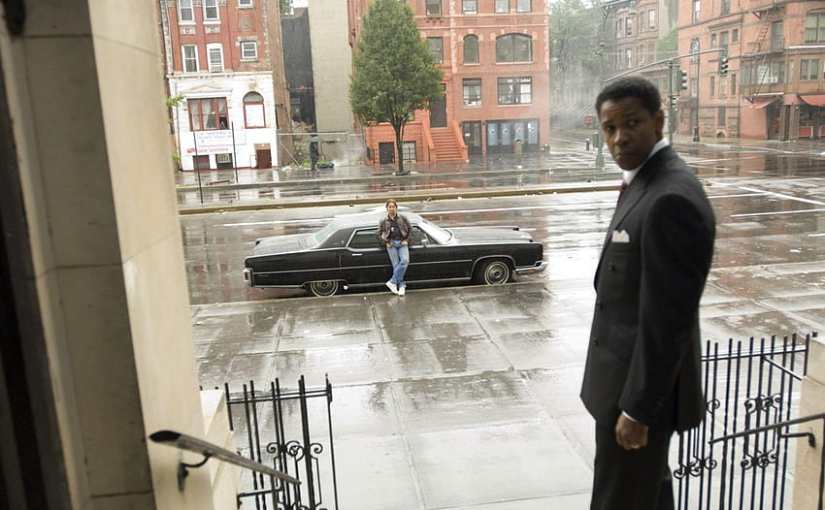
Ridley Scott and his nominated art directors, Arthur Max and Beth A Rubino, capture a gritty urban, crime ridden Harlem of the 1960s/70s.  The streets are filthily here, as well as in the five New York boroughs and all the way across the bridge into New Jersey.  Frank’s markets carry a very wide berth. The buildings are distressed and cracked.  The clothes are of the hippie era with polyester suits.  This is where Frank Lucas moves his imported contraband, white powder heroin, labeled exclusively as “Blue Magic.”  The film provides a convincing source locale deep within the jungles of Vietnam where thousands of kilos are shipped to Frank for sale on the street.  The purity of the drug is beyond compare.  Scott and his art designers place you directly in this time period of dingy grime and among the sweaty Viet Cong and rivers to finally arrive at the crop Frank purchases his products from.

Once he finds his footing by eliminating the competition and recruiting his brothers and cousins to run his business, Frank invests in creature comforts with a furnished penthouse apartment for himself and a beautiful mansion for his mother (Ruby Dee in an Oscar nominated performance that comes off so naturally; you’d think she’s sitting at the Thanksgiving table with you).  He marries a beautiful Puerto Rican wife that he treats like a princess. Frank is smart.  He stays under the radar by wearing conservative suits and not making many waves like going out at nights and showing himself around the social scene.  He knows famous athletes like boxer Joe Lewis or the staff on the New York Yankees that could give his nephew a shot at being a pitcher. Still, his profile manages to stay low. Like his mentor, he just operates a business with a viable commodity.  He tells his younger brother (Chiwetel Ejiofor) that the loudest one in the room is the dumbest and the most likely to get caught.  So, mind how you carry yourself, how you dress yourself and how you flaunt yourself.

A separate story has no business intersecting with Frank’s plight until something gives.  Richie Roberts is a good, honest cop. Though he’s also a lousy husband and father. He has been assigned to head up a task force that will bust the top of the assorted drug empires.  He needs those rare breed cops who are not on the take and follow a strict policy of law enforcement ethics.  His team will not bust a common street hustler.  They will be looking for the kingpins with unquestionable evidence to put them away for good.

American Gangster follows two separate stories for most of its running time.  At least during the first two acts of the film, Frank and Richie are unaware of one another.  It’s only through some gradual surveillance that the cop finally gets a whiff of an idea and starts to move methodically towards a conclusion. The methods are the fascinating parts the movie.

When Denzel Washington plays a villain it’s always memorable and contrary to popular opinion, Frank Lucas is my favorite of his antagonists, especially compared to his Oscar winning work in Training Day.  Watch how he walks or sits on a sofa and broods over how his family and his business are functioning.  He’s the only African American actor I can see playing this guy because I’m always convinced that whoever Denzel Washington portrays, it’s a character who will never be intimidated.  This guy faced down Gene Hackman during a threat of nuclear holocaust. Not many other actors can do that so authentically.

Russell Crowe works like that hero who doesn’t want to wear the cape.  Richie Roberts succeeds on so many levels where his peers surrender to their inhibitions.  This cop passes the bar exam while fighting for custody of his kid on top of going after the empirical criminals who litter the streets in drugs and murder.  I’m reminded of his role in The Insider, where he used a similar American accent.  Richie is not as temperamental or hard wired as that guy, but he is at least as focused on doing what’s right regardless of threat or distraction.  Russell Crowe has a way of getting audiences to admire the concentration needed for many of his complicated characters.  You have as much tunnel vision as he wants the men he’s portraying to have. You are zoned in with what his characters live by.  You only trust their standards.

There are signature staples within the construct of this true story adaptation.  There are gunfights.  Punches are thrown.  The guy at the top beats up one of his cronies when he gets out order.  Yet, what stands this material apart from others is that now I’m watching how Denzel Washington and Russell Crowe handle everything.

The truth behind the story of a black gangster defying the dirty cops and the Italian mobsters who were thought to run the metropolitan undergrounds is amazing.  It’s so interesting to see how novel Frank is with smuggling the product from one side of the world to the other. Then, you see how he uses his family members to distribute to the consumers and collect the monies. Ridley Scott provides all the breadcrumbs in an easy-to-understand fashion.  

Painted against the landscape of an unwinnable Vietnam War that just won’t end, power is acquired and thus the best police officers are forced to change their approach.  So again, you see two different stories that start out small and undetected.  Frank and Richie are the most careful and meticulous of guys in their respective fields.  Therefore, it only makes sense that their paths don’t cross until their missions are nearly over.

There’s much to learn from American Gangster.  

You get an idea of how the harm of the war was not exclusive to just what was happening over in Vietnam.  There were more indirect effects to that crisis impacting the streets of New York and New Jersey.  

You see what subtleties an investigation will collect upon before pouncing on to a bigger stake.  You also learn how to handle a criminal empire with trust and dignity rather than announcing your immorality. You witness the sheer defiance of a righteous guy in what is supposed to be a law-abiding field. Steve Zaillian’s script is not just good guy vs bad guy. It’s each of these guys holding on to the top while trying to catch up with or stay away from each other.

American Gangster is a very thorough and well-planned biographical thriller.  

BLADE II (2002)

by Miguel E. Rodriguez

Director: Guillermo del Toro
Cast: Wesley Snipes, Kris Kristofferson, Ron Perlman, Norman Reedus, Donnie Yen
My Rating: 9/10
Rotten Tomatometer: 57%

PLOT: Blade, half human/half vampire, forms an uneasy alliance with the vampire nation in order to combat a new breed of monster, the Reapers, who are feeding on vampires and humans alike.


Why don’t more people like this movie?  It’s like someone took the best fight scenes from The Matrix, removed the pretentious plotting, added a crapload of gore, and created one of the best villains in the history of vampire movies: the Reaper, an evil-looking creature whose lower jaw splits wide down the middle to reveal a blood-sucking appendage that might even give the Xenomorph nightmares.

Blade II is lean and mean.  Director Guillermo del Toro has gone on record as saying this was not exactly the movie he intended to make, as it doesn’t keep precisely to the Blade “canon” (in case you didn’t know, Blade is a lesser-known Marvel comics character who is scheduled to eventually make an appearance in the Marvel Cinematic Universe).  However, despite his misgivings about this film, del Toro nevertheless created an action-horror masterpiece.

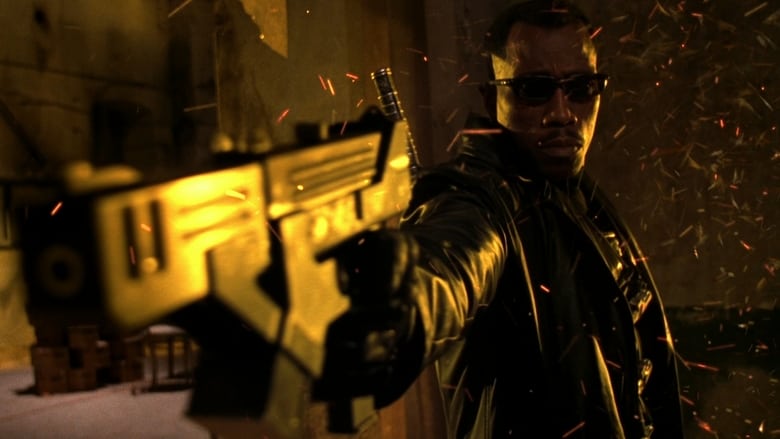
If you’re a fan of action films, what do you like?  Because it’s all here.  There are five great fight scenes, including a doozy in Blade’s own lair between Blade and two vampire ninjas wearing elaborate headgear that makes them look like humanoid bugs.  You like a great villain?  Here’s Jared Nomak, the vampire who carries the Reaper virus, whose wounds heal by themselves almost instantly, and who carries a dark secret.  His fighting skills are equal to those of Blade himself, who must learn to use more than brute force if he’s going to defeat Nomak.  (And let’s not overlook the cameo by Asian superstar Donnie Yen.)

You like a good story?  We got that, too.  Blade’s sworn enemies, the vampire nation, are forced to approach Blade for help when it becomes apparent they are no match for the Reapers.  Blade HAS to help, because who will the Reapers go after once they dispatch all the vampires?  Humans.  So you have the whole “uneasy alliance” going on, with no one more uneasy than Reinhardt, a vampire played by a deliciously malevolent Ron Perlman.  Reinhardt goes along with the plan, but can’t resist poking the tiger by asking Blade, “…can you blush?”  Blade’s response gives a whole new meaning to the term “kill switch.”  Game, set, match.

This is also a horror film, let’s not forget.  You like scares?  How about the part where a Reaper gets pinned to a wall with a ninja sword through its stomach…but escapes by crawling backwards up the wall, forcing the sword to slice through his body as he skitters away, unfazed by the damage?  YIKES.  We got gore, too.  Blade and company perform an autopsy on a dead Reaper.  I haven’t seen that much detailed gore since the autopsy in John Carpenter’s The Thing.

I mean, seriously.  This movie has everything I want in an action movie that’s also a horror film.  It covers ALL the bases.  (I could’ve done without the quasi-love-story, but it’s not dwelt on too much, so I can live with it.)  What more could anyone ask for?

(Also, it’s great to listen to on a bad-ass audio system…BOOMING bass and sound effects.  Great stuff.)