PIG (2021)

by Miguel E. Rodriguez

Director: Michael Sarnoski
Cast: Nicolas Cage, Alex Wolff, Adam Arkin
My Rating: 9/10
Rotten Tomatometer: 97% Certified Fresh

PLOT: A truffle hunter who lives alone in the Oregon wilderness must venture to urban Portland in search of his beloved foraging pig after she is, I guess, pig-napped.


Gotta tell you, that plot summary is one of the most bizarre summaries I’ve ever typed out.  To me, it’s on par with, “A file clerk working on the 7th-and-a-half floor of an office building discovers a portal that transports you into the brain of John Malkovich for 15 minutes before spitting you onto the side of the Jersey Turnpike.”

Who read the elevator pitch for Pig and thought it was worth filming?  Nicolas Cage himself is credited as one of the producers, so that’s a partial explanation, I guess.  The film has twenty other credited producers and executive producers, so it’s clear the financial burden was spread around.  But still…a movie about a guy looking for his stolen pig?  Is this a movie you should run out and rent/stream/buy?

Yes.  Yes, you should.  Oh, but let me tell you why.

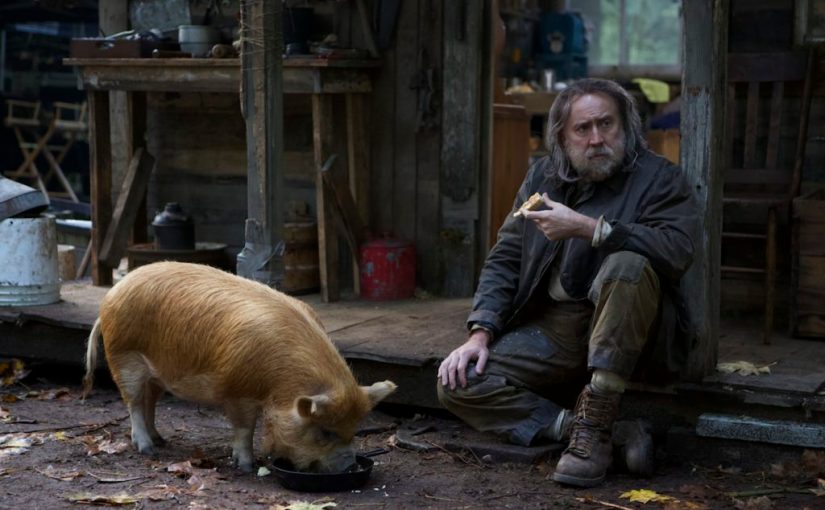
Cage plays a scraggly fellow named Rob who lives in the aforementioned cabin with his pig, whose name is never spoken throughout the movie.  (Although when it was over, I had one or two guesses of my own, each as unlikely as the other.)  This pig excels at finding valuable truffles hidden in the shallow forest soil.  How valuable?  Well, the ones we see in the movie are black, and the current market price for winter black truffles runs from $300 – $1,300 per kilo, depending on the variant.  So…yeah, pretty valuable.  Rob apparently funds his meager existence by selling his truffles to a high-end buyer named Amir (Alex Wolff, Hereditary [2018]), a slick customer who drives a banana-yellow late-model Camaro.  I’m not sure how many Portland restaurateurs can afford Camaros, but it didn’t bother me until this precise moment, so I’ll let it slide.

One night, unknown parties break into Rob’s cabin, beat him up, and steal his pig.  At this point, I was reminded unavoidably of the opening scenes of John Wick (2014), and I thought we were in for another kill-crazy-rampage film like Mandy (2018).  But I was very pleasantly surprised.

It turns out Pig isn’t a revenge movie, or a weird Spike-Jonze-esque journey into absurdity, or a mind-numbing Bergman-esque examination of the human condition.  Ultimately, it’s about food.  Yeah.  Or the transformative properties of food.  Or maybe it’s just about cooking food.  It feels like the kind of movie Anthony Bourdain would have loved, if that’s not being too presumptuous.

Once he gets a line on who the thieves might be, Rob convinces Amir to help him track them down by driving him into the city.  First stop is a sketchy-looking guy who rebuffs Rob’s request for information and asks Amir, “Do you even know his real name?”  That leads to a hidden restaurant under another restaurant where we learn Rob’s full name…a name that brings shock and awe to the eyes and faces of everyone who hears it.  Who is this guy?

One thing I noticed during this film was the great economy of the storytelling.  Scenes that might involve pages of dialogue in other movies are handled in seconds with either terse dialogue or sometimes none at all.  For example, there’s a scene in Amir’s apartment.  Rob wakes up on the couch to the sound of a fire alarm.  The camera tilts up and we see Amir standing on the counter trying to fan smoke away from the alarm.  Cut immediately to a kitchen table, Amir slides a plate in front of Rob, and he says sheepishly, “I don’t cook a lot.”  I can easily imagine that scene in some other movie involving a setup showing Amir trying to cook, burning something, trying to put the fire out, all very comic and probably well-done…but ultimately unnecessary.  Asking the viewer to do the occasional heavy lifting is not the worst thing in the world.  Pig is full of moments like this.  It’s a welcome change when it’s done right.

The screenplay is brilliant in other ways.  It convincingly leads you down one path where you think you can guess what’s about to happen, and then it throws a curveball or neatly sidesteps your expectations.  At least, it did mine.  Rob visits the house where he used to live, where he has a conversation with a small boy.  Where are the parents?  Who knows?  Doesn’t matter.  Amir talks about his family life, about his very successful father who doesn’t believe Amir can cut it in this business.  Later, there’s a scene where Rob and Amir cook a fancy meal for Amir’s father, and the dinner service for that food has a huge emotional payoff I did not expect, and which is worth the price of admission all by itself.

Is Pig a good movie just because it’s unique?  No.  But unique it is, and it is VERY good.  Cage gives one of his most understated performances in forever, so if you have been avoiding this one because you didn’t think you could take more Cage-ian histrionics, you don’t have to worry.  He’s very low-key.  There are a couple of moments where you can see the anger boiling deep within Rob, or when you might expect him to overturn a table or throw a glass of wine in someone’s face.  But it doesn’t happen, and that works for this unexpectedly touching film.

COLOR OUT OF SPACE (2019)

by Miguel E. Rodriguez

Director: Richard Stanley
Cast: Nicolas Cage, Joely Richardson, Madeleine Arthur, Tommy Chong
My Rating: 9/10
Rotten Tomatometer: 86% Certified Fresh

PLOT: A secluded farm is struck by a strange meteorite which has apocalyptic consequences for the family living there and possibly the world.


Some backstory…

Once upon a time, there was a film director named Richard Stanley.  He made a few unremarkable films in the early 1990s, toiling in relative obscurity, until he hit the big time in 1996 when he got the opportunity to direct his dream project: a remake of The Island of Dr. Moreau starring none other than Marlon Brando.  The story of that film’s troubled production inspired a documentary all by itself (Lost Soul: The Doomed Journey of Richard Stanley’s Island of Dr. Moreau [2014]).  Stanley himself was fired after only four days of shooting and replaced by John Frankenheimer.  Rumor has it that Stanley secretly convinced the makeup crew to turn him into one of the background mutants so he could keep tabs on his dream project.  After Moreau bombed, Stanley’s career imploded, and he never directed another feature film.

…until over twenty years later when an enterprising film production company expressed interest in allowing him to direct another dream project: an adaptation of an H.P. Lovecraft story from 1927 called The Colour Out of Space.  To say that Stanley redeemed himself with this film would be an understatement.  This is one of the scariest movies I’ve ever seen.  It was supposed to be the first part of a Lovecraftian trilogy, but alas, Stanley was accused of domestic abuse in March of 2021 and the trilogy was scrapped.  One hopes that someone like Guillermo del Toro or Jordan Peele might pick up the promising threads here.  [insert good mojo dance here]

Anyway, the movie.

Color Out of Space is, at first glance, an amalgam of previous horror films.  One can easily spot elements of The Thing (1982), Annihilation (2018), and David Cronenberg’s The Fly (1986).  But when you consider the screenplay has been adapted from a 95-year-old short story, the movie takes on a prescient nature.  Here are all the elements of a solid contemporary horror film, in a story that was published the same year sound was introduced to motion pictures for the first time.  Remarkable.

The Gardner family lives on a secluded farm in the forests of New England, where the nearest township, Arkham, is an hour’s drive away.  (No, Arkham isn’t a Batman reference, it’s Lovecraftian…which might explain why the very name “Arkham Asylum” has always felt a little creepy all by itself.)  One night, a meteorite lands with a crash in their front yard.  This is no ordinary meteorite.  It glows with an unearthly magenta light, and by the following morning it has disappeared.  Shortly thereafter, the youngest son, Jack, starts hearing strange noises outside.  Mrs. Gardner (Joely Richardson), who is recuperating from cancer surgery, keeps getting disconnected from her business calls.  Nathan Gardner (Nicolas Cage) takes a shower one day and discovers what looks like a cake of soap covering the shower drain.  He picks it up…and experiences something NO ONE wants to experience after picking up a cake of soap.

Things get stranger.  A local hydrologist takes some water samples and urges the Gardner family and their squatter, Ezra (Tommy Chong), who lives in a shack on the Gardner’s vast property, not to drink the water until he gets some test results.  Meanwhile, Jack, the youngest son, takes a peek down their well and watches as an alien-looking egg hatches and releases a magenta-colored praying mantis.  Mrs. Gardner gets distracted by…something…and has a kitchen accident with a knife.  Their daughter, Lavinia (Madeleine Arthur), who dabbles in Wiccan rituals, hears a noise that makes her sick to her stomach.  Time passes in fits and starts.

And the whole time, new vegetation has sprouted up around the well.  All the same magenta color…

Experienced moviegoers might be able to plot the film’s course from A to B to the climax, and they might be right on.  But Color Out of Space has one or two surprises up its sleeve that elevates it into the same level as other modern horror classics like Hereditary (2018) or The Babadook (2014).

There are scenes involving a small herd of alpacas – oh yeah, they raise alpacas – that are as unsettling as anything from John Carpenter.  At one point, mother and son are caught in the “grip” of the alien color/light.  What happens to them sets up one of the biggest jump scares I’ve ever had in my life.  I yelled so loud and long that my girlfriend ran to the back of the house wondering what was happening.

Color Out of Space is one of the most effective horror movies I’ve seen in a long time.  Naysayers may refuse to watch it because of Nicolas Cage’s presence, but I can assure you, his “hammy” talents are put to good use and are always in service of the story.  It’s not for everyone.  It’s not for the squeamish.  But for those who dare…Color Out of Space is a horror-film lover’s dream.

THE UNBEARABLE WEIGHT OF MASSIVE TALENT

By Marc S. Sanders

I’m looking forward to seeing a film that pokes fun at the life and career of actor Nicolas Cage.  After seeing his new film, The Unbearable Weight Of Massive Talent, I’m still waiting.

The title is the best thing about this film.  In fact, it might be the best title of any film to come out this year. 

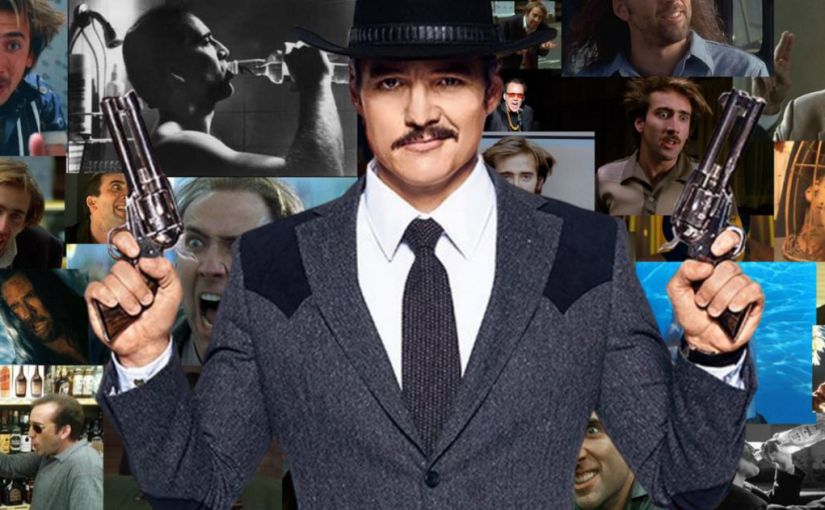
Cage portrays an account of himself, Nicolas Cage.  His career in Hollywood seems to always be scraping the bottom of the barrel and he comes up desperate for the next film that will financially sustain him.  Look actors gotta work too!  He’s so anxious for a part that he’ll recite a monologue with a dreadful Boston accent to a Hollywood producer as he’s waiting for the valet.  Alas, no roles are coming his way and he’s over $600,000 in debt.  Best that his agent (Neil Patrick Harris) can do is get him a million-dollar paycheck to spend a weekend at a supposed super fan’s island chateau.  Javi Gutierrez (Pedro Pascal) is that fan. 

As Nicolas’ stay commences, somehow, he finds himself caught up in a real-life action-packed story.  The CIA inadvertently recruits him to stay on top of Javi as they suspect he’s kidnapped the daughter of a foreign country’s President.  Yet, Javi doesn’t seem to give off any clues.  He’s only enthusiastically concerned with entertaining his celebrity guest and selling the adventure screenplay he’s written with Cage in mind.

I gave up on this film after the first fifteen minutes.  If I laughed three times during the course of the picture it was a lot.  The oversight that I think occurred here is that it never felt like a spoof of the actor Nicolas Cage.  Cage has a lot of suspect material in his past.  He’s a die-hard Superman fan.  After all, he named his son Kal-el.  Who does that?  As well, he’s infamously known to have recorded himself in a terrible looking Superman suit for Batman director Tim Burton to consider for a film revival with Cage in the superhero role.  Cage has also been married multiple times, including to Elvis Presley’s daughter at one point.  I believe his most recent marriage lasted all of three days.  He has his odd collection of film roles, and he’s a member of the famous Hollywood family, the Coppolas (as in Francis Ford and Sofia).  Yet, none of this material that comes to me off the top of my head makes its way into The Unbearable Weight Of Massive Talent.  The title seems to scream Nicolas Cage and yet this film is hardly about Nicolas Cage.

Instead, this film directed by Tom Gormican, who also co-wrote it, opts to actually turn the second half of the film into an actual shoot ‘em up adventure with clumsy comedy scraps.  Cage and Pascal scream amidst the bullets and car chases, but none of it is funny.  It certainly doesn’t reach the heights of Lethal Weapon fanfare.

I think back to a film called This Is The End which features the Judd Apatow fraternity of actors (James Franco, Seth Rogen, Jonah Hill and Jay Baruchel).  Earth is coming to an end and the celebrities play themselves.  The inside jokes were abundant with nods to their film careers, their penance for smoking weed and various gossip stories.  If Nicolas Cage is truly playing himself and this new film is selling itself on that message, then show me Nicolas Cage.  If you are just going to show an unfunny Pedro Pascal and clumsy gun fire galore, then you can easily swap out the celebrity at the center of it all and replace him with any other well-known actor.  Don Knotts could have been inserted here, or Charles Nelson Reilly.  Kim Kardashian could have had opportunity with this script.

Sure, there are some salutes to Cage’s film credits.  Javi’s secret man cave of all things Nicolas Cage is a little fun for the short while we are there.  Yet, what’s so relatable with a forgettable film like Guarding Tess?  It’s actually a good movie with Shirley MacLaine in the title role.  How many people actually saw it though, much less remember it?  Face/Off gets a nod but nothing great beyond the gold-plated prop guns he used.  Gone In Sixty Seconds is mentioned in one sentence of dialogue.  Con Air hearkens back to the bunny in the box for a beat.

Other than one well known celebrity cameo for a blink and you miss close up, the Hollywood populace doesn’t even turn up to roast the film’s star.  Imagine if Francis Ford Coppola made an appearance.  “Nic, stop embarrassing the family.”  Consider Sean Penn having a beer with Nicolas to reminisce about Fast Times At Ridgemont High (Nicolas’ first film appearance as a stoner dude, when his surname was Coppola).  There’s not even a mention about his Oscar winning turn in Leaving Las Vegas.

I am happy to admit that Nicolas Cage has a very storied career and life behind him, and yet hardly anything is touched upon in this film.  Instead, we are distracted with a kidnapped young woman that I don’t recall has even one line of dialogue in the picture.  If she did, it happened when I dozed off.

One avenue seems so obvious for a film intending to spoof this actor.  Walk with me for a second.  Nicolas Cage did the film Con Air with actor John Malkovich.  There’s already a much better film called Being John Malkovich that had a little fun at the expense of that real life actor.  It was written by Charlie Kaufman and directed by Spike Jonze.  Know what else Kaufman & Jonze wrote and directed?  A film called Adaptation with Nicolas Cage.  See where I’m going here?  This stuff writes itself.  I’d love to have watched a scene where Malkovich walks in and says “I know what you’re going through Nic.  I really do. Charlie and Spike never let up.”  There’s much to play with here. 

Yet instead, we are belabored with the unbearable weight of this unfunny film. 

KNOWING (2005)

by Miguel E. Rodriguez

Director: Alex Proyas

Cast: Nicolas Cage, Rose Byrne, Ben Mendelsohn (plus an early sighting of a young Liam Hemsworth in his first movie role)
My Rating: 9/10
Rotten Tomatometer: 33%

PLOT: M.I.T. professor John Koestler links a mysterious list of numbers from a 50-year-old time capsule to past and future disasters and starts to wonder…what happens when the numbers run out?


[SPOILER ALERTS…not that anyone is going to rush out and stream this, but whatever, still … SPOILER ALERTS]

Knowing is a polarizing film from Alex Proyas, the visionary director of The Crow (1994) and Dark City (1998).  It tells the story of an M.I.T. professor whose son is given an envelope that has been sealed inside a time capsule for 50 years.  Inside the envelope is a list of seemingly random numbers that appear to be meaningless, until he notices a pattern emerging.

I remember when this movie came out very well.  I was stoked to go see it because Alex Proyas is one of my favorite directors. But it got PANNED right out of the gate.  And most of the negativity stemmed from the movie’s ending, which turned off the vast majority of moviegoers who thought was the equivalent of someone saying, “It was all a dream!”

Knowing does NOT have one of your typical Shyamalan-esque endings.  The ending follows the strict logic of everything that has come before and arrives at an astonishing, awe-inspiring conclusion that left me gobsmacked.  But more on that later.

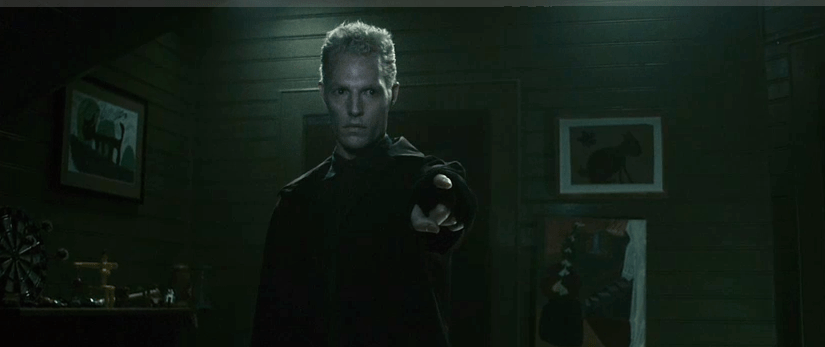
Let’s talk about how Knowing works.  First, everything about the movie sets us up for what appears to be a standard horror movie with Nicolas Cage’s son apparently in danger from mysterious pale figures in dark coats who show up at their house in the middle of the night and just stand there…watching the house.  Creepy.  At one point, one of them somehow gets INSIDE the house, a sequence that ends with the boy having a nightmarish vision of a raging forest fire.

These are, so far, basic horror tropes.  But director Proyas uses skillful styling and editing to create something that feels as creepy and suspenseful as any horror movie I’ve seen.  In fact, every time I watch Knowing, I find myself still on edge during certain scenes, particularly the ones involving the pale strangers.

Another feature of the movie that I feel elevates it is the visceral nature of the key scenes involving various accidents.  See, that 50-year-old list of numbers is actually a list of dates on which various catastrophes occurred over the last 50 years, along with the number of casualties…and Nicolas Cage’s character, John Koestler, can plainly see that three of them are coming up in the next few days.

So it’s a foregone conclusion that we, the audience, are going to see some sort of major accidents.  And, man…I have never seen, before or since, such astonishing, nerve-racking sequences of horrible accidents in films.  I don’t want to be a spoiler, but I CAN say that I guarantee this is one movie that will never be an option for in-flight movie channels on commercial airliners.  I mean…when it happens, it’s out of the blue, and it feels as real as these things can get with CGI.  It literally takes my breath away every time I watch, and I’ve seen it like ten times.  Easily.

So now that Koestler has proof the list is real, the question that keeps nagging at him is…what happens when the numbers run out?

And that’s where Knowing leapfrogs over other genre thrillers and actually becomes ABOUT something.  Before finding that fateful list, Koestler asks his students at M.I.T. to write a paper on determinism versus coincidence in the natural world.  That is, do you believe that everything up to this point has happened for a reason, or is literally everything we do completely random, with no purpose or design?  Koestler believes in the latter, even though he’s the son of a minister, a man with whom he’s had no contact for years.

Koestler has his reasons.  Years ago, his wife was killed in a hotel fire, an event which he perceives as a random accident.  But then he gets this list, and it seems as if someone has been able to accurately predict seemingly random events.  This list flies in the face of everything he’s believed for years.  If these accidents are predictable, is everything ELSE predictable?  Is there a REASON for the accidents?  Is life more than just the result of millions of years of evolution and genetic mutations?

Koestler cannot square this list with his personal beliefs, and it’s that conflict that’s at the heart of the movie.  Knowing forces its main character (and, by extension, the audience) to make a decision one way or the other.  Is there a plan for existence, or is it random?  How long can he ignore the evidence of his own eyes before he makes his choice?

And over all of that, there’s still the issue of the list running out of numbers.  What happens then?  The end of the world?  Is he destined to SAVE the world?  Or stand by helplessly as pre-determined events spin forward out of his control?

This is why the movie stands above other genre sci-fi thrillers.  It poses tough questions and forces us to confront our own beliefs.  And the movie does not take the easy way out by trying to have it both ways.  The finale of Knowing is as implacably logical as it is visually stunning.

Detractors of the movie decry this finale as a “deus ex machina” that cheapens everything that came before.  I even remember some mild laughter in the audience when I first saw it.  But seriously…given everything that happened before, what ELSE would have been a good ending?  Have Koestler wake up from a dream?  Have him discover that it was all really a government experiment?  A drug-fueled hallucination?

None of those would have worked NEARLY as good as the ending the movie DOES provide.  As I said before, it follows the logic of its own story to the bitter end, and gives us some spectacular visuals into the bargain.  It doesn’t cheat, it doesn’t pander or cop out.  We have gone from point A to point B, and the only way out is through point C.  When you think about it, isn’t that kind of audacious?  How many movies have had the nerve to follow the courage of its own convictions?  (I’m reminded of The Bridge on the River Kwai with its own fatalistic finale, combining spectacular visuals with an ending that was not a “happy” one by any stretch of the imagination.)

I stand behind this movie as one of the great sci-fi mystery thrillers.  Love the ending or hate it…I challenge you to come up with an ending that would have been better than the one presented in the film.