
By Marc S. Sanders
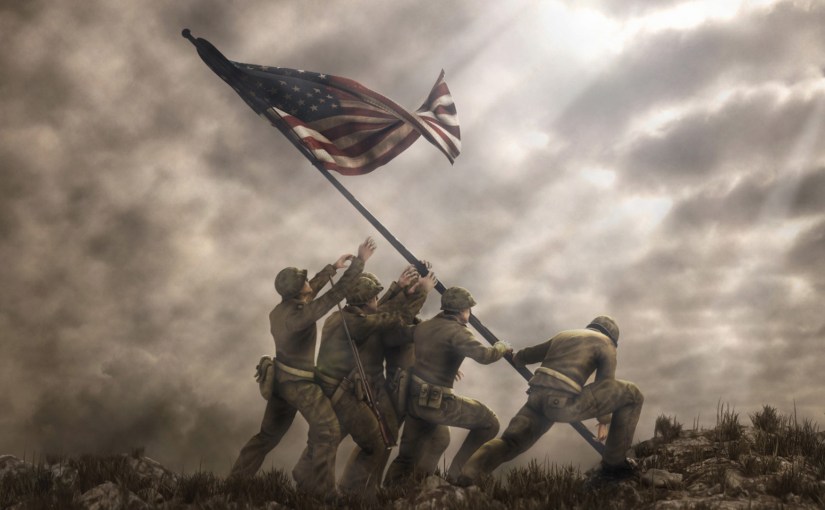
Arguably the most famous photograph in American history is that of the six soldiers raising the flag on the island of Iwo Jima while battling Japanese forces during World War II. I remain fascinated by the image.
I recall visiting the landmark statue in Washington DC when I was traveling by myself. I took countless pictures of the piece. I got close ups, wide lens shots, pictures of the flag and pictures of each sculpted soldier. It’s heroic in any aspect. It looks like something out of a Superman comic book. As it turns out, the famed image was just a happy accident during a violently terrible time in twentieth century history. Photographer Joe Rosenthal didn’t even realize what his camera captured until his film was later developed. Turned out this was the second attempt at raising the flag. Furthermore, this occurred on the fifth day of the conflict – with thirty-five days still to go before the Americans could claim victory over the bloody crisis.
So, while Rosenthal’s image seems to declare American patriotism at its finest, the real story is not as romantic. In fact, one of the narrators of Clint Eastwood’s film, Flags Of Our Fathers, suggests that there are no heroes to celebrate. Whoever the men in that picture were, they were not so much fighting for their country as they were trying to stay alive and look after the comrades ahead and behind them.
Flags Of Our Fathers has a very reminiscent feel to producer Steven Spielberg’s Saving Private Ryan with unforgiving battle scenes of blood, death, bombings and young soldiers storming a beach while screaming for their buddies. Spielberg might have impressed me first, but Clint Eastwood masterfully shoots wide landscapes and up-close turmoil with his reliable strategies of shooting in shadows and silohouettes. Eastwood’s film, scripted by Paul Haggis and William Broyles Jr veers into a unique direction though as Rosenthal’s picture takes on a life of its own back in the states. It makes the front page of every paper. Harry Truman stands proud of it along with all the decorated military leaders.
Now that America has entered the war, it is appropriate to ignite a propaganda campaign. This picture of the Stars and Stripes getting elevated into the sobering, smoky war-torn skies will motivate citizens to buy war bonds to further fund the war effort. The spokesmen will be the ones believed to be the remaining surviving three of the six in that image. Ryan Phillipe is Navy enlisted John “Doc” Bradley. Jesse Bradford is Rene Gagon, and Adam Beach plays Native American Ira Hayes, both of the Marine Corps.
I believe Flags Of Our Fathers embraces what every enlisted person did to serve the efforts of America during the war, and the picture mourns the countless sacrifices and losses that occurred. However, it frowns upon the domestic response to what really went on overseas. Those that returned carried terrible and unforgettable trauma based on their experiences. Yet, the three thought to be part of the flag raising were pushed to celebrate their achievements summed up in a split-second image. Bradley, Gagon and Hayes were skeptical if they were the ones in that picture. Government Bureaucrats could care less. There were others on that hill who cannot speak for themselves, but officials in suits and ties will insist otherwise to uphold a countrywide tour complete with recreations of the hill they ran up on that fateful day. Even desserts are crafted like the famed image.
Ira Hayes is the one who is especially conflicted with his new responsibilities to the governing body that historically acquired his ancestors’ territory. Adam Beach portrays a torn individual who is limited in celebration by the United States and certainly patronized. Who he stems from does not matter. He represents a false interpretation of the English acceptance of his Native heritage. His obligation to this machine of propaganda only doubles the exaggeration that his other two peers are coerced to parade with marching bands and fireworks. All that the ongoing extravagance does is keep him absorbed in the Japanese lives he brutally slaughtered and the bloodshed that surrounded him. It’s a heartbreaking performance told with an absence of true appreciation for what Hayes gave up on that battlefield.
I learned much from Flags Of Our Fathers, but I had issues with comprehending everything. While the immense war footage is chaotic with sharp editing and camerawork, it’s challenging to match names with faces in the picture. There are two elderly men who are recounting what occurred and what happened to these men and their families long after the incident was over. It was hard for me to line up which older man was who, on top of who they are talking about at times. Paul Walker is one famous face in the crowd. So is Barry Pepper but I could not identify the names of their characters until the film was arriving at its conclusion. It was not until the epilogue of the movie arrives that it became a little clearer. I also had to later reference what is listed on IMDB.
The entire design of Eastwood’s movie is authentic from the battles staged for the Iwo Jima conflict to what mid-1940s domestic life looked like back home. Truly absorbing while both storylines seem so different. Clint Eastwood also wrote the soundtrack composition, and it is truly sobering. His son Kyle performs with the orchestra.
Flags Of Our Fathers partnered with Clint Eastwood’s follow up later in the year, Letters From Iwo Jima, which offered the Japanese perspective of the incident. Bridge the films together and you get an incredible cinematic experience. So many war pictures are one sided. In all fairness, most movies do not have the time, luxury or finances to expand their palettes from one side to the other. Because these two films are companion pieces, the viewer gets a fair account of how this battle, located on a tiny island, treated the men on the ground while their governing bodies celebrated their stands for patriotism, victory and monetary funding.
Eastwood demonstrates that the war destroyed practically everyone who was engaged in it regardless of the countries these soldiers served. Many were slaughtered, but the innocence of those that physically survived died with everyone else during this period of time. Clint Eastwood directed two films that explain this never-ending atrocity. These men eventually laid down their weapons, but they never left the war.
 2 UNPAID MOVIE CRITICS!!!!