JAWS 2

By Marc S. Sanders

The last movie, the masterpiece of masterpieces, told us that a great white shark is rare for the kinds of waters that surround the New England area of Amity Island.  Well, Jaws 2 disproves that fictional theory as Chief Martin Brody (Roy Scheider) ascertains that another man eater has arrived with a large appetite for chomping on swimmers, scuba divers and water skiers.  It’s ridiculous but it’s an entertaining sequel with a supporting cast of young actors ready to effectively tremble and scream while trying to survive the clutches of a hungry great white.  

Things appear tranquil yet prosperous for Amity.  A developer has completed a large Holiday Inn hotel that will magnify tourism profitability.  To Martin’s chagrin, his wife Ellen (Lorraine Gary) works for this guy.  Mayor Vaughn (Murray Hamilton) somehow got reelected following that terrifying Fourth of July weekend from a few years ago.  (Well…his kids were on that beach too.) Chief Brody’s biggest concern though is his oldest son Michael’s penchant to laze around sailing with his friends for the summer when he should be getting a job.  Michael just wants to score with the new girl in town.

All is well until an abandoned boat is discovered off shore with an underwater camera dropped on the ocean floor, near Captain Quint’s shipwrecked Orca.  Thereafter, is an explosive water skiing accident.  The most hideous eyesore must be the beached, partly devoured corpse of a humongous killer whale.  The bite sizes are enormous.  Chief Brody is getting terribly suspicious, but once again his intuition is being disregarded until the truth reveals its blood in the waters. 

Jaws 2 is effective suspense.  The teens are straight out of familiar slasher movies, but this film actually released ahead of Halloween and Friday The 13th fare.  Director Jeannot Szwarc captures good close ups of the whole cast and magnificent pace with a speeding fin that slices through the ocean surface.  These kids are mostly nameless but the director gives them good moments to put their greatest fears on.  When the sailboats capsize and the kids topple into the water, there’s a nervous tension all the way to the end of the picture.

It’s no secret that Scheider hated making this movie.  Universal contractually beheld him to it after he dropped out of Michael Cimino’s The Deer Hunter.  Nonetheless, I like the direction the character takes with returning script writer Carl Gottlieb.  Brody’s job is in jeopardy and maybe his marriage, along with the paternal strife he gets in the way of his eldest boy.  Roy Scheider does fine with the material.  Perhaps his personal frustrations lent to the performance.

What doesn’t work is Bruce II – the shark.  To this day I’m still stricken with fear of the shark from Spielberg’s film, even after we finally get to see it.  It truly is a scary monster.  In Jaws 2 however, the animal looks like something you buy at a beach novelty store for your grandson to play with in a kiddie pool.  The texture of the shark never feels authentic particularly after it survives a fire.  I am not fond of how it swims or raises its head above water.  Even when a helicopter gets in its crosshairs, the shark looks small and literally mechanical, never seeming strong or powerful enough to kill, maim and destroy. The magic trick just appears entirely too transparent.  Fortunately, I bought into how this town’s worst fears eventually come true again.  The perception of Brody and the kids is the mightiest strength of the film.

A brief mention is given to Matt Hooper (famously played by Richard Dreyfus in the first picture).  That always left me curious with why Universal did not pursue a sequel based on his character instead of Brody.  It’s hard to swallow that another monster shark is terrorizing Amity again.  Wouldn’t it have more plausibility for the actual shark specialist to pursue another brutally unforgiving Carcharodon Carcharias elsewhere in the world?  I think a story moving in this direction could have opened a lot fresher possibility.

Regardless, Jaws 2 is a fun summertime escape with one of the most familiar taglines in cinematic history: “Just when thought it was safe to go back in the water.”

Only watch Jaws 3 & The Revenge when you’re ready to get your itch for a Mystery Science Theater 3000 kick to commiserate with some friends on a Saturday night.  Save Jaws 2 for when you want more shark chum after having watched the classic original for the five thousandth time.    
THE HUSTLER

By Marc S. Sanders

To get inside the turmoil that Fast Eddie Felson feels requires witnessing his highs and lows, all within a forty-hour time span, which equates to about thirty minutes in movie time.  Fast Eddie is The Hustler, and he was famously portrayed by Paul Newman, arguably his breakthrough role as a top billing super star.

Felson is a cocky, hard drinking pool player.  He’s got talent, but no matter how much he wins he’s always the loser because he has no discipline.  Eddie and his partner Charlie (Myron McCormick) travel from town to town, entering pool halls and setting up a bait and catch for some quick cash.  Charlie keeps his cool and treats the act like a profession.  Eddie has no subtlety.  Because he’s so how high on his expertise and what it earns him, he now only has his eye on dethroning the best in the country.  Eddie wants to take on Minnesota Fats (Jackie Gleason, in his only Oscar nominated role).

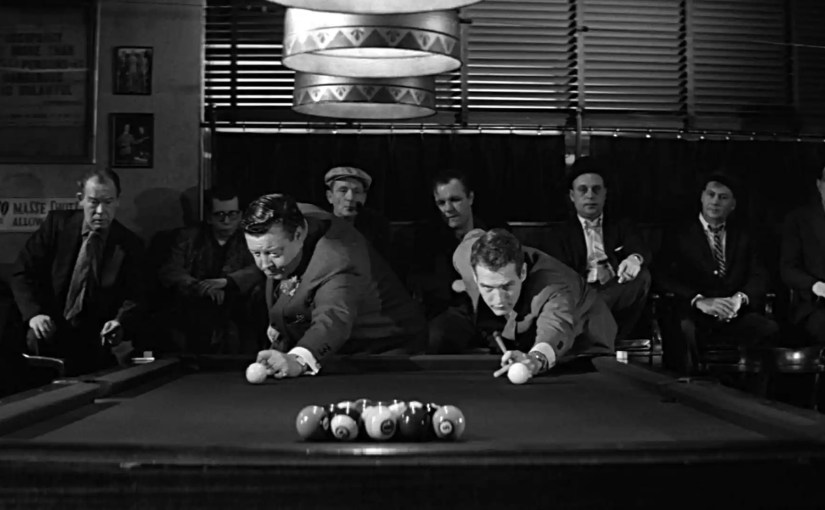
Fats sure looks intimidating.  Gleason handled his extra weight beautifully throughout his whole career, whether it be with his outrageous Ralph Kramden comedy, or when he was just being stand up Gleason for a live audience.  As well, his large frame appears kingly when he enters the pool hall.  He’s dressed to the nines with his hat, overcoat, silk tie, cuffs and studs, a cigarette in his hand, and the red carnation confidently tucked in his lapel.  The movie is in black and white, but that little flower had to be red if adorned by Minnesota Fats.  No question about it.

Newman versus Gleason in the first section of Robert Rosen’s drama is stunning to witness.  Like the actors who portray these characters, the antagonist was already a legend, while the up and comer was on the brink of higher class.  Both are the best of the best at pool, but as this scene progresses, with the regulars at Ames Pool Hall watching with their burning cigarettes and stained whiskey glasses in hand, the competition becomes a fierce and eerily quiet test of endurance.  Fast Eddie can keep on winning and winning, round after round, hour after hour, taking thousands of dollars out of Fats’ pockets, but if the fat man doesn’t surrender, has anyone really won or lost?

The Hustler isn’t so much about pool playing as it is about being a hustler or a con man who has no way to be genuine with himself or others in his life.  After the showdown between the two has finally concluded, Eddie gets acquainted with a woman who frequents the nearby bus depot.  Her name is Sarah (Piper Laurie), another hard drinker and someone who is not looking for love or companionship but will get trapped in Eddie’s charm.  What’s at play though is if their relationship, based initially on sex and booze, has anything more substantial to uphold their quick connection.  That is about to get tested by another member of this cast.

Bert Gordon (George C Scott) is the high stakes investor ready to front Eddie with a lot of money to go on the road and clean up on other wealthy players at the table.  Bert recognized a thoroughbred when Eddie went against Fats.  Now he wants to use him, but will Sarah serve a purpose or become a distraction in Bert’s plans for himself first, and Eddie second?

There’s a lot to think about when summing up The Hustler.  It’s not a typical sports film with the standard training montages.  The protagonist doesn’t necessarily get a beat down, only to triumph by the end.  Rosen’s film goes deeper than the pool playing that rests on the felt table surfaces.  Rosen co-wrote this script based on a novel by Walter Tevis, about a man overcoming the demons pecking at his attributes and skills.  When he’s not the trickster, he must ensure that he’s not getting tricked.

I was first introduced to Fast Eddie Felson with Martin Scorsese’s follow up picture called The Color Of Money, released twenty-five years after this film.  I like the coolness and rhythm of that film, but it’s mostly an exercise in Tom Cruise machismo.  It was only later that I saw The Hustler per my dad’s advice.  I didn’t care for it the first time I saw it.  Once the first act was over between Newman and Gleason, I found the picture to be slow moving and devoid of much energy.  I could not relate to the long sequence of Eddie getting involved with Sarah.  Unlike Scorsese’s film, Rosen does not rely on much music and quick edits to keep you alert.  It felt more like a movie drowning in the characters’ own drunken stupors.

Now that I have seen the film for a second time though, many years later, I can’t help but recognize the themes that carry over to The Color Of MoneyThe Hustler works better than its sequel because it functions as a character study in maturity and endurance.  The Color Of Money sets itself up that way for the Cruise character. Yet, I’m not sure it reaches a conclusion to any of the arcs or transitions for either an older Eddie Felson or for the hot shot 1980s kid, Vincent, the Tom Cruise character that Eddie mentors.

The Hustler has triumphs, but it has some shocking heartache for several characters as well.  Eddie has much to overcome internally as well as physically throughout the course of its narrative.  This fictional story had to be captured within this certain section of time (six months to a year, I think) to show how these appealing, yet cursed, individuals forever change one another.  After the film has closed, Rosen brings up the closing credits in the quiet pool hall allowing his characters to pack themselves up and walk out of frame.  There is something open ended to when the film chooses to stop. The viewer may think for a while after it’s over.  Rosen allows the viewer to take his last gulp of whiskey or bourbon and put out his cigarette and throw on his overcoat before stepping out into the cold late hours on the wet sidewalk below.

There are many impressive pool shots on display, thanks especially to the professional Willie Mosconi.  Shots are also done beautifully by Newman and Gleason.  Absolutely amazing to watch what they accomplish with a cue stick.  However, you don’t watch The Hustler for just trick billiard shots.  Rather you look at this intense drama to see a man struggling to be a winner or remain a loser.  What you realize very early on is that the outcome is never measured by how much money is wagered or what lines a man’s pockets.  Instead, The Hustler is assessed by what these people choose to do next.  Play or not play.  Bet or not bet.  Hustled or not get hustled.

1941

By Marc S. Sanders

Steven Spielberg’s first critical and box office flop, 1941, is a splattered mess of slapstick hysteria set a week after the Japanese attack on Pearl Harbor.  Residents of the California coast line prepare to be the next target.  Ahem!!!!!  Well, that’s it for the story…Goodnight.  Tip your waiters.

Just a year ahead of the Zucker brothers with Abrams comedy team that’ll deliver Airplane!, Spielberg opted to direct a spoof script penned by Robert Zemeckis and Bob Gale (Back To The Future).  1941 is full of gags galore beginning with a reference to the director’s most successful film to date, Jaws.  For me, seeing actress Susan Backline on screen again for another ocean skinny dip only to be intruded upon by a rising Japanese submarine was the second best joke of the film.  Once that was over, I had two hours left to go.  A long two hours. 

I’ve noted before that satire or spoofs are the riskiest genres to produce.  They can succeed with a picture like Dr. Strangelove…, or Network or Airplane!  Satire can be divisive too though, and thus only one half of your audience will appreciate the poke and prod.  Even worse, satire can just be unfunny across the board no matter which side of the aisle you lean on.  That’s 1941.  It plays too much like a Three Stooges series of slapstick violence.  Reader, even Steven Spielberg cannot capture the magic of the Three Stooges.

Zemeckis and Gale opt to poke a little fun at the Puerto Rican zoot suit riots vs the Enlisted men ahead of America’s entry into World War II.  So, when army soldier Treat Williams gets jealous of one handsome zoot suit dancer flirting with his girl, a fight breaks out which eventually populates two thirds of the film as it escalates all the way over to Hollywood Boulevard. Now thousands of stooge wannabe extras are walloping each other from one side of the street to the next. 

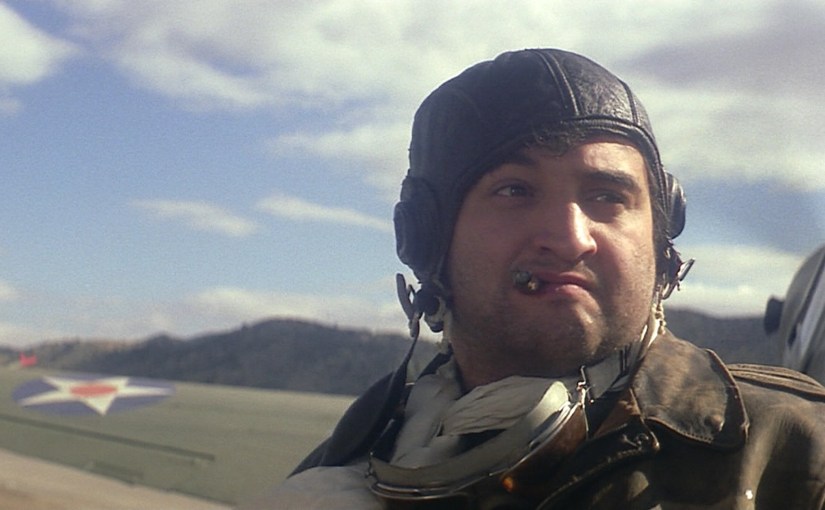
To allow a breather from this, the writers sidetrack over to Tim Matheson and Nancy Allen getting frisky in an out of control bi-plane while being mistaken for the enemy by John Belushi doing a very poor resurrection of his Bluto character from Animal House.  As Captain Wild Bill Kelso, Belushi’s pursuit fires upon everything else in sight, especially Hollywood Boulevard, but misses the plane occupied by Matheson and Allen.

The third point of this rectangle concerns Dan Aykroyd with John Candy and a whole platoon opting to set up a military cannon along the ocean view property belonging to Ned Beatty and Lorraine Gary in anticipation of the Japanese invasion.  Ned Beatty is the best stooge of the entire cast as the nerdy resident determined to protect his home while exercising his patriotic duty.  Gary’s response to Beatty’s ineptitude cracked me up as well.  The house wreckage of The Money Pit has nothing on what occurs in 1941.

The fourth storyline focuses on the enemy with a German speaking Nazi portrayed by Christopher Lee debating with the captain of a Japanese submarine (Toshiro Mifune) plotting to bomb Hollywood.  Somehow, each foil understands the other’s language.  These guys are just here to scream at one another.  There’s nothing funny about them.

Oh yeah.  Robert Stack is the Army General who watches Dumbo in the movie theatre while Hollywood Boulevard gets demolished outside.  Ho! Ho!

Often, I compliment Spielberg for his reliance on the sets he provides.  Everything you see on the screen serves a purpose to his films.  It happened as recently as with his remake of West Side Story in 2021, and it’s effectively used in Close Encounters…  He uses the same approach with 1941.  In this film though, there’s no pulse or significance to the props and pieces that are used.  The house is demolished.  So is the storage shed.  So is the movie theatre.  So is the Ferris wheel.  Yes.  What you’ve already seen in endless Looney Toons cartoons occurs here with a miniature model.  The Ferris wheel comes off its hinge and rolls across the beach side dock into the water along with Murray Hamilton and Eddie Deezen in tow.  When it happens, you’ll tell yourself I was waiting for that to happen.  What you expect to happen, happens, but you’re not laughing at it.

None of what you see in 1941 are terrible gags.  If you watch one scene out of context on a four minute You Tube channel, you may chuckle.  The problem is that every scene is treated like throwing spaghetti at a wall and seeing what will stick.  Mashing all of this together is not appetizing.  I like ice cream and I like steak.  I don’t like my ice cream on my steak.  Any idea of development is completely ignored.  The film can’t even work like a collection of skits.  Even Airplane! had a romantic storyline trajectory to perform with.  Here, two jealous guys have a fist fight and it more or less stretches that fight for an entire two hours.  The Three Stooges knew when to eventually quit.  Spielberg, Zemeckis and Gale didn’t. 

As soon as I saw Belushi on screen, I laughed.  It’s Bluto again.  Yet, the appearance wears off very quickly.  He has little dialogue and is limited to chomping on a cigar while grunting and groaning as the fighter plane he occupies wobbles around shooting at everything in sight.  When he eventually crash lands, Belushi continues to chomp on the cigar and grunt and groan.  Only now, he pratfalls as well…badly.

Ned Beatty is the real star here.  The ultimate nerd is also limited in dialogue. Still, to watch his body language with his glasses and bow tie and pear-shaped physique, accompanied with Lorraine Gary’s helpless gasping wife responding to the damage he commits with the cannon is hilarious.  Absolutely hilarious.  Tape all of their scenes together and make it a short to present ahead of the main attraction in a movie house. The audience will have a great time.

Otherwise, the only other fun I got out of 1941 was spotting the stars that were relevant at the time of its release.  Candy, Aykroyd, Frank McRae, Slim Pickens, Christopher Lee, Robert Stack, the cute blonde daughter from Eight Is Enough.  Even Penny Marshall has a quick blink and you miss it moment.  Oh, and look, there’s Lenny and Squiggy!

I think Zemeckis and Gale were on to a real smart idea here.  They maybe should have consulted with Harold Ramis and his National Lampoon’s crew however, because that’s the direction Spielberg’s film was aiming for.  What sets a film like Animal House apart from a 1941 though is in the set up.  Dialogue also helps.  1941 lacks set up.  1941 lacks dialogue.  It’s all visual and noise and more noise and more noise. 

1941 begins at letter A, and stops at letter A, never making it to B, and definitely never reaching Z.  An idea with potential was put down on paper.  The problem is these guys stopped writing after the first sentence.

JAWS

By Marc S. Sanders

Steven Spielberg’s third film, Jaws, is more than just an adventure or thriller piece of filmmaking. I believe it explores the dichotomy of motivations by man versus the intrinsic behavior of nature. In other words, in the peak season of summertime a great white man-eating shark will never care about how important it is for a small harbor town to sell the necessary amount of ice cream cones or hotel bookings to make an annual profit. You wanna swim with nature, then die by nature.

The New England coastal town of Amity Island has a new Police Chief named Martin Brody (Roy Scheider). When he comes upon what’s left of a girl’s mutilated corpse on the beach, he takes it extremely seriously when he learns the cause of death was a shark attack. The Mayor (Murray Hamilton) cannot afford to be mired with the inconvenience of a large fish just before the always profitable 4th of July weekend. So, the beaches must continue to stay open.

When the town gets a bloody public viewing of the problem at hand, a young, wealthy, educated oceanographer named Matt Hooper (a perfectly cast sarcastic and smart Richard Dreyfuss) is recruited. His knowledge with the science of shark behavior is not very welcome to anyone but Brody.

One dynamic of Hooper is his reliability of technology. Will any of his expensive tools be enough to rid the town of this shark?

As well, will a bounty hunt worth $3,000 satisfy? Any Joe Blow fisherman will take a crack at it. Spielberg’s film explores Hooper’s intellect of sea life, against the buffoonery that follows from others both near and far. Why not randomly toss some sticks of dynamite in the water or bait the animal with a pot roast while you’re at it? Maybe that’ll work. It’s money and technology in the face of one of nature’s most dangerous creations.

Will a sea faring Ahab like fisherman named Quint (Robert Shaw playing one of the greatest characters ever on screen) do the trick? His philosophy stems from his experience with the might of sharks in general. An illustrious monologue from Shaw describing Quint’s harrowing experience aboard the USS Indianapolis confidently tells us he’s seen what sharks can do. He’s floated in the blood red waters that sharks leave behind. Therefore, Quint has devoted his life to hunting one shark after another, boiling their large jaws of teeth for trophy hangings. He’ll win battle after battle, but never will he win the war with the nature of the ocean water.

Brody might be the only sensible guy, though. He fears the water and won’t go near it. He’s over with danger, leaving the cop’s life behind in the city for what he expected of the tranquility of ocean front real estate.

A mounting pressure always exists in Jaws. The townsfolk are hard pressed resistant to allow their businesses to avoid prosperity because of something as silly as a shark that isn’t even known to swim in these waters normally. Money is what matters. Money is what’s needed to live. During the age of quarantining with the spread of Coronavirus, Jaws is a fair allegory for the argument of staying at home or going back to work. You could die, but it’s still expensive to live.

The other argument lies in what’s more appropriate for this problem. Hooper’s technology or Quint’s hunter instinct. A metal “anti shark cage” with a spear of poison vs tying barrels to the predator and drowning him out in the shallows.

Spielberg with a script by Carl Gottlieb adapted from Peter Benchley’s best selling novel proposes no easy answer to ridding an ocean area of a man eating, uncompromising animal. That’s the thrill that keeps Jaws alive for over 45 years. Sharks will never change. Man might, but nature’s creatures will consistently emote the exact same patterns of behavior.

Unlike the fantasies of Jurassic Park or a Friday The 13th picture, a beast born of nature with enormous strength will always be unpredictable performing on God’s purpose. It will never be negotiable. If you’re a raggy fisherman like Quint, your old, leaky boat might keep you afloat for so long, but a shark will also not feel intimidated, no matter how many others of its kind this hunter might have conquered before.

Experience, technology or disregard for the elements of nature will not always win. Something unconquerable will come along.

To maintain the strength of the film’s monstrous antagonist is to watch the movie with your own most frightening, worst case scenario in mind. Hence, Spielberg gratefully never shows the great white until long after half the film is over. Masterful shots occur where his cameras seem positioned just at the surface of the water. When swimmers make desperate runs for the shore, away from danger, it feels as if the viewer is frozen in fear and getting trampled on by the panicked extras cast in the picture. What could be so terrible that these people are swimming and running away from? When Spielberg finally shows the gigantic shark emerge from the water, Scheider’s shock with his suggestion of needing a bigger boat assure you that, yes, this problem is actually this insurmountable.

Additionally, Spielberg uses props to keep the mystery of his beast alive. When the shark pulls a dock off its moorings with his bait, we know the fish is turning around to pursue its next victim as the wreckage now floats in the direction of a man’s panicky, desperate swim.

Most effectively beyond Steven Spielberg’s camerawork, has got to be the pulse pounding and blood curdling soundtrack from John Williams. (Cliche descriptions they may be, but I’d argue Williams’ score created the terms, nonetheless.). Without his music, the narration of the story would be a little lost, I’m sure. John Williams’ repetitive string notes that build, feel like the dialogue of the underwater monster. His music goes beyond the short rhythm everyone is familiar with. Looking at the opening scene with Susan Backline portraying the moonlight skinny dipper in the opening scene of the film, Williams brings in a variety of different sounding instruments that leave an impression of her body being torn apart by something she’s truly not aware of. Splashing, screams, body thrusting and harsh chords of long strings with percussion the emote panic and anarchy make for one of the most memorable opening scenes of any film. Spielberg with a collaboration of cinematography from Bill Butler and Williams orchestration make for an arguably unforgettable and frightening scene on the same level of the shower scene in Psycho.

Jaws transcends generation after generation. Everyone eventually has some kind of familiarity with the film, even if they’ve never seen it. People have seen the poster, heard the music or truly refused to step in the water off a coastline out of fear for what can’t be seen. Few films ever leave a subconscious effect on a viewer or a general public, but Jaws is most definitely one of those exceptions.