
By Marc S. Sanders
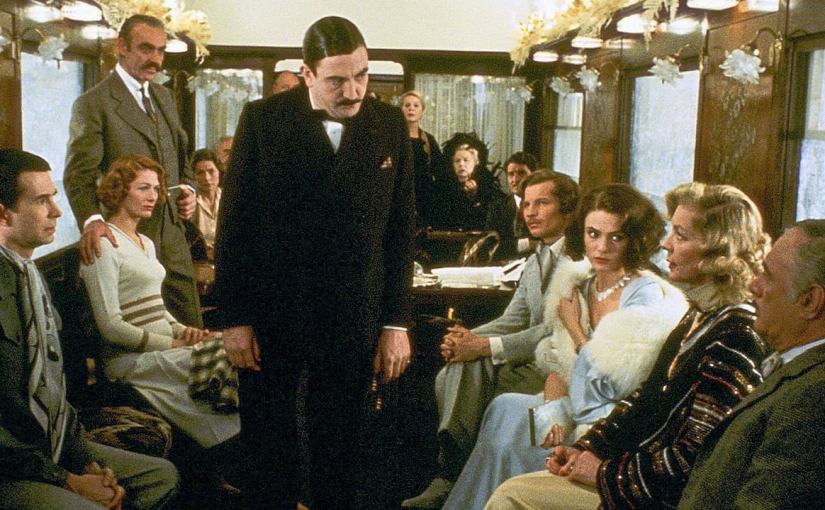
When considering Sidney Lumet’s admirable body of work, many would likely connect him with covering corruption within police precincts and the legal jargon of courtrooms. Fortunately, on occasion, he experimented outside of those genres, and we are all the better cinematic viewers because we were treated to an all-star cast, devouring up the scenery in an adaptation of Agatha Christie’s celebrated mystery Murder On The Orient Express.
Lumet abandons his penchant for the metropolitan jungles of conflicted souls and high stakes drama to offer up a deliciously fun who done it, with Albert Finney gleefully playing the oddball, mustached Belgian (not French) detective, Hercule Poirot. Despite a cast that features Sean Connery, Lauren Bacall, Jacqueline Bisset, Vanessa Redgrave, Martin Balsam, Richard Widmark, Michael York, John Gielgud, Anthony Perkins, and an Oscar winning performance from Ingrid Bergman, it is Albert Finney who makes the film wonderfully delightful. His stature that seemingly hides his neck within his stout torso, along with a shoe polished, flattened hairstyle and a thick, echoing dialect tempo are an absolute combination of pleasure. He makes the glossary of Tim Burton’s bizarre characters seem rather straightlaced.
He’s strange, but funny. Before the expected murder gets underway, we observe an unrecognizable Finney performing Poirot’s nightly routines, including applying cream to his hands and unique mustache, as well as donning a kind of strap beneath his nose to keep his signature trait in its proper shape. Batman maintains care of his cowl. This crime fighter must preserve his facial hair. It’s completely normal for Hercule. While these mundane tasks of his are executed, the great inspector is also alert to several rumblings and bustles going on in the nearby cabins aboard the famous train in the title. Lumet ensures we see how smart and observant Mr. Finney chooses to portray Poirot; unique, and instinctively wise without limits.
An impolite and bossy man named Ratchett (Widmark) is discovered dead with multiple stab wounds to the chest. It doesn’t make much sense considering the other passengers should all be complete strangers to one another. Or are they? Each one has an alibi, and their respective personalities couldn’t be more different. Who would have the motive to kill a stranger aboard a moving train?
There appear to be twelve suspects for Poirot to consider. That’s quite a list. The standouts for me include Bergman, Bacall, and Perkins, but Lumet allows at least a scene or two for each celebrated actor to shine.
Ingrid Bergman dresses down to portray a shy, nervous, homely Swedish woman. Sidney Lumet knows to back off on directing inventions when working with talent of such magnitude. In one uncut take, Bergman controls an interrogation scene with Poirot and the camera stays fixed on her never diverting away and very subtly tracking behind Finney to stay with the actress’ nervous portrayal and expression. The question is, should we trust this person? If Ingrid Bergman is putting on a façade, she’s awfully good at it.
Lauren Bacall carries such a strength on screen. She walks with square shoulders and utter confidence that makes it seem like she’ll be impenetrable to Poirot’s inquiries. Bacall’s booming signature voice would make me back down at any given moment. She commands the supporting cast and appears to defy intimidation.
This film was made fourteen years after Psycho and yet Anthony Perkins portrays Mr. McQueen, a secretary of the murder victim, with youthful naïveté. His stutter is perfectly timed and authentic, and he’s got body language that flails from one direction to the next when put to the test, not just by scenes he shares with Albert Finney, but anyone else in the cast as well. His character is clearly unrelaxed.
I decided to watch this picture for reference. In September of this year, I will be portraying Hercule Poirot in a stage adaptation of Agatha Christie’s story, written by Ken Ludwig. My colleague Miguel Rodriguez is in the production as well, occupying Martin Balsam’s role. They’re brilliant with magnificent energy by the way; Balsam and Rodriguez. I had to watch Lumet’s film twice to appreciate the gleeful nuances he offers with this celebrated cast, including the actual train which serves as not only a claustrophobic setting but a character as well, stuck in a snowdrift, trapping the guilty party with no means to escape. The dialogue flies fast and many of the various accents (Belgian, Russian, Scottish, Italian, Swedish, Hungarian) are challenging to decipher on a first watch, particularly Finney’s performance.
On a second watch, I was more wide-eyed to the detective’s behavior and how he breaks down a suspect during an interrogation. No two interviews of suspects are even remotely similar. Finney alters his way of approaching a scene partner each time. I’ll credit the screenplay’s dialogue from Paul Dehn for that achievement as well.
When a cabin door is opened to reveal the deceased victim, Finney’s odd mannerisms drastically change as he enters the room knowing what to say and look for immediately. Sidney Lumet characteristically will position his camera pointing up at his actors, so the audience is the perspective of the subject being looked upon. Albert Finney is gifted a wide scope within a narrow quarter to react as the famed detective. This filming technique was an inspired choice by the director. Hercule Poirot is built up to be the foremost detective and now we see him demonstrating his specialty for examining a crime scene, and thus where to begin with his examination. Albert Finney received an Oscar nomination for this role and it’s because of the skills he orchestrates under a guise of heavy makeup with a thick incomprehensible dialect. All are meant to be taken as winning compliments from me.
The art design of the train is breathtaking. The exteriors are magnificent too, particularly the train station located in Istanbul where the Turkish merchants crowd each cast member as they enter the film for the first time ready to board the Orient Express. In one spot, a steward is inspecting the food cargo. Another area has a merchant spilling over a carriage of oranges. Locals crowd Bacall, Bissett and York with trinkets to buy. Lumet captures the whole exotic tapestry.
Richard Rodney Bennett’s musical score is unforgettable. A sweeping, romantically uplifting waltz accompanies the locomotive’s ongoing trajectory. Then it gets more brooding when the journey comes to an unexpected halt in a chilling snowdrift, with the thought of a dangerous killer nearby.
Sidney Lumet is to be applauded for stepping back to allow his who’s who of legendary cast members play with Agatha Christie’s famous mystery. He’s done this on other occasions including his outstanding cast in Network and Paul Newman’s career best performance in The Verdict.
Those who are not familiar with the Agatha Christie’s tale are fortunate to experience the wonderfully twisted ending that serves the story’s continued appreciation. Lumet deserves credit for the final touch though. It’s not often that a film boasts such a collected caliber of talent together. So, the best way to cap it off is with a charmingly giddy champagne toast. It’s Sidney Lumet’s perfect little garnish to wrap one of greatest literary mysteries to ever be published and adapted for the stage and screen.
 2 UNPAID MOVIE CRITICS!!!!