BEFORE THE DEVIL KNOWS YOU’RE DEAD

By Marc S. Sanders

When it comes to crime – New York crime – few directors come as close as Sidney Lumet to make an audience feel the authenticity of its trappings.  Maybe only Martin Scorsese can stand next to Lumet.  Either with crime on the streets (Dog Day Afternoon, Serpico) or within the courtrooms (Find Me Guilty, 12 Angry Men), or both (Night Falls On Manhattan), Sidney Lumet hones directly upon how the plans should operate and when everything should unfold or derail.  

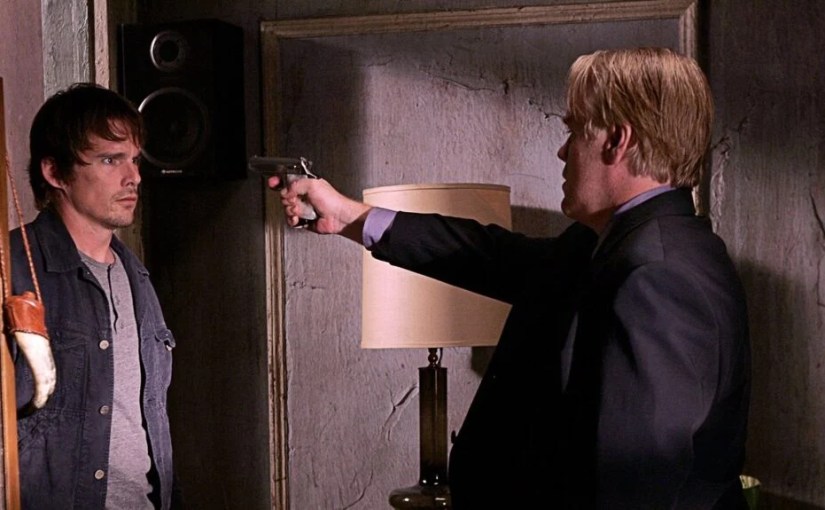
With the last picture before his death, Before The Devil Knows You’re Dead zeroes in on crime within an educated Irish family nucleus.  Andrew (Phillip Seymour Hoffman) has it laid out perfectly for his younger brother Hank (Ethan Hawke) to commit the perfect robbery. No one will get hurt and the insurance company will cover any loss.  The approximate take is around six hundred thousand. These guys carry their own desperate reasons for even considering such an idea, but Andy knows nothing can go wrong.  Hank has some trepidation though, because the target is mom and dad’s jewelry store.

Kelly Masterson’s script shows how quickly everything comes undone with bloodshed and unaccounted for details that could lead straight back to the two brothers.  It’s all told through three different perspectives – Andy, Hank and their father Charles played by Albert Finney.  Often, Lumet will return to the very same scene you saw moments earlier to show two sides of a phone call or in what direction one character goes versus that of another following a particular action that has occurred.  The timeline even jumps back in time a few days to show the direct perspective of any of these three particular characters ahead of showpiece scene – the robbery. Charles was retaking his driver’s license test. Elsewhere, Hank was struggling to pay spousal and child support with an angry ex-wife (Amy Ryan). Andrew was scheming and committing other clandestine acts both at work and in his free time.

However, Masterson’s script weaves all of these side details into how much more complicated this botched robbery becomes in the aftermath. All of what they commit following the robbery compounds into potentially making it worse for everyone involved.

Some of the breadcrumbs don’t carry enough water at times though. You might have to tolerate the characters being more intuitive than they likely should be.  Andrew leaves a business card with a side character.  When the film circles back to this item, it seems a little too easy for someone else to get wise about what has transpired.  I just chose to go with it.

Marisa Tomei is also part of the cast, caught in a love triangle as Andy’s wife and Hank’s mistress.  Tomei is really good, lending some authenticity with unscrupulous nudity in scenes with both Hoffman and Hawke.  This storyline serves as character exposition and only briefly scrapes against the crime drama at play.  It could have been excised from the film, but because the dialogue and scenario is written and performed so well, it effectively held my attention.

Albert Finney is magnificent as the patriarch owner of the store.  Simply his devastated, echoey breathing and the way he fumbles to put his eyeglasses on to learn more about what has occurred is absolutely genuine.  A late middle-aged man discovering horrible truths.  Finney plays it beautifully.  That being said, I wish the film offered more backstory to his character.  There are few hints suggesting how he regarded Andy as the first born who needed be thrown to the wolves and learn to fend for himself.  Contrarily, Hank is the younger and more disappointing son.  Yet, the script is short on material that further explores the relationship between the father and his sons.  I felt the film demanded more because Charles is quite significant to the conclusion of the story, which carries an unexpectedly abrupt ending.  

The acting and assembly of time and perspective are so finely tuned by the whole cast under Lumet’s direction.  Still, Before The Devil Knows You’re Dead needed another twenty to thirty minutes of storytelling.  One character runs out of frame with an unfinished storyline.  Another, seems too hasty in making a final decision with an easy convenience.

Don’t get me wrong.  I strongly recommend this last effort from Sidney Lumet.  It’s a unique crime yarn with an especially conniving Phillip Seymour Hoffman doing some of his best work.  The set up had me riveted and I couldn’t wait to see how all these terrible scenarios were going to fix themselves or make things horribly worse.
MAN OF STEEL (2013)

by Miguel E. Rodriguez

Director: Zack Snyder
Cast: Henry Cavill, Amy Adams, Michael Shannon, Diane Lane, Russell Crowe, Kevin Costner, Laurence Fishburne
My Rating: 9/10
Rotten Tomatometer: 56% (damn…haters gonna hate)

PLOT: The last son of a dead planet finds a home on Earth and, thanks to enhanced senses and powers, becomes its mightiest defender when an ancient enemy attacks.


I never tire of repeating this: the majority of my enjoyment of a movie is derived from how it affects me on an emotional level.  And, brother, in my case, Man of Steel knows exactly which buttons to push to make the hairs on my arm stand on end.

I can still remember the first time I saw the very first teaser trailer, back in 2012.  It fired my imagination almost as much as the first trailers for The Phantom Menace did.  “At last,” I thought, “someone is going to make a SERIOUS Superman movie!  It worked for The Dark Knight, why not Superman?”

And in my humble opinion, it did work.  But before I get into the debate between different Superman versions, let me talk about this movie first.

Man of Steel is ambitious, audacious, and visually spectacular.  Its one major fault lies in the finale, in which a human family is threatened by a heat ray, and it seems all they have to do is just…run the other way.  But a point is being made (a good one, I might add), so I can forgive it after the fact.  On first viewing, though, I will admit the mildly absurd situation took me a little bit out of the moment.

But I’m picking nits.  The rest of Man of Steel is just a great experience at the movies.

Right from the get-go, we know we’re in for something different when, for the first time since Superman II [1980], we get a glimpse of Kal-El’s homeworld, Krypton.  But this is not your father’s Krypton.  This is a lush, red-sky world, with stunning vistas, flying creatures, and hyper-advanced technology.

The familiar story is all there: a dying race and a loving mother and father who send their infant son to the stars for one last chance of survival, for him and for their race.  In flashback, we see Kal-El’s childhood in Kansas, as he struggles to adapt to his enhanced senses.  This is one of the great concepts I’m glad the movie took the time to show.  We see him trying to cope with seeing and hearing EVERYTHING, all at once, and learning to focus his powers so he can function in this new world.  That was a nice touch.  The school bus scene was handled especially well.

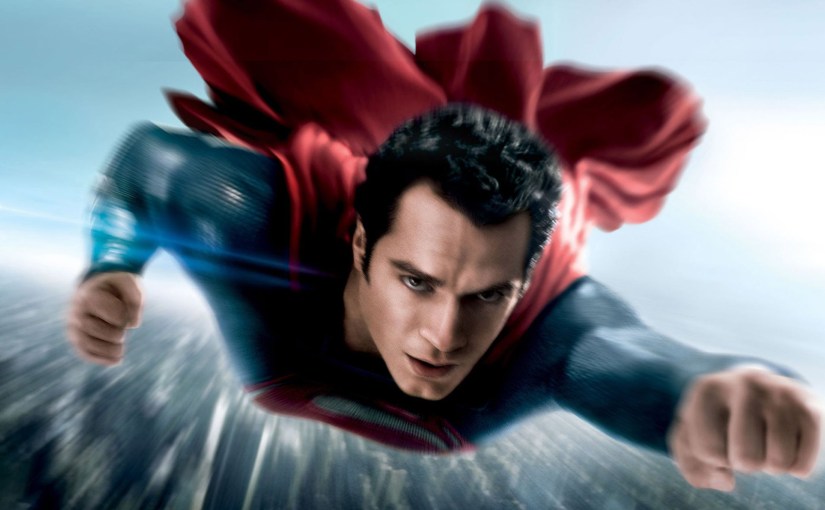
We see him as a grown man (played by Henry Cavill) before he dons the familiar suit, a drifter, only reluctantly playing the hero from time to time.  I liked the beats in this section because they echoed some of the good deeds we saw in “Superman” [1978], but everything was done from a standpoint of genuine awe and astonishment.

Then an alien ship is discovered buried under the ice in northern Canada, Clark investigates, and so does ace reporter Lois Lane (Amy Adams), and things start to snowball from there.  But in “Man of Steel”, everything is handled in a way that makes the far-fetched story seem more real and relatable, more so than its predecessors.  And that appeals to some part of me that is hard to quantify or put into words.

Ever since I was a kid, I was drawn to the darker, grittier aspects of comic books.  My favorite Batman comic?  “The Dark Knight Returns,” Frank Miller’s magnum opus in which Bruce Wayne is an old man, the Joker winds up getting killed, and Batman and Superman fight to the death.  My favorite Marvel comic?  “Identity Crisis,” in which a superhero’s wife is murdered and the Justice League bands together to find her killer.  My other favorite comics?  “Preacher”, “Y: The Last Man”, “Saga”, “Watchmen”, “V for Vendetta”, and “Ronin.”  I was always, and still am, a fan of how the medium of comics can be used for telling mature stories that don’t always depend on happy endings, or heroes swooping from the skies to catch falling helicopters.

So when a movie DOES come along that, by default, has swooping heroes and a happy ending, but can ALSO make things a little darker or grittier than usual, I am thrilled, because it means the filmmakers are not confining themselves to ancient stereotypes.  They’re trying to surprise me.  They’re making a movie for ME.  …at least, that’s how I feel, because it’s right up my alley.  For example, one of the heaviest criticisms involves the overblown battle scenes.  But, man, I was TOTALLY okay with it.  No flying sheets of cellophane or creepy identical twins here.  These guys are playing for KEEPS.

Does this mean I am somehow in favor of comic book movies removing all traces of fun?  Of course not.  One of my favorite DC movies is “Shazam!” which was WAY more fun than I anticipated.  It’s pretty much a straight up comedy.  Would I prefer a grittier “Shazam” movie drained of fun, with dark skies and a darker ending?  No.  For “Shazam”, the fun approach worked.

When it comes to Superman, I think it’s a mark of the character’s versatility and endurance that it’s even possible for the “fun” Superman (yes, including “Superman Returns [2006]) to exist alongside the darker Superman.  It’s not like “Man of Steel” or its sequels somehow erased or replaced previously existing versions.  They’re still there.  If the comic book industry has taught us anything, it’s that the market for reboots and “remixes” is almost inexhaustible, as long as you stay true to the core principles of the character you’re working with.  In my opinion, “Man of Steel” does exactly that.  It keeps Clark Kent’s innate principles and values in place while dressing up the story to give us one of the best reboots of a character since “The Dark Knight” [2005].

There is, perhaps, one glaring exception, and it comes at the finale of “Man of Steel”, so SPOILER, SPOILER, SPOILER.

SPOILER ALERT.  You have been warned.

If you’ve seen the movie, you know what I’m talking about: Superman is forced to kill General Zod (Michael Shannon) when it becomes clear that Zod will never stop his war on humanity, when he vows to kill everyone on Earth to avenge his lost civilization.  In the comic book, it’s a given that Superman himself does not kill anyone.  (There may be exceptions, but give me a break, I don’t read comic books religiously.)  So why this egregious contradiction?

Since “Man of Steel” is a reboot, I choose to think of it this way:

This is Kal-El’s first test as a hero, his first battle with an enemy as strong as he is in every physical way possible.  He is faced with an impossible choice: kill Zod, or allow countless more humans to die in who-knows-how-many-more battles.  He may be more powerful than a locomotive, but he is just plain inexperienced when it comes to this kind of decision.  So he does what he feels is necessary to preserve life.  He is definitely NOT okay with it.  Watch the movie, and you’ll see his howl of anguish and regret after the deed is done.

But he makes his choice.  He is the son of two worlds, but he chooses Earth.  “Krypton had its chance,” he yells at one point.  It’s time for him to move on.

I know, movies are subjective, and there are no doubt many excellent arguments against my interpretation.  Maybe that’s what makes “Man of Steel” and the Superman character so durable: the fact that there are so many vastly differing interpretations, and that they all apply equally.  Superman can be many things to many people, but no matter how many years go by, he’ll still be what he’s always been: a symbol of hope.

(Got a little mushy there at the end, hope you don’t mind.)

THE SHAPE OF WATER

By Marc S. Sanders

I love fantasy and science fiction for one simple rule. A writer/director’s imagination can be limitless. Rules for a good fantasy are normally established in the exposition, and as long as those rules are not violated, a viewer will accept the narrative all the way to the end. The Shape Of Water is loyal to its set up.

Director/Co-Writer, Guillermo Del Toro continues his reputable streak of very adult (yet playful) fantasy. In 50 years, I would not be surprised if Disney/Pixar remade this film and Pan’s Labyrinth for younger PG audiences simply because the roots of the stories are so well played out.

Here is a Cold War love story between an alien and a good soul played by Sally Hawkins doing her best mute. Hawkins is bright eyed and wonderful. She’s a character that doesn’t judge and only recognizes despair for salvation. I thought she was great at conveying her performance through the limits of only facial expression, sign language, sex and self pleasure in a bathtub. Try to avoid snickers at that last description. It really is an honest, necessary reflection of a lonely innocent woman. I appreciated the writing and performance there.

Michael Shannon is back on screen playing a frightening villain…again. The reasons for his ruthless intentions were never clear to me, but either Shannon is that good an actor or he’s gotta be like this in real life. This is not a guy I’d ever want to cut in line at Starbucks, much less audit his books. He’s scary good.

Didn’t find much point to Richard Jenkins lonely neighbor except to drive a van, eat pie, be unemployed and be a token homosexual. Same with Octavia Spencer. Was she channeling a more subtle Whoopi Goldberg from Ghost? Don’t get me wrong. Jenkins and Spencer are fine actors here, and their characters are likable, but they don’t add much to the story except to be Hawkins’ sidekicks. Too much story was devoted to them though unnecessarily. Del Toro and his co-writer might have used them for too much filler.

Del Toro doesn’t stop with the new material as the two hours swim on by at a nice pace. We are treated to a wonderful Busby Berkeley song and dance moment that is just inviting to be spoofed by the Wayans or Zucker brothers, sensual nudity is there, not for perversion, but to send home the message that though this relationship is weird, it’s also the real deal. I bought it all the way through. Racism and gay prejudice are perhaps unnecessary in a film like this but there is key lime pie. Cats are consumed. Cold War espionage is on hand with Russian spies, dirty American government politics is there too, and oh yeah, there’s an amphibious alien who seems like any one of Spielberg’s extra-terrestrials we’ve seen before. Yet, I’ll take this one as well because he’s narrated into a very mature love story that is hard not to like.

As quick as the movie begins, you know how it is going to end. Again I don’t mind. Most of the execution rescues the story’s predictability.

Del Toro won Best Director and the film was awarded Best Picture at the Oscars. It’s not what I would pick, but there could be worse choices from that year’s selections.

I liked The Shape Of Water. Most of it at least.

MIDNIGHT SPECIAL (2016)

by Miguel E. Rodriguez

Director: Jeff Nichols
Cast: Michael Shannon, Joel Edgerton, Kirsten Dunst, Adam Driver, Sam Shepard
My Rating: 10/10
Rotten Tomatometer: 83% Certified Fresh

PLOT: Two men go on the run with a child in tow, pursued by federal agents and by members of a cult who believe the child has special powers.


The general concept of “mystery” in a film is a subtle art.  Not enough mystery, and people will say they’ve seen it all before.  Too much mystery, and people will wonder why they’ve spent good money to be confused for two hours.

Every now and then, though, a movie comes along that shows everyone else how it’s done.  It manages to plunge the viewer headlong into the story with little to no exposition, provides just enough clues to keep things intriguing without giving the game away, and supplies a climax that is not just satisfying, but revelatory.  Prometheus is one of those movies.  So is Freaks (2018).

And so is Midnight Special, from director and screenwriter Jeff Nichols (Take Shelter, Mud).

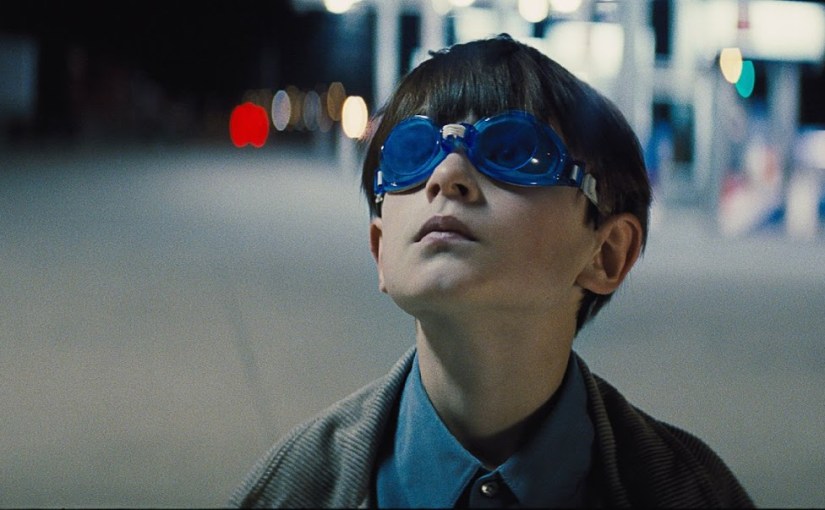
This movie grabs you right from the opening minutes.  Two men appear to be holed up in a hotel room with a young boy wearing blue swim goggles.  Cardboard and duct tape cover the windows.  A news broadcast on the TV reports on the young boy’s kidnapping.  However, he does not appear to be distressed in any way.  One of the men may or may not be his father.  He goes willingly when they vacate the room and hit the road.

In another part of the country, a pastor watches the same newscast with concern.  He later leads a church service, but the scripture reading consists of non-sequiturs and random numbers.  The FBI interrupts the service and hauls each and every church member in for questioning about the missing boy.

What the deuce is going on here?  How is this church connected to the boy?  Where are the two men taking the boy?  What’s with the blue goggles?  What is so important about this boy that the two men with him would be willing to kill for him?

These are all very good questions.  Whenever the movie takes the time to answer one of the questions, two more spring up in its place.  And I may as well tell you now: not every question will get an answer.  But instead of feeling frustrated, I just got more and more involved in the film.  I felt like I was an active participant in figuring out the story, along with the characters.  There’s nothing quite like feeling involved in a movie, rather than simply watching a movie.

When the revelations arrive about where the men are headed with the boy, why they’re headed there, and why the FBI is interested, I’m not gonna lie, I was gobsmacked.  In retrospect, I suppose I should have seen some of the plot points coming a mile away.  But that’s the beauty of the screenplay and the direction.  I wasn’t interested in trying to second guess what surprises were in store.  As a result, when the surprises arrived, I was constantly in a state of jaw-dropping amazement.

I would also like to point out the great restraint used by the filmmakers when it came to the few scenes that required CGI enhancement.  There are a hundred ways these scenes could have gone wrong, resulting in a shot that completely takes you out of the movie.  They avoided all those pitfalls and instead created scenes of startling beauty, even when things seem to be going wrong…or when they at last go right.

This is a movie that deserves to be seen with as clean a slate as possible.  It didn’t exactly make a dent in the pop-culture zeitgeist, so it’s not likely you’ll see any spoilers on the internet without Googling the movie, but why would you want to do that?  Keep an open mind, don’t ask how it ends, and find a way to see this movie.  You won’t be disappointed.

KNIVES OUT

By Marc S. Sanders

Rian Johnson’s new film Knives Out is an attempt to reinvent the Agatha Christie blueprint of The Who Done It? Murder Mystery. It primarily succeeds even if it is a little cookie cutter in its screenplay.

Famed best selling mystery writer Harlan Thrombley (Christopher Plummer) is discovered by his maid in his reading room to have slit his throat. All evidence points to suicide. Police follow through with simple procedural questioning of his next of kin, and yet a private detective (Daniel Craig) with an outstanding puzzle solving reputation is hired with a delivered envelope of cash from an unknown source. If it’s suicide, then why a detective, and who had reason to hire him?

Craig as Detective Benoit Blanc (great name) adopts a hilarious Kentucky southern drawl to rattle the cages of possible suspects, assuming that perhaps this wasn’t suicide. Could it have been…MURDER?

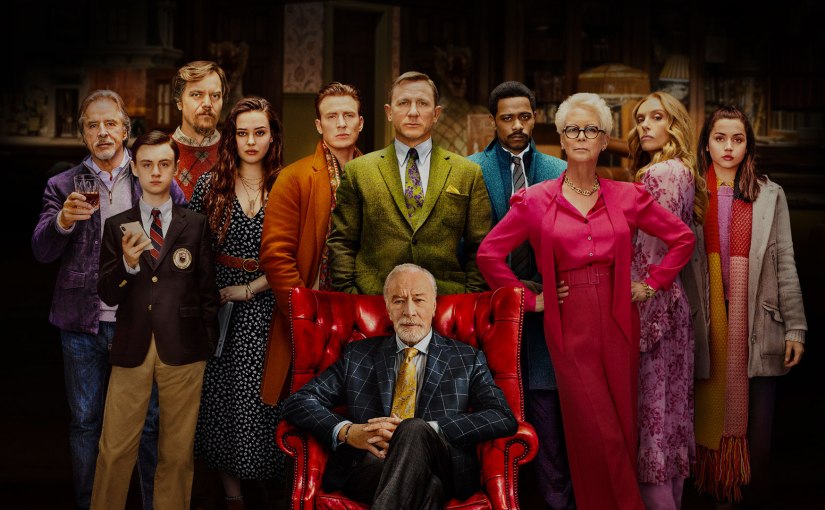
The suspects consist of family members and each is well exaggerated in their physical descriptions. Johnson wrote these connivers with possible motives to set them apart from one another-first by casting well known actors and then giving most of them a garish appearance or unusual trait. Jamie Lee Curtis as Linda with a short white as snow haircut and black circled glasses looks like no one else I can recall. Michael Shannon as Walt with a cane and exaggerated limp, not too bright but also quite discomforting. Don Johnson as Richard only with a goatee, Toni Collette as Joni putting on a bug eyed expression with ditzy delivery. Chris Evans as Ransom, with clean shaven good looks and a toothy smile in preppy, yet snobbish looking sweaters. Finally, Ana de Armas as Marta, Harlan’s nurse, who seems to be the only one devastated by what has transpired, and somehow inadvertently ends up being more involved than she ever expected. She can’t lie. If she does, she can’t help but vomit. A disadvantage perhaps but maybe a convenient advantage at times as well.

Early on, interviews are shown and it appears everyone has reason to maintain a grudge against Harlan. So if Harlan was in fact murdered, well then it’s fair to presume one of these people might have reason to commit the crime. A will is eventually read and then even more twists present themselves. Someone definitely wanted Harlan out.

Rian Johnson spells it out easily for the viewer. Each suspect has his/her own place in the film to toy around with. While I didn’t find it too challenging to predict a likely suspect that has orchestrated what’s occurred, it was more fun for me to watch how it was all pieced together. I kept asking myself what’s so important about the dogs or the baseball or the silent “Great Nana” (K Callan) who sits around the house but surely must have something to contribute.

Agatha Christie or Dashiell Hammet still hold as the much more clever writers. Still, Daniel Craig is having a blast in his role, conceived by Johnson. I’d like to see another mystery with this character. He’s funny at appearing unconcerned with new developments that could be occurring while he’s really just waiting for the inevitable fact that reveals the absolute truth.

Following leaving the scene of an arson a potential suspect makes an unexpected stop. Craig as Detective Blanc opts to wait in the car and put his ear buds on to sing show tunes. Who would do that? Yet, that’s what’s hilariously fun about this picture. A man has died but the shallowness of his surviving family and the disconnect of the detective are the entertainment factor.

Rian Johnson knows how to keep Knives Out amusingly interesting with a curiosity that does not stop.