
THE PLEDGE

By Marc S. Sanders

The Pledge is a moody and bleak crime drama that follows a retired detective’s descent into obsessive madness.

Director Sean Penn opens his film with the gruesome discovery of a murdered nine year old girl found amid the snow covered woods outside a small Nevada town.  She happens to be discovered on the evening of veteran detective Jerry Black’s (Jack Nicholson) retirement party.  Upon receiving word of the crime, Jerry leaves his celebration to explore the scene that is carelessly compromised by the local sheriffs.  His protege partner Stan (Aaron Eckhart) rushes through a possible suspect’s (Benicio Del Toro) interrogation that draws a quick conclusion along with an unnecessary and bloody outcome.

Jerry surrenders his position with the police department, but he’s not entirely convinced the crime has been solved.  He obligates himself to uphold a devout promise he gave to the victim’s parents (Patricia Clarkson, Michael O’Keefe) that he will catch their daughter’s killer.

Time passes and rather than retire into a quiet life of fishing, Jerry purchases an old gas station located within the vicinity of the crime scene as well as nearby where two other murders with similar circumstances occurred.  Jerry is going to wait out the next attempt committed by “The Wizard” or “The Racoon Killer,” and catch him in the act.

The Pledge is a brooding and lonely film.  Sean Penn’s piece offers an impressive list of who’s who actors that appear in small roles to shape out the detective’s progress.  Amidst all of these familiar names in the cast, Jack Nicholson has never appeared so isolated or despondent before.  His character is limited on dialogue.  A thin mustache and a wrinkled complexion with a smoking habit hide any humor or joy.  Jerry Black knows he’s the last capable police detective in this area.  It pains him to abandon his post to the halfwits he leaves behind.

A promise is a dangerous gesture.  If you adhere to it, all obstacles become nonexistent.  Anything will be done to uphold a pledge and conclude your wild theories, even if proof is not conveniently supplemented.   Nothing stands in the way of pledge.  

The second half of The Pledge moves at a slower pace when Jerry welcomes an abused mother (Robin Wright Penn) and her daughter into his home.  A new life seems destined for these three people but at what cost?  Is the hero of this film at least as dangerous as the psychopath that supposedly remains at large?

Would you go to the great lengths that Jerry puts himself through?  Is the expense of his own sanity, and the safety of an innocent woman and her daughter worth this pursuit?

Sean Penn’s film does not operate on suspense. What action there is only fuels Jerry’s chase at a long-shot truth.  It’s a slow burn crime drama that makes the central murder a far second priority to how the initial discovery overtakes the main character.  Again, this kind of mania is a different breed from Jack Nicholson’s other crazed portrayals found in One Flew Over The Cuckoo’s Nest, Five Easy Pieces, or The Shining.  Nicholson is not as vocal or expressive in this role.  Yet, we all know what drives this guy with what few words he uses.

Robin Wright Penn and Nicholson share some effective scenes together. Their motive to be with one another stems from a misery loves company ideal. Good casting here, and throughout the film with small appearances from Helen Mirren, Harry Dean Stanton, Sam Shepard, Vanessa Redgrave, Mickey Rourke, Tom Noonan, Clarkson, O’Keefe, Del Toro and Eckhart.

Sean Penn is very good at creating visual moods to his film. The image of Nicholson standing within the pen of a crowded turkey farm with the anguished parents of the victim is truly haunting. Animals of all kinds seem to emote a cold harshness as well. The first image to appear consists of a swarm of large, winged birds soaring above this backwoods area where the biggest thing to happen is a town parade. Otherwise, as one girl tells Jerry there’s nothing else to do here. This remote Nevada area is unprotected from greater powers, and its only guardian is forced to accept retirement, leaving his community vulnerable. This formerly decorated Marine is now a formerly decorated cop, and the unseen animals-or monsters-still roam.

I won’t spoil the ending which I commend, but there is one moment that Sean Penn includes in the final cut that is objectionable.  For the first time in the picture since Jerry Black accepted the case, one moment near the end of the movie tells the audience everything they need to know while leaving Jerry in the dark.  I think it was a poor choice to go this way.  The audience is going along with Jerry’s pursuit until they are spoon fed a resolution they didn’t earn because Jerry never arrives at this conclusion.  A better route would be to leave the audience in the same dizzying haze that Jerry must live with.  Some hanging threads should be left untied. The Pledge is a pot boiling, well-made and disturbing film, but with minutes to go before the end credits roll, a less is more approach should have been adopted.
CADDYSHACK

By Marc S. Sanders

Do you think in 10 years or even 50 years from now, people will remember that Harold Ramis was one of the funniest writers in film history? Animal House, Stripes, Scrooged, Groundhog Day (I hate it, but I won’t deny its legacy every February 2nd), and Ghostbusters. One film that cemented the stage for his success in the 1980s is arguably Caddyshack, which focuses on the snobs vs slobs at a high-end golf country club known as…ahem…Bushwood. It’s okay to laugh. Your mother is not in the room.

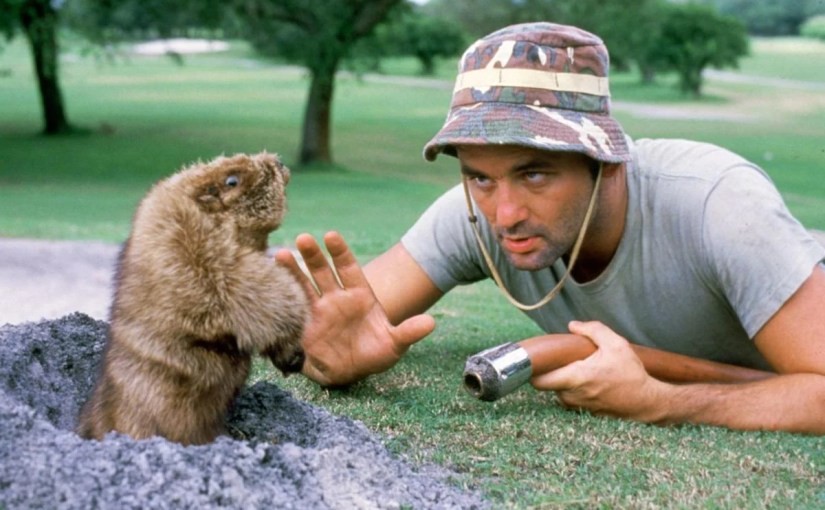
Caddyshack is more or less a vehicle for the comedic talents of Saturday Night Live players to put out their best material seemingly made up on the fly. Bill Murray is the demented grounds keeper tasked with getting rid of a damaging gopher. Chevy Chase seems to be the charmer with a delivery of wit in every word he says. He’s more or less good looking here but just as deliberately stupid as everyone else. Rodney Dangerfield goes beyond his stand-up routines, or maybe he doesn’t. He’s just shoved into the film and let loose to anger and harass the head snob, Ted Knight. Knight is unquestionably the best of the bunch here. He’s got such great timing with his outbursts and delivery. I even love how he pronounces the car maker Audi. It’s more like “ottie.”

Ramis has a thin storyline about one caddy (Michael O’Keefe) trying to win a college scholarship. Meh. So what! Caddyshack works best when it’s just playing for skits and raw laughs. There’s gross out comedy like doodie in the swimming pool, compliments of a Baby Ruth candy bar, and vomiting in cars. Dangerfield’s one liners are fast and loose. The judge’s daughter is a sly minx for the dweeby male cast to ogle, and the gopher footage with Murray is straight out of Looney Toons. I do love the irony of the Catholic priest going out to play 9 holes in the middle of an electrical storm; a prophet who will spit in the face of God. “OH RAT FARTS!!!!”

Caddyshack is not my favorite of Ramis’ films, but it’s become a touchstone in comedy quotes and repeat viewings. It’s stupid and coarse and silly and belongs nowhere in the Parthenon of great filmmaking efforts but it’s a favorite of almost anyone’s for how brash it truly is. It’s an R rated interpretation of The Three Stooges. If not for nothing, I’m sure that somewhere there is an esteemed judge of the cloth who was proud to sentence young men to the gas chamber as a means of “owing it to them.”

Harold Ramis with co-writer Brian Doyle Murray (Bill’s brother) conceived of Caddyshack as a push back against that system of order. Well done, men. Tee up!

MICHAEL CLAYTON

By Marc S. Sanders

The corporate world can be murder sometimes.  Just ask a well known “fixer” like Michael Clayton. 

George Clooney plays the title role that’ll leave your head spinning while watching the film, and thereafter keep you thinking about how frighteningly true much of what you’ve seen, in this fictional account from master writer Tony Gilroy, could potentially be all too real.

Michael Clayton is a lawyer who does not practice law but rather “fixes” sticky situations for his law firm.  When the attorneys of the firm don’t have enough imagination to swindle their client from bearing responsibility or surrendering to guilt, they turn to Michael.  Michael will know what to do.  Ironically, Gilroy’s script (which is also his directorial debut) will have you believe that Clayton is at a career midlife crisis moment where he understands that nothing really can be fixed or simply swept under the rug.  Not even money can buy any of us out of a guilty situation when there’s nothing to work with but the black and white facts of actual guilt.  Early on in the film, Michael explains to an aggravated high-priced client that there’s no getting out of the fact that a late-night hit and run is nothing else but a late-night hit and run.  Can’t undent a car.  Can’t bring a bicyclist back to life.  Can’t fix what is permanently broken.

Moving on to the main storyline will demonstrate the same ideal.  If knowing admission of guilt and wrongdoing is documented on paper in plain English, then there’s no getting around this.  Moreover, there’s no getting around the fact that one of the best lawyers in Michael’s firm, played expertly by Tom Wilkinson, is consciously arrested in his own guilt of ethics violation.  To be considered one of the greatest lawyers in the country, would you factor in how to squeak out a win at no costs? Would it be when you can accept that your own client is guilty of wrongdoing and help them from that point?  I don’t know.  I’m not a lawyer.  The point is that Tony Gilroy implies that Wilkinson’s character, Arthur Eden, was once considered among his peers in high esteem in order to earn the reputation he has. Then another way when perhaps that reputation was based on actions not so honorable.  As Arthur struggles with this conundrum, maybe it’s only telling that his wealthy corporate client, an environmental weed killer manufacturer and his law firm colleagues easily think it’s nothing like that.  Arthur must be literally losing his mind.  It’s the only explanation.  He’d have to be crazy to literally strip his clothes off in the middle of a witness deposition, and later run after the witness in a freezing cold parking lot, while stark naked.

The pawn of the corporate client is represented by a shark named Karen Crowder (a brilliant Tilda Swinton, putting on the American Ivy League grad persona).  Karen is only insecure in how capable she’s actually considered when behind her closed doors.  She nervously practices what she will say at presentations for the corporation or interviews that hold her client in the highest regard.  She’s also desperate to maintain a calm and unpanicked appearance of this firm who clearly caused the death of many people that were exposed to their product.  Karen will make certain this knowledge never sees the light of day.  Karen talks to her mirror while stuttering over her lines.  By the way, if Karen was so confident in what her corporate client stands for, then would she even have a stutter to begin with?  This is where Tilda Swinton is great with Gilroy’s script.  What she knows would be the death of her career. Then again, this is her career we are talking about here. 

Tony Gilroy’s script is deliberately muddied in its first act.  Random scenes that carry no relevance to one another occur.  Michael sits at an underground poker table. Arthur spews off endless speeches that give a voice to madness. An army of lawyers led by a shrewd Sydney Pollack are up late at night sifting through piles and piles of documents.  Karen talks to herself while smoothing out the wrinkles of her suit while getting dressed in the morning.  Then a car explodes, and the movie sends us back in time to four days prior.  This might seem frustrating on a first viewing, but I urge anyone interested in seeing the film to be patient.  Gilroy demonstrates that if crime truly occurs within the offices of corporate high-rise buildings, then it’s not going to be anything but complex.  It’s only when it is gradually simplified like a math equation, do we see how justifiable the desperation of these crimes really are.  Murder and attempted murders and violations of law and ethics are committed in the film Michael Clayton, and yet no one is carrying a gun. 

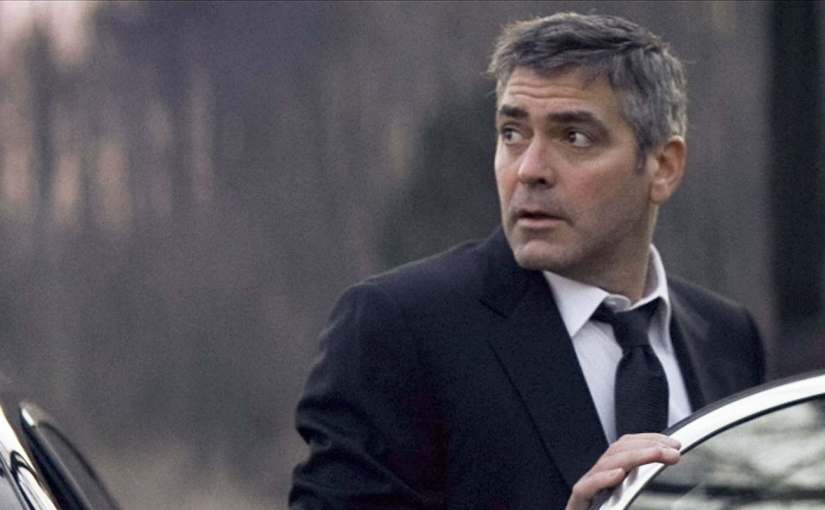
This film boasts a brilliant cast ready for complicated characters.  Clooney is far from his charming other characters that evoke cuteness and handsome tuxedo clad appearances.  He’s a tired professional soul, exhausted on the heavy lifting he does for his firm and their apathetic clients.  He’s failed at his dream of running a New York City restaurant with his recovering alcoholic brother and he’s mounted in debt to loan sharks.  Wilkinson is old and past the age of winning at all costs.  He can’t sleep with the contributions he’s lent to criminals he’s legally served and rescued on paper.  Swinton is the younger one of the trio with a massively rich and successful future ahead of her, while holding on to the same mentality of what Clooney and Wilkinson’s characters once had.  The only issue is that maybe she’s taking a few too many steps way too far. 

Tony Gilroy has written brilliantly faulty characters who must function with strength, but are weakened by their lack in morale or inability to recover from never having morale, and the actors he’s directed in this film deliver the message sensationally.

Michael Clayton is a smart film, and Michael Clayton is a great, great film.