
SONG SUNG BLUE

By Marc S. Sanders

Films that are based on true stories will always take theatrical liberties with the storytelling.  Look at Oliver Stone’s JFK.  Sometimes, if it is so skewed you absolutely should not approve of it.  Consider Bowling For Columbine which starts out with an offensive, bold-faced lie to draw you in.  

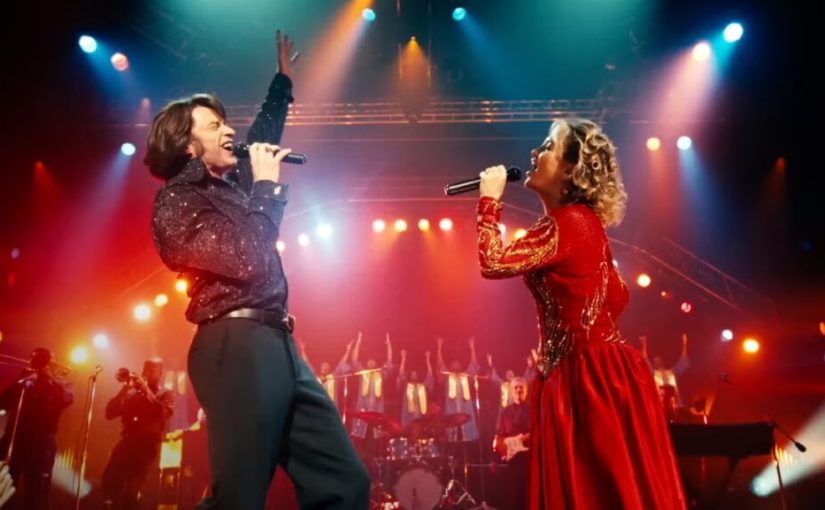
On other occasions, the alterations made justifiably serve the picture to obtain an emotional reach from the audience.  Craig Brewer wrote and directed Song Sung Blue, which he calls an incredible true story.  The set ups seem too perfect to convince me some of these events actually happened.  However, the major highlights ring absolutely authentic and with an entertaining pair like Hugh Jackman and Kate Hudson leading the picture, this is a magnificent experience.  The audience I saw it with on Christmas Day was so wrapped in what was put on screen, with organic comedy, tragic setbacks and toe tapping harmonized energy from the two actors doing outstanding “impressionism” of Grammy winning singer Neil Diamond.  

Mike and Claire Sardina (Jackman and Hudson) meet while working as tribute performers at a local fair.  She’s doing Patsy Cline.  He’s refusing to be Don Ho.  They quickly fall in love, like literally on the next night after they meet, and brainstorm with his guitar and her piano how they can become a musical act on their own.  Mike wants to emulate someone that lives up to his energy and persona. He declares to an AA group that he’s a “superhero of music.”  He’s Lightning.  She’s Thunder.  Claire thinks Neil Diamond is the perfect facade.  Mike agrees so long as the unfavorable “Suleman” opens their shows, and they resort to other numbers besides “Sweet Caroline.”

Soon they are married while his daughter Angelina (King Princess) befriends her daughter Rachel (Ella Anderson).  Her son Dana (Hudson Henley) takes to video recording their performances.  One happy, blended family.  

Like most musician biographies, Lightning and Thunder get off to a rocky start performing in seedy venues with audiences who would rather they play Lynyrd Skynyrd.  Naturally, a following and a stride eventually build, and the act is somehow opening for a popular grunge band from the 1990s.  I won’t spoil who it is because Mike and Claire never heard of this headliner. This delivers a great gag.

Song Sung Blue is a warm comfortable journey through its first act.  It’s hard not to love anyone occupying this picture, including supporting turns from Michael Imperioli, Fisher Stevens and an unrecognizable Jim Belushi.  Once you’re settled into the story the dramatic weight of the piece enters, and it becomes heartbreaking for Lightning and Thunder.  Only after this unexpected change is introduced does the need for triumph work as the story’s conflict, and there is a lot to contend with for the couple, and particularly Rachel.

These characters are so likable that you’re apt to feel proud of them and Brewer does good work at showing the struggle.  Kate Hudson, with a Midwest accent, is especially effective.  She goes from offering a welcome personality to being cold, bitter and angry.  I wouldn’t object if she got an Oscar nomination.

Hugh Jackman is a magnificent entertainer.  Unlike his Wolverine films, his real age with wrinkles and grey hair deliver a twenty-year sober alcoholic living with a chronic health issue. However, Mike has an unstoppable drive of positivity through music with a microphone, a strumming guitar, and his flowing hair to compliment his colorful and sparkled stage outfits.  Brewer allows room for Lightning’s weaknesses, both physically and mentally.  

There’s a nice balance of both characters at the top of their game as well as far beneath the bottom rung of the ladder.

Song Sung Blue is very absorbing in the moment.  Only after I walked out did I question some of the set ups and wonder if certain events truly happened as assembled into the final edit.  I’m skeptical if the conclusion for one character truly played out like it did.  It’s just too neatly wrapped up like a Hallmark film or a soap opera episode.  That being said, the manipulations worked on me and the audience.  So, why should it bother us?

A twisted irony also happens though, which I had no choice but to believe.  It’s just simply too outrageous that Craig Brewer would work it into this story if it wasn’t true.  My wife exclaimed “No way!  You’ve got to be kidding me!”  Without knowing anything about the real Mike and Claire or seeing the documentary film this picture is based on, my gut insists this has got to be true and a reason why Song Sung Blue merits a movie presentation featuring two Oscar nominated actors.

When you see Song Sung Blue I urge not to frown on the film if you notice some of the truths are stretched a little.  Instead, absorb the outstanding performances of Hugh Jackman and Kate Hudson doing electrifying interpretations of Neil Diamond’s collection of hit songs including “Better In Blue Jeans” and of course “Sweet Caroline.”

Song Sung Blue is marvelous entertainment.
LEAN ON ME

By Marc S. Sanders

The career of director John G. Avildsen is best defined by his inspirational stories of athletic prowess for the underdog, particularly The Karate Kid from 1984, and the Oscar winning Best Picture sensation, Rocky.  Both films follow similar formulas once the exposition phase is completed.  Music montages fill the screen with endless training with the protagonists giving it their all.  Avildsen’s film, Lean On Me, teeters on these conventions and it tells me one thing.  Training montages belong in the field of physical activities, not with tests of intelligence and academics.

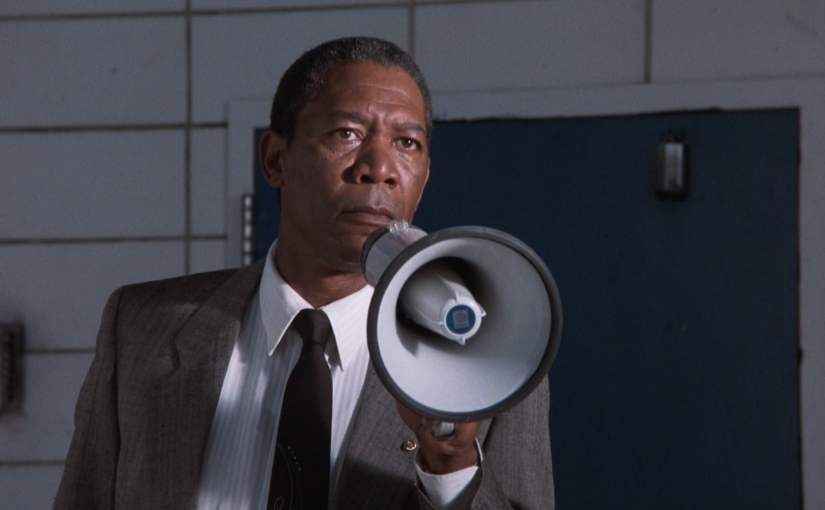
Morgan Freeman portrays Joe Clark, or Crazy Joe Clark with the baseball bat, who singlehandedly (at least according to the film) turned around the Eastside High School of Paterson, New Jersey from a hell hole of violence, drugs and terror into a respectable institution of education.  Eastside, where the actual film was shot, is depicted as the absolute worst.  You can’t even tell the original paint colors of walls because they are covered in so much graffiti.  Early in the film, a teacher’s head is bashed into a puddle of his own blood while trying to break up a fight among the students.  Drugs are exchanged out in the open.  This is a dangerous place. How dangerous?  “Welcome To The Jungle” by Guns N Roses is playing over all of this footage. 

Worst of all, however, seems to be the last place ranking of the school’s score on state’s standardized test for basic education.  After all that I saw in the first ten minutes of the film, that is the biggest concern? 

Joe seems to be the one and only candidate to get in there and clean this mess up.  His tough exterior and reputation for not getting along with his superiors or his peers is a gamble but what other choice does the mayor have at this point.  The first move that Joe carries out is to have all the drug pushers and criminals explicated from the school immediately.  His second move is to chain every door in the school to keep this riff raff out, which only ticks off the fire marshal and a firebrand activist mother who wants Clark terminated.  While I thought the mother was needlessly a pain in the ass, only to serve as a poorly written antagonist, I can’t help but empathize with the fire marshal; cuz, yeah, what would happen if there was an actual fire?

In between all of this, Crazy Joe bullies, berates and screams at his teaching staff and administration while the students paint over the graffiti.  Some of the staff scream back or toss over desks.  Morgan Freeman is such a capable actor and you can’t take your eyes off the energy he brings to his roles, whether they are subdued like in The Shawshank Redemption or Driving Miss Daisy, or they are out of control hyper as on display here.  Yet, I didn’t feel fulfilled or inspired by his portrayal of Mr. Clark or the film as a whole.  It’s not his fault.  Rather it’s the outline of the script.

A running theme here focuses on the scores of the test.  Joe is first mad as all hell at the low score of the practice tests.  We eventually reach the actual final exam.  Much has been cleaned up at Eastside and Joe screams like a hyped-up football or wrestling coach to the entire study body about how important it is to pass the exam they are about to take within the hour.  The students clap and applaud and sing the title song in harmony.  This scene supplies the inevitable and inspiring training montage that Avildsen relies on.  You know what’s going to happen, right?  They pass of course!  Yet, how did they really pass this exam within the ninety days that the film tells us they have to study?

Lean On Me gets distracted with its other problems such as single mothers who kick out their children and drug pushers who manage to get back into the school, where Crazy Joe disarms one of them threatening with a switch blade.  Late in the film, a teenage student gets pregnant, only to have this storyline abandoned thereafter.  The debate with the erratic mother and the fire marshal takes up large portions of the film as well, and when they don’t, Joe is screaming at his band of teachers making sure they know it is their own fault that the students are failing.  All of these moments are meant to get the audience to nod and shake their heads at how much the world is falling apart, while getting tearfully inspired by the angry, tough love of Mr. Clark.  Right on Joe!!!! It’s like a bad afterschool special, really.  I’m not in denial of the endless variety of problems our schools encounter.  However, this film is less than two hours, and these kids have a test to pass, people!

I just think the wrong movie was made here.  I recall from the late 1980s, the real Joe Clark on the cover a Time Magazine defiantly holding his baseball bat.  My teenage self found the cover shocking.  Having gone to private schools full of unspoken discipline, I’d never imagine a teacher brandishing a bat to make his point.  So unusual was this to me that naturally Clark’s story should be made into a movie.  Yet, the triumph of Lean On Me depends on the passing score of the state exam.  Only, just how did these students pass this exam? 

It’s easy to compare Lean On Me to the film Stand And Deliver.  It’s also easy to see which is the better film.  The latter film focused on underprivileged and uneducated Southeast Los Angeles students who triumphantly passed the most difficult of standardized mathematic exams.  When the passing scores arrive at the end, though, I believed the truth of it all because the film focused on the inspiring teacher Jaime Escalante and his methods for teaching algebra and calculus.  Stand And Deliver showed how those students sacrificed their Saturdays to attend class and studied while working or tending to their families.  In Lean On Me, I don’t recall one student opening a single book or any teacher even writing on a blackboard.  They did learn the school song though.

I don’t disagree with anything that Avildsen’s film offers.  Joe Clark saw the importance of learning the school song to build up pride among his students.  He saw the necessity in painting over the graffiti to maintain the image of a proper institution for learning.  He went to desperate and defiant measures to protect the integrity of Eastside High School.  My problem is the means don’t justify the end.  How does chaining doors, painting over graffiti, and singing the school song, accompanied with endless screaming measure up to passing a standardized test?  Did it all just hinge on one proud moment ahead of taking the test with a beautiful and soulful rendition of the song “Lean On Me”?   I know the passing scores were all achieved in real life.  I just wish I got to see it on screen.

Note: Eastside High School is where my mom graduated from.  It did her proud to see the school recover to its original reputation.