THE RUNNING MAN (2025)

By Marc S. Sanders

Everything you see in the remake of The Running Man belongs.  So why doesn’t any of it work?  I think director Edgar Wright needs to have his feet held to the fire.  He made this movie with his eyes closed and his ears muffed.

Like the Stephen King (or under his pseudonym, Richard Bachman) story and the original 1987 picture with Arnold Schwarzenegger, a violent game show called “The Running Man” occupies the airwaves in a dystopian future.  Modifications from the first film are done to separate this picture from that one.  In the last film, contestants were violent criminals on the run to win freedom from incarceration.  Here, anybody can try out to win the cash prize of a billion dollars.  I’m not sure which is more faithful to King’s novella.  

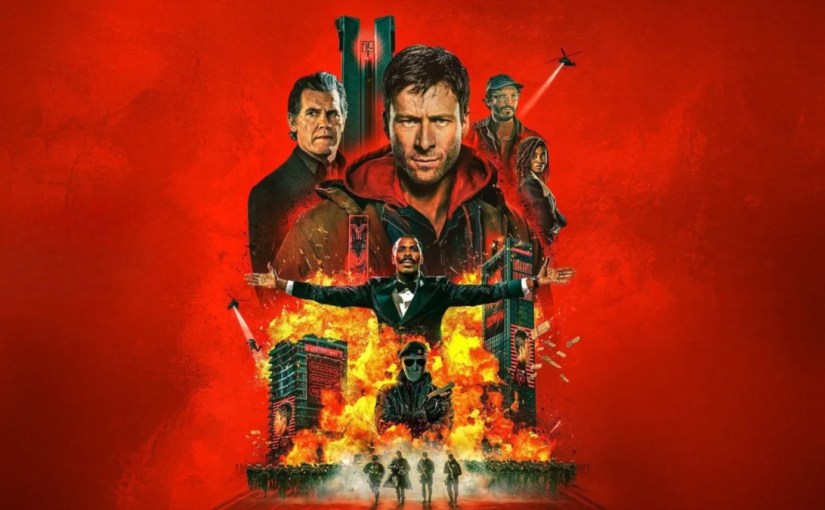
Ben Richards (a name which always gets me thinking of The Fantastic Four; Ben Grimm, Reed Richards) is played by Glen Powell with a handsome athletic build but not the muscular physique of Schwarzenegger.  Powell looks more like an Everyman who auditions for one of this future’s various twisted game shows, hoping to win cash prizes that will rescue his wife and sick baby girl from poverty.  He never intended to get thrust into the ultra-violent “Running Man” though.  The object is to outlast and survive for thirty days while sadistic headhunters attempt to find him and deliver a gruesome televised slaughter.  The producer, Dan Killian (Josh Brolin), foresees a ratings bonanza with Richards as his most wanted runner.

Glen Powell needs to enhance his career with his sudden popularity.  Between this film, Twisters and Top Gun: Maverick he is playing pick-up sticks on resurrected franchises, and he ends up being completely unmemorable and uninviting.  Other than a square chin, there’s nothing special about this guy and I never once felt empathy for his role here.  He does not convey fear or anger or humor like a Bruce Willis, a Tom Cruise or even an Arnold Schwarzenegger.  He’s boring.  Edgar Wright’s script with Michael Bacall does not help the actor either as The Running Man is neither quirky or offbeat like a dystopian action picture or a standard Edgar Wright piece (Scott Pilgrim Vs The World) should promise.

The most exciting ingredient is Coleman Domingo, one of my favorite actors working today.  He is so magnetic in anything he does that I can practically guarantee whatever pizzazz he brings as the larger-than-life game show host, Bobby T (Yes!  That’s his name!), carries no impact.  This script gives him nothing to do other than wear a purple sports jacket while belting out “WELCOME TO THE RUNNING MAN!!!”  If he was simply given all of Richard Dawson’s dialogue from the first film, Domingo could have elevated this drippy picture into something engaging and fun.

Lee Pace (The Lord Of The Rings) is fully masked until the third act and has little dialogue as he’s the hero’s main hunter.  Why waste such a charismatic actor?  He’s dressed in black with a black mask.  What’s fun about that? Josh Brolin sits behind a desk as the puppet master producer.  He plays his part like Josh Brolin on a press tour stop on The Today Show.  He’s really not acting at all.

It’s an eye-opening surprise to see Sean Hayes (Will & Grace) make an early appearance as another game show host for a different show.  This should offer magnificent promise.  Brilliant casting for an over-the-top comic performer.  I was waiting for Hayes and Domingo to get into a sparring match of egos for attention in this television world.  You know what happens, though? Sean Hayes is never seen again following his appearance ten minutes after the film begins.  Another overlooked waste of talent.

William H Macy is a good character actor for this kind of film.  Too bad he’s also given little to do other than to tell the hero to go see the guy played by Michael Cera.  Why not cut out the middle man and let Ben Richards just deal with Macy’s character? The Running Man is far from the leaner film it could have been.

Some of the action scenes in this violent tale work, and some don’t.  When Ben Richards catches up with Cera’s character, a run/hide shoot out in a two-story house plays like a video game with bannisters that come apart and rapid machine gun fire.  It’s edited quite well.  Later though, there’s a battle that occurs in the cockpit of a jumbo jet.  Gravity is disabled while gunfire and fisticuffs are at play and everything shakes and bounces so much that it’s hard to tell who gets the gun and who is shooting who.  This looks like the filmmakers were pressed against a deadline and just didn’t clean up or tighten the scene into something coherent.  I just stopped trying to focus on the film and waited for the scene to end with another escape by the dashing Ben Richards.

This screenplay feels like it was made up on the fly.  Glen Campbell is awarded several scenes to speechify melodramatic gargle.  Is there a noble cause that we are to learn about from The Running Man? Just as the third act is about to start, he hitches a ride with a young girl who we have never seen before.  Nor has she been referenced anywhere thus far.  Yet, she’s got something to say with some kind of cause on her mind as well.  This nameless sidekick takes over the movie for the next twenty minutes and then parachutes into open sky never to be seen again.  What was the point of this detour? Moreover, what the hell was she ever talking about?

This Running Man had all the ingredients to work with a stellar collection of fine actors who were up for the task of wit and satire amid ridiculous violence and totalitarianism.  With Edgar Wright at the helm, the new Running Man could have been a harkening back to Paul Verhoven’s ultra-violent tales of gonzo media silliness found in his movies like Robocop, Starship Troopers and Total Recall.

Sadly, Glen Powell is uninteresting, and the more amazing talents of the supporting cast were handed lackluster and witless material.  

The Running Man marches at a speed of sluggishness.  Better to turn off the TV and read Carrie or Misery.

BARBIE

By Marc S. Sanders

Having just returned from donning my pink t-shirt to watch Greta Gerwig’s box office smash Barbie, I am certainly relieved that I watched the film with my wife.  Just when I thought I understood everything I was watching in the movie, my better half explained to me that my perception was wrong.  Yet, I still believe Barbie was a magnificent experience that allowed me to reminisce about my pre-teen years occupied with my favorite toys (Kenner’s Star Wars figures and playsets).  I applaud this film for going even deeper than that though.  Barbie reflects on the patterns between men and women primarily in the fields of career, objectivity, and social stature.  As pink as the film is, and it is pinker than a truck load of Pepto Bismol, it is also observant and telling.

Someone commented on a Facebook post when I announced that I was seeing the film that Barbie is a “woke” movie.  I am so sick of that term, honestly, and it has nothing to do with which side of the political aisle I sit on, because I no longer sit on any side.  While watching Margot Robbie as the main “Barbie” of a whole community of “Barbies” in Barbie Land, I never recognized said “wokeness.”  Only afterwards did my wife have to explain where it likely exists within the film.  I still don’t think it’s a fair observation though.  Barbie and Ken dolls, Skipper and even the pregnant Midge doll and the lonely Allan doll and all their accessories are marketed by Mattel to a demographic for young girls.  Greta Gerwig’s script though questions what could threaten a Barbie Land.  Frankly, the only thing imaginable (besides opening the film on the same day as a biographical film about the man who invented the atomic bomb), is if the world of Barbie was no longer Barbie & Ken, but rather Ken & Barbie and a male dominated finish conquered Barbie Land following Ken (Ryan Gosling) reading up on some books about horses and machoism.  Very inventive, as well as comedically endearing to watch how Barbie and all the other Barbies undo what’s been done by Ken and all the other Ken variations.

A second storyline is really what rang true to me.  America Ferrara portrays Gloria, a mother in the Real World who has lost a bond with her daughter Sasha played by Arianna Greenblatt. Sasha has long outgrown spending time with Gloria and playing with Barbies together.  Sasha is a typical moody teenager.  This is crushing to Gloria and real-world thoughts enter the mother’s mind by the will of nature, including the uncertainty of death and even worse…cellulite.  Barbie (Margot Robbie) realizes the effect it has on her and with guidance from Weird Barbie (Kate McKinnon) embarks on a journey to the Real World to right what is wrong with the girl who plays with her.  Barbie is in for a surprise though. 

One day I will weave into one of my original plays about the time I showed my father my brand-new Star Wars TIE Fighter ship.  I demonstrated for him how the wings pop off.  His response was an artificial “Oh wow!” and then a return to his dinner with further discussion about his workday.  At six years old, I could even identify how uninterested he was.  This moment from so many years ago came back to me as I observed Ferrara’s emptiness.  The mother has lost her daughter, the same way my young self lost my father. 

Toys can draw out nurturing emotions of happiness, and perhaps disappointments, when we are young and imaginative.  As adults, a desire for a recapture of youth can blossom.  My generation yearns for the toys they played with and are even willing to pay enormous amounts of money for that tangible memory with what are now considered antiques.  Toys have always been a part of my life.  I was never an athlete.  I got much more pleasure out of playing with my action figures and my made-up car chases and shootouts in my bedroom. 

Gerwig’s script, co-written with Noah Baumbach, is quite intuitive.  Barbie and Ken (Robbie, along with wonderfully sweet and naïve Ryan Gosling) try to perfect what is imperfect about themselves and end up making things drastically worse for their respective existence within the Barbie World.  Barbie may fear bad breath and try to escape death, but how will that affect the pink, plastic world she stems from?  Ken tries to learn more from the Real World to enhance his noticeability with Barbie and deal with his insecurities against the other theatrical Kens he exists with. Does learning change Ken into a better version of himself, though?  Experience and exposure to foreign situations are necessary to enhance oneself but go a little too far and it might become a reminder to be careful what you wish for.

Mattel is even spoofed by means of Will Farrell and his posse of dark suit executives and the office’s grey cubicles representing white collar corporate America.  What Barbie and Ken have unleashed could have drastic consequences on the commodity of their bestselling dolls and playsets.  Honestly, I was waiting for an appearance by He-Man to enter the fold.  How would this carry over to the Masters Of The Universe??????

Barbie is more complex than the cheerful advertisements, the toy brand or even the bubbly appearances from Robbie, Gosling, McKinnon and the rest of the cast may appear to be. I’ve already heard it described as strange, and definitely not a movie for kids.  There’s a reason it is PG-13.  Mature themes are at play amid the sunniness of President Barbie, Astronaut Barbie, Supreme Court Justice Barbie, Mermaid Ken and Beach Ken.  Greta Gerwig didn’t want to settle for a just a happy go lucky fantasy.  The Barbie doll has existed for over fifty years and by now, nearly a quarter of the way into a new century, she better serve more purpose than a perfect smile, arched feet, and cheerful shades of pinks and yellows.  Gerwig sought to uncover the role Barbie has for girls and women at age 5, 8, 15, 30, 50 and on and on. 

I must recognize some of the attractions contained in the picture.  An inspired opening of the film had me rolling as Barbie answered the call of Stanley Kubrick’s classic 2001: A Space Odyssey.  (Makes me sad that I was the only one laughing in a full theater.)  Gerwig also took wise advantage of the multitalented Gosling with a collection of musical song and dance numbers.  I never really cared for the song “Push” by Matchbox Twenty, until Ryan Gosling and his Ken mates applied it as a substitute to Robbie’s Barbie and her Barbie gals’ adoration for “Closer To Fine” by the Indigo Girls.  Gosling puts such energy into his performance.  He’s certainly the go-to actor for musical films like Barbie and La La Land.  Those days on The Mickey Mouse Club truly paid off.

Barbie is a vibrant and very smart film.  I’m just not sure everyone will respond to it like I did.  It is no surprise that moviegoers resent that it is not catered for young children or that there’s an oddness to some of the stories.  You may not care for it.  Who knows?  Maybe you’ll find it to be “woke,” but I hope you’d look deeper than that.  I appreciate it on a personal level however, remembering back to my time as a kid with a toy or two that were more than just pieces of molded plastic.  Rather, my Boba Fett and Han Solo figures were often the best friends to spend time with and it’s only sad that dad may have missed out on what was truly special for his son. Still, even Barbie reminds me that none of us are perfect and that’s okay.

MOLLY’S GAME

By Marc S. Sanders

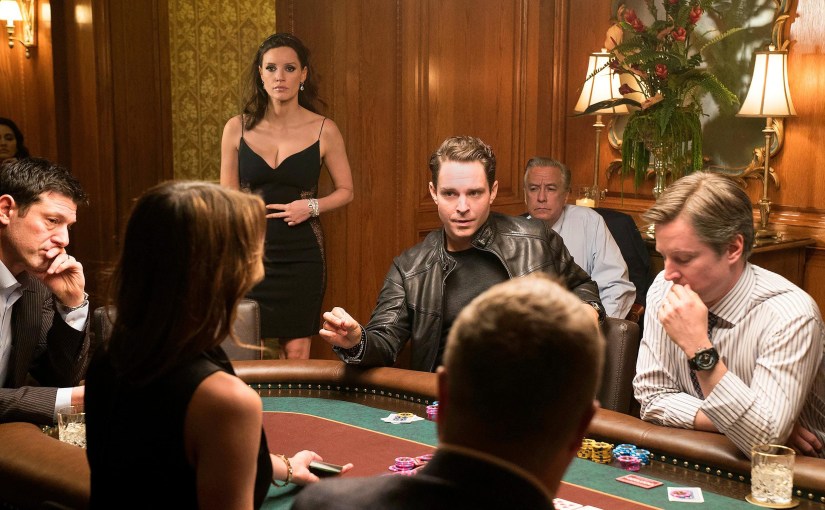
Despite being a little distracted by a drunk patron sitting next to me, I thought Molly’s Game was very good. It doesn’t measure up to The Social Network, and I feel justified in comparing the two because the sharp, fast dialogue follows what appears to be an intentionally similar narrative from writer, and here director, Aaron Sorkin.

Sorkin in his directorial debut uses great techniques for film editing to match the beats of his dialogue.  His opening voiceover of Jessica Chastain as Molly describing the ultimate worst sports experience will get your heartbeat racing.  It draws you into the film right away.

Chastain is good, but maybe a little over the top.  I needed a little more convincing that she was actually this brilliant, inventive and resourceful woman who was also considered one of the world’s greatest skiers.  Can’t put my finger on it but something was missing with her playing the Molly Bloom role.  Was she really holding her own against these high stakes guys who take big risks in her personally constructed poker ring?  I’m just not sure.

Felt the same about Kevin Costner in the role of her father.  He’s supposed to be an incredibly brilliant psychologist and an intimidating patriarch.  Yet Costner doesn’t fit that mold for me here.  Couldn’t feel the pressure from Dad on his daughter.  Someone else might have been stronger.

Michael Cera too.  I think he is playing a combination variation of Tobey Maguire & Leonardo DiCaprio, two of the most famous celebs that participated in the real Molly Bloom’s underground poker games, but Michael Cera?  Really?  He doesn’t carry the weight or looks of guys like that.  There just was not enough power or presence from him.

None of these actors were the worst options for this cast, I just think the film could have used more appropriate performers. There was more appropriate talent out there, I’m sure.

Idris Elba is great, however.  He’s blessed with an awesome Sorkin monologue in the 3rd act of the film, and he hits every note.

A great script.  A great story worthy of being a big screen film and it’s got me interested to learn more about the real Molly Bloom, including reading her novel.